


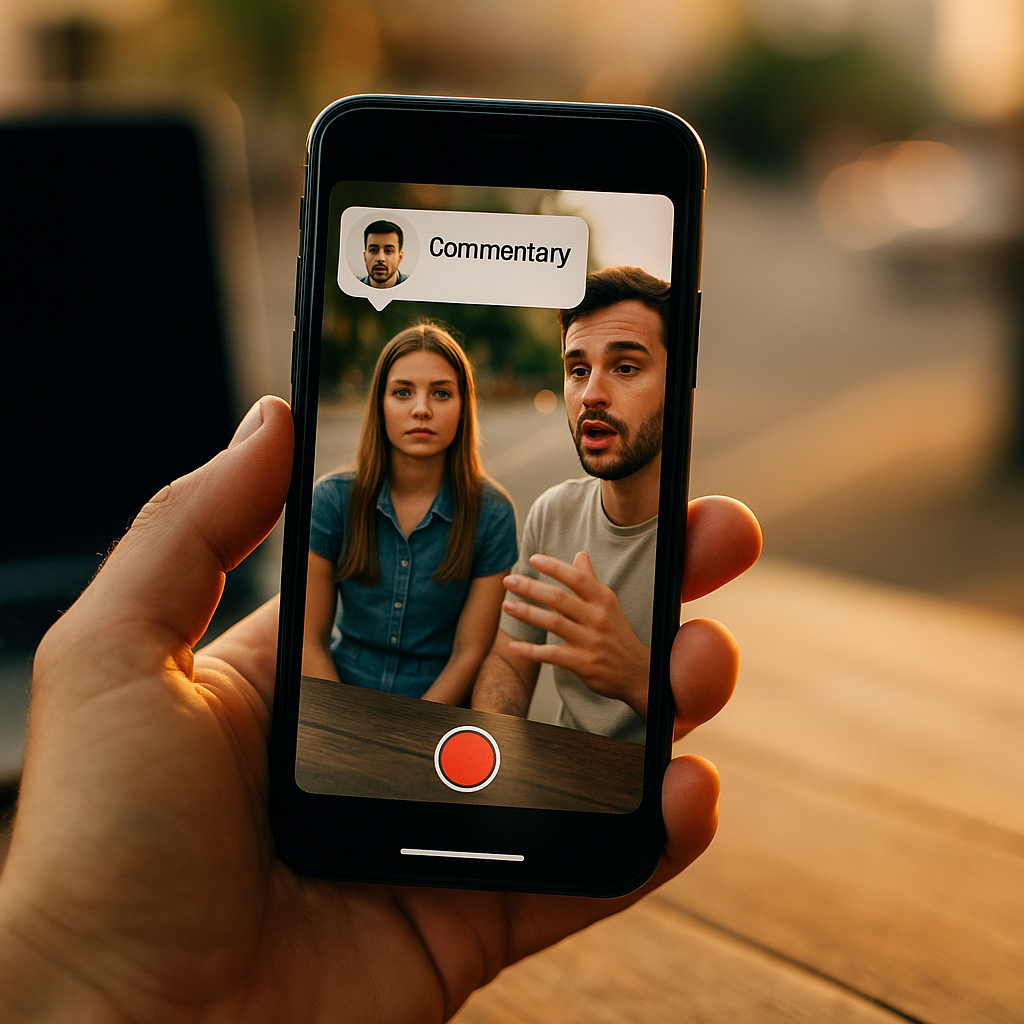
Platforms are quietly throttling reposted UGC. Meta’s duplicate content detection and TikTok’s originality scoring now suppress reach on clips that look recycled, even when you paid for usage rights. The fix isn’t a legal workaround. It’s a creative one: original commentary overlays, where a brand or second creator adds genuine reaction, analysis, or narration on top of existing footage, transforming repurposed UGC into a new piece of content entirely.
Why Reposting Raw UGC Is Getting Riskier
Here’s the uncomfortable truth most brands haven’t internalized: the UGC rights you negotiated don’t guarantee algorithmic distribution. You can own full usage rights to a creator’s video and still watch it die in the feed because the platform flags it as duplicate or low-effort content. Meta has been public about prioritizing “original” video signals in ranking, and TikTok’s own creator guidance leans hard on originality as a ranking input.
That creates a weird gap. Legal clearance says you can use the footage. The algorithm says it doesn’t want to show it. Brands caught in that gap end up with a library of perfectly licensed, perfectly unwatched assets.
Owning the rights to a video and owning its reach are two completely different things, and most contracts only cover the first one.
Commentary overlays solve this by changing what the asset actually is. You’re not reposting a UGC video anymore. You’re publishing a new reaction, review, or breakdown that happens to feature someone else’s footage as a visual reference. That distinction matters legally, creatively, and algorithmically.
What Counts as an Original Commentary Overlay?
An overlay isn’t a caption slapped on top of existing video. It’s substantive added value: a voiceover track reacting in real time, on-screen text breaking down why a product claim holds up (or doesn’t), split-screen framing with a host talking through the clip, or picture-in-picture commentary layered over the original footage. The bar is “does this add new information or perspective,” not “does this technically modify the pixels.”
- Voiceover narration that interprets, critiques, or explains the original clip
- Talking-head reaction recorded live while watching the UGC
- On-screen annotations that fact-check or contextualize claims
- Split-screen or picture-in-picture layouts combining new and original footage
- Remixed pacing with new b-roll inserted alongside commentary beats
This is the same principle behind commentary layer edits that have been quietly beating YouTube’s originality filter for months. The format works because it satisfies two audiences at once: platforms want original signal, and viewers want context, not just a repost.
The ROI Case Nobody’s Making Loudly Enough
Commentary overlays also happen to be cheap. You’re not commissioning new footage from scratch. You’re layering a 30 to 60 second voiceover or reaction segment on top of an asset you already licensed. Agencies running this format report production costs 40 to 60 percent lower than full reshoots, because the heavy lifting (the actual demo, unboxing, or testimonial) already exists.
That efficiency compounds. A single piece of UGC can spawn multiple overlay variants: one skeptical reaction, one expert validation, one myth-busting breakdown. Each variant counts as a distinct creative asset for ad platform diversity requirements, which matters more than most media buyers admit. Meta and TikTok both reward account-level creative variety in their delivery algorithms, so three overlay cuts of one UGC clip can outperform three completely separate shoots in terms of cost per result.
Where This Format Overlaps With Existing Repurposing Tactics
If you’ve already experimented with reaction content or expert reacts formats, commentary overlays will feel familiar. The difference is scope. Reaction content is usually a standalone format built around a creator watching something for the first time. Commentary overlays are a repurposing technique, specifically designed to extend the life of UGC assets you already have contracts for, without triggering originality penalties.
Think of it as the difference between a genre and a tool. Reaction videos are a genre. Overlay commentary is the tool you use to make old footage legally and algorithmically safe to reuse.
It also pairs well with testimonial compilation reels. Instead of just stitching five customer reviews together, add a brief commentary layer explaining why each review matters, what objection it answers, or what claim it validates. That single addition pushes the asset from “compilation” into “original editorial content,” which is a meaningfully different originality classification on most platforms.
How Does This Affect Creator Contracts?
This is where legal and creative teams need to actually talk to each other, which, let’s be honest, doesn’t happen often enough. Standard UGC licensing agreements typically cover “use and distribution of the content as delivered.” They rarely address derivative works, meaning content built on top of the original footage with added narration or editorial framing.
Before you build an overlay program at scale, update your contracts to explicitly grant derivative use rights, including voiceover, text overlay, and remix permissions. Most creators will agree to this without additional fees if you frame it correctly: you’re not stealing more value from their work, you’re extending its shelf life and, often, its visibility, which benefits their profile too.
A derivative use clause costs you nothing upfront and saves you a legal headache later. Skipping it is the single most common mistake brands make when scaling overlay content.
The FTC’s endorsement guidance still applies here too. If the overlay commentary comes from the brand itself rather than an independent creator, disclosure requirements shift. Review the FTC’s endorsement guidelines before publishing brand-voiced commentary on creator footage, especially if the tone implies independent review rather than brand narration.
Building the Workflow Without Slowing Down Your Team
Operationally, commentary overlays slot neatly into existing repurposing pipelines. The sequence looks something like this:
- Audit existing UGC library for clips with strong hooks but declining or flat reach
- Draft a commentary angle: skeptical, validating, educational, or comparative
- Record a short voiceover or on-camera reaction segment (60 to 90 seconds is usually enough)
- Layer the commentary using split-screen, picture-in-picture, or sequential cut structure
- Tag the new asset distinctly in your DAM so it’s tracked separately from the original UGC performance
That last step matters more than it sounds. Teams that don’t separate tracking end up unable to prove the overlay format is working, because performance data gets muddied with the original asset’s historical metrics. Set up a clean naming convention now, before you’ve produced fifty of these.
If you’re running this at volume, borrow structure from hook taxonomy systems designed for pre-production scale. Categorizing commentary types (skeptic, expert, myth-buster, comparison) the same way you’d categorize hook styles keeps creative briefs consistent even as volume grows. It also makes it far easier to brief external editors or agencies without a 20-minute explainer call every time.
What Metrics Actually Prove This Is Working?
Watch three signals specifically: reach relative to the original UGC’s historical average, completion rate on the overlay segment itself, and cost per result compared to fresh-shoot creative. If overlay variants are matching or beating fresh shoots on cost per result while costing 40 to 60 percent less to produce, you’ve got a format worth scaling. eMarketer’s creative performance benchmarks are a useful external reference point if you need to justify budget reallocation internally.
Finance and performance teams increasingly want this kind of proof before approving repurposing budgets. The same scrutiny now applied to explainer content, as covered in product explainer KPI frameworks, is coming for repurposed UGC too. Build the measurement habit now rather than retrofitting it after a budget review goes sideways.
Where Brands Get It Wrong
The most common failure mode isn’t legal, it’s creative laziness. A text overlay that just restates what’s happening on screen (“she’s trying the product”) adds zero originality value. Platforms are getting better at detecting thin commentary, and audiences can smell it instantly. The overlay needs a point of view: agree, disagree, add context, or compare against a competitor claim.
Another frequent mistake: treating overlay commentary as a one-and-done format rather than a recurring content line. The brands seeing the best results run overlay commentary as an ongoing series, often tied to a recognizable host or voice, similar to how Sprout Social’s research on branded content consistency shows recurring formats build audience trust faster than one-off posts.
Next step: pull your five highest-performing UGC assets from the last quarter, pair each with a distinct commentary angle (skeptic, expert, myth-buster), and test overlay variants against the originals in a controlled ad set before committing budget to a full production line.
Frequently Asked Questions
Does adding a commentary overlay actually change how platforms classify the content?
Yes. Platforms like Meta and TikTok evaluate originality signals including voiceover presence, on-screen text density, and structural changes to pacing. A substantive commentary layer shifts the asset’s classification away from “duplicate” or “low-effort repost” toward original editorial content, which typically improves distribution.
Do I need a new contract with the original creator to add commentary?
In most cases yes, unless your existing agreement already grants derivative use rights. Standard UGC licenses often cover use “as delivered” and don’t automatically extend to voiceover, remix, or editorial framing added later. Add a derivative use clause to future contracts to avoid renegotiating each time.
How long should the commentary segment be relative to the original UGC?
There’s no fixed ratio, but most effective overlays use 20 to 40 percent of the total runtime for new commentary. Too little and it reads as a thin wrapper around the original clip. Too much and you lose the UGC authenticity that made the source material valuable in the first place.
Can brand employees deliver the commentary, or does it need to be a creator?
Either works, but disclosure obligations differ. If brand staff deliver commentary that reads as independent review or endorsement, FTC disclosure rules may apply. Clarify the speaker’s relationship to the brand on screen or in the caption to stay compliant.
Is this format better suited to TikTok, Instagram, or YouTube?
It performs well across all three, but the mechanics differ. YouTube’s originality filter is the most explicit about derivative commentary, Instagram rewards it mainly through reach signals rather than explicit labeling, and TikTok’s For You algorithm treats it as a distinct content type when structural changes (split-screen, new audio track) are present.
Top Influencer Marketing Agencies
The leading agencies shaping influencer marketing in 2026
Agencies ranked by campaign performance, client diversity, platform expertise, proven ROI, industry recognition, and client satisfaction. Assessed through verified case studies, reviews, and industry consultations.
Moburst

-
2

The Shelf
Boutique Beauty & Lifestyle Influencer AgencyA data-driven boutique agency specializing exclusively in beauty, wellness, and lifestyle influencer campaigns on Instagram and TikTok. Best for brands already focused on the beauty/personal care space that need curated, aesthetic-driven content.Clients: Pepsi, The Honest Company, Hims, Elf Cosmetics, Pure LeafVisit The Shelf → -
3

Audiencly
Niche Gaming & Esports Influencer AgencyA specialized agency focused exclusively on gaming and esports creators on YouTube, Twitch, and TikTok. Ideal if your campaign is 100% gaming-focused — from game launches to hardware and esports events.Clients: Epic Games, NordVPN, Ubisoft, Wargaming, Tencent GamesVisit Audiencly → -
4

Viral Nation
Global Influencer Marketing & Talent AgencyA dual talent management and marketing agency with proprietary brand safety tools and a global creator network spanning nano-influencers to celebrities across all major platforms.Clients: Meta, Activision Blizzard, Energizer, Aston Martin, WalmartVisit Viral Nation → -
5

The Influencer Marketing Factory
TikTok, Instagram & YouTube CampaignsA full-service agency with strong TikTok expertise, offering end-to-end campaign management from influencer discovery through performance reporting with a focus on platform-native content.Clients: Google, Snapchat, Universal Music, Bumble, YelpVisit TIMF → -
6

NeoReach
Enterprise Analytics & Influencer CampaignsAn enterprise-focused agency combining managed campaigns with a powerful self-service data platform for influencer search, audience analytics, and attribution modeling.Clients: Amazon, Airbnb, Netflix, Honda, The New York TimesVisit NeoReach → -
7

Ubiquitous
Creator-First Marketing PlatformA tech-driven platform combining self-service tools with managed campaign options, emphasizing speed and scalability for brands managing multiple influencer relationships.Clients: Lyft, Disney, Target, American Eagle, NetflixVisit Ubiquitous → -
8

Obviously
Scalable Enterprise Influencer CampaignsA tech-enabled agency built for high-volume campaigns, coordinating hundreds of creators simultaneously with end-to-end logistics, content rights management, and product seeding.Clients: Google, Ulta Beauty, Converse, AmazonVisit Obviously →