


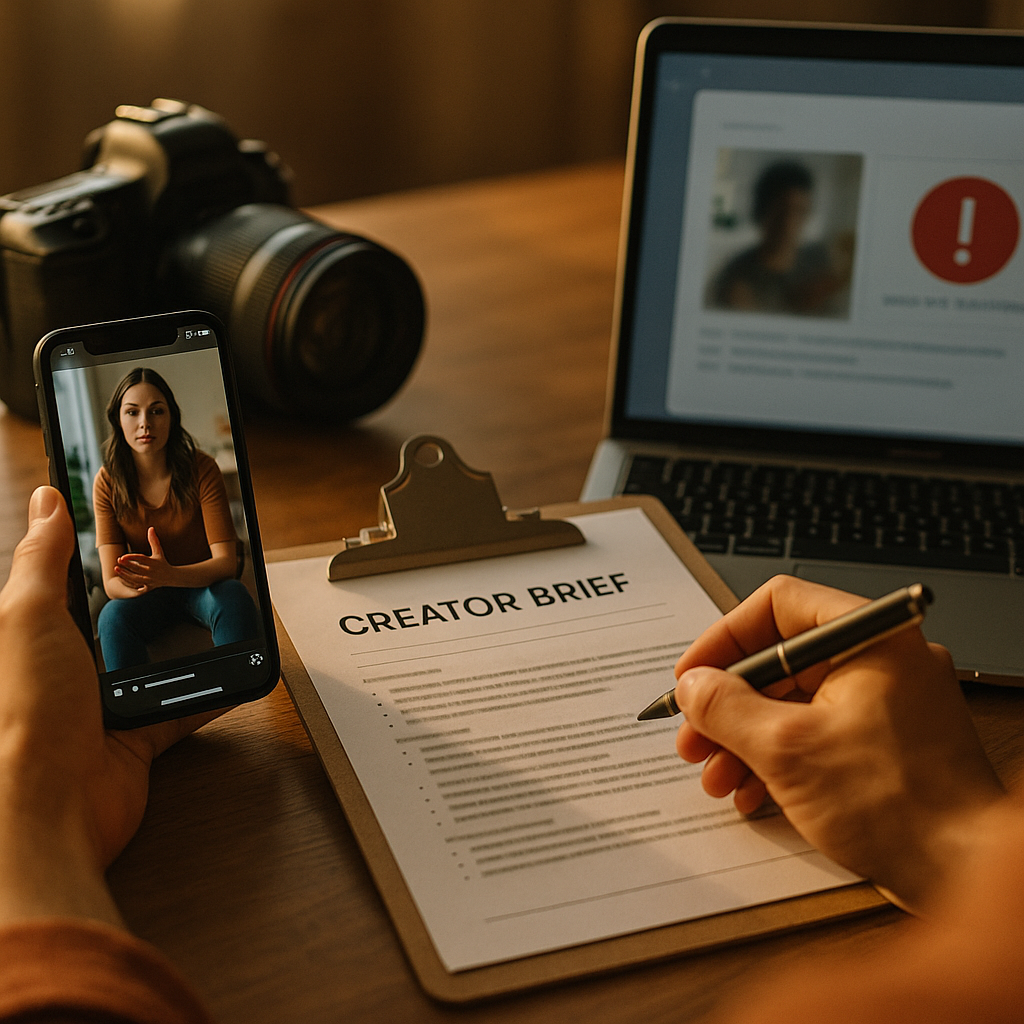
Algorithms Are Hunting Synthetic Content. Is Your Creator Brief Ready?
Meta’s latest classifier update flags roughly 40% more AI-generated video than it did twelve months ago. TikTok’s content provenance signals now feed directly into distribution scoring. For brands relying on creator partnerships, this changes everything about brand-safe content creation. If your briefs don’t deliberately engineer authenticity markers into format, delivery, production, and narrative, your sponsored posts risk being algorithmically suppressed — or worse, surfaced alongside a “generated by AI” label that tanks engagement before a single human sees the work.
Why Synthetic Detection Matters More Than Brand Guidelines
Most brand safety conversations still revolve around adjacency — keeping your ad away from harmful content. That’s table stakes. The new frontier is content identity: whether the platform’s recommendation engine treats your creator’s post as human-originated or machine-generated.
The distinction has real distribution consequences. According to TikTok’s advertising resources, content flagged with synthetic provenance metadata receives measurably lower organic push in For You feeds. Instagram’s Reels ranking, documented by Meta, now weighs “originality signals” as a top-tier factor — and those signals include audio waveform analysis, frame-level consistency checks, and caption-to-speech coherence scoring.
The brand safety risk of 2026 isn’t your creator saying something off-script. It’s your creator’s content being classified as synthetic and silently buried by the algorithm.
This means your brief is no longer just a creative document. It’s an anti-suppression strategy.
Format Choices That Signal “Human-Made”
Algorithms parse format metadata before they evaluate content quality. The container your creator chooses — aspect ratio, editing cadence, export settings — sends provenance signals the viewer never sees but the classifier reads instantly.
Favor native capture over imported renders. When a creator shoots directly inside TikTok or Instagram’s camera, the platform stamps that asset with first-party metadata. Imported files, especially those processed through AI editing suites like Runway or CapCut’s generative features, carry different fingerprints. Brief your creators to capture their primary footage in-app wherever possible, then do only minimal post-production externally.
Lean into imperfect framing. AI-generated video defaults to centered, stabilized, symmetrical composition. Human video has micro-jitter, off-center subjects, and inconsistent lighting shifts within a single take. These aren’t flaws — they’re authentication signals. Your brief should explicitly permit (even encourage) handheld footage, natural pans, and environment-reactive camera movement.
If you’re working with vertical video formats, specify in the brief that creators should avoid templates with uniform motion graphics overlays. Those patterns are now among the easiest for classifiers to flag.
- Specify native capture as the default, with exceptions requiring approval
- Encourage single-take or minimal-cut structures over montage-heavy edits
- Request that creators leave at least one “raw” transition per piece — a visible jump cut, a room-tone gap, an unpolished moment
Delivery Style: The Voice Problem
Voice is where synthetic detection has gotten eerily good. Platforms now analyze prosody — the rhythm, stress, and intonation patterns of speech — to distinguish human narration from AI voiceover. ElevenLabs, Murf, and similar tools produce convincing audio, but their output has consistent pitch envelopes and breath-gap spacing that classifiers catch.
Your brief should address this directly. Not with a vague “be authentic” note, but with specific delivery instructions:
- Self-interruptions. Tell creators to include at least one moment where they pause, rephrase, or visibly think. This is nearly impossible for current TTS models to replicate naturally.
- Environmental audio bleed. A dog barking, a door closing, ambient traffic — these background sounds are provenance markers. Brief creators to record in lived-in spaces, not treated studio environments that mimic the clean audio floor of AI generation.
- Reactive pacing. Human speech speed shifts in response to emotional content. When a creator speeds up during excitement about a product feature or slows down for a personal aside, those fluctuations register as authentic on waveform analysis.
The tension here is obvious: brands want polished delivery, but polished now overlaps with synthetic. The solution isn’t abandoning production value — it’s relocating it. High production value should show up in what the creator says (tight narrative, genuine specificity), not in how the audio sounds.
For creators who typically use teleprompters, brief them to read through the script three times, then record from memory with only bullet-point cues. The slight deviations from scripted language create the speech irregularities that classifiers read as human. This approach also tends to produce content that performs better in dark social distribution, where viewers are sharing with friends and polished ad-speak kills forwarding intent.
Production Approach: The Uncanny Valley of “Too Clean”
There’s an irony worth sitting with. Brands spent years pushing creators toward higher production quality. Better lighting. Cleaner audio. Tighter edits. Now those signals — the ones that used to mean “professional” — increasingly overlap with “possibly synthetic.”
This doesn’t mean you should brief for garbage-quality content. It means you need to be surgical about which production elements you elevate and which you deliberately leave rough.
Elevate: Narrative structure, product demonstration clarity, call-to-action placement, visual proof of real product interaction.
Leave rough: Color grading (let the native camera sensor do the work), audio mastering (room tone is your friend), transitions (hard cuts over generated transitions), and background environments (real spaces over virtual or heavily augmented ones).
The brief should explicitly state: “Do not use AI-generated backgrounds, AI voice enhancement, or AI-powered beauty filters. Platform classifiers flag these tools, and suppressed reach is a worse outcome than imperfect lighting.”
If you’re managing campaigns at scale, this production philosophy needs to be embedded in your onboarding materials, not buried in individual briefs. Teams running scaled creator programs should build a prohibited-tools list and update it quarterly as new generative features launch.
Narrative Specificity: The Hardest Part to Brief (and the Most Important)
Generic product praise is the single biggest authenticity killer — and it’s also what most briefs accidentally incentivize. When a brief says “highlight the product’s benefits and share your honest experience,” creators default to safe, surface-level language that sounds interchangeable with AI-generated copy. Because it essentially is.
Specificity is the antidote. And it needs to come from the brief itself.
Instead of “talk about why you love the product,” try:
- “Describe the specific moment you first tried this product — where you were, what you were doing, what surprised you.”
- “Name one thing about the product that’s slightly annoying but you use it anyway. Explain why.”
- “Show the product in the exact spot where you actually keep it — not staged, not cleaned up.”
These prompts generate content that is structurally impossible for AI to replicate because they require actual experience. A generative model can fabricate a plausible review. It cannot fabricate the specific drawer in someone’s bathroom where they keep the product next to a half-used tube of toothpaste and a hair tie.
This kind of narrative granularity also performs better with audiences. Research from Sprout Social consistently shows that specific, experience-grounded creator content outperforms generic endorsement on engagement rate and conversion. The velocity-authenticity trade-off is real: you produce fewer assets per creator, but each asset works harder.
For brands building story arc briefs, narrative specificity should be the structural backbone. The arc isn’t “problem → product → solution.” It’s “specific moment of frustration → specific discovery context → specific detail about ongoing use.” Every node in the arc should require lived experience to fill in.
Compliance and Disclosure in a Classifier-Aware World
One wrinkle brands overlook: AI content labeling requirements from the FTC and platform-specific policies now interact with algorithmic classification. If a creator uses generative tools and doesn’t disclose it, and the platform’s classifier detects synthetic elements, the content may be auto-labeled — stripping control from both the creator and the brand over how that disclosure appears.
Your brief should include a clear AI-tool policy with three tiers:
- Approved: Basic editing tools (trimming, color adjustment, text overlays)
- Requires pre-approval: AI-powered captioning, background removal, or enhancement tools
- Prohibited: AI voice cloning, generative video, deepfake filters, synthetic backgrounds
This isn’t paranoia. It’s operational risk management. A single auto-labeled post in a campaign of twenty creates a narrative problem that’s disproportionate to its reach impact.
Your Next Brief Should Include an Anti-Synthetic Checklist
Build a one-page addendum for every creator brief that lists five to seven specific authenticity signals you expect in the final deliverable: native capture metadata, environmental audio, at least one self-interruption, a specific personal detail, and no prohibited AI tools. Make it a deliverable acceptance criterion, not a suggestion. That single page will protect your distribution reach more than any brand guideline document ever has.
FAQs
What is brand-safe content creation in the context of AI-generated feeds?
Brand-safe content creation now extends beyond avoiding harmful adjacency to ensuring your creator content is recognized by platform algorithms as authentically human-made. This protects distribution reach and prevents auto-labeling that can damage audience trust and campaign performance.
How do social media algorithms detect synthetic or AI-generated content?
Platforms like TikTok and Instagram use audio waveform analysis, frame-level consistency checks, caption-to-speech coherence scoring, metadata provenance tracking, and prosody analysis to distinguish human-created content from AI-generated material. Detection capabilities are improving rapidly with each platform update.
What should a creator brief include to signal authenticity to algorithms?
Effective briefs should specify native in-app capture, handheld or imperfect framing, environmental audio bleed, speech self-interruptions, narrative specificity grounded in real experience, and a prohibited AI tools list. These elements create provenance signals that classifiers read as authentically human.
Can creators still use AI tools without triggering synthetic content flags?
Basic editing tools like trimming, color adjustment, and text overlays remain safe. However, AI voice enhancement, generative video, synthetic backgrounds, and deepfake filters are increasingly detected by platform classifiers and should be prohibited in creator briefs to protect organic distribution.
How does narrative specificity help content avoid AI suppression?
Narrative specificity requires creators to reference real, lived experiences — exact locations, personal habits, minor product complaints — that generative AI cannot authentically fabricate. This type of granular detail registers as authentic to both human audiences and algorithmic classifiers evaluating content originality.
Top Influencer Marketing Agencies
The leading agencies shaping influencer marketing in 2026
Agencies ranked by campaign performance, client diversity, platform expertise, proven ROI, industry recognition, and client satisfaction. Assessed through verified case studies, reviews, and industry consultations.
Moburst

-
2

The Shelf
Boutique Beauty & Lifestyle Influencer AgencyA data-driven boutique agency specializing exclusively in beauty, wellness, and lifestyle influencer campaigns on Instagram and TikTok. Best for brands already focused on the beauty/personal care space that need curated, aesthetic-driven content.Clients: Pepsi, The Honest Company, Hims, Elf Cosmetics, Pure LeafVisit The Shelf → -
3

Audiencly
Niche Gaming & Esports Influencer AgencyA specialized agency focused exclusively on gaming and esports creators on YouTube, Twitch, and TikTok. Ideal if your campaign is 100% gaming-focused — from game launches to hardware and esports events.Clients: Epic Games, NordVPN, Ubisoft, Wargaming, Tencent GamesVisit Audiencly → -
4

Viral Nation
Global Influencer Marketing & Talent AgencyA dual talent management and marketing agency with proprietary brand safety tools and a global creator network spanning nano-influencers to celebrities across all major platforms.Clients: Meta, Activision Blizzard, Energizer, Aston Martin, WalmartVisit Viral Nation → -
5

The Influencer Marketing Factory
TikTok, Instagram & YouTube CampaignsA full-service agency with strong TikTok expertise, offering end-to-end campaign management from influencer discovery through performance reporting with a focus on platform-native content.Clients: Google, Snapchat, Universal Music, Bumble, YelpVisit TIMF → -
6

NeoReach
Enterprise Analytics & Influencer CampaignsAn enterprise-focused agency combining managed campaigns with a powerful self-service data platform for influencer search, audience analytics, and attribution modeling.Clients: Amazon, Airbnb, Netflix, Honda, The New York TimesVisit NeoReach → -
7

Ubiquitous
Creator-First Marketing PlatformA tech-driven platform combining self-service tools with managed campaign options, emphasizing speed and scalability for brands managing multiple influencer relationships.Clients: Lyft, Disney, Target, American Eagle, NetflixVisit Ubiquitous → -
8

Obviously
Scalable Enterprise Influencer CampaignsA tech-enabled agency built for high-volume campaigns, coordinating hundreds of creators simultaneously with end-to-end logistics, content rights management, and product seeding.Clients: Google, Ulta Beauty, Converse, AmazonVisit Obviously →