


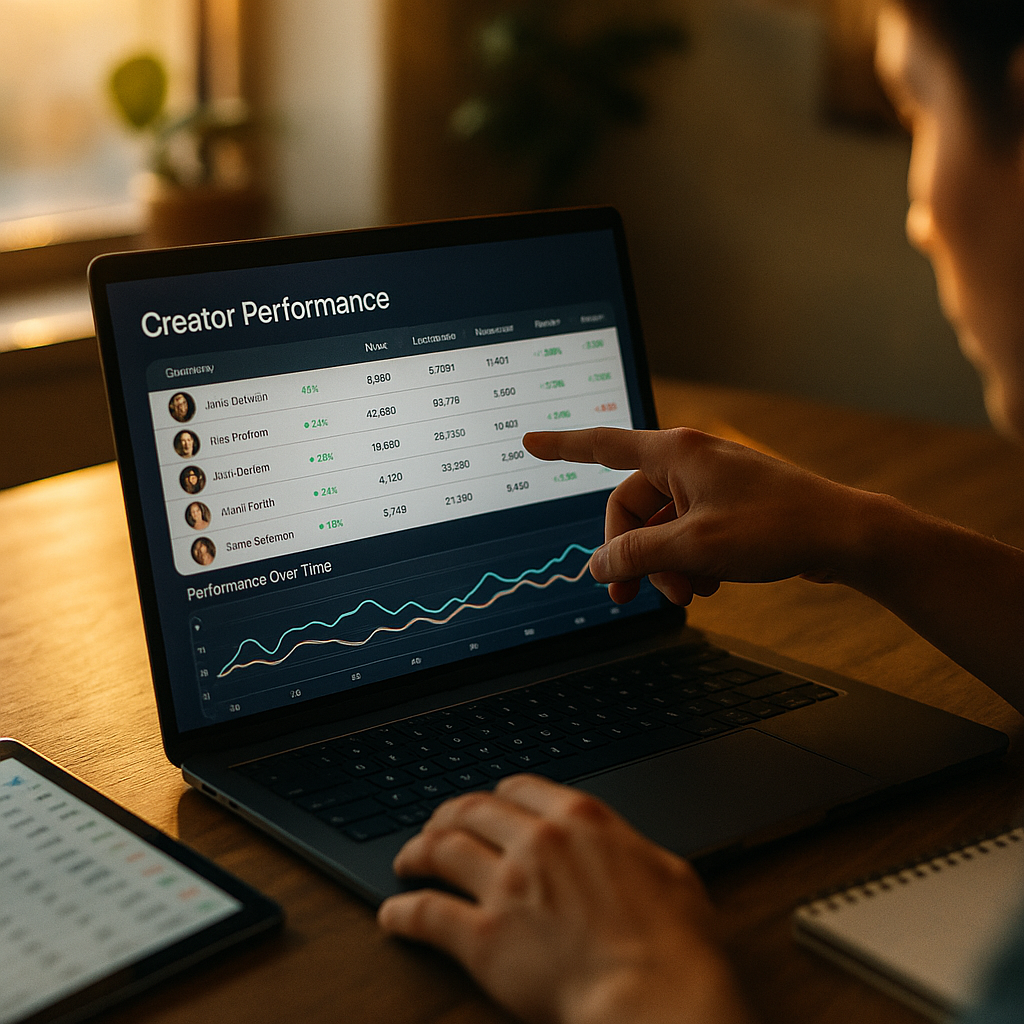
The Dashboard Gap Costing Brands Millions
According to Statista, global influencer marketing spend has surpassed $30 billion — yet most brand teams still toggle between five or more disconnected tools to evaluate creator performance. The result? Slow decisions, wasted budgets, and rosters bloated with underperformers. A growing cohort of sophisticated marketers is solving this by building what’s being called a creator performance intelligence layer: a unified dashboard integrating AI-powered analytics, CRM data, and attribution signals to enable real-time roster optimization decisions.
This isn’t a nice-to-have analytics upgrade. It’s the operational backbone that separates brands scaling influencer programs profitably from those still running campaigns on gut feel and vanity metrics.
What a Creator Performance Intelligence Layer Actually Looks Like
Strip away the buzzwords and the concept is straightforward. A creator performance intelligence layer is a centralized data environment that pulls from three core signal categories:
- AI-powered content and audience analytics — engagement quality scoring, audience overlap detection, sentiment analysis, content resonance prediction
- CRM and first-party data — customer lifetime value tied to creator-sourced leads, repeat purchase rates, email capture attribution, cohort behavior post-acquisition
- Multi-touch attribution signals — post-click and post-view conversions, incrementality testing outputs, assisted conversion paths, promo code and UTM tracking reconciliation
Most brands already have pieces of this data scattered across platforms like CreatorIQ, Grin, Salesforce, Google Analytics 4, and Meta Business Suite. The intelligence layer is the connective tissue. It normalizes disparate data, applies AI models for scoring and forecasting, and surfaces actionable signals in a single view — typically refreshed hourly or in real time.
Think of it less as a “dashboard” and more as a decision engine with a visual interface.
Why Spreadsheets and Point Solutions No Longer Cut It
Here’s the scenario most influencer marketing managers know too well. A campaign wraps. The team spends two weeks pulling platform exports, reconciling promo codes, matching CRM records, and building a post-mortem deck. By the time leadership sees the data, the next campaign is already in-flight — with the same roster, same assumptions, same blind spots.
The brands winning in creator marketing aren’t necessarily spending more. They’re compressing the feedback loop between performance data and roster decisions from weeks to hours.
Point solutions excel at slices of the problem. Sprout Social handles social listening well. Attribution platforms like Rockerbox or Northbeam tackle measurement. CRMs own the customer record. But no single tool was designed to answer the question a VP of Marketing actually cares about: “Which creators are driving profitable customer acquisition at scale, and which should we replace — right now?”
That question requires data fusion, not data silos.
The Architecture: How Leading Brands Are Building This
The technical implementation varies by organization, but a pattern has emerged among brands running 50+ creator relationships simultaneously.
Data ingestion layer. APIs pull from social platforms (Instagram Insights, TikTok Analytics, YouTube Studio), influencer management platforms, ecommerce systems (Shopify, BigCommerce), CRMs (HubSpot, Salesforce), and ad platforms. Webhook-based pipelines capture events in near real-time rather than relying on daily batch exports.
Identity resolution. This is where most DIY attempts fail. A creator’s Instagram handle, their TikTok handle, the email they used to register for your affiliate program, and the name on their contract are often four different identifiers. AI-powered entity matching — tools like LiveRamp or custom probabilistic models — stitches these into a single creator profile.
AI scoring and prediction engine. Once unified, the data feeds machine learning models that score creators on dimensions that matter to the business: revenue efficiency (revenue per dollar spent), audience quality (percentage of followers matching ICP), content durability (how long a post continues generating conversions), and brand safety risk. The nuances of AI reshaping creator talent are foundational to understanding how these models work.
Visualization and action layer. The dashboard itself is often built on Looker, Tableau, or custom React front-ends. What separates a performance intelligence layer from a reporting dashboard: automated alerts and recommended actions. The system flags when a creator’s engagement rate drops below their rolling average, when audience overlap between two creators exceeds a threshold, or when CRM data shows creator-sourced customers churning faster than average.
Attribution: The Hardest Piece to Get Right
If you’ve tried to attribute revenue to a specific Instagram Story or TikTok video, you know the pain. Platform-reported conversions are inconsistent. Last-click models drastically undervalue awareness-stage creators. And privacy changes continue to erode deterministic tracking.
The most advanced intelligence layers combine multiple attribution methodologies rather than relying on any single one:
- Deterministic signals — promo codes, vanity URLs, UTM parameters, affiliate links
- Probabilistic modeling — media mix modeling (MMM) and incrementality testing to measure lift
- AI-inferred pathways — natural language processing applied to customer survey data (“How did you hear about us?”) and CRM notes to capture dark social influence
Getting attribution right matters enormously for roster optimization. A creator who appears mediocre on last-click attribution might be your most efficient top-of-funnel driver — and cutting them would crater your pipeline. Our deep dive into creator-driven attribution explores this problem in detail.
Similarly, brands that haven’t audited their measurement stack may be making decisions on fundamentally flawed data — a problem we covered in our analysis of broken ad attribution models.
Real-Time Roster Optimization in Practice
So what does “real-time roster optimization” actually mean day-to-day?
Consider a DTC skincare brand running an always-on program with 120 creators across three tiers. Their intelligence layer surfaces the following signals on a Tuesday morning:
- Creator A’s last four posts have generated 60% fewer landing page visits than their six-month average, despite stable engagement rates — suggesting audience fatigue or bot inflation
- Creator B, a micro-influencer, has driven 14 first-time customers in the past week with a 22% higher LTV than the program average — flagging them for tier upgrade and budget increase
- Audience overlap between Creator C and Creator D has risen to 38% — the system recommends pausing one to eliminate redundant spend
- CRM data shows customers acquired through Creator E’s content have a 45% higher churn rate at 90 days — triggering a review of messaging alignment
None of these signals are visible in a standard social analytics dashboard. They only emerge when you fuse performance data, CRM data, and attribution data into a single layer. The team acts on these insights within hours, not after a quarterly review.
Real-time roster optimization isn’t about firing creators faster. It’s about investing more in what’s working, diagnosing what isn’t, and making those decisions with confidence instead of intuition.
Operational Gains Beyond Measurement
The intelligence layer delivers value that extends beyond analytics. Brands report significant operational efficiencies including:
Faster negotiations. When you can show a creator their actual revenue contribution, performance benchmarks versus peers, and audience quality scores, contract renewals move faster and pricing becomes more rational for both sides.
Brief optimization. AI analysis of top-performing content across your roster reveals which formats, hooks, CTAs, and posting times drive outcomes — feeding directly into better creative briefs. This connects to how brands are using AI-augmented creative briefs to improve campaign output quality.
Risk mitigation. Integrating brand protection against ad fraud signals into the intelligence layer lets teams spot fake engagement patterns before they corrupt budget allocation decisions.
Cross-functional alignment. When the same dashboard is accessible to influencer marketing, performance marketing, and CRM teams, the old turf wars over attribution credit diminish. Everyone sees the same numbers.
Getting Started Without a Seven-Figure Budget
Not every brand needs a custom-built platform on day one. A practical starting path:
Phase 1: Consolidate data exports from your influencer platform, CRM system, and Google Analytics into a single data warehouse (BigQuery, Snowflake, or even Airtable for smaller programs). Establish a unified creator ID.
Phase 2: Build basic composite scoring — weighting engagement quality, conversion rate, CRM-matched revenue, and content output frequency into a single creator health score. Automate weekly refreshes.
Phase 3: Layer in AI models for prediction (churn risk, content performance forecasting, audience quality degradation) and build alert-based workflows that push recommended actions to your team via Slack or email.
The leap from Phase 1 to Phase 2 is where most brands see the fastest ROI. Simply unifying data and creating a composite score eliminates the majority of gut-based roster decisions.
Your next step: Audit how many tools your team touches to evaluate a single creator’s performance end-to-end. If the answer is more than two, you have a business case for building your creator performance intelligence layer — and the brands that build it first will compound their advantage every quarter.
FAQs
What is a creator performance intelligence layer?
A creator performance intelligence layer is a centralized data environment that integrates AI-powered analytics, CRM data, and multi-touch attribution signals into a single dashboard. It enables brands to evaluate creator ROI holistically and make real-time roster optimization decisions instead of relying on siloed platform metrics or post-campaign reports.
How does a creator performance intelligence layer differ from an influencer marketing platform?
Influencer marketing platforms like CreatorIQ or Grin focus primarily on discovery, outreach, and campaign management. A performance intelligence layer sits on top of these tools, ingesting their data alongside CRM records and attribution signals to provide a unified, AI-scored view of creator value to the business — including revenue efficiency, customer lifetime value, and audience quality.
What data sources are needed to build this kind of dashboard?
At minimum, you need social platform analytics (engagement, reach, audience demographics), CRM or ecommerce data (customer acquisition source, LTV, repeat purchase rates), and attribution data (promo codes, UTM tracking, incrementality test results). Advanced implementations also incorporate sentiment analysis, brand safety signals, and audience overlap detection.
How does AI improve creator roster optimization?
AI models analyze historical performance patterns to predict future outcomes — such as which creators are likely to see declining engagement, which audience segments are becoming saturated, and which content formats will drive the highest conversion rates. This shifts roster decisions from reactive quarterly reviews to proactive, real-time adjustments.
Can smaller brands with limited budgets implement a creator performance intelligence layer?
Yes. Smaller brands can start by consolidating data exports from their influencer platform, CRM, and analytics tools into a single data warehouse or even a structured Airtable setup. Building a basic composite creator score — combining engagement quality, conversion rate, and revenue data — delivers significant ROI before investing in more advanced AI modeling.
Top Influencer Marketing Agencies
The leading agencies shaping influencer marketing in 2026
Agencies ranked by campaign performance, client diversity, platform expertise, proven ROI, industry recognition, and client satisfaction. Assessed through verified case studies, reviews, and industry consultations.
Moburst

-
2

The Shelf
Boutique Beauty & Lifestyle Influencer AgencyA data-driven boutique agency specializing exclusively in beauty, wellness, and lifestyle influencer campaigns on Instagram and TikTok. Best for brands already focused on the beauty/personal care space that need curated, aesthetic-driven content.Clients: Pepsi, The Honest Company, Hims, Elf Cosmetics, Pure LeafVisit The Shelf → -
3

Audiencly
Niche Gaming & Esports Influencer AgencyA specialized agency focused exclusively on gaming and esports creators on YouTube, Twitch, and TikTok. Ideal if your campaign is 100% gaming-focused — from game launches to hardware and esports events.Clients: Epic Games, NordVPN, Ubisoft, Wargaming, Tencent GamesVisit Audiencly → -
4

Viral Nation
Global Influencer Marketing & Talent AgencyA dual talent management and marketing agency with proprietary brand safety tools and a global creator network spanning nano-influencers to celebrities across all major platforms.Clients: Meta, Activision Blizzard, Energizer, Aston Martin, WalmartVisit Viral Nation → -
5

The Influencer Marketing Factory
TikTok, Instagram & YouTube CampaignsA full-service agency with strong TikTok expertise, offering end-to-end campaign management from influencer discovery through performance reporting with a focus on platform-native content.Clients: Google, Snapchat, Universal Music, Bumble, YelpVisit TIMF → -
6

NeoReach
Enterprise Analytics & Influencer CampaignsAn enterprise-focused agency combining managed campaigns with a powerful self-service data platform for influencer search, audience analytics, and attribution modeling.Clients: Amazon, Airbnb, Netflix, Honda, The New York TimesVisit NeoReach → -
7

Ubiquitous
Creator-First Marketing PlatformA tech-driven platform combining self-service tools with managed campaign options, emphasizing speed and scalability for brands managing multiple influencer relationships.Clients: Lyft, Disney, Target, American Eagle, NetflixVisit Ubiquitous → -
8

Obviously
Scalable Enterprise Influencer CampaignsA tech-enabled agency built for high-volume campaigns, coordinating hundreds of creators simultaneously with end-to-end logistics, content rights management, and product seeding.Clients: Google, Ulta Beauty, Converse, AmazonVisit Obviously →