


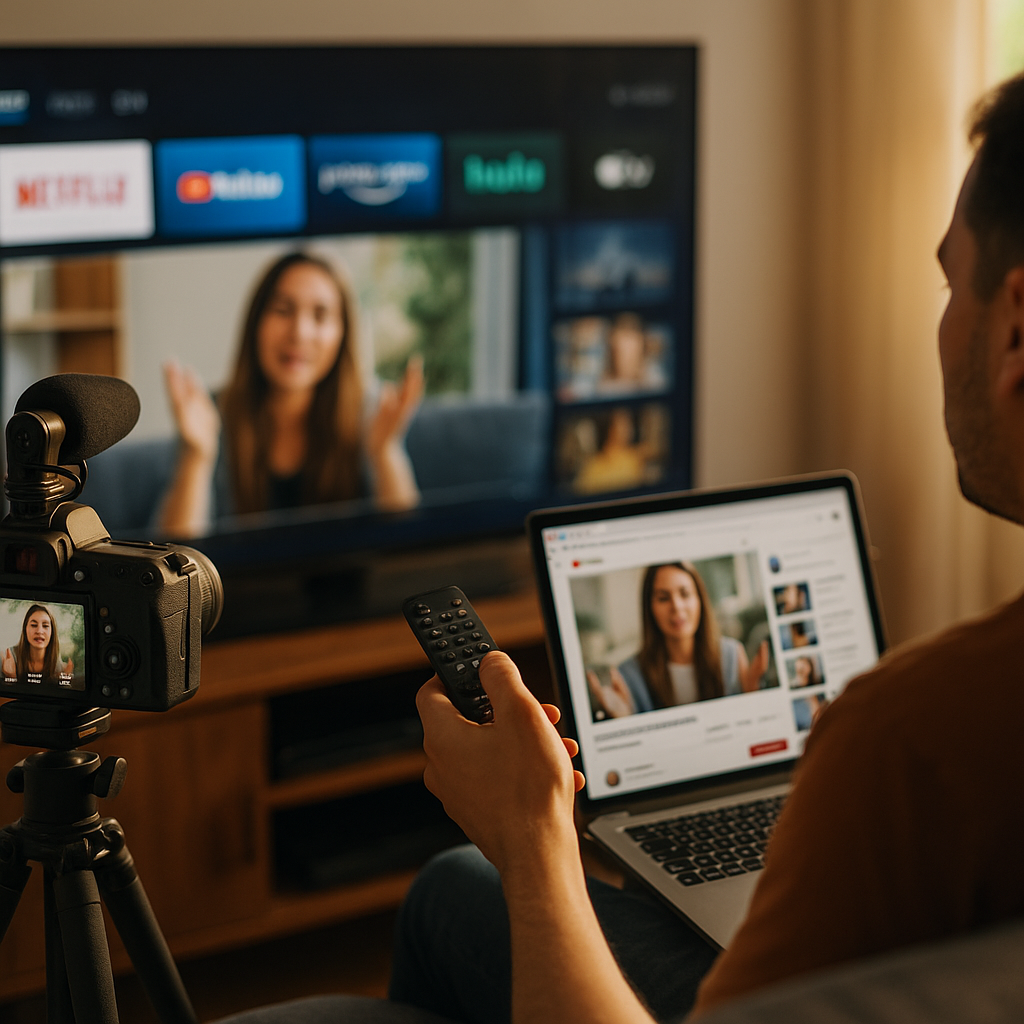
Connected TV ad spend is projected to surpass $40 billion in the U.S. alone, yet most influencer programs still produce assets engineered exclusively for a 9:16 feed. That mismatch is costing brands twice: once in production waste, and again in missed streaming inventory opportunities. Building a creator program for the OTT and streaming advertising era means designing for both environments from brief to final delivery.
Why the Feed-First Default Is Broken
For years, the mental model was simple. Hire a creator, get a TikTok or Reel, boost it via paid social. Done. But the media landscape has shifted underneath that assumption. Streaming platforms including Hulu, Peacock, Paramount+, and Amazon Prime Video now offer ad-supported tiers with CPMs that rival or exceed linear TV, and audiences that skew toward cord-cutters who are nearly unreachable on traditional broadcast.
The problem is not access to inventory. The problem is creative. Most creator-produced content fails OTT technical spec reviews for one or more reasons: wrong aspect ratio, embedded captions baked into the frame, music clearances that don’t extend to broadcast-adjacent channels, or talent agreements that only license digital social use. None of that is the creator’s fault. It’s a structural failure in how most brands commission content.
Brands that build dual-format creative requirements into their initial creator brief recover 60–80% of incremental production cost through asset reuse across paid social, OTT pre-roll, and CTV mid-roll placements.
Designing the Brief for Dual-Format Output
The fix starts before a creator films a single frame. Your creator brief needs a dedicated section that specifies OTT/CTV deliverables alongside the social-first assets. That means being explicit about:
- Aspect ratio requirements: 16:9 landscape for CTV/OTT pre-roll, 9:16 for Stories and Reels, 1:1 as the square fallback for feed placements
- Safe zones: UI overlays on streaming platforms obscure the bottom 20% of a 16:9 frame. Any text, logo, or CTA must clear that zone
- Clean audio tracks: Separate dialogue from background music so post-production can mix for broadcast audio standards (typically -24 LUFS)
- Music licensing: Require cleared or royalty-free music that explicitly covers streaming/broadcast distribution, not just digital social
- B-roll capture: Request 15–30 seconds of usable B-roll beyond the primary deliverable; this becomes editing flexibility for 15s and 30s CTV cuts
This doesn’t add significant burden to the creator. It adds specificity. Most creators working at a professional level already capture in high resolution with clean audio. The gap is instruction, not capability.
Rights and Contracts: The Part Brands Get Wrong Most Often
Even technically perfect creative becomes unusable without the right licensing structure. Standard influencer agreements grant social media use rights. CTV and OTT distribution require broadcast or “digital streaming” rights, and depending on your legal team’s interpretation, may trigger talent residuals under SAG-AFTRA rules if a creator is a union member.
Address this in your master service agreement, not a post-production addendum. Define “digital streaming platforms” and list them explicitly: Hulu, Peacock, Roku, Fire TV, Samsung Ads, YouTube TV. Specify the usage window (typically 12 months with renewal options). Lock music licensing to match. And build a talent likeness provision that covers appearing on a connected TV screen, which is technically different from appearing in a social app.
For larger programs, it’s worth consulting the FTC’s endorsement guidelines to confirm that disclosure requirements you’ve established for social also translate appropriately to streaming contexts. The FTC expects disclosures to be clear and conspicuous regardless of delivery channel.
Brands running athlete creator programs face an additional layer here, since NIL rights structures and conference agreements affect cross-channel distribution differently. The evolving framework around athlete collective deals is instructive for understanding how layered rights can be negotiated at scale.
Production Architecture: One Shoot, Multiple Outputs
The economics only work if you architect production for multiplicity from the start. A single creator shoot can realistically produce:
- One 60–90 second social-first video (primary deliverable)
- One 30-second CTV/OTT cut with clean end card and brand logo hold
- One 15-second pre-roll cut optimized for unskippable inventory
- One 6-second bumper for YouTube and programmatic display environments
- Three to five static image pulls for display and paid social
This requires a post-production brief alongside the creator brief. The creator captures the raw material; a brand-side editor (or a certified production partner) cuts the variants. Platforms like Statista’s media market reports consistently show CTV completion rates exceeding 90% for unskippable inventory, making even the 6-second cut worth producing. High completion rates translate directly to brand recall lift that your paid social assets can’t replicate because users scroll past them.
Budget-wise, think of the additional cuts as a media efficiency play, not a production cost. If a creator asset costs $8,000 to produce and an additional $1,200 in post to generate CTV-ready variants, but those variants serve against $25 CPM CTV inventory across 500,000 impressions, the incremental ROI math is not complicated. For a deeper look at how to structure this budget architecture, the creator program budget planning framework covers the paid amplification layer in detail.
Platform Selection and Distribution Logic
Not all OTT inventory is equal, and creator-produced content doesn’t perform uniformly across streaming environments. The general segmentation that matters for brands right now:
Free ad-supported streaming TV (FAST): Platforms like Tubi, Pluto TV, and The Roku Channel aggregate large audiences at lower CPMs. Creator content formatted as native-feeling spots (conversational, direct-to-camera) tends to outperform polished brand spots here because the viewer aesthetic aligns with creator authenticity.
Premium AVOD: Hulu and Peacock offer contextual targeting and programmatic guaranteed deals. Expect higher CPMs ($25–$45) but access to audience segments that are genuinely difficult to reach on social. These environments require creative that clears broadcast-quality standards.
YouTube CTV: Often overlooked, YouTube on TV screens now accounts for a significant share of living-room viewing. Creator content formatted for YouTube naturally bridges the gap here since YouTube’s ad system serves the same assets to both mobile and CTV placements. This is the easiest entry point for brands new to streaming distribution.
The distribution decision should flow from your audience data, not platform prestige. Use your DSP (The Trade Desk, DV360, or Amazon DSP) to identify where your target segment over-indexes in streaming environments, then match your creator content format to those specific placements. The unified social and TV distribution model is increasingly how sophisticated media teams are operating.
Measurement: Closing the Attribution Loop
The attribution challenge for OTT and creator content combined is real. Streaming platforms don’t pass click data the way social does. But the measurement toolkit has matured significantly.
Geo-matched sales lift studies, brand lift surveys through platforms like TikTok Ads Manager and Hulu’s Innovid-powered measurement suite, and cross-device graph matching through clean room environments (Google Ads Data Hub, Amazon Marketing Cloud) now allow brands to connect streaming exposure to downstream conversion behavior. The key is establishing baseline measurement parameters before the campaign launches, not after.
For programs running both social and CTV creator assets simultaneously, incremental reach analysis becomes the primary KPI. How many unique households did the CTV placement reach that the paid social flight did not? That incremental reach, priced against CTV CPM, is your cost-per-incremental-reach, which you can then benchmark against social reach cost. For more on closing these attribution loops, the data-driven creator workflow guide provides a working operational model.
Attribution in a streaming environment rewards patience. The purchase cycle from CTV exposure to conversion is typically 7–21 days longer than social. Set your measurement windows accordingly or you’ll undervalue the channel.
The brands pulling ahead right now aren’t spending more. They’re commissioning smarter, contracting comprehensively, and distributing the same creative investment across more inventory surfaces. Start with one creator, one dual-format brief, and one CTV campaign to prove the model internally before scaling.
Frequently Asked Questions
What technical specs does creator content need to meet for OTT and CTV ad placements?
Creator content for OTT and CTV generally requires a 16:9 aspect ratio, minimum 1920×1080 resolution, broadcast-standard audio at -24 LUFS, no embedded hard-coded captions within critical frame areas, and a clean end card with a brand logo hold of at least two seconds. Each platform (Hulu, Peacock, Roku) publishes its own spec sheet, but these standards cover the majority of premium inventory requirements.
Do standard influencer contracts cover streaming and CTV distribution?
No. Standard influencer agreements typically license content for social media use only. CTV and OTT distribution requires explicit “digital streaming” or “broadcast-adjacent” rights language in the contract. Brands must also ensure music licenses, talent likeness agreements, and third-party clearances extend to streaming environments. This should be addressed in the master service agreement, not added retroactively.
How do you measure the ROI of creator content running on streaming platforms?
Measurement options include geo-matched sales lift studies, brand lift surveys available through platforms like Hulu and Amazon, and cross-device attribution through clean room environments such as Google Ads Data Hub or Amazon Marketing Cloud. Incremental reach analysis (unique households reached by CTV that were not reached by paid social) is often the most defensible primary KPI for streaming creator campaigns.
Can smaller creator budgets realistically support both social and OTT asset production?
Yes, with the right production architecture. A single creator shoot can yield social-first content, a 30-second CTV cut, a 15-second pre-roll, and a 6-second bumper with modest additional post-production investment. The incremental production cost is typically 15–20% of the original shoot cost, while the asset extends across significantly higher-value inventory. Budget planning should treat CTV post-production as a media efficiency investment.
Which streaming platforms are the best entry point for brands new to creator-based CTV advertising?
YouTube CTV is the most accessible entry point because YouTube’s ad system already serves the same creator assets across mobile and living-room placements without separate trafficking. FAST platforms like Tubi and The Roku Channel offer lower CPMs and are receptive to creator-style creative formats. Premium AVOD platforms like Hulu and Peacock offer stronger targeting but require higher production quality and larger budget commitments.
Top Influencer Marketing Agencies
The leading agencies shaping influencer marketing in 2026
Agencies ranked by campaign performance, client diversity, platform expertise, proven ROI, industry recognition, and client satisfaction. Assessed through verified case studies, reviews, and industry consultations.
Moburst

-
2

The Shelf
Boutique Beauty & Lifestyle Influencer AgencyA data-driven boutique agency specializing exclusively in beauty, wellness, and lifestyle influencer campaigns on Instagram and TikTok. Best for brands already focused on the beauty/personal care space that need curated, aesthetic-driven content.Clients: Pepsi, The Honest Company, Hims, Elf Cosmetics, Pure LeafVisit The Shelf → -
3

Audiencly
Niche Gaming & Esports Influencer AgencyA specialized agency focused exclusively on gaming and esports creators on YouTube, Twitch, and TikTok. Ideal if your campaign is 100% gaming-focused — from game launches to hardware and esports events.Clients: Epic Games, NordVPN, Ubisoft, Wargaming, Tencent GamesVisit Audiencly → -
4

Viral Nation
Global Influencer Marketing & Talent AgencyA dual talent management and marketing agency with proprietary brand safety tools and a global creator network spanning nano-influencers to celebrities across all major platforms.Clients: Meta, Activision Blizzard, Energizer, Aston Martin, WalmartVisit Viral Nation → -
5

The Influencer Marketing Factory
TikTok, Instagram & YouTube CampaignsA full-service agency with strong TikTok expertise, offering end-to-end campaign management from influencer discovery through performance reporting with a focus on platform-native content.Clients: Google, Snapchat, Universal Music, Bumble, YelpVisit TIMF → -
6

NeoReach
Enterprise Analytics & Influencer CampaignsAn enterprise-focused agency combining managed campaigns with a powerful self-service data platform for influencer search, audience analytics, and attribution modeling.Clients: Amazon, Airbnb, Netflix, Honda, The New York TimesVisit NeoReach → -
7

Ubiquitous
Creator-First Marketing PlatformA tech-driven platform combining self-service tools with managed campaign options, emphasizing speed and scalability for brands managing multiple influencer relationships.Clients: Lyft, Disney, Target, American Eagle, NetflixVisit Ubiquitous → -
8

Obviously
Scalable Enterprise Influencer CampaignsA tech-enabled agency built for high-volume campaigns, coordinating hundreds of creators simultaneously with end-to-end logistics, content rights management, and product seeding.Clients: Google, Ulta Beauty, Converse, AmazonVisit Obviously →