


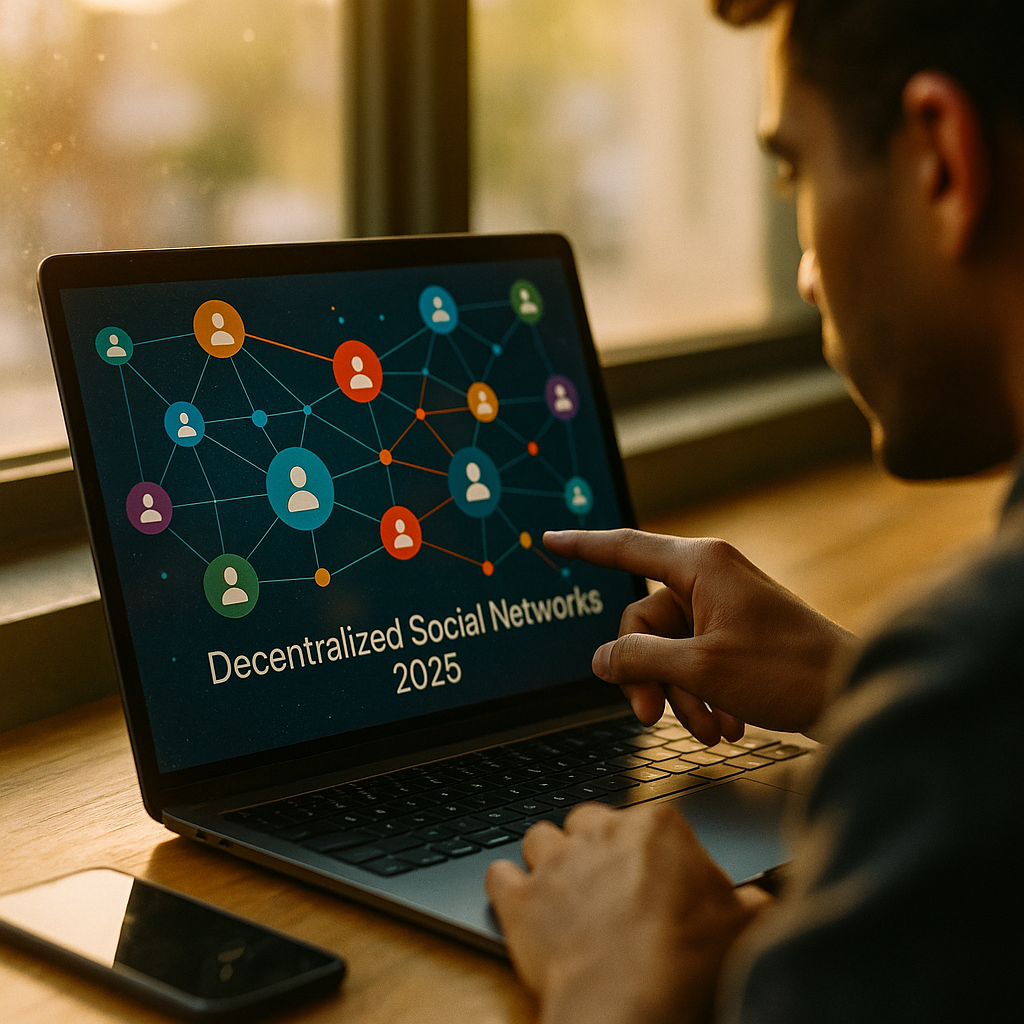
In 2025, the rise of decentralized social networks is reshaping how people connect online, challenging the ad-driven platforms that dominate attention and monetize identity. As users confront data breaches, opaque algorithms, and shifting moderation rules, a new model is gaining traction: communities built on open protocols and user-controlled accounts. But can these networks scale without repeating old mistakes?
Why decentralized social media is gaining momentum
Traditional social platforms succeeded by centralizing identity, content distribution, and monetization in a single company’s stack. That design makes onboarding simple and growth fast—but it also creates systemic risks: a single point of failure for privacy, a single set of rules for speech and reach, and a single business incentive that often prioritizes engagement over user well-being.
Decentralized social media flips that structure. Instead of one company owning the entire graph, decentralized systems distribute hosting, identity, and moderation across multiple providers or community-run servers. Users can often move accounts or audiences between providers, and developers can build new apps on shared protocols rather than starting from scratch.
Several forces are pushing this shift in 2025:
- Trust fatigue: Users have become more skeptical of “free” platforms after repeated privacy controversies and policy changes that affect reach and livelihoods.
- Creator dependency: Creators and businesses want durable audiences that don’t disappear when algorithms change or accounts are suspended without clear recourse.
- Regulatory pressure: Data protection and competition enforcement are increasing scrutiny on centralized gatekeepers, raising the value of portable identity and interoperable systems.
- Technical maturity: Open protocols, standardized feeds, and better moderation tooling have reduced the friction that previously kept decentralized alternatives niche.
If you’re wondering whether decentralization is “all or nothing,” it isn’t. Many systems are hybrid: identity might be portable while content is hosted by providers, or moderation may be localized to communities while global safety standards remain possible through shared lists and reputation signals.
Personal data sovereignty: what it means and why it matters
Personal data sovereignty means you can control how your data is collected, stored, shared, and monetized—without needing to trust a single platform to keep its promises. In practical terms, it’s less about never sharing data and more about informed, revocable consent plus real portability.
On centralized platforms, your posts, follows, likes, and messages often become part of a proprietary database. Even if you can download an archive, it may be incomplete, hard to reuse, or detached from the social graph that gives it value. Sovereignty improves when three conditions are met:
- Portability: You can move your identity, content, and relationships to another provider or app with minimal loss.
- Permissioning: You decide which apps can access which data, ideally with granular scopes and time limits.
- Transparency: You can see how recommendations are made and what data inputs drive personalization and ad targeting.
This matters beyond privacy. Sovereignty supports economic resilience for creators, reduces lock-in for organizations, and makes communities less vulnerable to abrupt platform shutdowns or policy swings. It also changes the power dynamic: platforms must compete on service quality, moderation competence, and user experience—not on trapping the social graph.
Readers often ask whether sovereignty conflicts with personalization. It doesn’t have to. The difference is where personalization happens and who controls it. A sovereign model can allow personalization on-device, in user-controlled data stores, or through audited services with explicit permissions.
Federated networks and open protocols: how they work
Federated networks are one of the most common approaches to decentralization. Instead of one platform running everything, many independently operated servers (often called “instances”) communicate through a shared protocol. Users on different instances can follow each other, reply, and share content across the network.
To understand federation, it helps to separate the stack into components:
- Identity: Your handle can be tied to a provider (like an email address) or to a more portable identifier.
- Hosting: A server stores your content and relays it to others.
- Protocol: A standard that defines how posts, follows, and moderation signals move between servers.
- Client apps: The interfaces people use—often interchangeable across the same protocol.
Open protocols enable interoperability. That means multiple apps can read and write to the same social graph, and users can switch experiences without abandoning their network. This is where decentralization becomes more than “another app”—it becomes an ecosystem.
However, open protocols also raise real operational questions that centralized platforms handle behind the scenes:
- Spam resistance: Without a single gatekeeper, networks need shared abuse defenses, rate limits, and reputation signals.
- Content discovery: Finding quality content across many servers requires indexing, search, and ranking mechanisms that don’t recreate opaque algorithmic control.
- Reliability: Smaller servers can have outages; users need clear options for backups and migration.
The best decentralized systems make these tradeoffs explicit. They provide sensible defaults for non-technical users while preserving the right to move, fork, and choose different governance models.
Digital identity and data portability: owning your social graph
Digital identity is the hinge point between convenience and sovereignty. If your identity is bound to a single platform, you can’t truly leave without losing reach. If your identity is portable, platforms must earn your presence every day.
In 2025, portability is increasingly defined by a few practical capabilities:
- Account migration: The ability to relocate your profile and posts to a new provider with redirects so others can still find you.
- Social graph transfer: Exporting and importing follows, blocks, mutes, and lists so your community structure persists.
- App-level interoperability: Using multiple clients for the same account, or multiple services that build on the same identity.
- Consent-based data sharing: Granting third-party apps access without handing over your password, with clear permission scopes.
For readers evaluating platforms, focus less on marketing claims and more on concrete user rights:
- Can you export your data in a usable format?
- Can you move your account to a different host without starting over?
- Can you revoke access from third-party apps instantly?
- Is the protocol documented and implemented by more than one provider?
A common concern is whether portability weakens safety. It can if mishandled. But portability can also strengthen safety by allowing users to leave poorly moderated spaces, choose stricter communities, and adopt clients that prioritize well-being. The key is ensuring migration preserves user protections like block lists and that abuse reporting has cross-network pathways.
Privacy, moderation, and security: real tradeoffs in decentralized platforms
Privacy and security in decentralized systems are not automatic. Decentralization reduces some risks—like a single database leak impacting everyone—but it introduces others, such as inconsistent operator practices across servers and varied moderation standards.
To assess safety realistically, consider these dimensions:
- Server trust: Your host can potentially access certain metadata and content, depending on architecture. Choose reputable operators with clear policies.
- Encryption: Private messaging may or may not be end-to-end encrypted. Verify what is actually protected in transit and at rest.
- Federation boundaries: Servers can block other servers. This can reduce harassment but may fragment conversations.
- Client security: Third-party apps can be excellent—or risky. Prefer well-audited clients and minimal permissions.
Content moderation is often the most misunderstood topic. In a decentralized world, moderation becomes multi-layered:
- Local moderation: Each community sets rules and enforces them on its own server.
- Network-level signals: Shared blocklists, labeling systems, and reputation services can help communities coordinate against spam and abuse.
- User-level controls: Individuals can curate their experience with filters, mutes, and custom feeds.
This approach can be healthier than one-size-fits-all moderation, but it demands clarity. Strong platforms publish enforcement guidelines, appeals processes, and transparency reports. They also invest in tooling so volunteer moderators aren’t overwhelmed—because burnout is a security risk, not just a community problem.
If you’re a business or public figure, also evaluate impersonation defenses (verification mechanisms, domain-based identity options, and reporting response times). Decentralization doesn’t remove the need for trust signals—it changes how they’re issued and validated.
Web3 social, creator monetization, and the future of online communities
Web3 social is often discussed alongside decentralized networks, but it’s best treated as a set of optional tools rather than the definition of decentralization. Blockchains can help with verifiable identity claims, portable ownership records, and certain payment rails. They can also add complexity, fees, and new attack surfaces. The question to ask is simple: What user problem does this solve that a non-blockchain approach cannot?
Where decentralized systems are already changing outcomes in 2025 is in creator monetization and community resilience:
- Direct relationships: Creators can reduce dependency on a single algorithm by building audiences across interoperable apps.
- Membership and subscriptions: Communities can support creators through recurring payments that aren’t tied to a platform’s ad model.
- Composable tools: Developers can build analytics, moderation assistants, publishing workflows, and community features on shared protocols.
Still, decentralized ecosystems must prove they can sustain themselves financially without reverting to surveillance advertising. Viable models include paid hosting, community memberships, patronage, marketplace services, and privacy-preserving ads that keep targeting on-device or based on contextual signals rather than personal profiling.
The future likely belongs to networks that combine:
- User choice (switchable apps and hosts)
- Clear governance (rules, enforcement, and appeals)
- Practical safety (anti-spam, abuse response, and moderation tooling)
- Economic sustainability (business models aligned with users)
FAQs about decentralized social networks and personal data sovereignty
What is a decentralized social network?
A decentralized social network distributes hosting, identity, and governance across multiple providers or community-run servers instead of one company. Users can often interact across servers and, in many systems, switch providers without losing their audience.
Are decentralized social networks safer than traditional platforms?
They can reduce certain systemic risks, such as a single massive data breach or unilateral policy changes. But safety varies by server, client app, and moderation quality. Choose reputable hosts, verify security features, and use strong account protections.
Can I take my followers with me if I switch servers?
Many federated systems support some form of migration, but the quality differs. Look for platforms that provide account redirects, social graph export/import, and preservation of blocks and mutes. Test portability before investing heavily.
How do decentralized networks handle moderation?
Moderation is typically layered: community rules enforced locally, coordinated defenses via shared signals (like blocklists or labels), and strong user-level controls. This can improve autonomy, but it requires transparent policies and good tooling to work well.
Does personal data sovereignty mean my data is never shared?
No. It means you control sharing through informed consent, can revoke access, and can move your data to other services. Sovereignty is about power and portability, not isolation.
Do I need crypto to use decentralized social media?
No. Many decentralized platforms do not require tokens or wallets. Some ecosystems offer optional blockchain-based features, but decentralization can be achieved through open protocols and federation without crypto.
Decentralized social networks are moving from experiment to practical alternative in 2025, driven by user demand for control, transparency, and portability. Personal data sovereignty turns identity and relationships into assets you can carry, not value trapped in a corporate database. The takeaway is straightforward: choose platforms that prove interoperability, publish clear moderation rules, and let you leave without losing your community.
Top Influencer Marketing Agencies
The leading agencies shaping influencer marketing in 2026
Agencies ranked by campaign performance, client diversity, platform expertise, proven ROI, industry recognition, and client satisfaction. Assessed through verified case studies, reviews, and industry consultations.
Moburst

-
2

The Shelf
Boutique Beauty & Lifestyle Influencer AgencyA data-driven boutique agency specializing exclusively in beauty, wellness, and lifestyle influencer campaigns on Instagram and TikTok. Best for brands already focused on the beauty/personal care space that need curated, aesthetic-driven content.Clients: Pepsi, The Honest Company, Hims, Elf Cosmetics, Pure LeafVisit The Shelf → -
3

Audiencly
Niche Gaming & Esports Influencer AgencyA specialized agency focused exclusively on gaming and esports creators on YouTube, Twitch, and TikTok. Ideal if your campaign is 100% gaming-focused — from game launches to hardware and esports events.Clients: Epic Games, NordVPN, Ubisoft, Wargaming, Tencent GamesVisit Audiencly → -
4

Viral Nation
Global Influencer Marketing & Talent AgencyA dual talent management and marketing agency with proprietary brand safety tools and a global creator network spanning nano-influencers to celebrities across all major platforms.Clients: Meta, Activision Blizzard, Energizer, Aston Martin, WalmartVisit Viral Nation → -
5

The Influencer Marketing Factory
TikTok, Instagram & YouTube CampaignsA full-service agency with strong TikTok expertise, offering end-to-end campaign management from influencer discovery through performance reporting with a focus on platform-native content.Clients: Google, Snapchat, Universal Music, Bumble, YelpVisit TIMF → -
6

NeoReach
Enterprise Analytics & Influencer CampaignsAn enterprise-focused agency combining managed campaigns with a powerful self-service data platform for influencer search, audience analytics, and attribution modeling.Clients: Amazon, Airbnb, Netflix, Honda, The New York TimesVisit NeoReach → -
7

Ubiquitous
Creator-First Marketing PlatformA tech-driven platform combining self-service tools with managed campaign options, emphasizing speed and scalability for brands managing multiple influencer relationships.Clients: Lyft, Disney, Target, American Eagle, NetflixVisit Ubiquitous → -
8

Obviously
Scalable Enterprise Influencer CampaignsA tech-enabled agency built for high-volume campaigns, coordinating hundreds of creators simultaneously with end-to-end logistics, content rights management, and product seeding.Clients: Google, Ulta Beauty, Converse, AmazonVisit Obviously →