


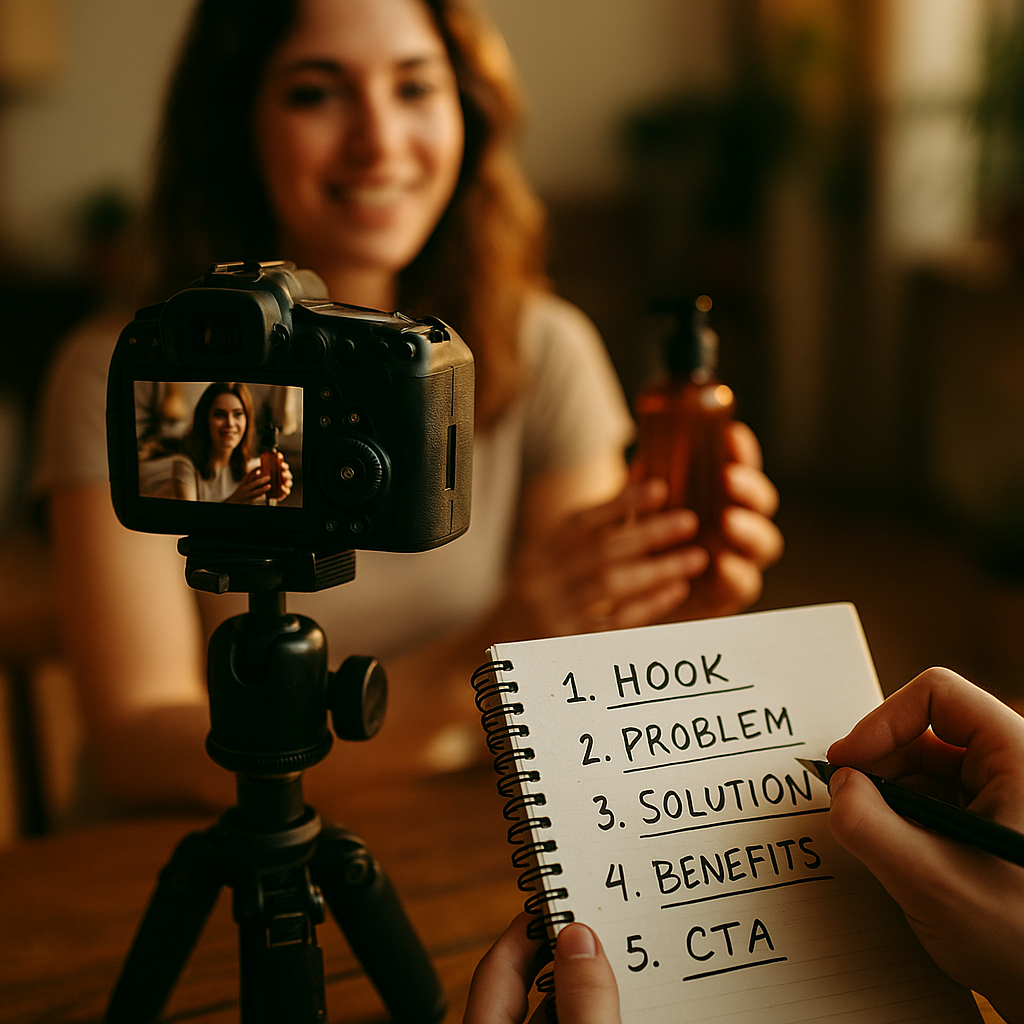
UGC style video ads now generate click-through rates 4 to 7 times higher than polished branded spots on platforms like TikTok and Instagram Reels, according to multiple agency benchmarking reports. Yet most brands still write these scripts like mini commercials, and it shows. The gap between a UGC style video ad that performs and one that flops almost never comes down to budget or talent. It comes down to the script.
Why Branded Polish Is Losing the Scroll
Viewers have gotten exceptionally good at pattern recognition. The three ring binder close up, the studio lighting, the voiceover that sounds like it was recorded in a booth: these cues trigger an almost instant “ad” reflex, and the thumb keeps moving. UGC style creative works because it borrows the visual grammar of content people already trust, their friends’ Stories, a creator’s unscripted rant, a phone propped against a water bottle.
But here’s the part brands get wrong constantly: UGC style doesn’t mean unscripted. It means scripted to look unscripted. That distinction is the entire craft.
The best performing UGC ads are among the most tightly scripted pieces of content a brand will ever produce. The looseness is the performance, not the absence of planning.
Agencies and in house teams that treat UGC as “just hand the creator a brief and let them riff” are leaving money on the table. Riffing without structure produces rambling videos with weak hooks, buried CTAs, and inconsistent claims that legal flags in review. Structure without rigidity is the sweet spot.
The Script Structure That Actually Converts
Every high performing UGC style ad follows a loose but consistent skeleton. Strip away the specific niche or product, and you’ll find the same five beats:
- The cold open hook (0 to 3 seconds): a claim, a question, or a visual pattern interrupt that stops the scroll before the viewer registers it’s an ad.
- The relatable setup (3 to 8 seconds): a quick context line that mirrors the viewer’s own situation. “I was today years old when I found out…” or “Nobody told me this before I bought a house.”
- The proof beat (8 to 20 seconds): the demo, the before/after, the ingredient callout, whatever makes the claim credible.
- The objection flip (20 to 30 seconds): addressing the skepticism the viewer is already feeling. This is the beat most brand scripts skip entirely.
- The soft CTA (final 5 to 8 seconds): low pressure, specific, often delivered almost as an afterthought.
Notice what’s missing: a logo bumper, a tagline, a jingle. Those belong in branded creative. In UGC style ads, they’re performance killers. If you want a deeper breakdown of hook mechanics specifically, our piece on scroll stopping hook formulas covers timing benchmarks worth building into your script template.
Writing Dialogue That Doesn’t Sound Written
This is where most scripts die. Writers trained on traditional ad copy default to complete sentences, parallel structure, clean transitions. Real people don’t talk that way. They trail off. They correct themselves mid sentence. They use filler words.
A trick that works well: write the line the “correct” way first, then deliberately break it. “This serum changed my skin in two weeks” becomes “Okay so, I wasn’t going to post about this, but my skin, like, genuinely changed in two weeks and I need to talk about it.” Same claim, same CTA energy, completely different trust signal.
Give creators a script with intentional imperfection baked in rather than a clean paragraph and a note that says “make it sound natural.” That note is doing none of the work. The imperfection has to be scripted, or the creator will either over polish it back into ad speak or improvise something off brand and off claim.
Where the POV Format Fits In
Point of view scripting deserves its own mention because it’s become the dominant subgenre of UGC style ads for a reason: it removes the “someone is selling me something” frame entirely. The camera becomes the viewer’s own eyes, or the creator talks directly into the lens as if the viewer is a friend they’re venting to. We’ve gone deep on building these frameworks in our guide to POV creator ad structures, and the CTR lift data there backs up what most performance marketers are seeing anecdotally: POV formats are currently outperforming straight talking head UGC by a meaningful margin on cost per click.
Product demo integration matters here too. A script that just shows a product without narrative tension reads flat no matter how native the visual style. Pairing POV delivery with an actual demonstration, the kind covered in our product demo skit framework, tends to outperform either approach in isolation.
Casting the Script, Not Just the Creator
A script written for a 22 year old beauty creator will fall flat delivered by a 45 year old dad testing a grill thermometer, even if every beat is technically sound. Write for the persona’s actual vocabulary, pacing, and platform habits. Pull real comment language from your brand’s existing posts or competitor videos. If your audience says “this is sending me” or “I’m not even exaggerating,” those phrases belong in the script draft, not generic ad copy softened slightly.
This is also where faceless and creator handle formats come into play. Brands running faceless UGC accounts or working within the structure outlined in creator handle ad formats need scripts that compensate for the missing face with stronger audio pacing and more explicit B roll direction, since visual personality cues are reduced. A solid shot list still matters even in a “low production” format. Our B roll shot list framework is a useful companion piece if you’re building these out at scale.
Disclosure and Compliance Aren’t Optional Polish
Here’s the uncomfortable truth: the more convincingly native a UGC style ad looks, the more scrutiny it deserves from a compliance standpoint. The FTC has been explicit that disclosure requirements apply regardless of how organic the content appears, and enforcement attention on influencer marketing has only increased. Scripts need to build disclosure language in as a natural beat, not a bolted on caption that contradicts the tone of everything before it.
If any part of the ad involves AI generated voiceover, overlays, or synthetic elements, the disclosure bar gets higher still. We’ve written specifically about this in AI asset disclosure requirements, and it’s worth building that checklist into your script review process before creative goes to brand or legal sign off.
A UGC style ad that gets flagged in review after the creator has already filmed it is the single most expensive mistake in this format. Build compliance into the script stage, not the editing stage.
What to Actually Measure
Hook rate (percentage of viewers still watching at 3 seconds) and hold rate through the proof beat are the two metrics that tell you whether the script structure is working before spend scales. TikTok Ads Manager and Meta’s ad reporting both surface these breakdowns natively, and they’re more actionable than overall CTR because they tell you which beat of the script is leaking attention. If hook rate is strong but hold rate collapses at second 8, the proof beat is the problem, not the opener.
Benchmarking data from eMarketer and platform insights from Sprout Social consistently show creator led, native feeling formats converting at a lower cost per acquisition than studio produced video, often by a wide margin once you factor in production cost per asset. UGC style scripts are also cheap to iterate. Test five hook variations against one proof beat before you ever touch the back half of the script; it’s the highest leverage testing you can do with the least production cost.
Scaling Without Losing the Voice
Once a script format proves out, the temptation is to template it aggressively and ship ten versions with different creators. That works, up to a point. Templating too rigidly reintroduces the exact “ad speak” problem you were solving for, because creators start performing the script instead of inhabiting it. Give creators a beat sheet, not a word for word script, once you’ve validated the structure. Let them bring their own phrasing to each beat. The framework stays constant. The voice flexes. That’s what keeps UGC style ads feeling native even at volume, and it’s the difference between a format that fatigues in two weeks and one that holds up across a full quarter of spend.
FAQs
What makes a UGC style video ad different from a regular influencer post?
A UGC style video ad is paid media, meaning the brand controls the script, usage rights, and distribution, even though the visual and tonal style mimics organic creator content. A regular influencer post is typically the creator’s own content shared on their organic feed under a partnership agreement, with less brand control over structure.
How long should a UGC style ad script be?
Most high performing scripts run 25 to 45 seconds for feed placements. Longer formats can work for product demos or testimonial style content, but the core five beat structure (hook, setup, proof, objection flip, CTA) should still be intact regardless of total runtime.
Should I write a full script or just give creators a brief?
Give creators a structured beat sheet with key claims, required disclosure language, and specific proof points locked in, but leave room for them to phrase individual lines in their own voice. Full word for word scripts often sound stilted when delivered; loose briefs often miss required claims or compliance language.
Do UGC style ads need FTC disclosure even if they look organic?
Yes. Disclosure requirements apply based on whether there’s a material connection between the brand and the creator, not on how polished or native the content appears. This applies to paid UGC style ads regardless of production style.
What’s the biggest scripting mistake brands make with UGC style ads?
Writing dialogue in complete, grammatically clean sentences. Real conversational speech includes filler words, trailing thoughts, and self correction. Scripts that read too cleanly tend to get performed too cleanly, which breaks the native feel the format depends on.
Start by auditing your next three briefs: if the script reads like ad copy with a creator’s name swapped in, it will perform like ad copy. Rewrite the hook and proof beat using the five part structure above, then test hook variants before scaling spend on any single version.
Top Influencer Marketing Agencies
The leading agencies shaping influencer marketing in 2026
Agencies ranked by campaign performance, client diversity, platform expertise, proven ROI, industry recognition, and client satisfaction. Assessed through verified case studies, reviews, and industry consultations.
Moburst

-
2

The Shelf
Boutique Beauty & Lifestyle Influencer AgencyA data-driven boutique agency specializing exclusively in beauty, wellness, and lifestyle influencer campaigns on Instagram and TikTok. Best for brands already focused on the beauty/personal care space that need curated, aesthetic-driven content.Clients: Pepsi, The Honest Company, Hims, Elf Cosmetics, Pure LeafVisit The Shelf → -
3

Audiencly
Niche Gaming & Esports Influencer AgencyA specialized agency focused exclusively on gaming and esports creators on YouTube, Twitch, and TikTok. Ideal if your campaign is 100% gaming-focused — from game launches to hardware and esports events.Clients: Epic Games, NordVPN, Ubisoft, Wargaming, Tencent GamesVisit Audiencly → -
4

Viral Nation
Global Influencer Marketing & Talent AgencyA dual talent management and marketing agency with proprietary brand safety tools and a global creator network spanning nano-influencers to celebrities across all major platforms.Clients: Meta, Activision Blizzard, Energizer, Aston Martin, WalmartVisit Viral Nation → -
5

The Influencer Marketing Factory
TikTok, Instagram & YouTube CampaignsA full-service agency with strong TikTok expertise, offering end-to-end campaign management from influencer discovery through performance reporting with a focus on platform-native content.Clients: Google, Snapchat, Universal Music, Bumble, YelpVisit TIMF → -
6

NeoReach
Enterprise Analytics & Influencer CampaignsAn enterprise-focused agency combining managed campaigns with a powerful self-service data platform for influencer search, audience analytics, and attribution modeling.Clients: Amazon, Airbnb, Netflix, Honda, The New York TimesVisit NeoReach → -
7

Ubiquitous
Creator-First Marketing PlatformA tech-driven platform combining self-service tools with managed campaign options, emphasizing speed and scalability for brands managing multiple influencer relationships.Clients: Lyft, Disney, Target, American Eagle, NetflixVisit Ubiquitous → -
8

Obviously
Scalable Enterprise Influencer CampaignsA tech-enabled agency built for high-volume campaigns, coordinating hundreds of creators simultaneously with end-to-end logistics, content rights management, and product seeding.Clients: Google, Ulta Beauty, Converse, AmazonVisit Obviously →