


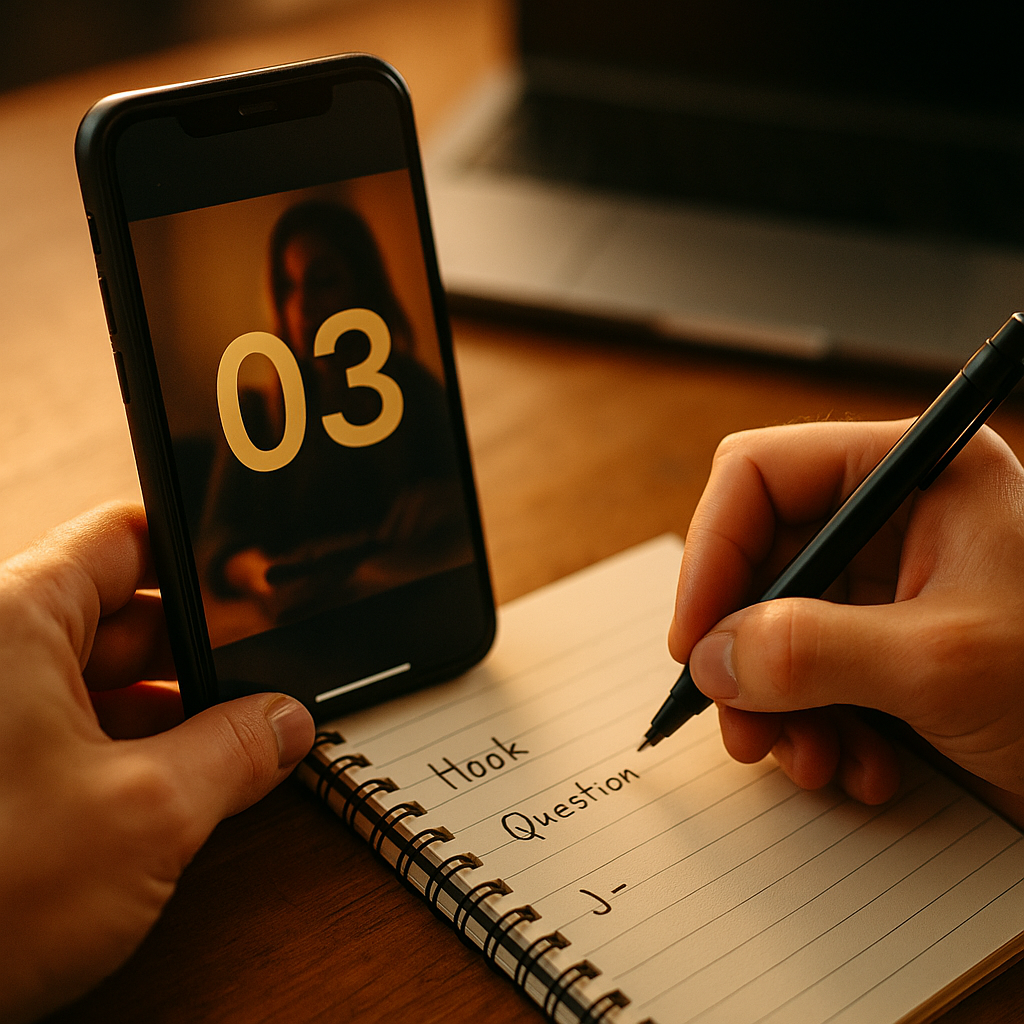
You have less time to earn attention than it takes to read this sentence. Platform data from TikTok and Meta has shown for years that viewers decide whether to keep watching within the first three seconds, and that window hasn’t gotten any longer as feeds get more crowded. If your three second hook doesn’t land, your production budget, your creator fee, and your media spend are all sunk costs before the second scene even loads.
This isn’t about clever editing. It’s about formula. The brands winning attention at scale have stopped treating hooks as creative inspiration and started treating them as repeatable, testable systems.
Why Three Seconds Became the Whole Game
Short form platforms reward instant retention because their algorithms are built to measure it. TikTok, Instagram Reels, and YouTube Shorts all weight early drop off heavily in distribution decisions. A video that loses forty percent of viewers in the first three seconds gets throttled before it ever reaches a second wave of impressions. According to eMarketer, average attention spans on short form video have continued to compress even as total video consumption rises, which means the opening beat now carries more weight than the entire rest of the script combined.
For brand marketers, this changes the math on creative review. A script that reads beautifully on page three means nothing if the opening line doesn’t survive the scroll test. Most brand safety and legal reviews focus on claims and disclosures in the body of the content. They should be spending equal time on the hook, because that’s where most of the ROI lives or dies.
A three second hook isn’t a creative flourish. It’s the single highest leverage three seconds in your entire media plan.
The Seven Formulas That Actually Work
Nano content hooks tend to fall into a handful of repeatable patterns. Here are the ones that consistently outperform in brand-sponsored content, based on patterns agencies and in-house teams have tested across thousands of briefs.
- The Interrupted Statement: Start mid-sentence or mid-action, as if the viewer tuned into something already happening. “So I just found out my skincare routine was…” forces the brain to fill the gap.
- The Contrarian Claim: Open by contradicting common wisdom. “Stop using a primer before your foundation” stops scroll because it challenges an assumption the viewer already holds.
- The Visual Anomaly: A product doing something it shouldn’t, an unexpected color, a strange texture, an object out of place. Pattern interrupts work because the eye is wired to notice what doesn’t fit.
- The Direct Address Question: “Why does nobody tell you this about renting an apartment?” Questions aimed straight at the viewer trigger a need for resolution.
- The Stakes Flash: Show the outcome first, then rewind. A dramatic result in the first frame (a before/after, a disaster averted) creates curiosity about the process.
- The Number Drop: Lead with a specific, unexpected figure. Specificity reads as credibility, and credibility buys you another second of attention.
- The Confession Opener: “I used to think this brand was overpriced.” Admissions feel honest, and honesty is rare enough in branded content to earn a pause.
None of these require big production budgets. Most work better without them. A phone camera, a confident delivery, and a sharp first line will outperform a polished montage nine times out of ten.
Matching the Hook to the Platform
Not every formula performs equally across platforms. TikTok audiences respond well to Interrupted Statements and Confession Openers because the platform’s native tone rewards rawness. Instagram Reels, where discovery skews slightly more aspirational, tends to favor Visual Anomalies and Stakes Flash hooks. LinkedIn video, increasingly relevant for B2B creator campaigns, performs best with Contrarian Claims and Number Drops because the audience is scanning for professional insight, not entertainment.
If you’re running the same creative across three platforms with the same hook, you’re leaving performance on the table. Platform-native hook selection should be a line item in your creative brief, not an afterthought handled in editing.
Scripting Hooks Without Sounding Scripted
Here’s the tension every brand team runs into: a hook that’s been through legal, compliance, and three rounds of stakeholder feedback often sounds like it. Viewers can smell a corporate-approved opening line from a mile away, and they scroll past it faster than an unscripted one.
The fix isn’t to skip review. It’s to build hook testing into the creator brief itself. Give creators the formula, not the exact words. Tell them “open with a contrarian claim about sunscreen” rather than handing them a scripted line to read verbatim. Creators who understand the underlying psychology of a hook will deliver it in their own voice, which preserves authenticity while still giving your team the structural control needed for brand safety sign off.
This approach pairs well with frameworks already used in POV script templates built for paid media, where the same discipline of structure-over-script has already proven it lifts click through rate without sacrificing creator voice. The same logic applies when you’re deciding between a creator handle ad format and a brand-owned post, since the hook requirements shift depending on whose name is attached.
What Brands Get Wrong With Nano Hooks
The most common mistake? Front-loading the brand name or logo. Viewers haven’t decided to care yet, and leading with a branded visual before earning attention reads as an ad, which triggers an immediate scroll. Save the branding for after the hook has done its job, typically somewhere between second four and second eight.
The second mistake is treating the hook as a standalone creative decision rather than part of a scripted arc. A strong hook that promises intrigue but delivers a flat payoff trains viewers to distrust your next hook. This is the same principle behind puzzle style creator content, where the opening tease only works if the resolution actually satisfies curiosity. A hook writes a check the rest of the script has to cash.
Third, brands overindex on novelty and underindex on repetition. The best performing hooks on any given platform are rarely original. They’re variations on formulas that have already proven they work, re-skinned for a new product or category. Reinventing hook mechanics for every campaign is expensive and unnecessary. Borrow the structure, change the specifics.
Novelty in hook structure is overrated. Novelty in the specific claim or visual inside a proven structure is where performance actually comes from.
Measuring Hook Performance Like a Media Buyer
If you’re not pulling three second view-through rate or average watch time at the two to three second mark, you’re flying blind on hook performance. Most platform ad managers, including TikTok Ads Manager and Meta Business Suite, surface this data natively. Treat it the way you’d treat open rate in email marketing: it’s the gatekeeping metric that determines whether anything downstream has a chance to perform.
Run hook variants the same way you’d run subject line tests. Shoot three to five openings against a single body script, traffic them to a small audience, and let the data decide which formula wins before you commit full budget. This is cheap to test and expensive to skip. A single day of hook testing can save a five-figure media spend from underperforming against a weak opening three seconds.
Teams running live or extended-format content face a related challenge, since hooks matter just as much when opening a livestream as they do in a fifteen second clip. The same urgency principles show up in livestream audio scripts, where the first moments of a broadcast determine whether viewers stay for the sale or bounce to another stream entirely.
A Quick Framework for Your Next Brief
Before your next creator brief goes out, run it through three questions: Does the hook formula match the platform’s native behavior? Does the hook withhold branding until attention is earned? And is there a clear payoff that matches the promise made in the first three seconds? If you can answer yes to all three, you’ve already outperformed most of what’s currently in market.
For teams building out broader creator governance, pairing hook standards with existing brand safe content playbooks keeps creative velocity high without reopening legal review for every new format experiment. Document the formulas that pass review once, and reuse them as a sanctioned list creators can pull from directly.
Frequently Asked Questions
What exactly counts as a three second hook?
It’s the opening visual and audio combination in a piece of short form content, typically the first one to three seconds, designed specifically to stop a viewer from scrolling past before the main message is delivered.
Do three second hooks work the same way in paid and organic content?
No. Paid content needs to overcome active skip intent since viewers know it’s an ad, which means hooks for paid placements often need a sharper pattern interrupt than organic content relying on algorithmic discovery.
How many hook variations should a brand test per campaign?
Three to five variations is typically enough to identify a clear performance leader without overspending on production. Testing more than that usually produces diminishing returns relative to the added cost.
Can a weak hook be fixed in editing after filming?
Sometimes. Trimming dead air or re-sequencing the first few frames can help, but a hook built on a weak formula rarely improves through editing alone. It’s more efficient to reshoot the opening line than to rescue it in post.
Should influencers write their own hooks or follow brand scripts?
Give creators the formula and intent, not a word-for-word script. Hooks delivered in a creator’s authentic voice consistently outperform ones that sound read off a page, even when the underlying structure is brand-approved.
The next brief you write should include a named hook formula, not just a vague instruction to “grab attention early.” Pick one from this list, test it against your current baseline, and let the three second retention data make the call.
Frequently Asked Questions
What exactly counts as a three second hook?
It’s the opening visual and audio combination in a piece of short form content, typically the first one to three seconds, designed specifically to stop a viewer from scrolling past before the main message is delivered.
Do three second hooks work the same way in paid and organic content?
No. Paid content needs to overcome active skip intent since viewers know it’s an ad, which means hooks for paid placements often need a sharper pattern interrupt than organic content relying on algorithmic discovery.
How many hook variations should a brand test per campaign?
Three to five variations is typically enough to identify a clear performance leader without overspending on production. Testing more than that usually produces diminishing returns relative to the added cost.
Can a weak hook be fixed in editing after filming?
Sometimes. Trimming dead air or re-sequencing the first few frames can help, but a hook built on a weak formula rarely improves through editing alone. It’s more efficient to reshoot the opening line than to rescue it in post.
Should influencers write their own hooks or follow brand scripts?
Give creators the formula and intent, not a word-for-word script. Hooks delivered in a creator’s authentic voice consistently outperform ones that sound read off a page, even when the underlying structure is brand-approved.
Top Influencer Marketing Agencies
The leading agencies shaping influencer marketing in 2026
Agencies ranked by campaign performance, client diversity, platform expertise, proven ROI, industry recognition, and client satisfaction. Assessed through verified case studies, reviews, and industry consultations.
Moburst

-
2

The Shelf
Boutique Beauty & Lifestyle Influencer AgencyA data-driven boutique agency specializing exclusively in beauty, wellness, and lifestyle influencer campaigns on Instagram and TikTok. Best for brands already focused on the beauty/personal care space that need curated, aesthetic-driven content.Clients: Pepsi, The Honest Company, Hims, Elf Cosmetics, Pure LeafVisit The Shelf → -
3

Audiencly
Niche Gaming & Esports Influencer AgencyA specialized agency focused exclusively on gaming and esports creators on YouTube, Twitch, and TikTok. Ideal if your campaign is 100% gaming-focused — from game launches to hardware and esports events.Clients: Epic Games, NordVPN, Ubisoft, Wargaming, Tencent GamesVisit Audiencly → -
4

Viral Nation
Global Influencer Marketing & Talent AgencyA dual talent management and marketing agency with proprietary brand safety tools and a global creator network spanning nano-influencers to celebrities across all major platforms.Clients: Meta, Activision Blizzard, Energizer, Aston Martin, WalmartVisit Viral Nation → -
5

The Influencer Marketing Factory
TikTok, Instagram & YouTube CampaignsA full-service agency with strong TikTok expertise, offering end-to-end campaign management from influencer discovery through performance reporting with a focus on platform-native content.Clients: Google, Snapchat, Universal Music, Bumble, YelpVisit TIMF → -
6

NeoReach
Enterprise Analytics & Influencer CampaignsAn enterprise-focused agency combining managed campaigns with a powerful self-service data platform for influencer search, audience analytics, and attribution modeling.Clients: Amazon, Airbnb, Netflix, Honda, The New York TimesVisit NeoReach → -
7

Ubiquitous
Creator-First Marketing PlatformA tech-driven platform combining self-service tools with managed campaign options, emphasizing speed and scalability for brands managing multiple influencer relationships.Clients: Lyft, Disney, Target, American Eagle, NetflixVisit Ubiquitous → -
8

Obviously
Scalable Enterprise Influencer CampaignsA tech-enabled agency built for high-volume campaigns, coordinating hundreds of creators simultaneously with end-to-end logistics, content rights management, and product seeding.Clients: Google, Ulta Beauty, Converse, AmazonVisit Obviously →