


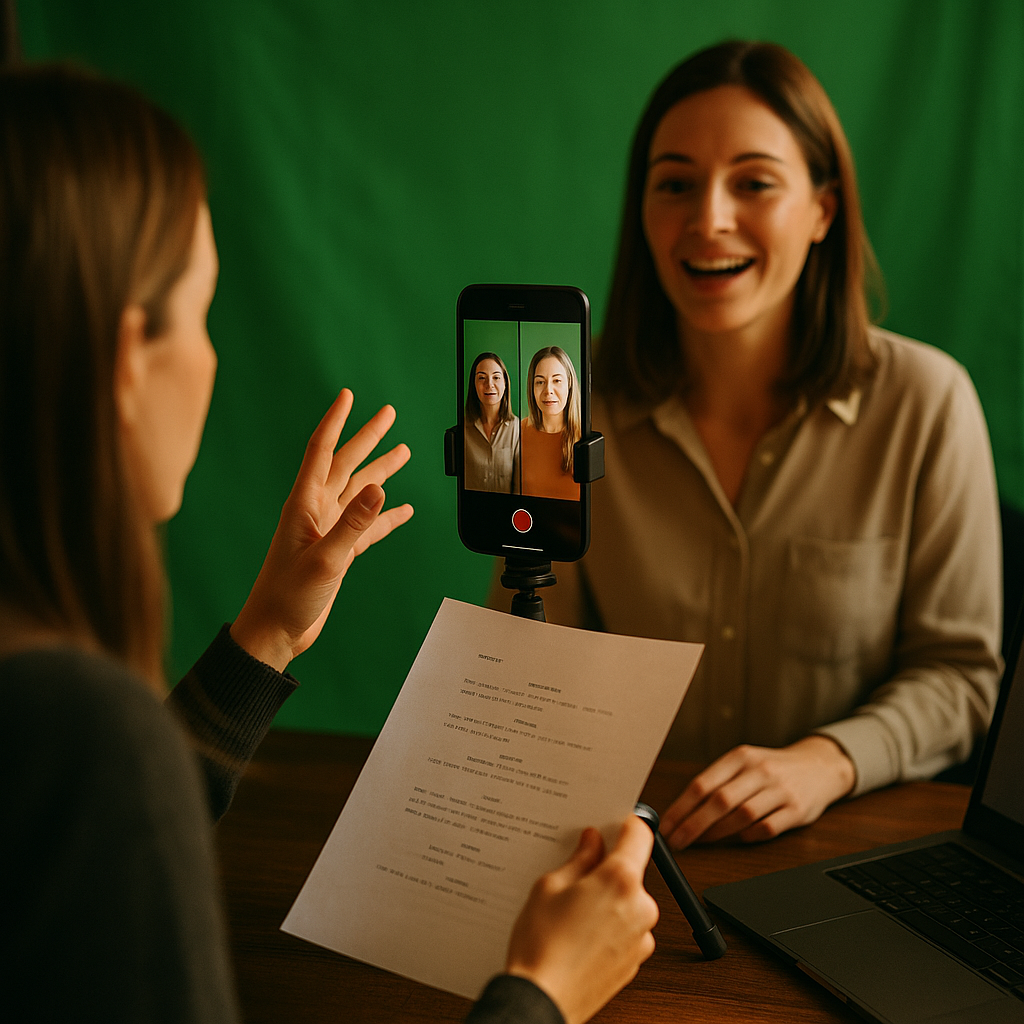
Duet and Stitch posts generate roughly 1.5 times more comments than standard uploads, according to TikTok’s own creator guidance, yet most brands still treat the format like an afterthought. That is a mistake. A well-built green screen duet program turns reactive content into a repeatable acquisition channel, not a one-off stunt. This playbook breaks down how brand teams script, approve, and scale it without losing control of the message.
Why Green Screen Duets Earn Trust Paid Media Can’t Buy
Here is the uncomfortable truth for brand marketers: audiences trust a stranger reacting to your product more than they trust your own ad copy. The green screen duet format exploits that bias on purpose. A creator stitches themselves next to your original post, comments in real time, and the split-screen layout signals authenticity because it looks unscripted, even when it is tightly scripted behind the scenes.
This is the same psychological lever used in picture in picture reaction ads, where doubt and verification drive the narrative arc. Duet and Stitch content just does it natively, inside the platform’s own tools, which means lower production cost and faster turnaround than a full reaction ad shoot.
Brands that script duet reactions as a repeatable format, rather than a one-off creative experiment, see measurably higher save and share rates because the format trains the algorithm to recognize a consistent response pattern.
What Counts as a “Brand Format” Here
Not every duet is a brand asset. For this playbook, a brand format means three things are locked before filming starts: the original source clip is brand-owned or licensed, the creator’s reaction follows an approved beat sheet, and the output is tagged for paid amplification. Without those three conditions, you have a nice organic moment, not a scalable channel.
- Source control: You own or have usage rights to the original clip being duetted.
- Scripted beats: The creator has a loose framework for pacing, not a word-for-word script.
- Amplification readiness: The final cut meets specs for Spark Ads, Meta’s boosted posts, or Reels ad placements.
This framework overlaps heavily with what we covered in green screen duet reactions, but the brand format lens adds a compliance and rights layer that most creator briefs skip entirely.
Stitch Versus Duet: Choosing the Right Mechanic
Stitch and Duet are not interchangeable, and picking the wrong one wastes a creative concept. Stitch clips a few seconds of the original video and lets the creator respond after it, sequentially. Duet runs the original and the reaction side by side, simultaneously, for the whole video. Use Stitch when you want a punchy “wait, what?” hook followed by a longer explanation. Use Duet when the visual contrast between the original product shot and the creator’s live reaction is the whole point, think unboxings, taste tests, or before-and-after demos.
A quick rule of thumb from brand teams running this at scale: Duet performs better for product demo and proof content, Stitch performs better for commentary and myth-busting content. If you are building a product demo skit library, bias toward Duet. If you are countering misinformation or reframing a competitor claim, Stitch gives you the sharper narrative control.
Scripting the Beat Sheet Without Killing the Vibe
Overscripting is the fastest way to make a duet feel fake, and audiences notice instantly. The fix is a beat sheet, not a script. A beat sheet gives the creator three or four moments to hit (initial reaction, a specific product detail to mention, a question posed to the audience, a soft CTA) and lets them fill in the language themselves.
A typical beat sheet for a green screen duet reaction looks like this:
- 0 to 3 seconds: Genuine surprise or skepticism reaction to the original clip.
- 3 to 10 seconds: Pause the duet, point out one specific claim or feature from the source video.
- 10 to 20 seconds: Personal testing moment, “let me actually check this,” with on-screen text reinforcing the claim.
- 20 to 30 seconds: Verdict plus a low-pressure CTA, “link in bio if you want to try it too.”
This mirrors the structure used in POV script templates, where hooks matter more than polish. The goal is proof, not performance. If your beat sheet reads like ad copy, rewrite it.
Rights, Usage, and the Compliance Layer Brands Forget
This is where most legal teams get nervous, and honestly, they should. Duet and Stitch content legally remixes someone else’s video, which raises two separate rights questions: do you have permission to let creators duet your branded content, and do you have permission to use the resulting duet in paid media?
Platform terms of service generally grant duet and stitch rights by default unless a creator disables them, but that default permission does not automatically transfer to commercial usage rights for you, the brand. You still need a standard influencer agreement covering whitelisting, usage term, and territory, the same way you would for any creator handle ad. The FTC’s endorsement guidance applies here too: if the creator received compensation or product, the duet needs clear disclosure, even in a reaction format that feels spontaneous. Review the FTC’s endorsement guidelines before your legal team signs off on a duet program at scale.
A duet that goes viral organically but lacks a signed usage agreement is a liability, not a win. Lock the rights before you brief the creator, not after the view count spikes.
Disclosure Without Killing Authenticity
Brands worry disclosure tags make duets look staged. They do not have to. A simple “#ad” or “Paid Partnership” tag placed naturally in the caption, paired with verbal acknowledgment like “brand sent this over,” actually reinforces trust rather than undermining it. Audiences have grown comfortable with transparent sponsorship; what they reject is the feeling of being misled. For reference, the Interactive Advertising Bureau and the FTC both treat native-feeling disclosed content as compliant as long as the tag is clear and unavoidable, not buried in a hashtag pile at the end of a caption.
Building the Approval Workflow That Doesn’t Slow Everything Down
Speed is the entire value proposition of duet and stitch content. If your approval chain takes five business days, you have already missed the trend window the format depends on. Set a two-tier approval structure instead: tier one covers brand safety and claims accuracy (fast, same-day), tier two covers legal and usage rights (pre-cleared via a standing creator agreement, so it does not need per-post review).
This is the same operational logic behind trend jacking frameworks that promise brand safety within a six-hour window. Apply it here. Pre-approve the beat sheet and the creator roster once, then let individual duets move through a lightweight checklist rather than a full legal review each time.
A practical checklist for tier-one review:
- Does the reaction misrepresent the product claim from the original clip?
- Is the disclosure tag present and visible in the first frame or caption?
- Does the creator’s tone match brand voice guardrails (no profanity, no competitor disparagement)?
- Is the source clip properly licensed for duet and paid amplification?
Measuring ROI: What Actually Moves the Needle
Views are vanity here. The metrics that matter for a green screen duet brand format are completion rate, share-to-view ratio, and conversion lift when the duet is run as a Spark Ad or boosted post against a lookalike audience. Marketers running this at volume report that duets with a strong “proof” beat (the creator actually testing a claim on camera) outperform pure commentary duets on click-through rate by a meaningful margin, because the visual proof does the persuading rather than the words.
Benchmark your program against industry data where you can. Sprout Social’s engagement benchmarks and eMarketer’s creator economy forecasts both show reaction and response formats outperforming static posts across engagement rate, which gives you a defensible baseline when pitching budget internally.
If you are trying to justify spend to a CFO who sees “duet” and thinks “meme,” frame it the way you would any creator ad framework: cost per thousand views against a paid benchmark, then layer in the earned media value of organic shares you did not pay for. That dual accounting usually closes the argument.
Common Mistakes That Tank Performance
A few patterns show up again and again in underperforming duet campaigns. Brands brief creators with a full script instead of a beat sheet, which kills the authenticity the format depends on. Teams skip the rights conversation until after the content performs well, creating a scramble to retroactively secure usage. And far too many programs treat duet as a single campaign rather than an always-on format, which means they rebuild the workflow from scratch every single time instead of compounding learnings across cycles.
Treat it like the ongoing rating and review series model: a format you run continuously, refine quarterly, and staff like a channel, not a campaign.
FAQs
Frequently Asked Questions
What is the difference between a Duet and a Stitch for brand content?
Duet runs the original video and the creator’s reaction side by side for the entire clip, which works best for product demos and visual proof. Stitch clips a short segment of the original and plays it before the creator’s response, which works better for commentary and reframing a claim.
Do brands need separate usage rights for duet and stitch content?
Yes. Platform defaults allow the mechanic itself, but commercial usage in paid media requires a separate agreement covering whitelisting, term, and territory, the same as any other influencer content used in ads.
How do you keep green screen duets from feeling scripted?
Use a beat sheet instead of a word-for-word script. Give the creator three or four moments to hit and let them use their own language to fill in the rest.
What metrics best indicate duet performance for a brand?
Completion rate, share-to-view ratio, and paid conversion lift when the duet runs as a Spark Ad or boosted post matter far more than raw view count.
Is disclosure required for duet reactions even if they look spontaneous?
Yes. If the creator received payment or product, FTC endorsement guidelines require clear disclosure regardless of how organic the format appears.
Start small: pick one approved creator, one source clip, and one beat sheet, run it through the two-tier approval workflow above, and measure completion rate against your existing reaction content before scaling the roster.
Top Influencer Marketing Agencies
The leading agencies shaping influencer marketing in 2026
Agencies ranked by campaign performance, client diversity, platform expertise, proven ROI, industry recognition, and client satisfaction. Assessed through verified case studies, reviews, and industry consultations.
Moburst

-
2

The Shelf
Boutique Beauty & Lifestyle Influencer AgencyA data-driven boutique agency specializing exclusively in beauty, wellness, and lifestyle influencer campaigns on Instagram and TikTok. Best for brands already focused on the beauty/personal care space that need curated, aesthetic-driven content.Clients: Pepsi, The Honest Company, Hims, Elf Cosmetics, Pure LeafVisit The Shelf → -
3

Audiencly
Niche Gaming & Esports Influencer AgencyA specialized agency focused exclusively on gaming and esports creators on YouTube, Twitch, and TikTok. Ideal if your campaign is 100% gaming-focused — from game launches to hardware and esports events.Clients: Epic Games, NordVPN, Ubisoft, Wargaming, Tencent GamesVisit Audiencly → -
4

Viral Nation
Global Influencer Marketing & Talent AgencyA dual talent management and marketing agency with proprietary brand safety tools and a global creator network spanning nano-influencers to celebrities across all major platforms.Clients: Meta, Activision Blizzard, Energizer, Aston Martin, WalmartVisit Viral Nation → -
5

The Influencer Marketing Factory
TikTok, Instagram & YouTube CampaignsA full-service agency with strong TikTok expertise, offering end-to-end campaign management from influencer discovery through performance reporting with a focus on platform-native content.Clients: Google, Snapchat, Universal Music, Bumble, YelpVisit TIMF → -
6

NeoReach
Enterprise Analytics & Influencer CampaignsAn enterprise-focused agency combining managed campaigns with a powerful self-service data platform for influencer search, audience analytics, and attribution modeling.Clients: Amazon, Airbnb, Netflix, Honda, The New York TimesVisit NeoReach → -
7

Ubiquitous
Creator-First Marketing PlatformA tech-driven platform combining self-service tools with managed campaign options, emphasizing speed and scalability for brands managing multiple influencer relationships.Clients: Lyft, Disney, Target, American Eagle, NetflixVisit Ubiquitous → -
8

Obviously
Scalable Enterprise Influencer CampaignsA tech-enabled agency built for high-volume campaigns, coordinating hundreds of creators simultaneously with end-to-end logistics, content rights management, and product seeding.Clients: Google, Ulta Beauty, Converse, AmazonVisit Obviously →