


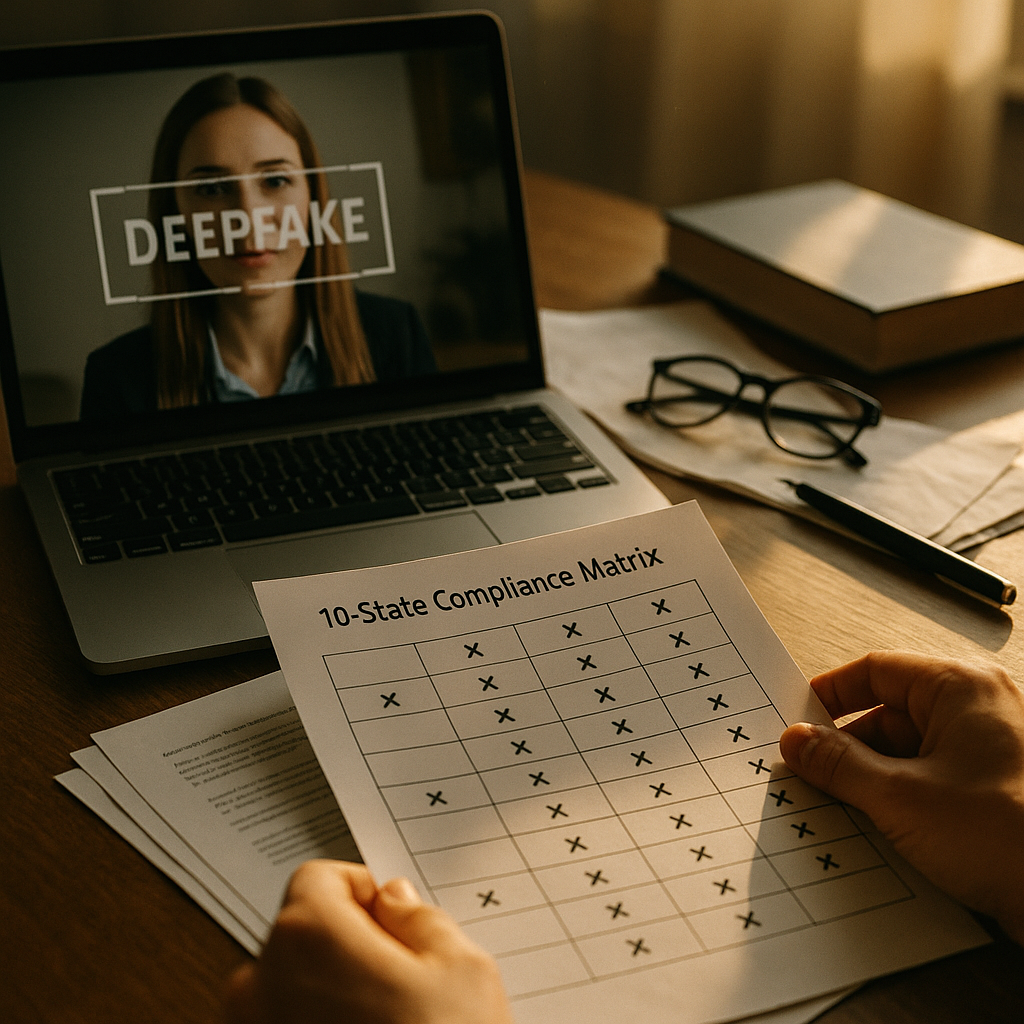
Fourteen states now criminalize undisclosed synthetic media in political ads. Three more just added product endorsement rules to the mix. If your legal team is still treating deepfake advertising laws as a single federal question, you’re already behind, and the penalties are no longer theoretical.
This isn’t a niche compliance footnote anymore. It’s a state-by-state minefield, and the states don’t agree on definitions, disclosure thresholds, or who counts as a “creator” versus an “advertiser.” One brief covering all 50 states doesn’t exist because the laws themselves refuse to align. What follows is a working matrix for the ten states generating the most enforcement activity and legal exposure right now.
Why This Suddenly Matters for Brand Teams
Political deepfake statutes used to be a campaign-finance problem, something for election lawyers to sort out every other autumn. That changed when several states expanded their definitions of “synthetic media” to cover commercial endorsements, not just candidate ads. A synthetically generated celebrity voice pitching a supplement, a de-aged spokesperson in a retail spot, an AI avatar “recommending” a fintech app: all of it now falls under statutes originally written for election season.
At least six of the ten states in this matrix apply their deepfake disclosure rules to commercial advertising and political content simultaneously, meaning a single piece of AI-generated creative can trigger two separate compliance regimes at once.
Brand and legal teams that treated this as a “wait and see” issue are now scrambling. Agencies running influencer campaigns with AI-generated content, virtual influencers, or voice-cloned testimonials need to know which states require disclosure, what the disclosure must say, and how it must appear on screen. Get it wrong and you’re not looking at a takedown request. You’re looking at statutory damages, in some states as high as $500,000 per violation.
The 10-State Compliance Matrix
Here’s the breakdown practitioners actually need, organized by the practical question: does this state’s law reach your endorsement content, and what triggers the disclosure requirement?
- California (AB 730 / AB 2839 lineage): Covers political deepfakes within 60 days of an election and extends to commercial synthetic media that could deceive a reasonable consumer about endorsement authenticity. Disclosure must be “clear and conspicuous,” a phrase California regulators interpret aggressively.
- Texas: Criminal statute targeting deepfakes made “with intent to injure” a candidate or deceive voters. Product endorsement content isn’t explicitly named, but Texas AG guidance has signaled that fake celebrity endorsements using cloned likeness could trigger parallel right-of-publicity claims stacked on top of deepfake statutes.
- Washington: One of the broadest disclosure mandates. Requires a disclaimer any time synthetic media depicts a real person saying or doing something they didn’t, in political or commercial contexts, with no election-window limitation.
- Minnesota: Criminalizes deepfakes intended to injure a candidate or influence an election, with civil remedies available to depicted individuals. Its endorsement-related exposure comes through separate consumer protection statutes that Minnesota’s AG has started pairing with deepfake claims.
- New York: Requires disclosure for synthetic performer replacement in commercial contexts (a direct response to AI-generated spokesmodels) and layers in political deepfake rules within 60 days of an election.
- Michigan: Election-focused statute with disclosure requirements inside a 90-day pre-election window, among the longest windows in the country. No dedicated commercial provision yet, but AG statements suggest FTC-style deception theories will fill that gap.
- Florida: Requires disclaimers on political ads using generative AI, with specific font-size and duration requirements for the disclosure text, stricter than most states’ “reasonably conspicuous” language.
- Illinois: Broad synthetic media disclosure law covering both political content and paid commercial endorsements, with a private right of action for individuals whose likeness was used without consent, a meaningful difference from states that leave enforcement solely to the AG.
- Arizona: Political deepfake disclosure requirement tied to the 90 days before an election, paired with existing false advertising statutes for anything commercial. No unified deepfake-specific commercial provision yet.
- Colorado: Newer entrant with a disclosure mandate covering political and issue-advocacy deepfakes, plus emerging guidance treating undisclosed AI-generated brand ambassadors as a deceptive trade practice under existing consumer protection law.
Notice the pattern? Only three of these ten states have a dedicated, explicit commercial endorsement deepfake statute. The rest are stretching existing consumer protection or right-of-publicity law to cover the same conduct. That ambiguity is actually the harder compliance problem, because it means your legal exposure in “silent” states isn’t zero. It’s just less codified, and legal teams should know that state fixes can trigger federal risk under Section 5 even where no explicit deepfake law exists.
What Counts as “Synthetic” Anyway?
Definitions matter more than most brands realize. Some states define synthetic media narrowly, requiring the content to be indistinguishable from authentic video or audio to a reasonable person. Others, like Washington, use a broader “materially deceptive” standard that could sweep in obviously stylized AI content if it implies a real endorsement.
This is where a lot of marketing teams get tripped up. A brand using an AI-generated brand mascot that clearly isn’t meant to be a real person is on safer ground. A brand using AI to recreate a real influencer’s voice, even with that influencer’s consent, may still trigger disclosure obligations depending on the state, because several statutes protect the public’s right to know, not just the depicted individual’s rights.
Political vs. Product Endorsement: Two Different Risk Profiles
Political deepfake rules exist to protect election integrity. They’re time-boxed (60, 90 days before an election), narrowly targeted at candidates and ballot measures, and usually enforced by a state’s Secretary of State or Attorney General with criminal penalties attached in the worst cases.
Product endorsement deepfake exposure is messier. It sits at the intersection of state consumer protection law, the FTC’s endorsement guides, and now these emerging synthetic media statutes. A brand running an AI-voiced testimonial in Illinois faces different exposure than the same ad running in Texas, even though the creative asset is identical. That’s the operational headache: the same campaign asset can be compliant in one state and non-compliant in another, purely based on where it’s served.
This is exactly the kind of fragmentation covered in our breakdown of the state AI disclosure law patchwork, and it’s why geo-targeted compliance review, not a single national standard, is becoming the operational norm for performance marketing teams running influencer and paid social campaigns across state lines.
Building the Compliance Workflow
So what does an actual review process look like for a brand running influencer campaigns with AI-assisted content across multiple states? A few non-negotiables:
- Tag every asset by AI involvement level. Full synthetic generation, voice cloning, likeness recreation, and AI-assisted editing are not the same risk category, and your review workflow should treat them differently.
- Map media buys to state-specific windows. If you’re running political-adjacent or issue-based influencer content, know the disclosure window (60 vs. 90 days) for every state you’re targeting, not just where the brand is headquartered.
- Standardize your disclosure language, then localize it. Florida’s font-size requirements won’t satisfy Washington’s “clear and conspicuous” standard automatically. Build a base disclosure and a state-specific override library.
- Loop in creator contracts. If a creator’s likeness or voice is synthetically replicated or extended, your contract needs to address consent, disclosure responsibility, and indemnification explicitly. This connects directly to auditing creator contracts for AI training data rights, since likeness rights and training data rights increasingly overlap in these disputes.
- Run quarterly audits, not annual ones. This legal landscape moves faster than most brands’ compliance calendars. A quarterly creator compliance audit catches drift before regulators do.
Brands already building AI creative review pipelines have a head start here. The same legal review framework for AI-generated ad creative that catches FTC disclosure gaps can be extended to flag state-specific deepfake triggers, provided legal and marketing teams are actually looking at the same checklist.
Worth noting: platform-level rules add another layer. Meta, TikTok, and Google all have their own AI-content labeling requirements that operate independently of state law, meaning compliance with a platform’s label doesn’t necessarily satisfy a state disclosure statute, and vice versa. Teams juggling both should review how platform AI labels differ from FTC requirements before assuming one covers the other.
The Enforcement Reality Check
How seriously are states actually enforcing these laws? Unevenly, which is its own risk. A handful of state AGs have issued warning letters to political consultants over synthetic media. Commercial enforcement has been quieter, but that’s changing as consumer protection divisions start treating undisclosed AI endorsements the same way they’ve treated undisclosed paid partnerships for the past decade. According to the FTC, endorsement disclosure enforcement has been trending upward, and state AGs tend to follow federal enforcement patterns with a lag of roughly one to two years. Expect that lag to shrink as the political examples generate headlines and public complaints.
Industry data backs up the urgency. Surveys from eMarketer show AI-generated content in influencer marketing growing faster than brands’ internal governance structures can track it, a gap that regulators are increasingly eager to close. Meanwhile, Statista data on consumer trust shows declining confidence in online endorsements generally, giving state legislators political cover to keep expanding these statutes rather than narrowing them.
FAQs
Do deepfake advertising laws apply to brands headquartered outside the state?
Yes. Most of these statutes are triggered by where the ad is served or viewed, not where the advertiser is based. A campaign run nationally can trigger obligations in all ten states in this matrix simultaneously.
Does an FTC disclosure automatically satisfy state deepfake laws?
No. FTC endorsement disclosures address paid partnership transparency, while state deepfake laws address synthetic media authenticity. Meeting one doesn’t guarantee compliance with the other, and legal teams should treat them as separate checklist items.
What penalties are actually being applied under these laws?
Penalties vary widely: some states cap civil damages, others allow statutory damages per violation reaching into six figures, and a few carry criminal exposure for political deepfakes made with intent to deceive voters. Commercial endorsement penalties typically route through existing consumer protection statutes with their own damages structures.
Are AI-generated brand mascots covered by these laws?
Generally not, if the mascot is clearly stylized and not presented as a real person. Risk increases sharply when AI content mimics a real, identifiable individual’s voice, face, or mannerisms, even with a disclaimer buried in fine print.
How often should brands update their compliance matrix for these laws?
Quarterly, at minimum. Several states have active legislative sessions introducing amendments to existing deepfake statutes, and waiting for an annual review cycle risks running non-compliant creative for months.
The states aren’t waiting for Congress to unify this, and neither should you. Build a living compliance matrix now, assign ownership between legal and marketing, and treat every AI-assisted endorsement asset as a multi-state legal question before it ever goes live.
FAQs
Do deepfake advertising laws apply to brands headquartered outside the state?
Yes. Most of these statutes are triggered by where the ad is served or viewed, not where the advertiser is based. A campaign run nationally can trigger obligations in all ten states in this matrix simultaneously.
Does an FTC disclosure automatically satisfy state deepfake laws?
No. FTC endorsement disclosures address paid partnership transparency, while state deepfake laws address synthetic media authenticity. Meeting one doesn’t guarantee compliance with the other, and legal teams should treat them as separate checklist items.
What penalties are actually being applied under these laws?
Penalties vary widely: some states cap civil damages, others allow statutory damages per violation reaching into six figures, and a few carry criminal exposure for political deepfakes made with intent to deceive voters. Commercial endorsement penalties typically route through existing consumer protection statutes with their own damages structures.
Are AI-generated brand mascots covered by these laws?
Generally not, if the mascot is clearly stylized and not presented as a real person. Risk increases sharply when AI content mimics a real, identifiable individual’s voice, face, or mannerisms, even with a disclaimer buried in fine print.
How often should brands update their compliance matrix for these laws?
Quarterly, at minimum. Several states have active legislative sessions introducing amendments to existing deepfake statutes, and waiting for an annual review cycle risks running non-compliant creative for months.
Top Influencer Marketing Agencies
The leading agencies shaping influencer marketing in 2026
Agencies ranked by campaign performance, client diversity, platform expertise, proven ROI, industry recognition, and client satisfaction. Assessed through verified case studies, reviews, and industry consultations.
Moburst

-
2

The Shelf
Boutique Beauty & Lifestyle Influencer AgencyA data-driven boutique agency specializing exclusively in beauty, wellness, and lifestyle influencer campaigns on Instagram and TikTok. Best for brands already focused on the beauty/personal care space that need curated, aesthetic-driven content.Clients: Pepsi, The Honest Company, Hims, Elf Cosmetics, Pure LeafVisit The Shelf → -
3

Audiencly
Niche Gaming & Esports Influencer AgencyA specialized agency focused exclusively on gaming and esports creators on YouTube, Twitch, and TikTok. Ideal if your campaign is 100% gaming-focused — from game launches to hardware and esports events.Clients: Epic Games, NordVPN, Ubisoft, Wargaming, Tencent GamesVisit Audiencly → -
4

Viral Nation
Global Influencer Marketing & Talent AgencyA dual talent management and marketing agency with proprietary brand safety tools and a global creator network spanning nano-influencers to celebrities across all major platforms.Clients: Meta, Activision Blizzard, Energizer, Aston Martin, WalmartVisit Viral Nation → -
5

The Influencer Marketing Factory
TikTok, Instagram & YouTube CampaignsA full-service agency with strong TikTok expertise, offering end-to-end campaign management from influencer discovery through performance reporting with a focus on platform-native content.Clients: Google, Snapchat, Universal Music, Bumble, YelpVisit TIMF → -
6

NeoReach
Enterprise Analytics & Influencer CampaignsAn enterprise-focused agency combining managed campaigns with a powerful self-service data platform for influencer search, audience analytics, and attribution modeling.Clients: Amazon, Airbnb, Netflix, Honda, The New York TimesVisit NeoReach → -
7

Ubiquitous
Creator-First Marketing PlatformA tech-driven platform combining self-service tools with managed campaign options, emphasizing speed and scalability for brands managing multiple influencer relationships.Clients: Lyft, Disney, Target, American Eagle, NetflixVisit Ubiquitous → -
8

Obviously
Scalable Enterprise Influencer CampaignsA tech-enabled agency built for high-volume campaigns, coordinating hundreds of creators simultaneously with end-to-end logistics, content rights management, and product seeding.Clients: Google, Ulta Beauty, Converse, AmazonVisit Obviously →