


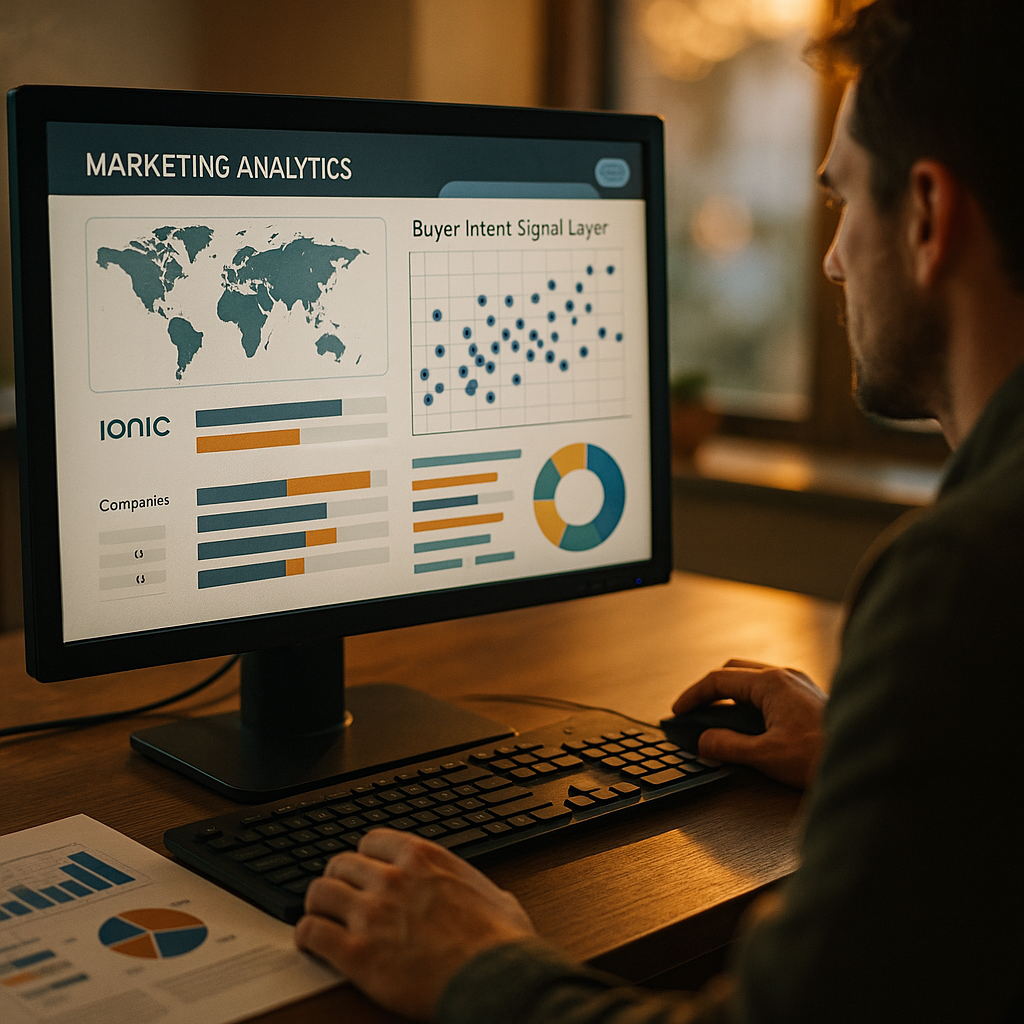
Only 21% of B2B marketers say their intent data actually predicts a closed deal, according to recent eMarketer survey data. So when a vendor claims its buyer-intent signal layer can automate campaign distribution and still hit pipeline targets, demand gen leaders should ask hard questions before signing anything. This is where DemandScience Ionic enters the conversation, and where a technical evaluation matters more than a sales deck.
What Ionic Actually Is (And Isn’t)
DemandScience Ionic bills itself as an intent-signal aggregation and activation layer built for B2B demand gen teams that want to automate audience selection and campaign routing without a human reviewing every list pull. It sits between raw third-party intent feeds (think bidstream data, content consumption signals, firmographic overlays) and your activation channels: paid social, programmatic display, ABM platforms, even influencer and creator distribution stacks increasingly used in B2B.
It is not a demand-side platform. It is not a CRM enrichment tool, though it plugs into both. Think of Ionic as a signal-scoring and routing engine — it ingests intent data, scores accounts against your ideal customer profile, and pushes qualified segments downstream automatically. The pitch is speed: less manual list-building, faster campaign launches, tighter alignment between signal strength and spend.
That’s the theory. The technical reality is more nuanced, and it depends heavily on how your team defines “intent” in the first place.
The Signal Quality Question Nobody Wants to Ask
Intent data has a credibility problem industry-wide. Bidstream data — the raw exhaust from programmatic ad auctions — has been criticized for years as noisy and easily gamed. Ionic claims to filter and de-duplicate across multiple third-party sources rather than relying on a single feed, which is a legitimate technical improvement over first-generation intent tools. But “multiple sources” doesn’t automatically mean “clean data.”
For demand gen teams evaluating this, the real technical question is: what’s the signal-to-noise ratio after Ionic’s scoring model runs? Vendors rarely publish this openly, so ask for a sandbox trial against your own closed-won accounts. If Ionic’s top-scored accounts from the last quarter don’t overlap meaningfully with deals you actually closed, the model isn’t calibrated to your market — no matter how automated the distribution pipeline looks.
Automation only compounds the value of good data — it also compounds the cost of bad data, faster and at greater scale than any manual process ever could.
This is the trap a lot of teams fall into with intent-driven automation generally. It’s the same failure mode described in this piece on AI agent underperformance: the model gets blamed when the pipeline feeding it was broken from the start.
Integration Cost: The Part the Sales Team Won’t Lead With
Ionic markets native integrations with major MAP and ABM platforms — Demandbase, 6sense-adjacent workflows, HubSpot, and programmatic DSPs. In practice, “native integration” in the intent-data category often means a scheduled CSV export plus a webhook, not a true API-level sync with real-time scoring updates. Ask your solutions engineer for API documentation before you ask for a demo. If they can’t produce it quickly, budget for a systems integrator or an internal engineering sprint to build the connective tissue yourself.
For teams already running fragmented martech stacks, this matters. A signal layer that requires six weeks of custom integration work isn’t really “automating” anything in the short term — it’s adding a project to your roadmap. Weigh that against the labor cost you’re trying to eliminate. If your team currently spends 15 hours a week manually building segment lists, and integration eats three months of engineering time before the automation pays off, the ROI math shifts considerably.
Where Automation Actually Helps: Distribution Routing
The strongest technical case for Ionic isn’t signal generation — it’s distribution logic. Once accounts are scored, Ionic’s routing rules can automatically push high-intent segments into different channels based on score thresholds: top-tier accounts to ABM sales plays, mid-tier to retargeting, lower-tier to nurture. That’s a genuinely useful automation layer, and it mirrors the kind of governance frameworks demand gen and creator teams are already building elsewhere.
If your organization runs influencer or creator-led B2B campaigns (increasingly common for enterprise SaaS and fintech brands), this routing logic can extend to creator brief distribution too — matching high-intent accounts to specific creator content variants rather than a single generic asset. That’s a meaningful efficiency gain, provided your creative team has enough asset variety to feed the system. Most don’t yet, which is a separate operational gap worth fixing before you buy the signal layer.
Teams building this kind of governance model should look at how AI agent governance for media buying is being structured elsewhere in the creator economy — the same approval and audit logic applies here.
Compliance and Data Provenance: The Risk Nobody Prices In
Buyer-intent data sits in a regulatory gray zone that’s getting less gray by the quarter. Bidstream and third-party cookie-adjacent data sources face mounting scrutiny from both regulators and platform policy teams. The FTC has signaled increased interest in data broker practices, and UK-facing campaigns need to account for ICO guidance on legitimate interest as a lawful basis for processing.
Before automating campaign distribution off any third-party intent layer, demand gen leaders should get clear answers on data provenance: where does Ionic’s underlying data actually come from, is consent documented at the source, and what happens to your automated campaigns if a key data supplier gets cut off or fined? This isn’t hypothetical. Intent data suppliers have disappeared from the market before, sometimes overnight, taking entire segment strategies down with them.
Build a fallback plan the same way you’d build one for any critical AI or data vendor. The logic in this AI model fallback protocol piece applies just as well to intent data providers as it does to language models — single points of failure are single points of failure, regardless of category.
Measuring Whether It Actually Moves Pipeline
Here’s the uncomfortable truth: most demand gen teams adopt intent-data automation and then never rigorously test whether it outperforms their prior manual targeting. They look at activity metrics — campaigns launched faster, more segments activated — and call it a win. Activity isn’t outcome.
Run a proper holdout test. Split comparable account lists, run half through Ionic-automated distribution and half through your existing manual or semi-automated process, and measure pipeline velocity and win rate over a full quarter, not a two-week sprint. Intent-driven campaigns often show early engagement lifts that don’t survive contact with actual sales cycles, especially in complex B2B deals with six-plus stakeholders.
This is also where marketing-mix modeling earns its keep. If you’re already using MMM to prove incremental lift on influencer spend, extend the same rigor to intent-driven paid and ABM spend. Vendors love vanity dashboards. Insist on incrementality.
Practical Checklist Before You Sign
- Request a 90-day sandbox against your own closed-won account list, not a vendor case study.
- Get written documentation on data sourcing, consent basis, and supplier redundancy.
- Confirm true API-level integration timelines with your own engineering team, not the vendor’s estimate.
- Set a holdout test before full rollout, and define the pipeline metric that determines renewal.
- Map how creative/creator asset variety needs to scale to actually use the routing logic Ionic offers.
None of this means Ionic is a bad product. It means buyer-intent signal layers are infrastructure decisions, not campaign tactics, and infrastructure decisions deserve the same scrutiny you’d apply to a HubSpot or LinkedIn Ads platform migration.
The Bottom Line
Run the 90-day sandbox test against your closed-won data before you commit budget, and insist on an incrementality holdout — not a vanity dashboard — as your renewal criteria.
Frequently Asked Questions
What is DemandScience Ionic’s buyer-intent signal layer?
It’s a signal-scoring and routing platform that aggregates third-party intent data, scores accounts against a defined ideal customer profile, and automates campaign distribution across paid, ABM, and retargeting channels based on score thresholds.
How is Ionic different from a standard DSP or ABM platform?
Ionic doesn’t buy media or manage CRM records directly. It sits upstream, scoring and segmenting accounts, then pushes those segments into your existing DSP, ABM, or MAP tools rather than replacing them.
Is bidstream data reliable enough to automate campaign distribution?
Bidstream data alone has known noise and manipulation issues. Multi-source aggregation, which Ionic claims to do, can improve reliability, but teams should validate signal-to-noise ratio against their own closed-won data before trusting it for automated decisions.
What compliance risks come with third-party intent data?
The main risks are unclear consent provenance and supplier instability. Regulators including the FTC and ICO have increased scrutiny of data broker practices, so demand gen teams should document data sourcing and build a supplier fallback plan.
How long does Ionic typically take to integrate with existing martech stacks?
Marketed “native integrations” often mean scheduled data exports rather than real-time API syncs. Actual integration timelines vary widely depending on your existing stack complexity, so confirm scope directly with your engineering team before estimating ROI timelines.
Top Influencer Marketing Agencies
The leading agencies shaping influencer marketing in 2026
Agencies ranked by campaign performance, client diversity, platform expertise, proven ROI, industry recognition, and client satisfaction. Assessed through verified case studies, reviews, and industry consultations.
Moburst

-
2

The Shelf
Boutique Beauty & Lifestyle Influencer AgencyA data-driven boutique agency specializing exclusively in beauty, wellness, and lifestyle influencer campaigns on Instagram and TikTok. Best for brands already focused on the beauty/personal care space that need curated, aesthetic-driven content.Clients: Pepsi, The Honest Company, Hims, Elf Cosmetics, Pure LeafVisit The Shelf → -
3

Audiencly
Niche Gaming & Esports Influencer AgencyA specialized agency focused exclusively on gaming and esports creators on YouTube, Twitch, and TikTok. Ideal if your campaign is 100% gaming-focused — from game launches to hardware and esports events.Clients: Epic Games, NordVPN, Ubisoft, Wargaming, Tencent GamesVisit Audiencly → -
4

Viral Nation
Global Influencer Marketing & Talent AgencyA dual talent management and marketing agency with proprietary brand safety tools and a global creator network spanning nano-influencers to celebrities across all major platforms.Clients: Meta, Activision Blizzard, Energizer, Aston Martin, WalmartVisit Viral Nation → -
5

The Influencer Marketing Factory
TikTok, Instagram & YouTube CampaignsA full-service agency with strong TikTok expertise, offering end-to-end campaign management from influencer discovery through performance reporting with a focus on platform-native content.Clients: Google, Snapchat, Universal Music, Bumble, YelpVisit TIMF → -
6

NeoReach
Enterprise Analytics & Influencer CampaignsAn enterprise-focused agency combining managed campaigns with a powerful self-service data platform for influencer search, audience analytics, and attribution modeling.Clients: Amazon, Airbnb, Netflix, Honda, The New York TimesVisit NeoReach → -
7

Ubiquitous
Creator-First Marketing PlatformA tech-driven platform combining self-service tools with managed campaign options, emphasizing speed and scalability for brands managing multiple influencer relationships.Clients: Lyft, Disney, Target, American Eagle, NetflixVisit Ubiquitous → -
8

Obviously
Scalable Enterprise Influencer CampaignsA tech-enabled agency built for high-volume campaigns, coordinating hundreds of creators simultaneously with end-to-end logistics, content rights management, and product seeding.Clients: Google, Ulta Beauty, Converse, AmazonVisit Obviously →