


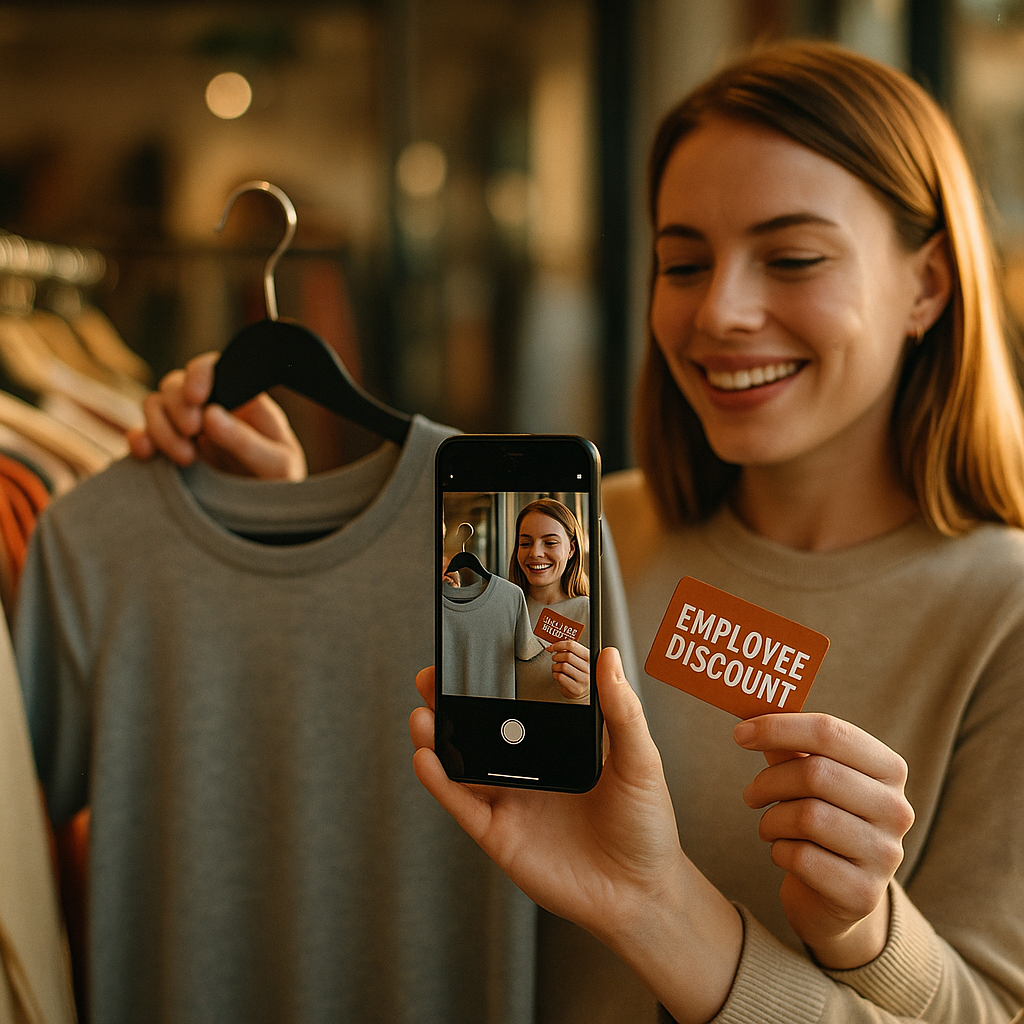
Would you trust a stranger’s product review more if you knew the company’s own employees bought it at full markup, discount and all? That’s the quiet power behind the employee discount reveal, a format where brands show staff genuinely using and choosing their own products. It’s cheap to produce, nearly impossible to fake convincingly, and it’s quietly outperforming polished influencer content on trust metrics across retail, beauty, and food brands.
What Is the Employee Discount Reveal, Really?
Strip away the branding and it’s simple: an employee (or a group of them) shows what they bought with their staff discount, why they chose it, and what they think of it. No script. No talent fee. Just a Target cashier showing her cart, or a software company’s support rep explaining why she pays for the premium tier even with a discount code that makes the base tier free.
The format works because it answers a question consumers already ask themselves: if the people who work there don’t even want it, why would I? Flip that logic and you get instant credibility. Employees choosing to spend their own discounted dollars on the product is a stronger signal than any paid testimonial, because the incentive structure is backwards. They’re not being paid to say it’s good. They’re paying (a little) to have it.
An employee spending their own discounted money on a product is a stronger trust signal than a paid endorsement, because the financial incentive runs in the opposite direction.
Why This Format Is Landing Right Now
Audiences are exhausted by obvious sponsorships. A 2024 Edelman Trust Barometer finding that consistently resurfaces in agency decks: people trust “a person like me” far more than celebrities or executives, and employees occupy a strange, useful middle ground. They’re insiders with credibility, but they’re not paid spokespeople in the legal sense (though disclosure still matters, more on that below).
There’s also a production-cost angle that matters to anyone managing a content budget. You don’t need a creator agency retainer or a shoot day with lighting rigs. You need a phone, a willing employee, and ten minutes. Compare that to the average UGC production budget most mid-size brands run, and the ROI math gets hard to ignore.
This isn’t a replacement for creator partnerships. It’s a complementary layer, similar in spirit to formats covered in micro-community testimonials, where the source of the review matters more than the production value.
The Compliance Question Nobody Wants to Ask First
Here’s where marketing and legal need to actually talk to each other before this goes live. If an employee posts about company products on their personal account and it’s connected to their job in any visible way (bio mentions employer, video is clearly filmed in-store), the FTC’s endorsement guidelines likely apply. Material connections need disclosure, full stop. That means a simple “#employee” or “I work here” caption, not a buried disclosure or none at all.
Brands that skip this step aren’t just risking a fine. They’re risking the exact trust the format is supposed to build. If a customer finds out later that “just a happy employee” was actually a scripted, brand-approved post with no disclosure, the backlash is worse than if you’d never made the content at all. Treat this the same way you’d treat any other FTC-conscious creator campaign, with clear disclosure language baked into the brief from day one.
Building the Program: Who to Feature and How
Not every employee should be on camera, and that’s fine. Look for people who are already naturally chatty about the product internally, the retail associate who recommends things unprompted, the customer service rep who has opinions about SKUs. Authenticity can’t be manufactured, but it can be identified and given a platform.
- Start with volunteers, not mandates. Forcing participation kills the authenticity that makes this format work in the first place.
- Keep the brief loose. A rigid script defeats the purpose. Give a topic (what did you buy this month, what’s your go-to) and let them talk.
- Rotate departments. Warehouse staff, customer support, merchandising, corporate. Different vantage points read as more credible than five people from the same team.
- Capture in batches. One afternoon with five willing employees can produce a month of content, similar to the efficiency gains discussed in studio-style UGC production approaches.
The goal isn’t a content calendar full of employee cameos. It’s a steady drip, maybe two or three pieces a month, that reinforces the idea that this is simply how the company operates, not a campaign with a start and end date.
Where the Format Fits in Your Funnel
Employee discount reveals aren’t top-of-funnel awareness plays, and they’re not hard-sell conversion content either. They live in the consideration stage, the moment a shopper has narrowed down options and is looking for a reason to trust one brand over another. Think of it as a trust accelerant layered into a broader content system, the kind mapped out in a discovery to conversion content ladder.
Retail and DTC brands see the clearest lift because the discount mechanic is tangible and easy to understand. SaaS and service brands can adapt the format too, an employee explaining why they use the internal tool discount on the premium plan works the same way, just with a longer consideration cycle attached.
Measuring What Actually Matters
Vanity metrics will lie to you here. A video with modest views but a high save-to-view ratio or a spike in branded search afterward is doing real work. Track:
- Comment sentiment (are people asking “is this real?” in a good way, or a skeptical way)
- Branded search lift in the 48 hours after posting
- Employee content’s share rate compared to your standard creator or paid content
- Any measurable bump in loyalty program signups if the discount mechanic is tied to a membership tier
Most brands running this consistently report engagement rates that beat their paid influencer content, even with a fraction of the production spend. That’s not surprising once you consider what platforms like Sprout Social have repeatedly found about authenticity driving engagement over polish.
Employee content routinely beats paid influencer content on engagement rate, often at a fraction of the production cost, because the audience can tell the incentive is different.
Where This Can Go Wrong
The failure mode is predictable: marketing gets excited, starts scripting “spontaneous” employee posts, and the format collapses into exactly the kind of content it was meant to replace. If you find yourself editing an employee’s language to sound more “on brand,” stop. That’s the tell that you’ve killed the thing that made it work.
The other failure mode is treating this as a one-off stunt rather than an ongoing content stream. A single viral employee video is a nice moment. A consistent cadence of them is a trust system, similar to how confessional founder videos work best as a recurring format rather than a single splashy post.
Finally, don’t ignore internal culture implications. If employees feel pressured, underpaid for their time, or worried about job security tied to “performing well” on camera, you’ll create resentment that eventually surfaces publicly, and that’s a much harder story to walk back than a mediocre marketing campaign.
A Quick Framework Before You Launch
Before greenlighting an employee discount reveal series, run through this checklist:
- Is participation genuinely voluntary, with no performance pressure attached?
- Does every piece include clear, compliant disclosure language?
- Is there a loose brief, not a script, guiding the content?
- Are you measuring trust signals (saves, sentiment, branded search) rather than just views?
- Is this positioned as an ongoing program, not a one-time campaign?
If you can check all five, you’re set up for something that compounds. If you can’t, fix those gaps before a single camera comes out.
Start small: pick three willing employees, give them a loose prompt, and post their unscripted reactions with proper disclosure. Track engagement against your last paid influencer post, and let the data decide whether this becomes a permanent content line.
FAQs
What makes the employee discount reveal different from standard UGC?
Standard UGC comes from customers with no financial relationship to the brand. Employee content carries an inverted incentive, staff are spending their own money even with a discount, which reads as a stronger trust signal to skeptical audiences.
Do employee posts need FTC disclosure?
Yes, if the connection to the employer is identifiable, whether through the employee’s bio, the filming location, or the caption. The FTC’s endorsement guidelines treat this as a material connection that requires clear disclosure, regardless of whether the employee was paid extra to post.
How do you keep employee content from feeling scripted?
Give a loose topic prompt instead of a script, let employees choose their own words, and resist the urge to edit their language into brand-approved phrasing. The moment it sounds polished, it loses the credibility that made it work.
What size brand can realistically run this format?
Any brand with retail staff, customer-facing employees, or an internal discount or free-product benefit can run a small version. It scales with headcount but works even with a five-person team willing to participate.
How often should employee discount content be posted?
Two to three pieces a month tends to work well, enough to build a recognizable pattern without turning into a forced campaign. Consistency matters more than volume here.
Top Influencer Marketing Agencies
The leading agencies shaping influencer marketing in 2026
Agencies ranked by campaign performance, client diversity, platform expertise, proven ROI, industry recognition, and client satisfaction. Assessed through verified case studies, reviews, and industry consultations.
Moburst

-
2

The Shelf
Boutique Beauty & Lifestyle Influencer AgencyA data-driven boutique agency specializing exclusively in beauty, wellness, and lifestyle influencer campaigns on Instagram and TikTok. Best for brands already focused on the beauty/personal care space that need curated, aesthetic-driven content.Clients: Pepsi, The Honest Company, Hims, Elf Cosmetics, Pure LeafVisit The Shelf → -
3

Audiencly
Niche Gaming & Esports Influencer AgencyA specialized agency focused exclusively on gaming and esports creators on YouTube, Twitch, and TikTok. Ideal if your campaign is 100% gaming-focused — from game launches to hardware and esports events.Clients: Epic Games, NordVPN, Ubisoft, Wargaming, Tencent GamesVisit Audiencly → -
4

Viral Nation
Global Influencer Marketing & Talent AgencyA dual talent management and marketing agency with proprietary brand safety tools and a global creator network spanning nano-influencers to celebrities across all major platforms.Clients: Meta, Activision Blizzard, Energizer, Aston Martin, WalmartVisit Viral Nation → -
5

The Influencer Marketing Factory
TikTok, Instagram & YouTube CampaignsA full-service agency with strong TikTok expertise, offering end-to-end campaign management from influencer discovery through performance reporting with a focus on platform-native content.Clients: Google, Snapchat, Universal Music, Bumble, YelpVisit TIMF → -
6

NeoReach
Enterprise Analytics & Influencer CampaignsAn enterprise-focused agency combining managed campaigns with a powerful self-service data platform for influencer search, audience analytics, and attribution modeling.Clients: Amazon, Airbnb, Netflix, Honda, The New York TimesVisit NeoReach → -
7

Ubiquitous
Creator-First Marketing PlatformA tech-driven platform combining self-service tools with managed campaign options, emphasizing speed and scalability for brands managing multiple influencer relationships.Clients: Lyft, Disney, Target, American Eagle, NetflixVisit Ubiquitous → -
8

Obviously
Scalable Enterprise Influencer CampaignsA tech-enabled agency built for high-volume campaigns, coordinating hundreds of creators simultaneously with end-to-end logistics, content rights management, and product seeding.Clients: Google, Ulta Beauty, Converse, AmazonVisit Obviously →