


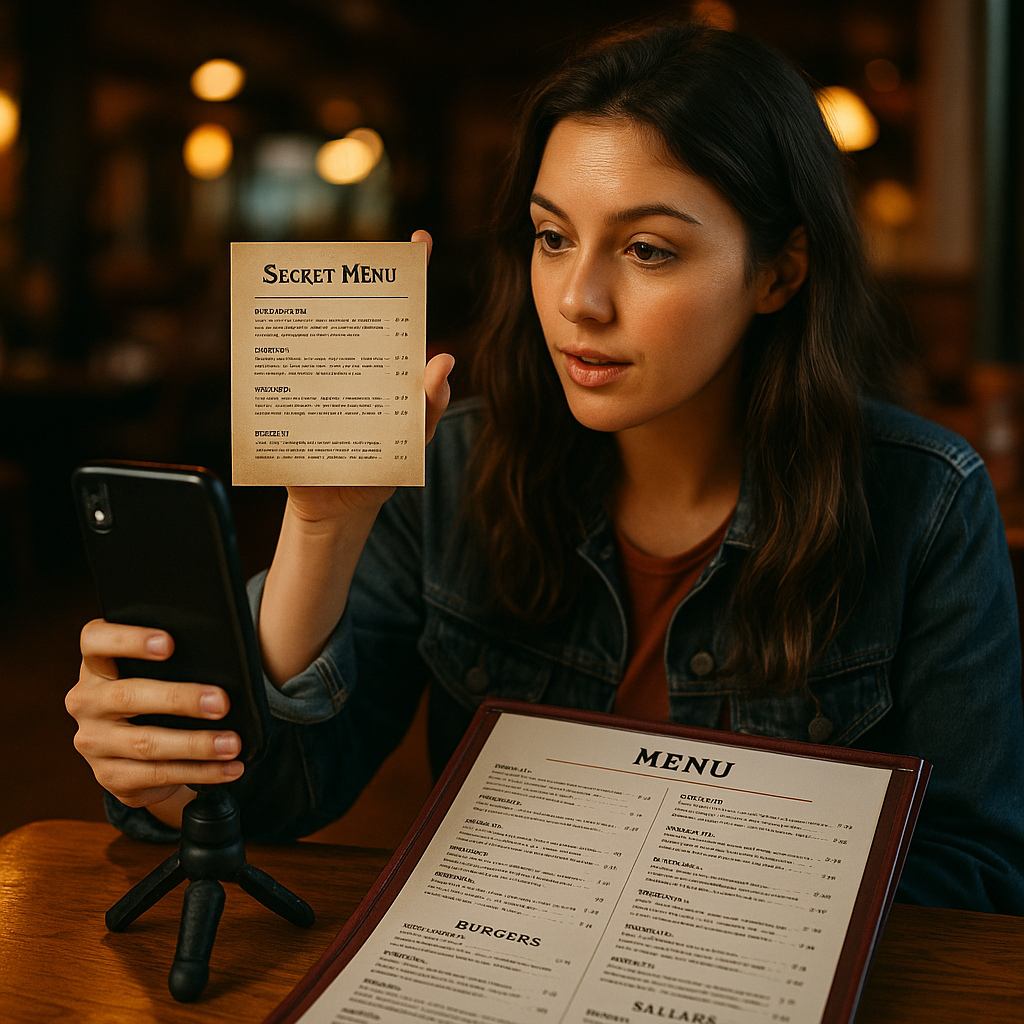
In-N-Out’s secret menu has zero official marketing budget and generates more organic content than most brands’ entire paid media plan. That’s the power of a secret menu content strategy: no discount code, no paid placement, just curiosity engineered into a shareable reveal. For brands sitting on unlisted variants, hidden combos, or staff-only tricks, directing creators to expose them can build loyalty faster than any coupon ever will.
Why Secret Menus Beat Discounts for Building Loyalty
Discounts train customers to wait for the next sale. Secret menus train customers to feel like insiders. That’s a fundamentally different psychological contract, and it’s why brands from Starbucks to Chick-fil-A have leaned into off-menu culture for years without spending a dime on paid promotion for it.
The mechanism is simple. A creator posts a video revealing “the item they don’t put on the board,” viewers feel like they’ve been let in on something exclusive, and they show up to order it by name. That in-store moment, ordering something the cashier has to double-check, is itself a tiny performance. People film it. They tell friends. Word of mouth compounds without a single paid media dollar behind it.
A secret menu reveal converts curiosity into a store visit, and a store visit into a story the customer tells someone else, which is the entire definition of organic growth.
Compare that to a 20 percent off code. A discount is transactional and forgettable. An unlock is experiential and memorable. According to Sprout Social’s research on consumer behavior, audiences increasingly favor brands that feel authentic and community-driven over ones that lead with promotional messaging. Secret menus sit squarely in that authenticity lane, even when the brand engineered the whole thing.
The Mechanics: How to Brief Creators for an Unlock
This only works if creators are briefed correctly. Hand someone a list of “hidden items” with no context and you’ll get a flat, ad-read version of a reveal. The unlock needs pacing, stakes, and a payoff.
- Give them the origin story. Every secret menu item needs a myth: a regular who invented it, a staff member who created it on a slow shift, a regional variant that never made the printed menu. Creators need something to narrate, not just a recipe.
- Script the ordering moment. The most shareable beat is the customer saying the secret name out loud and watching the staff reaction. Brief creators to film that exchange, not just the finished product.
- Leave room for reaction, not recitation. The best unlock content looks discovered, not scripted. This is the same principle behind unboxing content that feels real, where authenticity beats polish every time.
- Stagger the reveal across creators. Don’t drop all five secret items in one week. Space them out so the “secret menu” narrative keeps building over a quarter, not a single sprint.
Nano and micro creators tend to outperform big names here, mostly because their audiences trust the “I just found this” framing more. If you haven’t already built a program around smaller creators, the loyalty math is worth studying in nano-influencer repeat-purchase content, which shows how smaller accounts drive disproportionate return visits.
What Counts as a Secret Menu, Anyway?
You don’t need a fast food chain to run this play. A skincare brand can have a “double cleanse” layering trick that isn’t on the packaging. A software company can have an undocumented keyboard shortcut power users swap in Discord. A hotel brand can have a room upgrade hack only staff mention if you ask nicely.
The category doesn’t matter. What matters is that the “secret” is real enough to survive scrutiny, and small enough that it doesn’t cannibalize your actual product roadmap. If your secret menu item requires a refund policy exception or breaks your unit economics, you’ve built a liability, not a loyalty mechanic.
Compliance Isn’t Optional Just Because It Feels Organic
Here’s where marketers get tripped up. Because secret menu content feels grassroots, teams sometimes skip the disclosure conversation entirely. That’s a mistake. If a creator was briefed, compensated, or gifted product to reveal the item, the FTC’s endorsement guidance still applies in full. “Insider” framing does not exempt anyone from disclosure requirements.
The moment a brand directs the reveal, even loosely, it stops being organic discovery and starts being sponsored content, and disclosure rules follow accordingly.
The safest approach is to build disclosure into the script itself rather than bolting it on as an afterthought. A quick “brand sent me this to try” at the top of the video doesn’t kill the reveal energy, it just sets expectations. Brands running urgency-driven formats have already worked through similar tension between spontaneity and compliance, and the approach in restock countdown campaigns without FTC risk translates well to secret menu briefs too.
Measuring the Unlock: What Actually Moves
Secret menu content rarely drives immediate last-click conversion, and if your measurement plan only rewards that, you’ll kill the program before it proves out. Look instead at:
- Search volume for the item name. If people are Googling “how to order the [secret name],” the reveal is working.
- In-store or on-site requests using the unofficial name. Staff and support tickets are a surprisingly good signal here.
- Repeat visit rate among customers who order the secret item. These customers tend to skew loyal, and tracking that cohort separately tells you whether the mechanic is retention-positive.
- Share rate and duet/stitch volume. Secret menu content is built for remixing. If nobody’s stitching the reveal, the myth isn’t landing.
Brands already running structured content ladders can slot secret menu unlocks in as a mid-funnel loyalty layer. The framework in discovery to conversion content ladders is a useful reference for where this fits relative to top-of-funnel awareness content and bottom-funnel conversion pushes.
Where This Fails
Two failure modes show up constantly. First, brands over-produce the reveal until it looks like a commercial, which kills the “I found this” illusion instantly. Second, brands roll out too many secret items at once, diluting the mythology until nothing feels special anymore. Scarcity of the secret itself is part of what makes it work. According to eMarketer’s data on creator content performance, novelty-driven formats see steep engagement drop-off when repeated too frequently in short windows, and secret menu content is no exception.
If you’re building this out at scale across a niche audience, pacing the brief carefully matters more than the item itself. The community-first approach detailed in niche micro-community content briefs is worth reviewing before you greenlight a full rollout.
Frequently Asked Questions
What is a secret menu content strategy?
It’s a brand tactic where creators are directed to reveal unlisted or off-menu products, features, or hacks, generating curiosity-driven word of mouth without relying on discounts or paid promotion.
Do secret menu creator videos need FTC disclosure?
Yes. If the creator was compensated, gifted product, or briefed by the brand, standard FTC endorsement disclosure rules apply regardless of how organic the reveal feels.
Which creators work best for secret menu reveals?
Nano and micro creators typically outperform larger names because their “I just discovered this” framing feels more credible to their audience, which is central to the reveal’s effectiveness.
How do you measure success beyond sales?
Track search volume for the secret item’s name, in-store requests using the unofficial name, repeat visit rates among customers who order it, and share or stitch rates on the content itself.
Can this work outside restaurants or food brands?
Yes. Any brand with an undocumented feature, layering trick, or insider tip can build a secret menu style reveal, as long as the “secret” is real and doesn’t strain fulfillment or support operations.
Next step: Pick one real, low-risk off-menu item, brief three nano creators to reveal it with disclosure built into the script, and measure search and repeat-visit lift before scaling to a full program.
Top Influencer Marketing Agencies
The leading agencies shaping influencer marketing in 2026
Agencies ranked by campaign performance, client diversity, platform expertise, proven ROI, industry recognition, and client satisfaction. Assessed through verified case studies, reviews, and industry consultations.
Moburst

-
2

The Shelf
Boutique Beauty & Lifestyle Influencer AgencyA data-driven boutique agency specializing exclusively in beauty, wellness, and lifestyle influencer campaigns on Instagram and TikTok. Best for brands already focused on the beauty/personal care space that need curated, aesthetic-driven content.Clients: Pepsi, The Honest Company, Hims, Elf Cosmetics, Pure LeafVisit The Shelf → -
3

Audiencly
Niche Gaming & Esports Influencer AgencyA specialized agency focused exclusively on gaming and esports creators on YouTube, Twitch, and TikTok. Ideal if your campaign is 100% gaming-focused — from game launches to hardware and esports events.Clients: Epic Games, NordVPN, Ubisoft, Wargaming, Tencent GamesVisit Audiencly → -
4

Viral Nation
Global Influencer Marketing & Talent AgencyA dual talent management and marketing agency with proprietary brand safety tools and a global creator network spanning nano-influencers to celebrities across all major platforms.Clients: Meta, Activision Blizzard, Energizer, Aston Martin, WalmartVisit Viral Nation → -
5

The Influencer Marketing Factory
TikTok, Instagram & YouTube CampaignsA full-service agency with strong TikTok expertise, offering end-to-end campaign management from influencer discovery through performance reporting with a focus on platform-native content.Clients: Google, Snapchat, Universal Music, Bumble, YelpVisit TIMF → -
6

NeoReach
Enterprise Analytics & Influencer CampaignsAn enterprise-focused agency combining managed campaigns with a powerful self-service data platform for influencer search, audience analytics, and attribution modeling.Clients: Amazon, Airbnb, Netflix, Honda, The New York TimesVisit NeoReach → -
7

Ubiquitous
Creator-First Marketing PlatformA tech-driven platform combining self-service tools with managed campaign options, emphasizing speed and scalability for brands managing multiple influencer relationships.Clients: Lyft, Disney, Target, American Eagle, NetflixVisit Ubiquitous → -
8

Obviously
Scalable Enterprise Influencer CampaignsA tech-enabled agency built for high-volume campaigns, coordinating hundreds of creators simultaneously with end-to-end logistics, content rights management, and product seeding.Clients: Google, Ulta Beauty, Converse, AmazonVisit Obviously →