


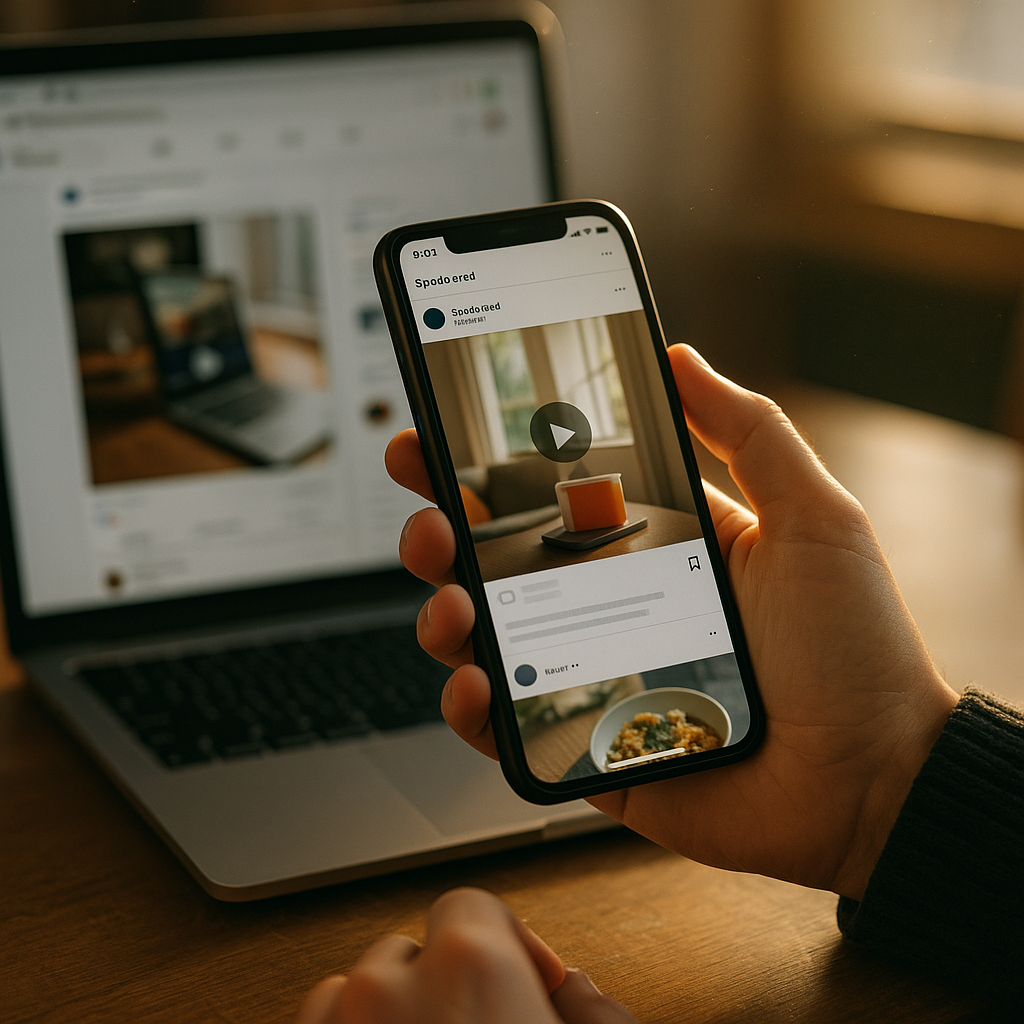
One European Commission proposal could kill the mechanic your entire paid social funnel depends on. Autoplay and infinite scroll bans are moving from theoretical regulation to drafted law, and the creative that’s carried Meta, TikTok, and YouTube campaigns for a decade won’t survive unchanged. Brands that wait for final legislation will be rebuilding under deadline pressure. The ones redesigning now will just be shipping.
Why regulators are coming for the scroll itself
This isn’t a cookie-consent-style inconvenience. The EU’s push against autoplay and infinite scroll targets the underlying persuasive architecture of social platforms, the design patterns that keep users watching past the point of intent. Lawmakers frame it as a public health and children’s safety issue, citing research linking endless-scroll UX to compulsive use and attention fragmentation, particularly among teens.
The regulatory logic borrows from the EU’s Digital Services Act enforcement posture: platforms must not design experiences that exploit psychological vulnerabilities. Autoplay video and bottomless feeds sit squarely in that category. Several member states have already floated national measures, and the Commission has signaled interest in a bloc-wide standard rather than a patchwork of local rules.
For a deeper regulatory breakdown, our earlier coverage of the Meta autoplay and scroll rules walks through the enforcement timeline and platform-specific exposure. Worth a read if you haven’t mapped your risk yet.
If your media plan assumes passive, autoplay-driven impressions, you’re planning for a mechanic that may not legally exist in the EU within the next reporting cycle.
What actually changes for paid social buyers
Strip away the policy language and the practical impact lands on three things: video defaults, feed pagination, and consent-gated playback. Here’s what brands should expect, based on drafts circulating in Brussels and early platform responses.
- Click-to-play becomes the default. Video ads in-feed will likely require explicit user action to start, not silent autoplay muted loops.
- Scroll depth gets checkpoints. Infinite scroll may be replaced by “load more” prompts or session-length nudges, changing how many ad slots a user actually sees per session.
- Session time drops. Fewer autoplay loops and interrupted scroll means shorter average sessions, which compresses total ad inventory per user across the EU market.
None of this kills paid social in Europe. But it does kill the specific creative assumptions built around autoplay: the three-second hook optimized for silent motion, the vertical video designed to loop indefinitely, the feed density that let brands rely on volume over resonance.
The creative brief has to change, not just the media plan
Most brands are treating this as a targeting or bidding problem. It’s not. It’s a creative problem first. When autoplay disappears, the entire “stop the scroll” doctrine that’s dominated performance creative since 2016 stops working, because there’s no scroll to stop. Users are making a deliberate choice to press play.
That changes what earns the click. A muted, motion-heavy loop optimized to catch peripheral attention is worthless if the user has to tap first. Thumbnail, static frame, and first-second framing now carry the entire weight of the decision. Think of it less like a TV pre-roll and more like a YouTube thumbnail battle, where the still image does the persuading before any video plays at all.
Redesign priority one: the paused-state frame
Every video asset needs a static first frame strong enough to earn a tap on its own. That means designing the opening frame as a standalone creative object, not just extracting frame one from an existing edit. Brands running UGC-style creator content should brief creators to shoot a distinct, high-contrast opening frame separate from the natural video flow.
Test this like you’d test a thumbnail on YouTube: multivariate, ruthless, iterative. Sprout Social’s creative benchmarking tools and platform-native A/B testing (Meta’s dynamic creative, TikTok’s Smart Video) both support this kind of iteration without needing a new tech stack.
Redesign priority two: front-loaded value, not front-loaded hook
The old model: hook in 1.5 seconds, sustain attention through motion, deliver message by second 6. The new model has to assume the user already opted in by tapping. That’s actually good news. You get permission to slow down slightly, because the user has demonstrated intent rather than being ambushed mid-scroll.
Brands should test longer opening beats, clearer value statements, and less reliance on jump-cut pacing designed purely to defeat thumb-scroll velocity. eMarketer data has repeatedly shown completion rates rising when creative front-loads value proposition over pure pattern interrupt, a trend this regulation will likely accelerate.
Redesign priority three: sound-on by design
Autoplay’s demise probably kills the muted-video-with-captions default, at least for the tap-to-play moment. If a user actively presses play, they’re more likely watching with sound on or expecting audio. Creative teams should re-shoot or re-edit hero assets with sound-first storytelling in mind: voiceover clarity, music cues, dialogue that doesn’t rely on burned-in captions as a crutch.
This has downstream implications for compliance too, particularly around AI-generated voiceover and disclosure. If you’re using synthetic voice in ad creative, review your process against the guidance in our AI-generated creative review process before scaling sound-on assets.
Feed pagination kills the “spray and pray” volume model
If infinite scroll gets checkpointed, users see fewer total ad units per session. That’s a straightforward inventory contraction. Brands that have relied on high-frequency, low-cost variations, dozens of near-identical creative cuts pushed through dynamic creative optimization, will see diminishing returns as impression volume tightens.
The strategic response is fewer, stronger assets rather than more, weaker ones. Consolidate creative testing budgets into fewer concepts tested harder. Kill the “iterate fast, judge later” model that only worked because inventory was cheap and abundant.
This also changes attribution modeling. Fewer impressions per session means view-through metrics get noisier, and brands relying heavily on view-through conversion credit should expect measurement gaps. Worth revisiting your MMM inputs now, before the policy lands and your Q1 reporting suddenly looks broken with no clear explanation.
What this means for creator-led paid social specifically
Whitelisted creator content (Meta’s Partnership Ads, TikTok’s Spark Ads) faces the same click-to-play requirement as brand-native creative. But creator content often performs precisely because it mimics organic autoplay behavior, blending into the feed until the viewer barely notices they’re watching an ad. Remove autoplay, and that camouflage advantage disappears.
Creators and their brand partners will need to brief for the paused-state frame just as rigorously as in-house creative teams. This is also a good moment to revisit creator contract language around usage rights for these reworked assets. If a creator’s original video was optimized for autoplay and now needs a redesigned opening frame or re-edited pacing, make sure your creator network contracts cover derivative edits and re-cuts without triggering fresh negotiation every time.
Disclosure requirements don’t disappear either. If anything, a tap-to-play environment makes AI disclosure labels and sponsorship tags more visible, since users are engaging deliberately rather than passively scrolling past. Review your current disclosure stack against the frameworks in our TikTok and Meta AI disclosure guide to make sure labeling logic still holds once creative formats shift.
Building the compliance-to-creative pipeline now
Legal and compliance teams tend to get looped in after creative is built, which is backwards for a regulatory shift this structural. The brands handling this well are running joint sprints: legal maps the draft requirements, creative redesigns the brief, media buying adjusts inventory forecasts, all in the same room.
Practical steps for the next quarter:
- Audit current EU-facing video creative for autoplay dependency (muted loops, no distinct opening frame, sound-optional design).
- Brief creative and creator partners on paused-state frame requirements before the legislation finalizes, not after.
- Rebuild measurement models to reduce reliance on view-through metrics that assume high impression volume.
- Consolidate testing budget into fewer, higher-conviction concepts rather than high-volume dynamic variations.
- Loop legal into creative review cycles, following a structured process like the one in our cross-functional creative review guide.
Check platform guidance directly too. Meta’s Meta for Business policy hub and TikTok’s TikTok for Business resources are the fastest-updating sources once implementation details firm up. Don’t rely solely on secondhand policy summaries for launch-critical decisions.
The brands that treat this as a creative strategy shift, not a compliance checkbox, will come out with stronger-performing assets even outside the EU. Tap-to-play discipline is just better creative discipline.
The upside nobody’s talking about
It’s easy to frame this purely as a constraint. But forcing brands to design for deliberate engagement rather than compulsive scrolling tends to produce creative that performs better on intent-based metrics: completion rate, click-through, actual conversion, not just cheap impressions. HubSpot’s ongoing research into engagement quality has consistently shown that deliberate-action metrics correlate more tightly with down-funnel conversion than passive view counts ever did.
Regulation forcing a redesign isn’t always a loss. Sometimes it’s the excuse creative teams needed to stop optimizing for scroll-defeat tactics and start optimizing for actual persuasion.
Next step
Don’t wait for final legislative text to start testing tap-to-play creative. Run a controlled EU pilot now, static-first assets, sound-on storytelling, consolidated testing, so your team has performance data before the ban forces the redesign under deadline.
FAQs
What exactly is being banned under the EU autoplay and infinite scroll rules?
Draft proposals target default autoplay video (playing without user action) and unlimited infinite scroll feeds, requiring platforms to insert deliberate user actions like tap-to-play or scroll checkpoints instead of continuous, frictionless engagement loops.
When will these rules take effect?
As of now the legislation is in draft and consultation stages, with no confirmed enforcement date. Brands should treat implementation as likely within the next few reporting cycles and prepare creative now rather than waiting for final text.
Will this apply to all paid social platforms operating in the EU?
Yes, the proposals are platform-agnostic in principle, covering any service using autoplay video or infinite scroll design patterns for EU users, which includes Meta, TikTok, YouTube, and Reddit, among others.
How should brands change video creative for a tap-to-play environment?
Prioritize a strong static opening frame designed to earn the tap, shift from muted-loop pacing to sound-on storytelling, and front-load clear value rather than relying purely on pattern-interrupt hooks built for passive scrollers.
Does this affect creator content and whitelisted ads the same way?
Yes. Creator-led paid social, including Partnership Ads and Spark Ads, will face the same click-to-play requirements, meaning creators need to be briefed on paused-state framing just like in-house creative teams.
What’s the biggest measurement risk from this change?
Reduced impression volume from feed checkpoints will make view-through conversion metrics noisier and less reliable, so brands should reduce dependency on view-through credit and revisit marketing mix models ahead of the policy taking effect.
Top Influencer Marketing Agencies
The leading agencies shaping influencer marketing in 2026
Agencies ranked by campaign performance, client diversity, platform expertise, proven ROI, industry recognition, and client satisfaction. Assessed through verified case studies, reviews, and industry consultations.
Moburst

-
2

The Shelf
Boutique Beauty & Lifestyle Influencer AgencyA data-driven boutique agency specializing exclusively in beauty, wellness, and lifestyle influencer campaigns on Instagram and TikTok. Best for brands already focused on the beauty/personal care space that need curated, aesthetic-driven content.Clients: Pepsi, The Honest Company, Hims, Elf Cosmetics, Pure LeafVisit The Shelf → -
3

Audiencly
Niche Gaming & Esports Influencer AgencyA specialized agency focused exclusively on gaming and esports creators on YouTube, Twitch, and TikTok. Ideal if your campaign is 100% gaming-focused — from game launches to hardware and esports events.Clients: Epic Games, NordVPN, Ubisoft, Wargaming, Tencent GamesVisit Audiencly → -
4

Viral Nation
Global Influencer Marketing & Talent AgencyA dual talent management and marketing agency with proprietary brand safety tools and a global creator network spanning nano-influencers to celebrities across all major platforms.Clients: Meta, Activision Blizzard, Energizer, Aston Martin, WalmartVisit Viral Nation → -
5

The Influencer Marketing Factory
TikTok, Instagram & YouTube CampaignsA full-service agency with strong TikTok expertise, offering end-to-end campaign management from influencer discovery through performance reporting with a focus on platform-native content.Clients: Google, Snapchat, Universal Music, Bumble, YelpVisit TIMF → -
6

NeoReach
Enterprise Analytics & Influencer CampaignsAn enterprise-focused agency combining managed campaigns with a powerful self-service data platform for influencer search, audience analytics, and attribution modeling.Clients: Amazon, Airbnb, Netflix, Honda, The New York TimesVisit NeoReach → -
7

Ubiquitous
Creator-First Marketing PlatformA tech-driven platform combining self-service tools with managed campaign options, emphasizing speed and scalability for brands managing multiple influencer relationships.Clients: Lyft, Disney, Target, American Eagle, NetflixVisit Ubiquitous → -
8

Obviously
Scalable Enterprise Influencer CampaignsA tech-enabled agency built for high-volume campaigns, coordinating hundreds of creators simultaneously with end-to-end logistics, content rights management, and product seeding.Clients: Google, Ulta Beauty, Converse, AmazonVisit Obviously →