


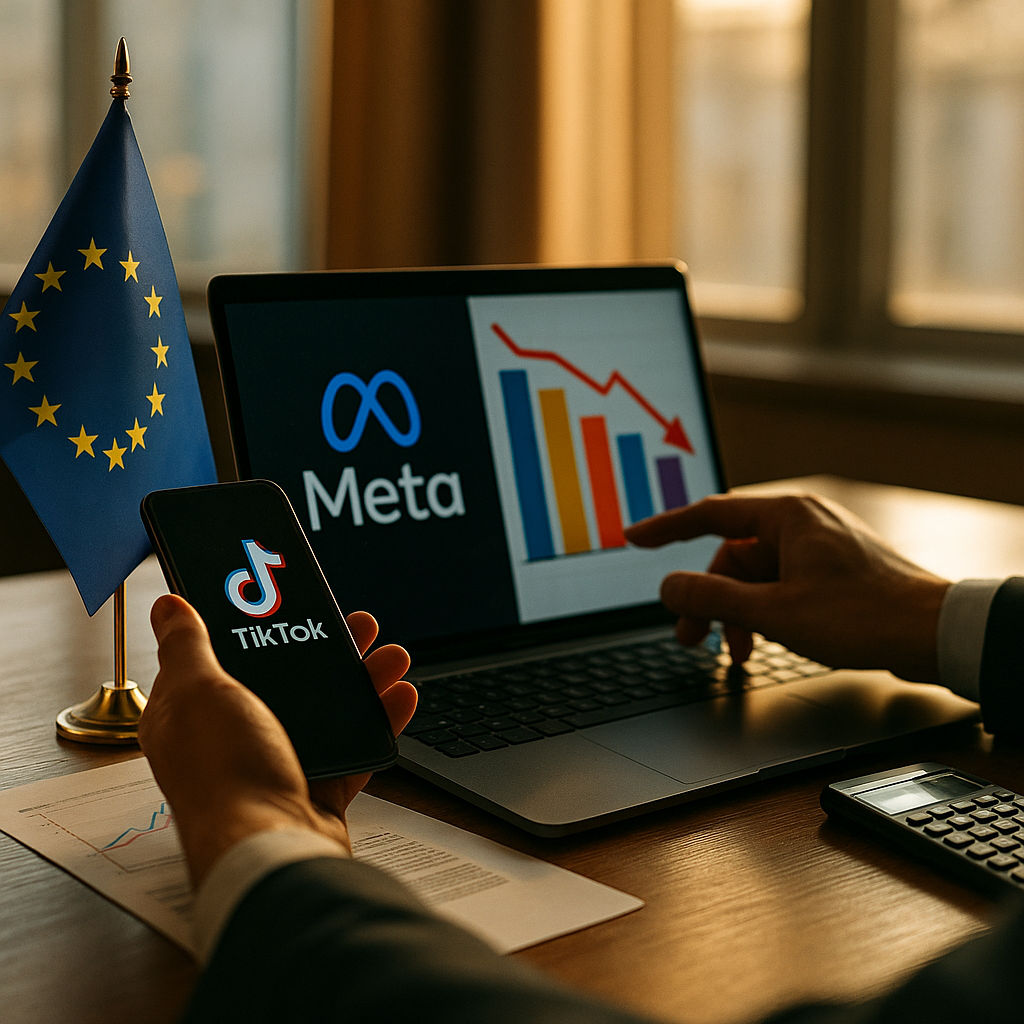
Brussels just told Meta and TikTok that “engagement optimization” and “addictive design” are now regulatory terms, not just growth-team jargon. If your youth-adjacent media plan for 2027 still assumes infinite scroll and autoplay will run unchecked, you’re planning against a platform reality that’s already gone. The EU’s coordinated crackdown, spanning Digital Services Act enforcement actions against both platforms, isn’t a PR headache for Meta and ByteDance. It’s a budget-planning problem for every brand chasing under-25 audiences.
What Actually Happened, and Why It’s Different This Time
The European Commission has been building cases against Meta and TikTok under the Digital Services Act since 2024, focusing on addictive design features: infinite scroll, autoplay defaults, variable reward notifications, and recommender systems tuned to maximize watch time among minors. What changed recently is coordination. Regulators aren’t treating this as isolated platform-by-platform enforcement anymore. They’re comparing notes, aligning timelines, and signaling that remedies imposed on one platform will become the baseline expectation for all of them.
That matters for brands because platform-level design changes cascade directly into campaign performance. Fewer autoplay loops means lower organic reach for youth content. Mandatory “time well spent” nudges mean shorter average sessions. Age-verification friction means smaller addressable audiences in the exact demographic many DTC and CPG brands have built entire funnels around.
If the EU forces even a 15-20% reduction in average session length among under-18 users, brands relying on high-frequency exposure models will see their effective CPM double without any change in media spend.
The Youth-Adjacent Budget Problem, Quantified
“Youth-adjacent” is doing a lot of work in most media plans, whether brands admit it or not. Skincare, gaming, fast fashion, energy drinks, streaming bundles, even financial apps targeting “young professionals” all lean on 16-24 reach because that’s where attention has been cheapest and most bingeable. According to eMarketer, short-form video still commands a disproportionate share of under-25 attention relative to its share of ad budgets, which is precisely why CMOs have kept pouring incremental dollars into TikTok and Reels.
The problem: that arbitrage was built on design mechanics regulators are now dismantling. If TikTok has to default to time limits for under-18 accounts across the EU, and Meta has to strip out certain notification triggers for teen accounts, the underlying attention economics shift. Brands that built 2027 plans on 2024-era engagement assumptions are planning against a platform that won’t exist in its current form.
This isn’t theoretical. The UK’s Information Commissioner’s Office has already pushed platforms toward stricter default settings for minors under its Children’s Code, and ICO guidance has previously forced design changes that measurably reduced under-18 session times. The EU’s DSA action is broader in scope and backed by fines that can reach 6% of global revenue. Platforms will comply, and compliance changes the inventory brands are bidding on.
Three Ways This Reshapes Spend, Not Just Compliance
Most compliance-driven coverage stops at “brands need to audit disclosures.” That’s necessary but insufficient here. The addictive-design crackdown forces three structural budget decisions.
- Reach forecasting needs a design-risk discount. Any 2027 media plan assuming current TikTok/Meta youth engagement rates should apply a 10-15% discount to projected reach and frequency, because default settings for minors are moving toward friction, not flow.
- Creator partnerships shift toward longer-form, lower-frequency formats. If platforms de-emphasize autoplay loops, the value of single-hit, high-volume creator drops declines relative to sustained, trust-based creator relationships. Budget should follow that shift now, not after the algorithm change hits.
- Compliance documentation becomes a media-buying prerequisite. Agencies and brand safety teams will increasingly need proof that youth-targeted campaigns weren’t built around design features regulators have flagged as exploitative. That’s a new line item, not a footnote.
None of this means pulling out of TikTok or Meta. It means treating platform design risk the way smart brands already treat platform policy risk: as a recurring line in the media plan, reviewed quarterly, not annually.
Where the Regulatory Overlap Bites Hardest
Brands running pan-EU or transatlantic youth campaigns face a layering problem. The DSA’s addictive-design provisions sit alongside the EU AI Act’s rules on AI-driven recommender systems, plus a growing patchwork of US state-level protections for minors on social platforms. Our breakdown of EU AI Act rules versus US synthetic performer laws is a useful reference point here, because the same reconciliation logic applies: what’s compliant in one jurisdiction may trigger review in another, and campaigns need a single compliant standard rather than a market-by-market patch job.
There’s also a data angle brands underweight. Youth-adjacent campaigns often lean on granular targeting and geolocation data to fine-tune reach among younger cohorts. If your creator platform agreements haven’t been updated for tightening state and EU data rules, that’s a parallel exposure. The Virginia geolocation amendment guidance we published covers exactly this kind of gap, and it’s worth an audit even for brands that think of themselves as EU-focused, because most creator platforms operate on shared, global data infrastructure.
What Brand Teams Should Actually Do Before Budgets Lock
Skip the temptation to wait for final rulings. Regulatory timelines move slower than budget cycles, and by the time the Commission issues final decisions, you’ll have already committed 2027 spend. Instead:
- Audit current youth-adjacent creative for design-dependency. Does the campaign rely on autoplay, endless scroll context, or notification-driven urgency to perform? If yes, model a version that doesn’t, and compare projected CPMs.
- Rebalance toward owned and earned channels for under-25 reach. Email, SMS, and creator-owned communities (Discord, Substack-style newsletters) are less exposed to platform design remediation than algorithmic feeds.
- Build a risk-appetite statement specific to youth targeting. Not every brand needs the same tolerance for platform volatility. A gaming brand with heavy under-18 exposure needs a tighter posture than a B2B SaaS company with incidental Gen Z reach. Our risk appetite framework is built for AI creative but the structure transfers cleanly to platform-design risk.
- Update creator contracts for disclosure and platform-compliance contingencies. If a platform mid-campaign changes default settings for minors, who absorbs the performance shortfall? That should be a negotiated term, not an afterthought. See our guide on escalation trigger policies for a workable model.
- Loop legal into media planning earlier. The FTC and EU regulators are both scrutinizing youth-facing digital ads more aggressively; brands that treat legal review as a final gate rather than an input lose planning time when something changes mid-quarter.
Worth noting: HubSpot’s own research on marketing budget allocation consistently shows that brands with quarterly reforecasting cycles adapt to platform shifts faster than those locked into annual plans. If you haven’t checked recently, HubSpot’s marketing benchmarks are a decent gut-check for whether your planning cadence matches the pace of platform change.
The Uncomfortable Truth About “Youth-Adjacent” Strategy
Here’s the part most brand decks won’t say out loud: a lot of youth-targeted strategy was quietly betting on the platforms staying addictive. Not maliciously, just structurally. High-frequency exposure works better when users can’t put the app down. Regulators are now making that bet more expensive to hold. That’s not a reason to panic. It’s a reason to diversify the mechanics your youth strategy depends on, so you’re not exposed to a single design-enforcement decision in Brussels.
Brands that treat this moment as purely a legal compliance exercise will miss the budget-planning opportunity. The ones who get ahead will rebuild youth-adjacent strategy around durable creator relationships, owned-channel growth, and platform-diversified reach, so that whatever the DSA enforcement lands on next, their 2027 numbers don’t move.
Next step: Run a design-dependency audit on your top three youth-adjacent campaigns this quarter, and rebuild reach forecasts assuming a 10-15% engagement discount from EU-driven platform changes. Don’t wait for the Commission’s final ruling to start the rebuild.
FAQs
What is the EU’s Digital Services Act crackdown on addictive design actually targeting?
It targets specific platform mechanics, such as infinite scroll, autoplay, and engagement-maximizing notification systems, that regulators argue exploit minors’ attention and can be classified as manipulative design under the DSA.
Will this affect brands outside the EU?
Yes. Meta and TikTok generally implement design changes globally or across large regional blocs rather than building separate versions per country, so EU-driven remediation often shifts platform behavior for US and global audiences too.
Should brands pause youth-adjacent campaigns until enforcement concludes?
No. Pausing wastes planning time. The better move is auditing current campaigns for design-dependency and building flexibility into 2027 budgets so performance assumptions can adjust as platform changes roll out.
How does this connect to existing FTC rules for brands?
The FTC has separately scrutinized dark patterns and youth-targeted digital advertising, so EU enforcement often previews the kind of scrutiny US regulators may apply next, making early compliance a hedge against both jurisdictions.
What’s the single biggest budget risk brands are underestimating?
Assuming current reach and engagement rates for under-25 audiences will hold steady through 2027, when platform design remediation is likely to reduce session length and organic reach in exactly that demographic.
Top Influencer Marketing Agencies
The leading agencies shaping influencer marketing in 2026
Agencies ranked by campaign performance, client diversity, platform expertise, proven ROI, industry recognition, and client satisfaction. Assessed through verified case studies, reviews, and industry consultations.
Moburst

-
2

The Shelf
Boutique Beauty & Lifestyle Influencer AgencyA data-driven boutique agency specializing exclusively in beauty, wellness, and lifestyle influencer campaigns on Instagram and TikTok. Best for brands already focused on the beauty/personal care space that need curated, aesthetic-driven content.Clients: Pepsi, The Honest Company, Hims, Elf Cosmetics, Pure LeafVisit The Shelf → -
3

Audiencly
Niche Gaming & Esports Influencer AgencyA specialized agency focused exclusively on gaming and esports creators on YouTube, Twitch, and TikTok. Ideal if your campaign is 100% gaming-focused — from game launches to hardware and esports events.Clients: Epic Games, NordVPN, Ubisoft, Wargaming, Tencent GamesVisit Audiencly → -
4

Viral Nation
Global Influencer Marketing & Talent AgencyA dual talent management and marketing agency with proprietary brand safety tools and a global creator network spanning nano-influencers to celebrities across all major platforms.Clients: Meta, Activision Blizzard, Energizer, Aston Martin, WalmartVisit Viral Nation → -
5

The Influencer Marketing Factory
TikTok, Instagram & YouTube CampaignsA full-service agency with strong TikTok expertise, offering end-to-end campaign management from influencer discovery through performance reporting with a focus on platform-native content.Clients: Google, Snapchat, Universal Music, Bumble, YelpVisit TIMF → -
6

NeoReach
Enterprise Analytics & Influencer CampaignsAn enterprise-focused agency combining managed campaigns with a powerful self-service data platform for influencer search, audience analytics, and attribution modeling.Clients: Amazon, Airbnb, Netflix, Honda, The New York TimesVisit NeoReach → -
7

Ubiquitous
Creator-First Marketing PlatformA tech-driven platform combining self-service tools with managed campaign options, emphasizing speed and scalability for brands managing multiple influencer relationships.Clients: Lyft, Disney, Target, American Eagle, NetflixVisit Ubiquitous → -
8

Obviously
Scalable Enterprise Influencer CampaignsA tech-enabled agency built for high-volume campaigns, coordinating hundreds of creators simultaneously with end-to-end logistics, content rights management, and product seeding.Clients: Google, Ulta Beauty, Converse, AmazonVisit Obviously →