


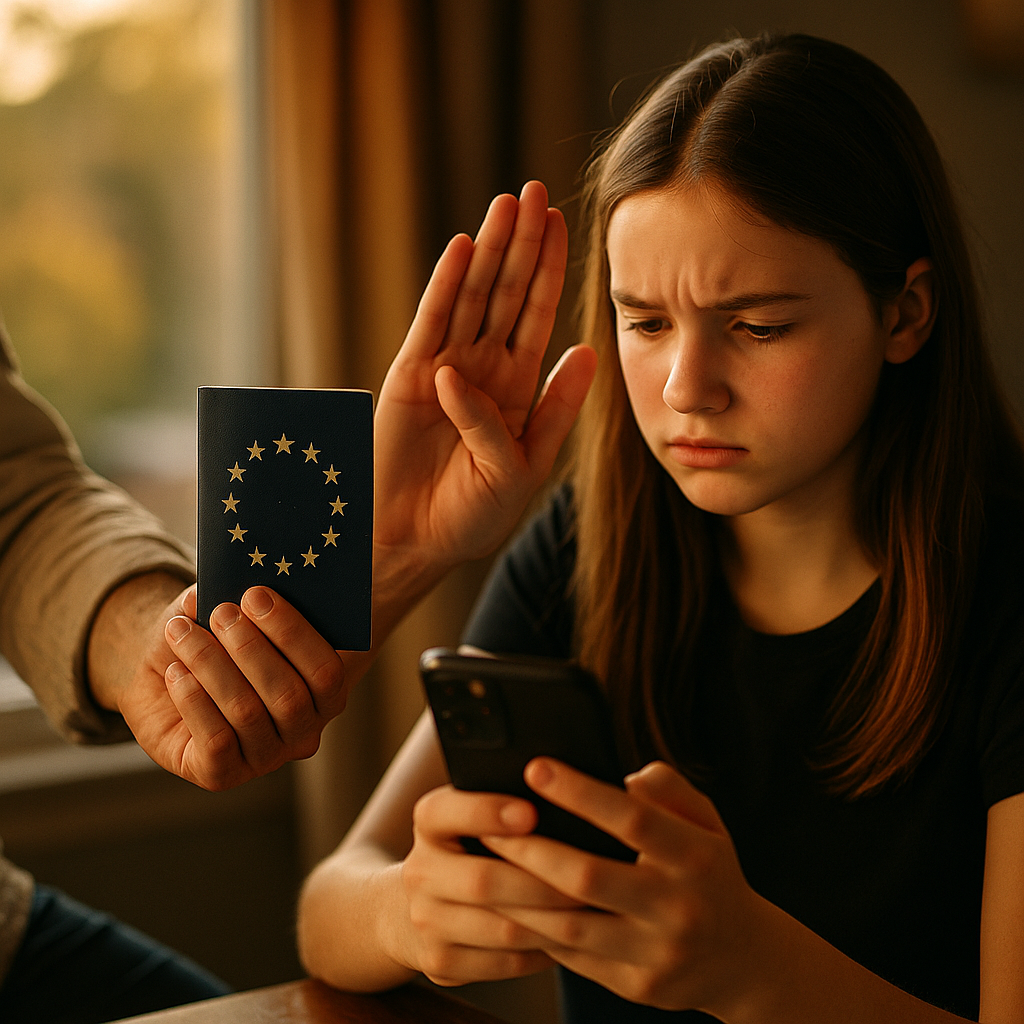
Denmark restricted it. Australia banned it outright for under-16s. Now Brussels is drafting rules that could lock an estimated 12 million EU teenagers out of mainstream social platforms entirely. The EU’s proposed under-15 social media ban is still moving through committee, but the compliance groundwork for brands running influencer campaigns across European markets needs to start now, not after the regulation passes.
The Proposal, In Plain Terms
The European Commission’s working draft would require platforms to verify user age at signup and restrict account creation for anyone under 15 without verified parental consent. It borrows heavily from France’s 2023 age-verification law and Australia’s under-16 social media ban, both of which forced platforms to build (or license) age-assurance technology practically overnight.
Unlike a single-country rule, this one applies across 27 member states simultaneously. That’s a market of roughly 450 million people, a huge chunk of it reachable through Instagram, TikTok, Snapchat, and YouTube campaigns that US brands run today without a second thought about who’s actually watching.
If the EU proposal passes in anything close to its current form, platforms will need verified age data before serving personalized ads to anyone in the bloc, not just self-declared minors.
Why This Isn’t Just a European Problem
Here’s the thing marketers keep missing: you don’t need a European office to be affected. If your brand runs pan-EU influencer campaigns through global creator networks, targets EU audiences via TikTok Shop or Meta ads, or works with creators who have significant EU-based followings, this regulation touches your media plan.
Global platforms rarely build region-specific product tiers when they can help it. Meta didn’t build a separate ad product just for California’s privacy law; it adjusted defaults globally where feasible. Expect the same pattern here. Age-verification requirements built for EU compliance often become the platform’s baseline everywhere, including US-facing campaigns that touch EU users incidentally.
According to eMarketer’s social platform research, teen and pre-teen engagement already represents a disproportionate share of watch time on short-form video platforms. Regulators know this. That’s exactly why the EU is targeting the demographic where platform growth has been most aggressive and disclosure practices have been thinnest.
Age Verification Is the Real Compliance Headache
Age bans sound simple until you try to enforce one. The EU proposal doesn’t specify a single verification method, which means platforms will likely deploy a patchwork: facial-age-estimation tools, ID document checks, or parental consent flows similar to what US COPPA already requires domestically.
Brands running youth-adjacent campaigns (think back-to-school, gaming, beauty, fast fashion) need to understand that age verification isn’t just a platform problem. If a creator’s audience skews young and your campaign lands in front of unverified or underage users, you inherit the same reputational and regulatory exposure as the platform, even if you didn’t build the verification system.
This mirrors what’s already happening in the US with COPPA enforcement around live shopping streams and minor audiences. The FTC has made clear that “the platform handles it” is not a defense brands can rely on. The FTC’s COPPA guidance already treats advertisers as co-responsible when campaigns knowingly or negligently reach children under 13. The EU proposal simply raises that threshold to 15 and applies it bloc-wide.
What Platforms Are Already Doing
Meta has rolled out default teen account restrictions with limited ad targeting and content controls, detailed on its Meta for Business policy pages. YouTube has similarly expanded its supervised and teen account settings to restrict ad personalization for younger, unverified users. Neither of these was built specifically for the EU proposal, but both give you a preview of what compliant infrastructure will look like once the law lands: fewer targeting options, more consent gates, and a shrinking pool of “known” young users you can legally reach with personalized creative.
What Happens to Influencer Campaigns Aimed at Teens?
If you’re running campaigns that lean on nano and micro-creators with young, highly engaged audiences (a common tactic in beauty, gaming, and fast fashion), the addressable pool shrinks the moment age verification kicks in. Some of that audience won’t disappear; it’ll just become invisible to your targeting and measurement tools because platforms won’t be able to confirm age with the personalization data they currently rely on.
Practically, this means:
- Lookalike audiences built on teen engagement data will degrade in accuracy as unverified accounts get suppressed from ad delivery.
- Creator partnerships that historically over-indexed with under-15 followers may show sharp reach declines in EU markets specifically, distorting cross-market performance comparisons.
- Campaign briefs will need explicit language about audience age thresholds, not just “18+” boilerplate that nobody enforces.
- Consent and disclosure documentation will need to account for parental consent flows, not just standard opt-in language.
This is the same operational shift brands have already had to make around consent infrastructure more broadly. The playbook for closing consent and identity data gaps that emerged around deterministic ID tracking applies almost directly here: you need documented, auditable proof of age and consent status, not just a platform’s word that it’s handled.
Contracts, Content Libraries, and the Compliance Paper Trail
Legal and procurement teams should be updating creator contracts now, not waiting for final legislative text. Three clauses deserve immediate attention.
First, audience representations. Creators should be contractually required to disclose known audience demographics, including any documented skew toward under-15 followers, at the time of contracting. Second, indemnification language covering platform-level compliance failures that expose the brand to regulatory risk in the EU specifically. Third, data handling clauses that align with whatever consent and processing standards the final regulation requires, similar to how brands have already had to formalize data processing agreements with creator platforms under GDPR.
None of this is theoretical. The UK’s Information Commissioner’s Office already enforces an Age Appropriate Design Code that pushed platforms toward default privacy settings for minors years before the EU’s current proposal existed. You can review the underlying framework directly at ico.org.uk, and it’s a reasonable preview of the compliance direction Brussels is likely to formalize at scale.
Brands that wait for the EU regulation to pass before updating creator contracts will be renegotiating dozens of agreements under deadline pressure instead of building the language in now.
A Readiness Checklist for the Next Two Quarters
You don’t need to overhaul your entire influencer program today. But a handful of concrete moves will put you ahead of the compliance curve rather than scrambling once the rule takes effect.
- Audit current EU-facing influencer campaigns for audience age data and flag any skewing meaningfully toward under-15 followers.
- Update creator contract templates with audience representation and indemnification clauses covering EU age-verification compliance.
- Talk to your platform reps (TikTok, Meta, YouTube, Snapchat) about their EU age-verification roadmap and whether it will affect ad targeting or measurement in your existing markets.
- Review your duty-of-care obligations more broadly. Age regulation is only one piece of a larger shift toward platform accountability for minor safety, covered in depth in our breakdown of duty of care laws affecting organic reach.
- Build a documentation process now for age and consent verification so you’re not reconstructing records retroactively during an audit.
Marketing teams that treat this as a legal-only issue are missing the media planning implications. If your EU reach concentrates in the 13 to 15 age bracket for any product category, your working assumptions about audience size, targeting precision, and campaign measurement are about to change, possibly within the next few budget cycles.
The Bottom Line for Budget Owners
This regulation won’t just restrict who sees your ads. It will restrict how precisely you can know who saw them, which affects attribution, creator payment structures tied to performance, and any campaign built on granular audience data. Sprout Social’s ongoing research into platform trust and brand safety benchmarks already shows advertisers pulling back from platforms with unclear minor-safety practices. Regulatory pressure will accelerate that shift, not slow it down.
Frequently Asked Questions
What exactly is the EU’s proposed under-15 social media ban?
It’s a draft regulation that would require social media platforms to verify user age and block account creation for anyone under 15 without verified parental consent, applying across all EU member states.
Does this affect US brands that don’t operate in Europe?
Yes, if your influencer campaigns reach EU audiences through global platforms like TikTok, Instagram, or YouTube, or if your creators have significant EU-based followings, the compliance requirements apply to that portion of your campaign delivery regardless of where your company is headquartered.
How is this different from existing US laws like COPPA?
COPPA applies to children under 13 and primarily governs data collection practices. The EU proposal sets the age threshold at 15 and focuses on account access and ad personalization, a broader and more restrictive standard than current US federal law.
When might this regulation actually take effect?
The proposal is still in committee review with no confirmed enactment date. Based on comparable EU legislative timelines, brands should expect a multi-year rollout with transition periods for platform compliance, but should not wait for final passage to begin contract and audience audits.
What should brands do first?
Start by auditing EU-facing campaign audience data for age skew, updating creator contract language around audience representations, and confirming your ad platforms’ current age-verification roadmap.
Next step: Pull your last two quarters of EU-facing influencer campaign data, flag any creator partnerships with meaningful under-15 audience overlap, and get updated contract language in front of legal before the next campaign cycle locks in.
Top Influencer Marketing Agencies
The leading agencies shaping influencer marketing in 2026
Agencies ranked by campaign performance, client diversity, platform expertise, proven ROI, industry recognition, and client satisfaction. Assessed through verified case studies, reviews, and industry consultations.
Moburst

-
2

The Shelf
Boutique Beauty & Lifestyle Influencer AgencyA data-driven boutique agency specializing exclusively in beauty, wellness, and lifestyle influencer campaigns on Instagram and TikTok. Best for brands already focused on the beauty/personal care space that need curated, aesthetic-driven content.Clients: Pepsi, The Honest Company, Hims, Elf Cosmetics, Pure LeafVisit The Shelf → -
3

Audiencly
Niche Gaming & Esports Influencer AgencyA specialized agency focused exclusively on gaming and esports creators on YouTube, Twitch, and TikTok. Ideal if your campaign is 100% gaming-focused — from game launches to hardware and esports events.Clients: Epic Games, NordVPN, Ubisoft, Wargaming, Tencent GamesVisit Audiencly → -
4

Viral Nation
Global Influencer Marketing & Talent AgencyA dual talent management and marketing agency with proprietary brand safety tools and a global creator network spanning nano-influencers to celebrities across all major platforms.Clients: Meta, Activision Blizzard, Energizer, Aston Martin, WalmartVisit Viral Nation → -
5

The Influencer Marketing Factory
TikTok, Instagram & YouTube CampaignsA full-service agency with strong TikTok expertise, offering end-to-end campaign management from influencer discovery through performance reporting with a focus on platform-native content.Clients: Google, Snapchat, Universal Music, Bumble, YelpVisit TIMF → -
6

NeoReach
Enterprise Analytics & Influencer CampaignsAn enterprise-focused agency combining managed campaigns with a powerful self-service data platform for influencer search, audience analytics, and attribution modeling.Clients: Amazon, Airbnb, Netflix, Honda, The New York TimesVisit NeoReach → -
7

Ubiquitous
Creator-First Marketing PlatformA tech-driven platform combining self-service tools with managed campaign options, emphasizing speed and scalability for brands managing multiple influencer relationships.Clients: Lyft, Disney, Target, American Eagle, NetflixVisit Ubiquitous → -
8

Obviously
Scalable Enterprise Influencer CampaignsA tech-enabled agency built for high-volume campaigns, coordinating hundreds of creators simultaneously with end-to-end logistics, content rights management, and product seeding.Clients: Google, Ulta Beauty, Converse, AmazonVisit Obviously →