


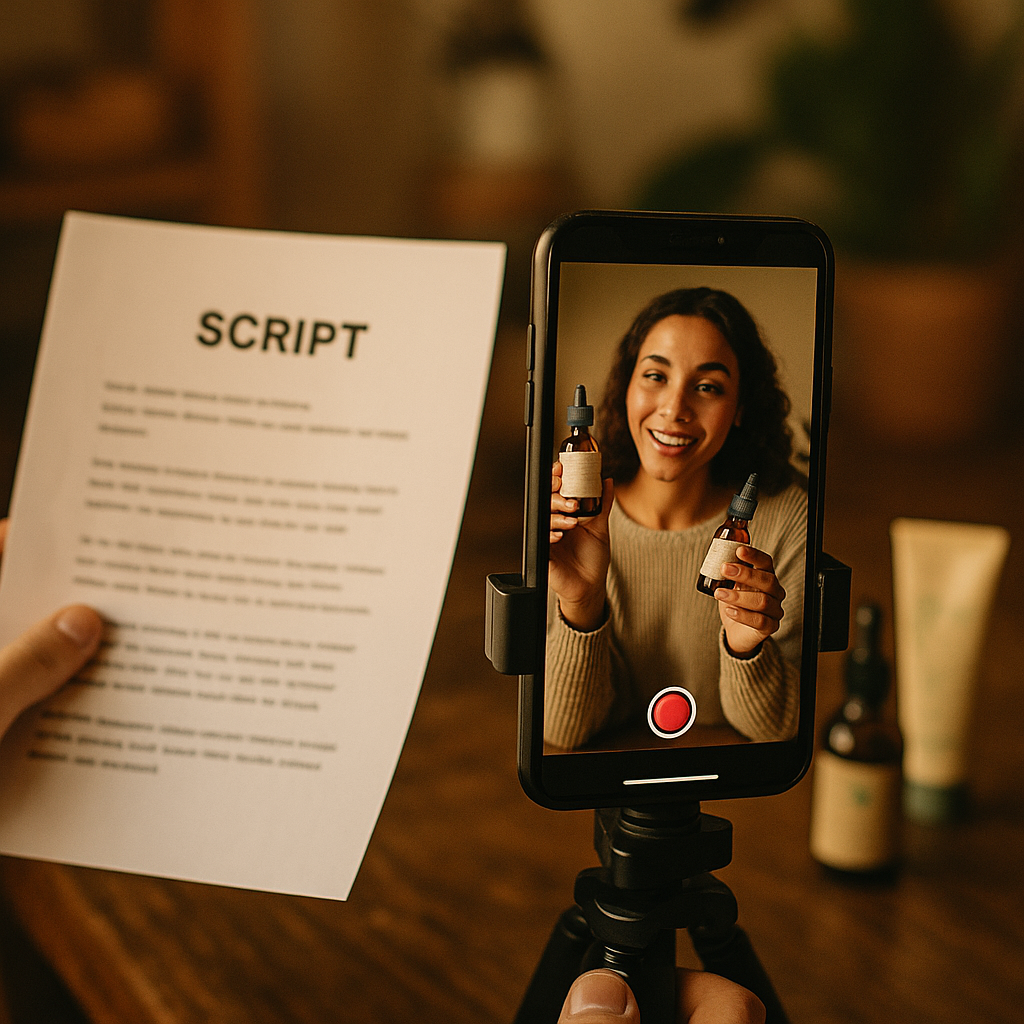
Only 12% of consumers say they can reliably tell a paid social video from an organic one, according to recent eMarketer consumer trust research. That gap is the entire business model behind fake-organic video scripts. If your paid UGC still looks like an ad, you’re leaving reach and conversion on the table.
This isn’t about deception for its own sake. It’s about writing paid creator content that survives the scroll test: does it look, sound, and move like the stuff a viewer’s friend would post? Get that right and you cut cost-per-view, boost watch time, and quietly outperform your polished brand spots. Get it wrong and you get flagged, skipped, or reported.
What “Fake Organic” Actually Means
Fake-organic doesn’t mean fake product claims or hidden sponsorships. It means the production language of organic content, shaky framing, ambient noise, mid-sentence corrections, applied deliberately to paid creator video. The product is real. The creator is paid. The disclosure is present. But the craft of the script mimics the imperfection patterns that platforms and audiences associate with unpaid, unscripted posting.
Brands have been chasing this for a while. What’s changed is the sophistication of the scripting. Early UGC briefs just said “make it casual.” Now the best-performing scripts engineer specific imperfection cues at specific timestamps, because randomness reads as fake just as easily as polish does.
Audiences don’t reward authenticity. They reward the specific signals they’ve learned to associate with authenticity, and those signals can be scripted.
The Anatomy of a Native-Blending Script
A fake-organic script has four load-bearing components. Skip one and the illusion cracks.
- The cold-open flaw. Organic video rarely opens clean. Scripts should open mid-action, mid-sentence, or with a visible fumble (dropped cap, wrong lighting adjustment, a “wait, let me start over” that isn’t cut).
- The context anchor. A visible detail that grounds the video in a real, specific life: a kitchen with dishes in the sink, a car dashboard, a gym locker room. This is what separates fake-organic from studio UGC dressed down with a ring light off.
- The digression. A brief, unscripted-sounding tangent before returning to the product point. “Okay so, side note, I almost didn’t buy this because…” This single beat does more for perceived authenticity than any amount of casual wardrobe styling.
- The soft CTA. No “link in bio, swipe up now” energy. Organic-coded CTAs sound like a recommendation to a friend: “I’ll drop it below if anyone wants it.”
This structure pairs well with the scripting discipline covered in actor-style UGC scripts, where creators perform a brief rather than read a script verbatim. The performance layer is what sells the imperfection; a stiff read kills it instantly.
A Working Template You Can Steal
Here’s a script skeleton our contributors have seen used across beauty, supplements, and app-based DTC campaigns. Adjust pacing per platform, but the beat order holds.
- 0 to 2 seconds: Cold-open flaw, no logo, no intro music.
- 2 to 6 seconds: Context anchor plus the real reason they’re filming (“my sister asked me what I use for this so I’m just gonna show her”).
- 6 to 15 seconds: Product demonstration with one visible hesitation or correction.
- 15 to 22 seconds: The digression tangent, ideally something mildly self-deprecating or unrelated to the sale.
- 22 to 28 seconds: Soft CTA plus disclosure, spoken naturally, not read.
Note the disclosure sits inside the natural CTA, not bolted on as a text overlay only. That matters more than most briefs account for, and we’ll get to why in the compliance section below. This beat structure also plays nicely with the review workflows outlined in brand-approved hook frameworks, which help legal sign off on scripts without stripping out the imperfection cues that make them work.
Where Brands Get Caught
Fake-organic is not the same as undisclosed. That distinction is the whole ballgame. The FTC’s endorsement guidance doesn’t care how casual your video looks; it cares whether a reasonable viewer understands they’re seeing paid content. Plenty of brands have tried to hide behind “authentic-looking” video as cover for skipping disclosure, and it doesn’t hold up under scrutiny.
The more native your paid UGC looks, the more deliberate your disclosure language needs to be. Ambiguity is the actual violation, not polish.
Practical fix: build the disclosure into the spoken script, not just an on-screen tag that autoplay-muted viewers never see. If you’re already stripping sound-off considerations out of your edits, revisit the guidance in sound-off editing techniques so disclosure text survives the mute.
Before any fake-organic asset goes to paid spend, run it against a rights and compliance checklist. Amplification without the correct usage rights or disclosure language is the fastest way to get a video pulled mid-flight, and the paid amplification rights checklist exists specifically to catch this before it becomes a legal problem.
Platform Nuances Aren’t Optional
TikTok, Instagram Reels, and YouTube Shorts each have a different organic “accent,” and scripts that ignore this get spotted fast by algorithm and audience alike.
- TikTok rewards raw pacing and jump cuts that look like in-app editing mistakes rather than post-production. Use the native caption tool’s default font, not a branded overlay.
- Instagram Reels audiences expect slightly more composed framing, since Reels culture skews toward aspirational-casual rather than pure chaos. The flaw should be smaller: a glance-away, not a dropped phone.
- YouTube Shorts viewers tolerate longer setup before the flaw appears, since Shorts audiences migrated from long-form and expect a beat of context first.
Check current specs before shooting, since aspect ratio and caption safe zones shift. TikTok’s ads platform and Meta’s business tools both publish updated creative specs worth referencing at brief stage, not after the shoot.
Measuring Success Without Killing the Illusion
Standard ad metrics still apply: hook rate, three-second view rate, CTR, CPA. But fake-organic scripts should also be tracked against a secondary signal most brands ignore: comment sentiment asking “is this an ad?” A rising rate of that comment means the script’s imperfection cues have gone stale or feel manufactured. Rotate your flaw types every few weeks the same way you’d rotate hooks.
Multi-hook shooting days help here. Instead of scripting one fake-organic video per creator session, capture several flaw variations (dropped object, verbal stumble, context-anchor swap) in a single shoot. The approach mirrors what’s laid out in multi-hook shoot production, just applied to imperfection cues instead of opening lines.
If you’re running these scripts against testimonial-driven formats for lower-funnel conversion, pair the native-blending opener with the structured trust-building midsection described in testimonial stitch ad formats (note: verify link before publishing). Combining a fake-organic hook with a proof-driven middle tends to outperform either format run in isolation, based on patterns reported across several agency case studies referenced by Sprout Social’s creator content research.
Track performance decay closely. Fake-organic formats fatigue faster than polished brand video because the “trick” only works while it’s unrecognized. Budget for refresh cycles every three to four weeks rather than treating one winning script as evergreen.
The Next Step
Write your next fake-organic script backward: pick the flaw, the context anchor, and the digression before you write a single line of product copy. The imperfection is the creative brief, not an afterthought layered on after the sales pitch is locked.
FAQs
What is a fake-organic video script?
It’s a scripted approach to paid UGC that intentionally builds in the production imperfections, pacing, and framing patterns typical of unpaid, organic social content, while keeping the product claims and disclosures fully compliant.
Is fake-organic content legal?
Yes, as long as paid partnership disclosure is clear and understandable to the average viewer. The production style can look casual; the disclosure cannot be hidden, buried, or omitted. Consult the FTC’s endorsement guidelines for specifics.
How is this different from regular UGC briefs?
Standard UGC briefs ask for a casual tone. Fake-organic scripts go further, specifying exact imperfection cues (a flaw, a digression, a context anchor) at specific timestamps so the video reads as unscripted even though every beat is planned.
Does fake-organic content actually outperform polished ads?
In hook rate and cost-per-view, generally yes, based on data patterns reported by platforms like HubSpot on short-form video performance. Polished ads still perform better for brand-building and premium positioning, so the format choice should match the funnel stage.
How often should fake-organic scripts be refreshed?
Every three to four weeks in most feeds. The format’s effectiveness depends on audiences not recognizing the pattern, so overused flaw cues stop working faster than traditional creative fatigue timelines.
Top Influencer Marketing Agencies
The leading agencies shaping influencer marketing in 2026
Agencies ranked by campaign performance, client diversity, platform expertise, proven ROI, industry recognition, and client satisfaction. Assessed through verified case studies, reviews, and industry consultations.
Moburst

-
2

The Shelf
Boutique Beauty & Lifestyle Influencer AgencyA data-driven boutique agency specializing exclusively in beauty, wellness, and lifestyle influencer campaigns on Instagram and TikTok. Best for brands already focused on the beauty/personal care space that need curated, aesthetic-driven content.Clients: Pepsi, The Honest Company, Hims, Elf Cosmetics, Pure LeafVisit The Shelf → -
3

Audiencly
Niche Gaming & Esports Influencer AgencyA specialized agency focused exclusively on gaming and esports creators on YouTube, Twitch, and TikTok. Ideal if your campaign is 100% gaming-focused — from game launches to hardware and esports events.Clients: Epic Games, NordVPN, Ubisoft, Wargaming, Tencent GamesVisit Audiencly → -
4

Viral Nation
Global Influencer Marketing & Talent AgencyA dual talent management and marketing agency with proprietary brand safety tools and a global creator network spanning nano-influencers to celebrities across all major platforms.Clients: Meta, Activision Blizzard, Energizer, Aston Martin, WalmartVisit Viral Nation → -
5

The Influencer Marketing Factory
TikTok, Instagram & YouTube CampaignsA full-service agency with strong TikTok expertise, offering end-to-end campaign management from influencer discovery through performance reporting with a focus on platform-native content.Clients: Google, Snapchat, Universal Music, Bumble, YelpVisit TIMF → -
6

NeoReach
Enterprise Analytics & Influencer CampaignsAn enterprise-focused agency combining managed campaigns with a powerful self-service data platform for influencer search, audience analytics, and attribution modeling.Clients: Amazon, Airbnb, Netflix, Honda, The New York TimesVisit NeoReach → -
7

Ubiquitous
Creator-First Marketing PlatformA tech-driven platform combining self-service tools with managed campaign options, emphasizing speed and scalability for brands managing multiple influencer relationships.Clients: Lyft, Disney, Target, American Eagle, NetflixVisit Ubiquitous → -
8

Obviously
Scalable Enterprise Influencer CampaignsA tech-enabled agency built for high-volume campaigns, coordinating hundreds of creators simultaneously with end-to-end logistics, content rights management, and product seeding.Clients: Google, Ulta Beauty, Converse, AmazonVisit Obviously →