


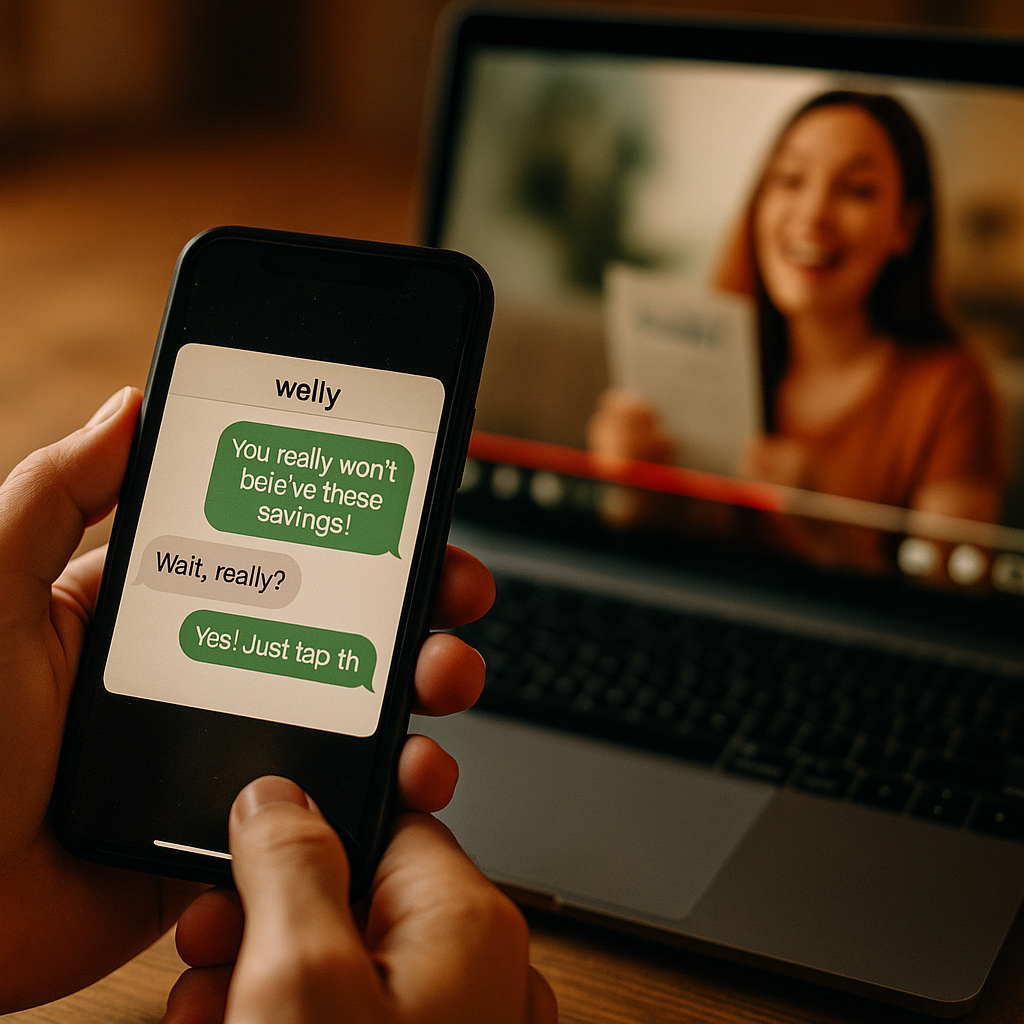
A fake text message is outperforming six-figure video production budgets. Across TikTok and Meta ad libraries, iMessage-style screenshot ads, the ones mimicking a friend’s text thread, are quietly posting lower CPAs than studio-shot video. Why would a brand pay for lighting, talent, and editors when a plain white bubble on a gray background converts better? The answer says a lot about where consumer trust actually lives in 2026.
What Exactly Is an iMessage-Style Screenshot Ad?
Picture a static image or short video that looks like a screenshot from someone’s phone. Gray and blue speech bubbles. A contact name at the top, sometimes just “Mom” or “Sarah.” Timestamps. Maybe a typing indicator bouncing before the next message drops. It’s the visual language of a private conversation, repurposed as a public ad unit.
The format didn’t start in marketing. It started organically, as creators shared real screenshots of recommendations from friends: a skincare tip, a product someone swore by, a link someone sent at 11pm. Brands noticed the engagement on those organic posts and started scripting their own versions. Now it’s a recognized ad archetype on TikTok Ads Manager and Meta’s ad library, sitting alongside UGC testimonials and talking-head reviews.
Why Does a Fake Text Thread Beat a Polished Video Ad?
Polished video signals “advertisement” within the first half second. Viewers have spent over a decade training their pattern recognition to detect and skip branded content. A screenshot ad bypasses that filter because it mimics a format people associate with private, unscripted communication. There’s no music swell, no b-roll, no cinematic transition cueing “this is paid media.”
The format works because it borrows credibility from a context (private messaging) that has never been colonized by advertising, at least not visibly.
There’s also a cognitive shortcut at play. When we read a text thread, we fill in tone, relationship, and intent automatically, the same way we do with a real conversation. That mental processing makes the content feel earned rather than served. Compare that to a 30-second product video, which announces its persuasive intent from frame one.
This isn’t just a creative hunch. It lines up with broader shifts documented by eMarketer’s research on ad trust, which has tracked declining consumer confidence in traditional brand advertising for years, alongside rising trust in peer recommendations and informal content formats.
The Scroll-Stop Mechanics
There’s a practical reason these ads work on the feed level, too. A text thread doesn’t look like an ad in the thumbnail. It looks like a notification, a screenshot someone saved and shared, the kind of thing that shows up in group chats. That split-second ambiguity buys the creative an extra beat of attention before the viewer’s brain categorizes it as “promotional” and decides whether to scroll past.
- No obvious production value cues (lighting, framing, music) that read as “ad.”
- Text is legible without sound, which matters since most feed video plays muted.
- The format rewards curiosity. Readers want to see how the conversation resolves.
- It mirrors content people already save and forward organically, so it feels native to the platform.
That last point connects to a broader trend: formats that work with sound off and without obvious polish keep winning attention. It’s the same logic behind silent captioned demos outperforming narrated product videos on TikTok Shop. Viewers are consuming content in contexts (open offices, transit, waiting rooms) where sound is off by default, and formats built for that reality simply get more completed views.
The Data Behind the Trend
Ad buyers running screenshot-style creative report completion rates and click-through rates that rival or beat traditional UGC testimonial video, often at a fraction of the production cost. A screenshot ad can be built in Figma or Canva in under an hour. No talent fees, no shoot day, no editor queue. For performance marketing teams under pressure to hit CPA targets while production budgets shrink, that math is hard to ignore.
This fits a pattern Influencers Time has tracked repeatedly: formats that look unpolished or native to the platform tend to outperform formats that look like traditional advertising, even when the “unpolished” look is itself carefully art directed. The static image comeback trend follows the same logic. Carousels and screenshots are winning saves and shares precisely because they don’t perform production value.
HubSpot’s ongoing research into content marketing trends has flagged a similar shift: audiences increasingly reward authenticity signals over craft signals. A shaky phone video with real reactions often beats a studio edit. A screenshot of a real-feeling text beats a scripted monologue to camera.
Where the Format Overlaps With Storytime and Narrative Hooks
Screenshot ads share DNA with other narrative-driven formats gaining traction right now. The storytime format works for similar reasons: it opens with narrative tension rather than a product pitch, and viewers stay to find out what happens. A text thread ad does the same thing in miniature. “Wait, did you actually try it?” “Omg yes, let me send you the link” creates a tiny narrative arc with a natural resolution: the product mention.
It also pairs well with reaction-driven content. Several brands are now layering screenshot threads into reaction content, where a creator reads the fake text thread aloud on camera, reacting as if it were real. That hybrid format adds a human layer on top of the screenshot’s inherent believability, stacking two trust signals instead of one.
Where This Format Can Backfire
Nothing this effective stays loophole-free for long. The core risk is disclosure. If a screenshot ad is designed to look like a private, organic recommendation, regulators and platforms are going to ask whether the audience understands it’s paid content. The FTC’s endorsement guidelines apply regardless of format. A fake text thread implying a personal recommendation, without clear disclosure that it’s sponsored, sits in the same risk category as an undisclosed influencer post. UK advertisers face equivalent scrutiny from the ICO on data and messaging practices, particularly where ads mimic personal communications.
There’s also a brand safety angle that gets overlooked. Screenshot ads that lean too hard into “deceptive realism” (fake contact photos, fake read receipts, implied personal relationships) can trigger backlash once audiences realize the trick. The format’s power comes from borrowed trust. Burn that trust once, publicly, and it doesn’t come back cheap.
The line between “relatable format” and “deceptive mimicry” is thinner than most creative teams want to admit, and it’s exactly where compliance teams should be looking first.
Platform policy is another moving target. Meta’s advertising standards and TikTok’s creative guidelines both require clear sponsorship labeling, and both have tightened enforcement around ads that impersonate organic UI elements, including fake notifications and fake chat interfaces. A format can work great for a quarter and then get flagged in a policy update. Build disclosure into the creative itself (a small “#ad” or “sponsored” tag inside the frame) rather than relying on platform-level labels alone.
How to Script a Screenshot Ad That Actually Converts
Treat the text thread like a script, not a prop. Every message needs a job: setting context, raising a question, delivering the product mention, or closing with a natural call to action. Sloppy threads read as obviously fabricated, and that kills the trust effect the format depends on.
- Start with a real question, not a pitch. “Did that thing actually work?” reads more credibly than “You have to try this product.”
- Keep the pacing realistic. Real texters don’t send five perfectly punctuated sentences in a row. Break messages up the way people actually type.
- Use typing indicators and delays strategically if you’re animating the thread as video. The pause before a reply creates anticipation, similar to a countdown hook but in a more intimate register.
- Disclose inside the frame. A small sponsored tag at the top of the thread protects compliance without killing the format’s authenticity.
- Test the resolution. Does the thread end with a link drop, a screenshot of a product, or a vague “trust me”? Each resolution style performs differently depending on whether you’re optimizing for clicks or brand recall.
Agencies running this at scale often build a swipe file of real customer service chats or review snippets, then lightly fictionalize them into thread format. That keeps the dialogue sounding human instead of marketing-adjacent. It’s a similar discipline to writing discovery feed hooks, where the first few seconds (or in this case, the first message) determine whether anyone keeps reading.
Does This Replace Video, or Sit Alongside It?
Screenshot ads aren’t a replacement for video content, they’re a complement to it, particularly in upper-funnel and retargeting sequences. A text thread ad can do the trust-building work that a polished product video struggles to do, then a follow-up video or demo clip can close the sale once skepticism is lowered. Smart media buyers are sequencing creative this way: screenshot ad for the cold audience, proof-driven video or multi angle product demo for the warm one.
The format also fits naturally into broader creator strategies. A creator who already builds an audience around relatable, lightly scripted storytelling (think the narrative pacing used in episodic creator series) can extend that same voice into screenshot-style ad units without it feeling like a jarring format shift for their followers.
Budget allocation should reflect this complementary role rather than an either/or decision. Sprout Social’s work on social media engagement benchmarks consistently shows that format diversity, not format replacement, drives sustained performance. Screenshot ads are a strong addition to the toolkit, not a reason to cancel the next shoot.
FAQs
What makes iMessage-style screenshot ads different from regular UGC video?
Screenshot ads mimic the visual interface of a private text conversation rather than showing a creator talking to camera. They remove production cues like lighting, framing, and music that signal “advertisement,” which often lowers the viewer’s guard and increases engagement.
Are screenshot-style ads compliant with advertising disclosure rules?
They can be, as long as sponsorship is clearly disclosed inside the creative itself. Regulators like the FTC require clear disclosure regardless of format, and relying solely on platform-level ad labels is riskier than embedding a visible sponsored tag within the thread.
Do screenshot ads actually cost less to produce than video?
Generally yes. A screenshot ad can be designed in tools like Figma or Canva without talent fees, shoot days, or editing teams, which is a major reason performance marketers are testing the format under tightening production budgets.
Which platforms perform best for this ad format?
TikTok and Meta’s feed and Stories placements currently show the strongest results, largely because both platforms favor native-feeling, sound-off-friendly creative in their algorithmic ranking.
Should brands replace video ads with screenshot ads entirely?
No. Screenshot ads work best as a trust-building layer earlier in the funnel, often paired with product demo video or proof-based content later in the sequence to close the sale.
Next step: pull your last three UGC testimonial ads, rebuild the strongest one as a text thread, and run it head-to-head against the original video for two weeks before committing more budget to either format.
FAQs
What makes iMessage-style screenshot ads different from regular UGC video?
Screenshot ads mimic the visual interface of a private text conversation rather than showing a creator talking to camera. They remove production cues like lighting, framing, and music that signal “advertisement,” which often lowers the viewer’s guard and increases engagement.
Are screenshot-style ads compliant with advertising disclosure rules?
They can be, as long as sponsorship is clearly disclosed inside the creative itself. Regulators like the FTC require clear disclosure regardless of format, and relying solely on platform-level ad labels is riskier than embedding a visible sponsored tag within the thread.
Do screenshot ads actually cost less to produce than video?
Generally yes. A screenshot ad can be designed in tools like Figma or Canva without talent fees, shoot days, or editing teams, which is a major reason performance marketers are testing the format under tightening production budgets.
Which platforms perform best for this ad format?
TikTok and Meta’s feed and Stories placements currently show the strongest results, largely because both platforms favor native-feeling, sound-off-friendly creative in their algorithmic ranking.
Should brands replace video ads with screenshot ads entirely?
No. Screenshot ads work best as a trust-building layer earlier in the funnel, often paired with product demo video or proof-based content later in the sequence to close the sale.
Top Influencer Marketing Agencies
The leading agencies shaping influencer marketing in 2026
Agencies ranked by campaign performance, client diversity, platform expertise, proven ROI, industry recognition, and client satisfaction. Assessed through verified case studies, reviews, and industry consultations.
Moburst

-
2

The Shelf
Boutique Beauty & Lifestyle Influencer AgencyA data-driven boutique agency specializing exclusively in beauty, wellness, and lifestyle influencer campaigns on Instagram and TikTok. Best for brands already focused on the beauty/personal care space that need curated, aesthetic-driven content.Clients: Pepsi, The Honest Company, Hims, Elf Cosmetics, Pure LeafVisit The Shelf → -
3

Audiencly
Niche Gaming & Esports Influencer AgencyA specialized agency focused exclusively on gaming and esports creators on YouTube, Twitch, and TikTok. Ideal if your campaign is 100% gaming-focused — from game launches to hardware and esports events.Clients: Epic Games, NordVPN, Ubisoft, Wargaming, Tencent GamesVisit Audiencly → -
4

Viral Nation
Global Influencer Marketing & Talent AgencyA dual talent management and marketing agency with proprietary brand safety tools and a global creator network spanning nano-influencers to celebrities across all major platforms.Clients: Meta, Activision Blizzard, Energizer, Aston Martin, WalmartVisit Viral Nation → -
5

The Influencer Marketing Factory
TikTok, Instagram & YouTube CampaignsA full-service agency with strong TikTok expertise, offering end-to-end campaign management from influencer discovery through performance reporting with a focus on platform-native content.Clients: Google, Snapchat, Universal Music, Bumble, YelpVisit TIMF → -
6

NeoReach
Enterprise Analytics & Influencer CampaignsAn enterprise-focused agency combining managed campaigns with a powerful self-service data platform for influencer search, audience analytics, and attribution modeling.Clients: Amazon, Airbnb, Netflix, Honda, The New York TimesVisit NeoReach → -
7

Ubiquitous
Creator-First Marketing PlatformA tech-driven platform combining self-service tools with managed campaign options, emphasizing speed and scalability for brands managing multiple influencer relationships.Clients: Lyft, Disney, Target, American Eagle, NetflixVisit Ubiquitous → -
8

Obviously
Scalable Enterprise Influencer CampaignsA tech-enabled agency built for high-volume campaigns, coordinating hundreds of creators simultaneously with end-to-end logistics, content rights management, and product seeding.Clients: Google, Ulta Beauty, Converse, AmazonVisit Obviously →