


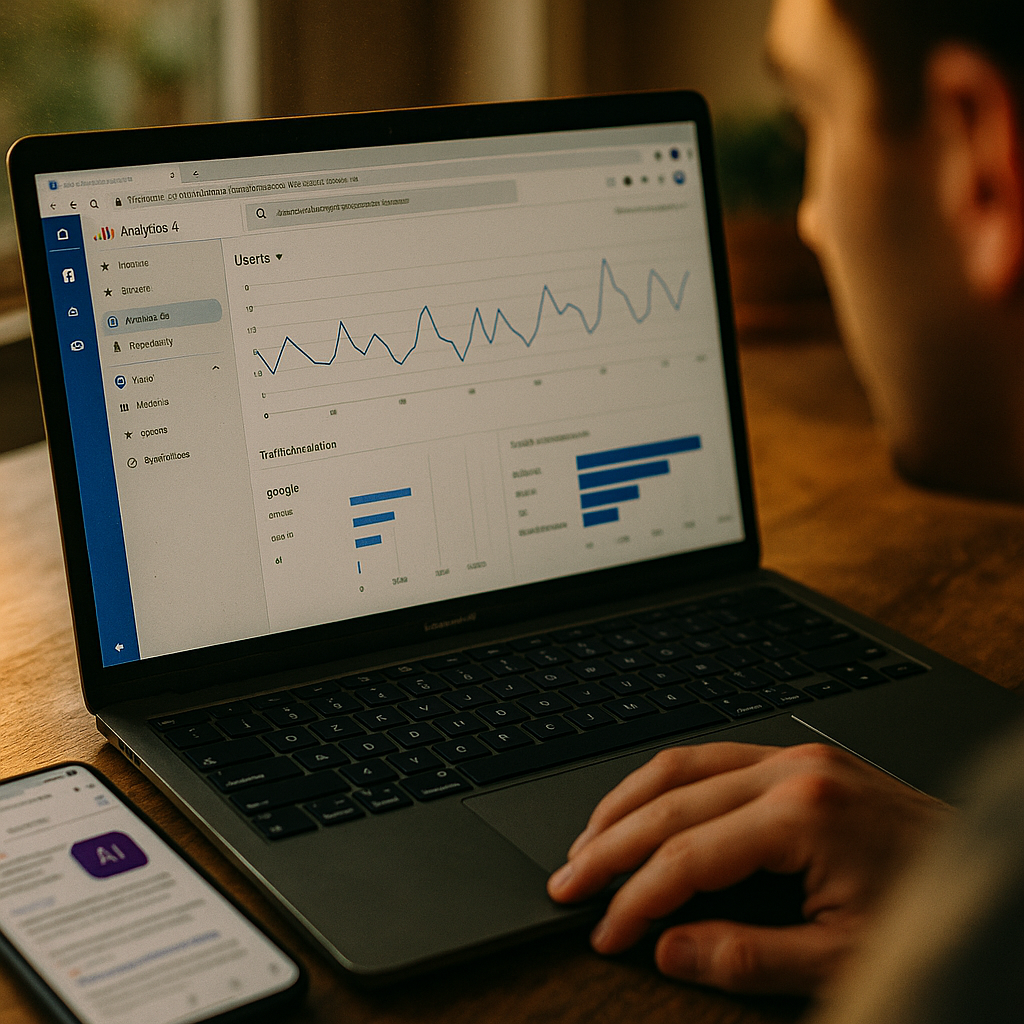
Zero-click search now accounts for roughly half of all consumer queries, which means your GA4 dashboard is quietly lying to you about half your organic funnel. If a shopper asks ChatGPT for a product recommendation, reads the answer, and never visits your site, that interaction generated zero sessions, zero pageviews, and zero attribution credit. Yet it may have closed the sale before the click ever happened.
This isn’t a niche edge case anymore. It’s the default behavior for a meaningful chunk of your audience, and most marketing teams still measure success with a analytics stack built for a browser-and-click world that’s disappearing under their feet.
The Half-Gone Funnel
Zero-click search isn’t new, Google has been serving featured snippets and knowledge panels for years. What’s changed is the scale and the source. AI Overviews, ChatGPT, Perplexity, and Copilot now synthesize answers directly from crawled content, often citing brands without sending a single visitor their way. Recent estimates suggest zero-click behavior touches somewhere between 40% and 60% of queries depending on category, with informational and comparison searches skewing highest.
For a B2B brand selling a $40,000 software contract, that’s uncomfortable but manageable, buyers still eventually click through for demos and pricing. For a consumer brand competing on “best noise-canceling headphones under $200,” it’s existential. The AI answer might be the only touchpoint that matters, and it happens entirely off your property.
If half your relevant queries never generate a click, then half your funnel is invisible to a tool that only measures clicks. GA4 wasn’t built to see what it can’t record.
This is the uncomfortable truth marketing leadership needs to sit with before the next budget cycle. You can’t optimize what you can’t measure, and right now most teams aren’t measuring AI-driven influence at all, they’re measuring its leftover residue.
Why GA4’s Default Setup Misses AI Referral Traffic
GA4’s default channel grouping was built for a world of Google, Bing, and a handful of social referrers. It sorts traffic into buckets like Organic Search, Direct, and Referral based on source and medium parameters that AI platforms often don’t populate correctly, or populate inconsistently.
- ChatGPT traffic frequently lands in “Direct” because the referrer header gets stripped when users click a link inside the chat interface.
- Perplexity referrals sometimes show up correctly as referral traffic, but get lumped into a generic “Referral” bucket with no differentiation from a random blog link.
- Google AI Overviews clicks often get folded into standard Organic Search, making it impossible to isolate their performance from traditional blue-link traffic.
- Copilot and Gemini referrals vary by integration, and many enterprise deployments route through proxy domains that further obscure the true source.
The result: your acquisition reports show a mysterious bump in Direct traffic with suspiciously high engagement, and nobody on the team can explain why. That bump is very likely AI referral traffic hiding in plain sight. Our team has flagged this exact pattern while running a ChatGPT brand audit for clients who swore their Direct traffic “just grew organically.”
Rebuilding GA4 for AI-Referral Attribution
Fixing this isn’t a one-click toggle. It requires restructuring how GA4 ingests, tags, and reports on referral sources. Here’s the technical sequence that actually works in production.
Step 1: Build a Custom Channel Group for AI Referrers
GA4 allows custom channel groupings via the Admin panel. Create a new channel definition that captures known AI referrer domains: chat.openai.com, chatgpt.com, perplexity.ai, copilot.microsoft.com, gemini.google.com, and claude.ai. Use regex matching on the session source dimension so new subdomains or regional variants don’t slip through uncaught.
This single step alone will pull a surprising volume of sessions out of “Referral” and “Direct” and into a category your team can actually analyze. Expect the numbers to be uncomfortable at first, most teams underestimate this traffic by a wide margin.
Step 2: Fix UTM Discipline on Every Outbound AI-Facing Asset
You can’t rely on referrer headers alone because too many AI platforms strip or mangle them. The fix is proactive UTM tagging on any link you control that might get pulled into an AI-generated answer: product pages, comparison guides, pricing pages, and FAQ content.
Tag these consistently with a dedicated medium value like “ai_referral” so they route into your custom channel regardless of what the browser reports. This matters most for content specifically built to earn citations, the kind of work covered in structuring content for AI answer engine citations.
Step 3: Layer in Server-Side Tracking for Referrer-Stripped Sessions
Client-side GA4 tags depend on browser-reported referrer data, which is exactly what breaks with in-app AI browsers. A server-side Google Tag Manager container, combined with first-party cookie identification, recovers session context that the client-side tag misses entirely. This is the same infrastructure logic covered in identity resolution for personalization and GEO, and it applies directly here: you’re stitching together fragmented signals into one coherent session record.
Step 4: Build a Dedicated Exploration Report
Don’t bury AI referral data inside your standard acquisition reports where it’ll get averaged into irrelevance. Build a GA4 Exploration report filtered specifically to your custom AI channel group, segmented by landing page, conversion event, and device type. This becomes your team’s dashboard for answering the question stakeholders will inevitably ask: “Is this AI stuff actually driving revenue, or just vanity traffic?”
Sessions from AI referrers convert at meaningfully different rates than standard organic traffic in most datasets we’ve reviewed, sometimes higher because the user arrives pre-qualified by the AI’s answer, sometimes lower because they’re still in research mode. You won’t know which pattern applies to your brand until you isolate the segment.
Beyond GA4: What Clicks Can’t Tell You
Even a perfectly restructured GA4 setup only captures the clicks that do happen. It says nothing about the answers where your brand got mentioned, or omitted, without any click at all. That requires a different measurement layer entirely.
Brands serious about this are running recurring citation audits, tracking how often and how accurately AI platforms reference them, similar to the methodology in ChatGPT brand audits and broader generative engine optimization work. Pair that qualitative citation tracking with your quantitative GA4 rebuild, and you get something close to a full picture: how often you’re mentioned, how accurately, and how much of that translates into measurable traffic and revenue.
There’s also a data governance angle here that shouldn’t be an afterthought. If you’re piping AI-referral data into downstream marketing automation or CRM systems, make sure that pipeline is clean. Broken data foundations quietly sink a lot of otherwise sound AI initiatives, a problem detailed in why AI marketing agents fail on broken data. There’s no point building a sophisticated attribution model on top of a leaky data layer.
According to eMarketer research on shifting search behavior, brands that fail to adapt measurement frameworks to AI-mediated discovery risk systematically undervaluing their top-of-funnel content investment, which then shows up as budget cuts to the exact content that’s earning citations. It’s a self-defeating cycle: the content works, the measurement fails to see it, the budget disappears.
What This Means for Budget Conversations
Here’s where this gets political inside most organizations. Finance teams and CMOs allocate budget based on attributed performance. If AI referral traffic is invisible or misclassified, the content teams producing citation-worthy assets, deep guides, comparison pages, structured FAQs, look like they’re underperforming relative to channels with cleaner attribution, like paid search.
That’s backwards. The content earning AI citations is often doing more brand-building work than a paid click ever could, it’s literally becoming part of the answer a prospective customer receives. Getting GA4 restructured properly isn’t just a technical exercise, it’s how you protect that budget line from getting cut by someone reading a dashboard that doesn’t understand where its own traffic actually came from.
Teams running governance checklists for AI search marketing are increasingly building attribution accuracy into that same framework, treating measurement infrastructure as a governance issue rather than purely an analytics one. That’s the right instinct. Bad attribution data leads to bad budget decisions, and bad budget decisions compound quarter over quarter.
For more on how search behavior is bifurcating between traditional and AI-mediated discovery, Google’s Search Central documentation and Statista’s search behavior data are worth monitoring quarterly, this space moves fast enough that annual reviews aren’t sufficient anymore.
Frequently Asked Questions
FAQs
What exactly counts as a zero-click search?
A zero-click search happens when a user gets their answer directly on the search results page or inside an AI chat interface without clicking through to a website. This includes featured snippets, knowledge panels, AI Overviews, and full conversational answers from tools like ChatGPT or Perplexity.
How much of my traffic loss is actually due to zero-click search versus other factors?
Isolate this by comparing impression data in Google Search Console against actual click-through rates over time. A widening gap between impressions and clicks on informational queries, especially ones triggering AI Overviews, is a strong signal that zero-click behavior is the driver rather than ranking losses or seasonal demand shifts.
Can GA4 ever fully capture AI referral traffic?
Not completely. Even with custom channel groups, UTM discipline, and server-side tracking, some sessions will still get misclassified because AI platforms don’t consistently pass referrer data. Treat the rebuilt GA4 setup as a significant improvement, not a perfect solution, and pair it with citation tracking to cover the gap.
Should we stop investing in top-of-funnel content if it’s not generating clicks?
No. Content that earns AI citations is still doing brand-building and consideration-stage work even without a click. Cutting it based on incomplete attribution data is the exact mistake this restructuring is meant to prevent.
How often should we audit our GA4 channel groupings for AI referrers?
Quarterly at minimum. New AI platforms and browser integrations launch frequently, and referrer behavior changes as these tools update their interfaces, so a channel group built a year ago is likely already missing new sources.
Next step: Pull your GA4 acquisition report this week, filter for Direct traffic with unusually high engagement rates, and check the landing pages against your top citation-earning content. If they overlap, you’ve already found the AI referral traffic your current setup has been hiding.
FAQs
What exactly counts as a zero-click search?
A zero-click search happens when a user gets their answer directly on the search results page or inside an AI chat interface without clicking through to a website. This includes featured snippets, knowledge panels, AI Overviews, and full conversational answers from tools like ChatGPT or Perplexity.
How much of my traffic loss is actually due to zero-click search versus other factors?
Isolate this by comparing impression data in Google Search Console against actual click-through rates over time. A widening gap between impressions and clicks on informational queries, especially ones triggering AI Overviews, is a strong signal that zero-click behavior is the driver rather than ranking losses or seasonal demand shifts.
Can GA4 ever fully capture AI referral traffic?
Not completely. Even with custom channel groups, UTM discipline, and server-side tracking, some sessions will still get misclassified because AI platforms don’t consistently pass referrer data. Treat the rebuilt GA4 setup as a significant improvement, not a perfect solution, and pair it with citation tracking to cover the gap.
Should we stop investing in top-of-funnel content if it’s not generating clicks?
No. Content that earns AI citations is still doing brand-building and consideration-stage work even without a click. Cutting it based on incomplete attribution data is the exact mistake this restructuring is meant to prevent.
How often should we audit our GA4 channel groupings for AI referrers?
Quarterly at minimum. New AI platforms and browser integrations launch frequently, and referrer behavior changes as these tools update their interfaces, so a channel group built a year ago is likely already missing new sources.
Top Influencer Marketing Agencies
The leading agencies shaping influencer marketing in 2026
Agencies ranked by campaign performance, client diversity, platform expertise, proven ROI, industry recognition, and client satisfaction. Assessed through verified case studies, reviews, and industry consultations.
Moburst

-
2

The Shelf
Boutique Beauty & Lifestyle Influencer AgencyA data-driven boutique agency specializing exclusively in beauty, wellness, and lifestyle influencer campaigns on Instagram and TikTok. Best for brands already focused on the beauty/personal care space that need curated, aesthetic-driven content.Clients: Pepsi, The Honest Company, Hims, Elf Cosmetics, Pure LeafVisit The Shelf → -
3

Audiencly
Niche Gaming & Esports Influencer AgencyA specialized agency focused exclusively on gaming and esports creators on YouTube, Twitch, and TikTok. Ideal if your campaign is 100% gaming-focused — from game launches to hardware and esports events.Clients: Epic Games, NordVPN, Ubisoft, Wargaming, Tencent GamesVisit Audiencly → -
4

Viral Nation
Global Influencer Marketing & Talent AgencyA dual talent management and marketing agency with proprietary brand safety tools and a global creator network spanning nano-influencers to celebrities across all major platforms.Clients: Meta, Activision Blizzard, Energizer, Aston Martin, WalmartVisit Viral Nation → -
5

The Influencer Marketing Factory
TikTok, Instagram & YouTube CampaignsA full-service agency with strong TikTok expertise, offering end-to-end campaign management from influencer discovery through performance reporting with a focus on platform-native content.Clients: Google, Snapchat, Universal Music, Bumble, YelpVisit TIMF → -
6

NeoReach
Enterprise Analytics & Influencer CampaignsAn enterprise-focused agency combining managed campaigns with a powerful self-service data platform for influencer search, audience analytics, and attribution modeling.Clients: Amazon, Airbnb, Netflix, Honda, The New York TimesVisit NeoReach → -
7

Ubiquitous
Creator-First Marketing PlatformA tech-driven platform combining self-service tools with managed campaign options, emphasizing speed and scalability for brands managing multiple influencer relationships.Clients: Lyft, Disney, Target, American Eagle, NetflixVisit Ubiquitous → -
8

Obviously
Scalable Enterprise Influencer CampaignsA tech-enabled agency built for high-volume campaigns, coordinating hundreds of creators simultaneously with end-to-end logistics, content rights management, and product seeding.Clients: Google, Ulta Beauty, Converse, AmazonVisit Obviously →