


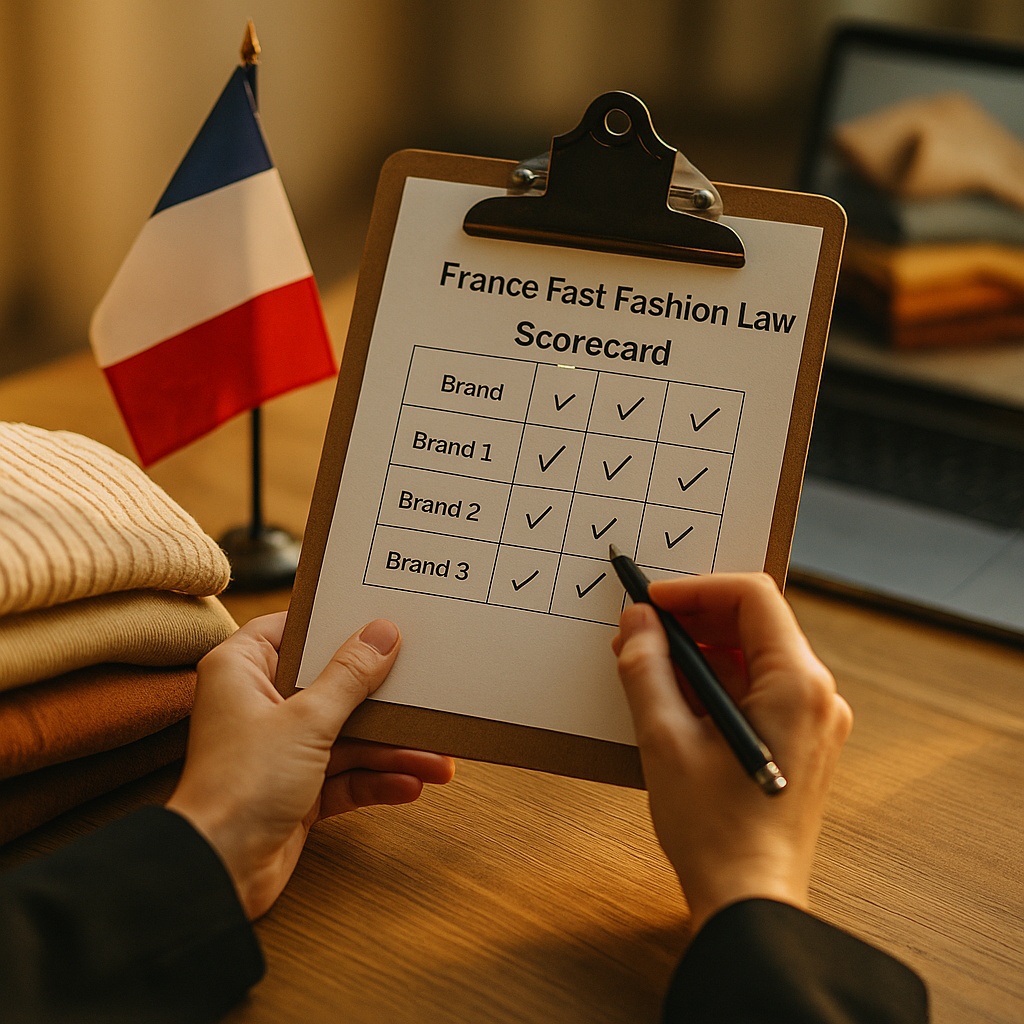
Roughly 62% of French consumers say they’ve noticed fewer ultra-fast fashion ads since France’s landmark law took effect — but the bigger story is who else got caught in the blast radius. The France ultra-fast fashion law was supposed to target Shein and Temu. Six months in, brands selling home goods, beauty, and even mid-market apparel are discovering the rules bleed further than anyone drafted for.
If your brand sells anything remotely adjacent to fast fashion and you’re running influencer campaigns targeting French consumers, this is your scorecard. Not a legal summary. An operational gut-check.
What the Law Actually Does (A Quick Refresher)
France’s law, passed to curb the environmental and social harm of disposable fashion, does three things that matter to marketers: it bans advertising for designated ultra-fast fashion brands, it imposes escalating environmental penalties on qualifying garments, and it requires influencer disclosures specific to sustainability claims. The government maintains a list of covered companies, currently anchored by Shein, with Temu’s fashion vertical under review for addition.
Sounds narrow. It isn’t. The ad ban language covers “promotion” broadly enough that agencies are still arguing over what counts. Does a haul video featuring one Shein item alongside eight other brands count as promotion? What about a creator who reviews a Shein product critically, but still shows the unboxing? Six months of enforcement guidance later, we have partial answers, not full clarity.
The compliance risk isn’t the ban itself — it’s the definitional fuzziness around “adjacent” categories that weren’t the law’s original target but got swept into its enforcement logic.
The Scope Creep Nobody Priced In
Here’s what caught brand legal teams off guard: the law’s environmental scoring mechanism (based on garment lifecycle, production volume, and textile origin) doesn’t just apply to companies on the named list. It’s a scoring framework that could be extended to any apparel brand with a similar production model. France’s environment ministry has signaled openness to adding brands that meet the scoring threshold, regardless of whether they’re a household “ultra-fast fashion” name.
That means beauty brands with fashion-adjacent drop culture (think: limited collections, TikTok-driven virality, high SKU turnover) are watching nervously. So are homeware brands using the same low-cost, high-volume manufacturing playbook. If your production model rhymes with Shein’s, even if your product category doesn’t, you’re a candidate for future scope expansion.
We covered the initial ad-law mechanics in detail when the legislation passed — see why brands must pre-audit now for the baseline. Six months on, the pre-audit advice holds, but the target list has gotten blurrier, not clearer.
Who’s Actually at Risk Right Now
- Named brands and their retail partners: Direct ad restrictions, plus liability for any creator campaign that promotes them even indirectly.
- Marketplace sellers using Shein/Temu-style fulfillment: Even without brand-name exposure, similar production and pricing models put you on the ministry’s radar for future scoring inclusion.
- Multi-brand haul and dupe content creators: Creators who regularly feature named brands alongside others now carry disclosure and placement risk that brands can’t fully control once content goes live.
- Beauty and accessories brands with fast-cycle drops: Not currently covered, but structurally similar enough to warrant a compliance review before scope expansion catches you flat-footed.
Six-Month Enforcement Reality: What’s Actually Happening
Enforcement so far has been more bark than bite, but the bark is getting louder. France’s advertising regulator (ARPP) has issued warnings rather than fines in most early cases, giving brands a grace period that’s clearly not permanent. Reports suggest a handful of formal penalty notices have gone out, mostly targeting direct paid media placements rather than organic influencer content.
That’s the gap brands are exploiting, intentionally or not. Paid ads are easy to police. Organic creator content, especially cross-border content viewed by French audiences but posted by creators based elsewhere, is much harder to enforce against. Regulators know this. Expect enforcement focus to shift toward influencer content specifically as the paid-media compliance rate improves.
Practically, that means the honeymoon period for organic influencer gray zones is ending. If your brand has been treating creator content as lower-risk than paid media under this law, that assumption needs revisiting now, not after the first high-profile enforcement action against a creator campaign.
Building Your Compliance Scorecard
Rather than waiting for definitive guidance that may never fully arrive, treat this like any other emerging regulatory risk: build a scoring framework internally and audit against it quarterly. Here’s the structure we’d recommend for brand and agency compliance teams.
1. Category Proximity Score
Rate your product category on a scale of direct exposure: apparel with fast-cycle production sits at high risk, beauty and accessories with similar drop cadences sit at medium risk, and unrelated categories (food, tech, services) sit at low risk. This isn’t about current legal status. It’s about how quickly you’d need to pivot if scope expands.
2. Creator Content Audit
Pull the last two quarters of influencer content mentioning your brand in France-facing markets. Flag any content that also features named ultra-fast fashion brands, even in passing. Haul videos, “get ready with me” content, and dupe comparisons are the highest-risk formats because they naturally juxtapose your product against covered brands.
3. Disclosure Language Review
France’s disclosure requirements around sustainability claims are stricter than general EU rules. If your creators make any environmental or ethical production claims, cross-check that language against current ARPP guidance. This connects directly to broader disclosure consistency work brands should already be doing — see our cross-border disclosure matrix for how FTC, ASA, and DSA rules intersect with country-specific rules like France’s.
4. Contract Language Update
Most influencer contracts written before this law don’t address ultra-fast fashion adjacency at all. Brands should be adding specific clauses requiring creators to disclose any competing brand placements in the same content, and indemnification language covering regulatory penalties tied to non-compliant creator posts. Our piece on creator contracts that prevent disputes covers the broader indemnification logic that applies here too.
If your creator contracts were drafted before this law passed, they almost certainly don’t cover ultra-fast fashion adjacency risk — and that gap is now a live liability, not a theoretical one.
5. Escalation Trigger Mapping
Set clear internal thresholds for when a compliance question gets escalated to legal versus handled by the marketing team. Ambiguous cases (a creator wearing an unnamed brand that resembles a covered product) shouldn’t sit with a campaign manager making a judgment call alone. This is the same logic behind referral risk triggers used for FTC escalation in the US market, adapted for France’s regulatory structure.
Why This Matters Beyond France
France rarely legislates in isolation on consumer protection issues. The EU has watched France’s Anti-Waste Law framework closely, and there’s active discussion at the EU level about extending fast-fashion environmental scoring bloc-wide. Italy and Germany have both signaled interest in similar textile-waste legislation.
That means brands treating this as a France-only compliance exercise are underestimating the timeline. What’s happening in Paris now is very likely a preview of what’s coming to Brussels within the next 18 to 24 months. Building the scorecard framework now, rather than waiting for EU-wide rules, gives compliance and legal teams a real head start.
It also intersects with existing EU digital commerce rules already reshaping creator commerce operations, like the parcel duty changes covered in our TikTok Shop merchant agreement audit. Brands running EU-facing commerce and content programs are increasingly dealing with a patchwork of overlapping rules, not a single clean regulation. Data from Statista on EU fast-fashion consumption trends suggests regulatory pressure is only going to intensify as textile waste volumes climb.
The Practical Cost of Getting This Wrong
Penalties under the current law scale with garment volume and can reach up to 10% of a brand’s advertising spend allocated to the offending campaign, capped at a fixed ceiling that ARPP has adjusted upward since initial passage. That’s real money for a mid-market brand running a heavy French influencer program. But the bigger cost is usually reputational, not financial.
French consumers, and increasingly EU consumers broadly, have shown they’ll punish brands seen as skirting environmental accountability rules. A recent eMarketer analysis of European sustainability sentiment found consumer trust drops sharply after any public compliance failure tied to environmental claims, regardless of whether a fine was ultimately issued. Getting flagged, even without a formal penalty, does damage that outlasts the fine.
Agencies managing creator relationships in France should also expect client-side scrutiny to intensify. Marketing leadership doesn’t want to explain to a board why an influencer program triggered regulatory attention that legal didn’t see coming. That’s an internal credibility cost that’s harder to quantify than a fine, but arguably more damaging long-term.
What to Do This Quarter
Don’t wait for the “adjacent category” list to become official. Run the category proximity audit now, update creator contracts before your next campaign cycle, and build the escalation trigger map before, not after, a creator content issue lands on your desk.
The brands treating this as a paperwork exercise are going to be the ones explaining themselves to ARPP next quarter. The brands treating it as an operational build are going to be ready when the EU inevitably follows France’s lead.
Frequently Asked Questions
Does France’s ultra-fast fashion law apply to brands outside the named companies?
Not directly yet, but the environmental scoring mechanism underlying the law is designed to be extensible. Brands with similar high-volume, low-cost production models should assume future scope expansion is likely rather than unlikely.
What counts as “promotion” under the ad ban?
Enforcement guidance so far treats direct paid advertising as clearly covered. Organic influencer content featuring named brands, even alongside other products, sits in a gray zone that regulators are actively clarifying through case-by-case warnings rather than published rules.
Are creators based outside France at risk for content viewed by French audiences?
This remains one of the murkiest areas of enforcement. Cross-border content aimed at or reaching French audiences can theoretically fall under the law’s scope, but enforcement against non-French creators has been minimal to date. That’s likely to change as regulators shift focus from paid media to organic content.
How should brands update influencer contracts for this law?
Add clauses requiring creators to disclose any competing or covered-brand placements within the same content, and build in indemnification language covering regulatory penalties tied to non-compliant posts. Review this alongside broader disclosure and contract compliance work already underway for FTC and ASA rules.
Is this law likely to expand across the EU?
Signals point that way. The EU has shown active interest in textile-waste legislation modeled partly on France’s approach, and Italy and Germany have both floated similar measures. Brands with meaningful EU exposure should treat France’s law as an early preview, not an isolated case.
Frequently Asked Questions
Top Influencer Marketing Agencies
The leading agencies shaping influencer marketing in 2026
Agencies ranked by campaign performance, client diversity, platform expertise, proven ROI, industry recognition, and client satisfaction. Assessed through verified case studies, reviews, and industry consultations.
Moburst

-
2

The Shelf
Boutique Beauty & Lifestyle Influencer AgencyA data-driven boutique agency specializing exclusively in beauty, wellness, and lifestyle influencer campaigns on Instagram and TikTok. Best for brands already focused on the beauty/personal care space that need curated, aesthetic-driven content.Clients: Pepsi, The Honest Company, Hims, Elf Cosmetics, Pure LeafVisit The Shelf → -
3

Audiencly
Niche Gaming & Esports Influencer AgencyA specialized agency focused exclusively on gaming and esports creators on YouTube, Twitch, and TikTok. Ideal if your campaign is 100% gaming-focused — from game launches to hardware and esports events.Clients: Epic Games, NordVPN, Ubisoft, Wargaming, Tencent GamesVisit Audiencly → -
4

Viral Nation
Global Influencer Marketing & Talent AgencyA dual talent management and marketing agency with proprietary brand safety tools and a global creator network spanning nano-influencers to celebrities across all major platforms.Clients: Meta, Activision Blizzard, Energizer, Aston Martin, WalmartVisit Viral Nation → -
5

The Influencer Marketing Factory
TikTok, Instagram & YouTube CampaignsA full-service agency with strong TikTok expertise, offering end-to-end campaign management from influencer discovery through performance reporting with a focus on platform-native content.Clients: Google, Snapchat, Universal Music, Bumble, YelpVisit TIMF → -
6

NeoReach
Enterprise Analytics & Influencer CampaignsAn enterprise-focused agency combining managed campaigns with a powerful self-service data platform for influencer search, audience analytics, and attribution modeling.Clients: Amazon, Airbnb, Netflix, Honda, The New York TimesVisit NeoReach → -
7

Ubiquitous
Creator-First Marketing PlatformA tech-driven platform combining self-service tools with managed campaign options, emphasizing speed and scalability for brands managing multiple influencer relationships.Clients: Lyft, Disney, Target, American Eagle, NetflixVisit Ubiquitous → -
8

Obviously
Scalable Enterprise Influencer CampaignsA tech-enabled agency built for high-volume campaigns, coordinating hundreds of creators simultaneously with end-to-end logistics, content rights management, and product seeding.Clients: Google, Ulta Beauty, Converse, AmazonVisit Obviously →