


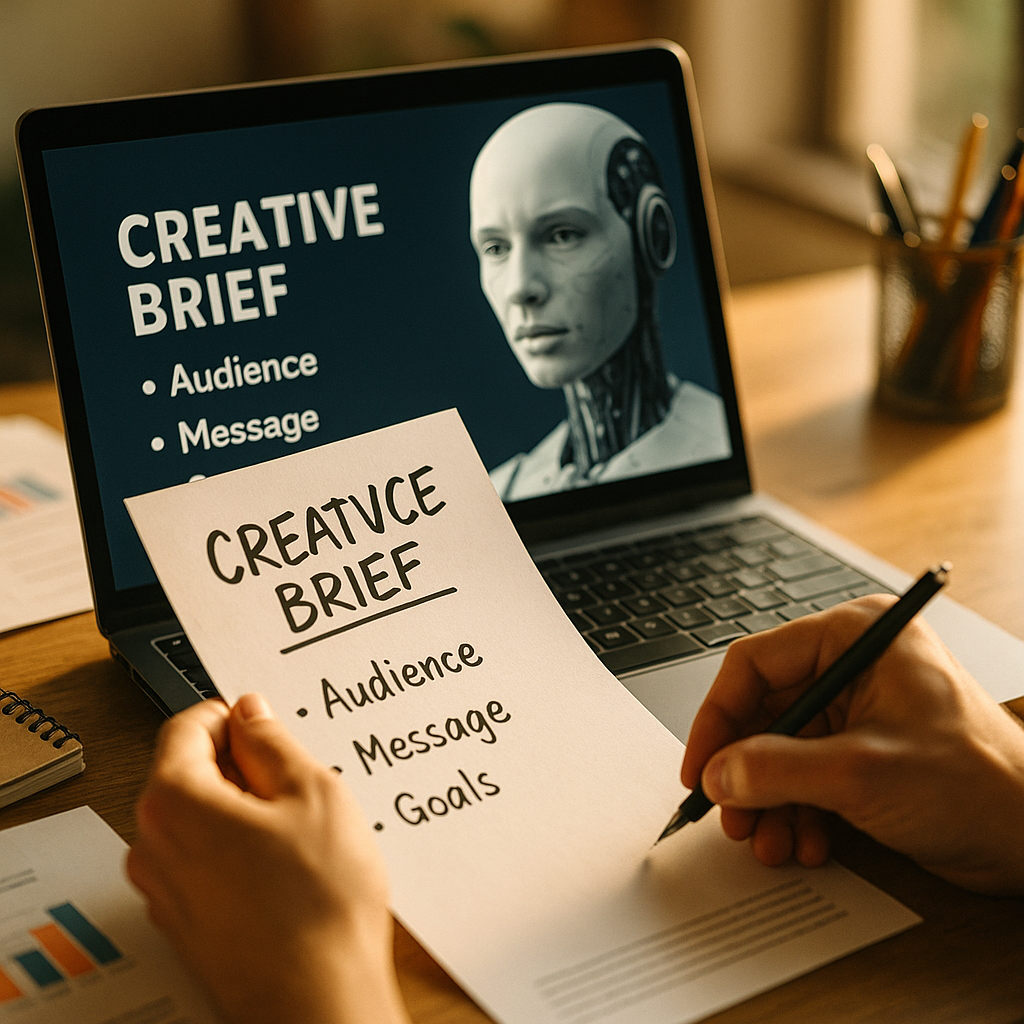
One in three marketers using generative AI for creative work has shipped a brief containing a fabricated statistic, a made-up influencer quote, or a nonexistent campaign precedent. Retrieval-Augmented Generation is the fix most brand teams haven’t implemented yet, even though the technology has been production-ready for years. If your creative briefs are still coming out of a raw LLM with no grounding layer, you’re one hallucinated claim away from a legal review nightmare.
What RAG Actually Does (No, It’s Not Just “Better Prompting”)
Retrieval-Augmented Generation pairs a large language model with a retrieval system that pulls real documents, before the model generates a response. Instead of asking an LLM to answer purely from its training data (which is frozen, dated, and prone to confident guessing), RAG fetches relevant, verified content from your own knowledge base first. The model then writes its answer using that retrieved material as grounding.
Think of it as the difference between asking a freelancer to write from memory versus handing them your brand guidelines, past campaign reports, and creator performance data before they start typing. One approach invites invention. The other constrains it.
For creative briefs specifically, this matters enormously. A brief touches brand voice guidelines, past campaign learnings, influencer performance benchmarks, legal disclosure requirements, and competitive positioning. Ask a general-purpose model to draft that without grounding, and it will fill gaps with plausible-sounding fiction. That’s not a bug in the model, it’s the mechanism working exactly as designed: LLMs predict likely next words, not verified facts.
RAG doesn’t make an AI model smarter. It makes the model’s answers accountable to a source you control, which is what marketing legal and compliance teams actually need.
Why Hallucinations Are a Bigger Risk in Briefs Than in Chat
A hallucinated answer in a casual chatbot session is annoying. A hallucinated claim baked into a creative brief that goes to twelve creators, three agencies, and a paid media team is a liability event.
Consider what actually happens downstream. A brief states “per FTC guidance, disclosure hashtags must appear within the first three lines of caption text.” Sounds authoritative. It’s also not quite what the FTC’s actual endorsement guidance says, and if creators follow the brief verbatim, your brand owns the compliance exposure, not the AI vendor. Multiply that across a 40-creator campaign and you have a real remediation cost.
Or take a subtler case: the brief cites “our Q2 campaign with a mid-tier beauty creator drove 4.2x ROAS,” except no such campaign existed at that ROAS. The number is a statistical average the model inferred from adjacent training data. Nobody catches it until a client asks for the source deck.
This is the same failure mode explored in AI hallucination detection for autonomous media buying — ungrounded outputs look fine until someone tries to verify them, and by then budget has already moved.
The Compliance Angle Nobody’s Pricing In
Brand and agency teams are increasingly using AI to draft not just briefs but disclosure language, contract summaries, and usage-rights clauses. A hallucinated clause referencing a licensing term that doesn’t exist in your actual contract isn’t a creative miss, it’s a legal one. If your governance framework hasn’t caught up, start with something like the AI governance checklist for autonomous media buying agents, which maps closely onto brief generation risk even though it was built for media buying.
How RAG Fits Into a Creative Brief Workflow
Here’s the practical architecture, stripped of vendor jargon:
- Index your source-of-truth documents. Brand guidelines, past brief templates, creator contracts, legal disclosure policies, campaign performance reports, and approved messaging pillars all get chunked and embedded into a vector database.
- Retrieval happens at query time. When a strategist asks the system to “draft a brief for a skincare launch targeting Gen Z creators on TikTok,” the retrieval layer pulls the specific brand guideline sections, the last three skincare campaign reports, and current FTC disclosure language relevant to that request.
- Generation happens with citations. The LLM writes the brief using only the retrieved chunks as its factual basis, and a well-built system will show which source document backed each claim.
- Human review closes the loop. Someone on your team still checks the output, but now they’re verifying against cited sources instead of fact-checking from scratch.
The result: briefs that reference real campaign data, current legal language, and actual brand voice examples, rather than the model’s best guess at what a marketing brief “usually” contains.
What This Looks Like in Practice
Say a mid-size DTC brand runs 15-20 influencer campaigns a quarter. Without RAG, each brief takes a strategist 90 minutes to draft and another 45 minutes for a second reviewer to fact-check against brand docs. With a RAG-grounded drafting tool, the first draft comes back already citing the correct campaign precedent and disclosure language, cutting review time to roughly 15 minutes because the reviewer is confirming, not hunting.
That’s not a hypothetical efficiency gain. It’s the same pattern documented in LSE’s AI marketing pilot, where grounded AI tools reduced review cycles but human oversight remained essential for judgment calls the retrieval layer couldn’t make.
RAG vs Fine-Tuning: Don’t Confuse the Two
Marketers often ask whether fine-tuning a model on brand data solves the same problem. It doesn’t, not fully. Fine-tuning bakes patterns into model weights, which is good for tone and style consistency but bad for factual currency. A fine-tuned model still can’t tell you what happened in last month’s campaign unless that data was in its training set, and retraining every time a new campaign wraps is expensive and slow.
RAG solves a different problem: keeping the model’s factual grounding current without retraining. You update the knowledge base, not the model. New campaign data, updated legal guidance, refreshed brand guidelines, all of it becomes available to the model the moment it’s indexed, no retraining cycle required.
The two approaches aren’t mutually exclusive. Many mature setups combine a fine-tuned model for voice and structure with a RAG layer for facts. If you’re weighing this tradeoff for your own stack, small language models vs fine-tuned LLMs for brand copy breaks down where each approach earns its cost, and the real cost math on fine-tuning versus vendor licensing is worth reading before you commit budget either way.
Fine-tuning teaches a model how to sound like your brand. RAG teaches it what’s actually true about your brand right now. Briefs need both, but they need the second one badly.
What to Actually Look For in a Vendor
RAG has become a checkbox feature in marketing AI tools, which means the term gets used loosely. Ask vendors these specific questions before you buy:
- Can it cite sources? If the tool can’t show which document backed a given claim, it’s not real retrieval grounding, it’s marketing copy.
- How current is the index? Ask about refresh frequency. A knowledge base updated monthly won’t reflect last week’s campaign results.
- Does it retrieve from your data or a generic corpus? Some tools claim RAG but retrieve from public web content, not your proprietary brand assets. That’s not the same thing.
- What happens when retrieval finds nothing relevant? A well-built system should say “I don’t have grounding for this” rather than falling back to ungrounded generation silently.
That last point matters more than most buyers realize. The failure mode to fear isn’t the system that admits uncertainty, it’s the one that fills gaps confidently. This is the same due-diligence lens covered in AI agent marketplace vetting for budget access, and it applies just as directly to brief-generation tools as it does to autonomous bidding agents.
The Data Foundation Problem Is Bigger Than the Tool
Here’s the uncomfortable truth: RAG is only as good as what you feed it. If your brand guidelines live in seventeen outdated Google Docs, your campaign reports are scattered across three platforms, and nobody’s updated the disclosure policy doc since a compliance review two years ago, RAG will retrieve stale or contradictory information just as confidently as an ungrounded model hallucinates. Recent industry survey data backs this up: eMarketer’s research on marketing AI adoption consistently finds a gap between AI tool rollout and measurable performance gains, largely because underlying data hygiene lags behind the tooling.
This is the exact gap explored in AI adoption is up, performance is flat: the data foundation gap. If you’re evaluating a RAG-based briefing tool, budget time and resources for a source-document audit first. It’s unglamorous work, but it’s the actual determinant of whether the system reduces hallucinations or just launders them through a more sophisticated interface.
Related to this: a fragmented MarTech stack makes retrieval harder, not easier, because relevant documents end up siloed across disconnected systems that the retrieval layer can’t reach. If that sounds familiar, the MarTech stack audit for agentic AI data fragmentation is a useful next read before you shop for a RAG vendor.
The ROI Argument Your CFO Will Actually Care About
Frame this in terms finance understands. Every hallucinated claim that reaches a creator, client, or legal reviewer costs real time to catch and correct, and the ones that slip through cost reputation and possibly regulatory exposure. RAG doesn’t eliminate review, but it shifts review from “verify everything from zero” to “confirm cited sources,” which is a meaningfully faster and cheaper task.
According to HubSpot’s state of AI marketing research, teams using grounded AI workflows report materially higher trust in AI-generated first drafts, which translates directly into fewer revision cycles and faster campaign launches. That’s the operational efficiency case, and it’s the one that gets budget approved.
Next step: before your next AI vendor evaluation, ask for a live demo where the tool drafts a brief from a prompt you supply, then trace every factual claim in the output back to a cited source. If it can’t show you the receipts, it’s not RAG, it’s just a well-dressed hallucination risk.
Frequently Asked Questions
What is Retrieval-Augmented Generation in simple terms?
RAG is a method that pairs an AI language model with a search system that retrieves relevant, verified documents before the model generates a response. Instead of relying only on training data, the model grounds its answer in real content you provide, such as brand guidelines or campaign reports.
How does RAG reduce hallucinations in creative briefs specifically?
Creative briefs require accurate references to brand voice, past campaign data, and legal disclosure rules. RAG retrieves the actual source documents for these details before the model writes, which limits the model’s tendency to invent plausible-sounding but false facts.
Is RAG the same as fine-tuning a model?
No. Fine-tuning adjusts a model’s internal weights to match a style or tone, which is useful for voice consistency but doesn’t keep facts current. RAG keeps factual grounding up to date by updating a retrievable knowledge base, without retraining the model itself.
Can small marketing teams implement RAG without a large engineering budget?
Yes. Many current AI marketing platforms now offer RAG-style grounding as a built-in feature, letting teams upload brand documents rather than build retrieval infrastructure from scratch. The main investment is organizing and maintaining a clean, current document library rather than engineering the retrieval system itself.
What’s the biggest risk if a brand skips RAG and uses a raw LLM for briefs?
The main risk is downstream propagation of fabricated claims, whether that’s a misstated compliance requirement, a fictional campaign statistic, or an inaccurate contract term, that reaches creators, agencies, or clients before anyone catches the error.
FAQs
What is Retrieval-Augmented Generation in simple terms?
RAG is a method that pairs an AI language model with a search system that retrieves relevant, verified documents before the model generates a response. Instead of relying only on training data, the model grounds its answer in real content you provide, such as brand guidelines or campaign reports.
How does RAG reduce hallucinations in creative briefs specifically?
Creative briefs require accurate references to brand voice, past campaign data, and legal disclosure rules. RAG retrieves the actual source documents for these details before the model writes, which limits the model’s tendency to invent plausible-sounding but false facts.
Is RAG the same as fine-tuning a model?
No. Fine-tuning adjusts a model’s internal weights to match a style or tone, which is useful for voice consistency but doesn’t keep facts current. RAG keeps factual grounding up to date by updating a retrievable knowledge base, without retraining the model itself.
Can small marketing teams implement RAG without a large engineering budget?
Yes. Many current AI marketing platforms now offer RAG-style grounding as a built-in feature, letting teams upload brand documents rather than build retrieval infrastructure from scratch. The main investment is organizing and maintaining a clean, current document library rather than engineering the retrieval system itself.
What’s the biggest risk if a brand skips RAG and uses a raw LLM for briefs?
The main risk is downstream propagation of fabricated claims, whether that’s a misstated compliance requirement, a fictional campaign statistic, or an inaccurate contract term, that reaches creators, agencies, or clients before anyone catches the error.
Top Influencer Marketing Agencies
The leading agencies shaping influencer marketing in 2026
Agencies ranked by campaign performance, client diversity, platform expertise, proven ROI, industry recognition, and client satisfaction. Assessed through verified case studies, reviews, and industry consultations.
Moburst

-
2

The Shelf
Boutique Beauty & Lifestyle Influencer AgencyA data-driven boutique agency specializing exclusively in beauty, wellness, and lifestyle influencer campaigns on Instagram and TikTok. Best for brands already focused on the beauty/personal care space that need curated, aesthetic-driven content.Clients: Pepsi, The Honest Company, Hims, Elf Cosmetics, Pure LeafVisit The Shelf → -
3

Audiencly
Niche Gaming & Esports Influencer AgencyA specialized agency focused exclusively on gaming and esports creators on YouTube, Twitch, and TikTok. Ideal if your campaign is 100% gaming-focused — from game launches to hardware and esports events.Clients: Epic Games, NordVPN, Ubisoft, Wargaming, Tencent GamesVisit Audiencly → -
4

Viral Nation
Global Influencer Marketing & Talent AgencyA dual talent management and marketing agency with proprietary brand safety tools and a global creator network spanning nano-influencers to celebrities across all major platforms.Clients: Meta, Activision Blizzard, Energizer, Aston Martin, WalmartVisit Viral Nation → -
5

The Influencer Marketing Factory
TikTok, Instagram & YouTube CampaignsA full-service agency with strong TikTok expertise, offering end-to-end campaign management from influencer discovery through performance reporting with a focus on platform-native content.Clients: Google, Snapchat, Universal Music, Bumble, YelpVisit TIMF → -
6

NeoReach
Enterprise Analytics & Influencer CampaignsAn enterprise-focused agency combining managed campaigns with a powerful self-service data platform for influencer search, audience analytics, and attribution modeling.Clients: Amazon, Airbnb, Netflix, Honda, The New York TimesVisit NeoReach → -
7

Ubiquitous
Creator-First Marketing PlatformA tech-driven platform combining self-service tools with managed campaign options, emphasizing speed and scalability for brands managing multiple influencer relationships.Clients: Lyft, Disney, Target, American Eagle, NetflixVisit Ubiquitous → -
8

Obviously
Scalable Enterprise Influencer CampaignsA tech-enabled agency built for high-volume campaigns, coordinating hundreds of creators simultaneously with end-to-end logistics, content rights management, and product seeding.Clients: Google, Ulta Beauty, Converse, AmazonVisit Obviously →