


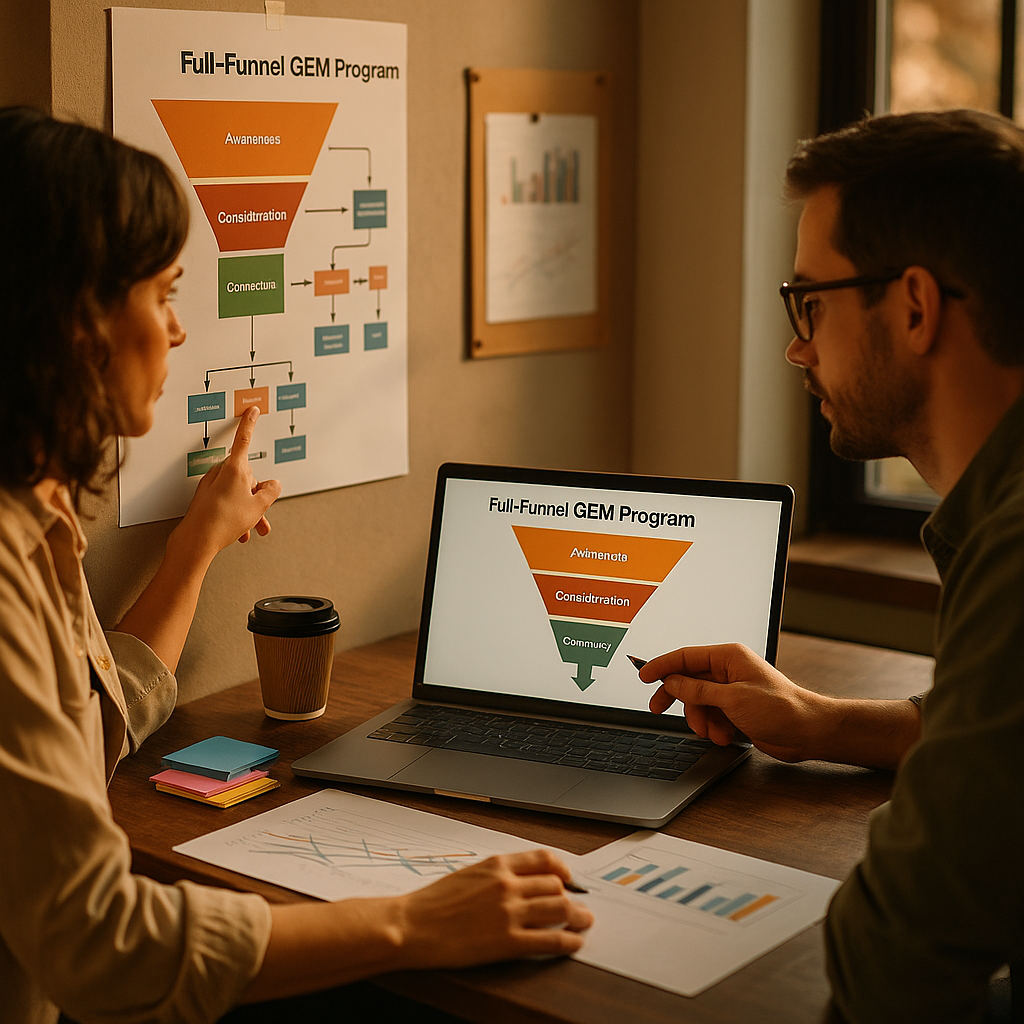
What if your SEO team spent the last three years optimizing for search engines that your buyers have already stopped using as their primary discovery tool? Full-funnel GEM program strategy is now the operational imperative — and most brand digital teams don’t have a build plan.
Why GEO-Only Is Now a Single Point of Failure
Generative AI interfaces — ChatGPT, Perplexity, Google’s AI Overviews, Claude — are intercepting purchase intent queries before they ever reach a traditional SERP. Statista data shows AI assistant usage among working adults grew faster in the last 18 months than any previous search channel transition. Brands optimized exclusively for GEO (Generative Engine Optimization) — structured data, featured snippet targeting, schema — are discovering that ranking signals don’t automatically translate into AI citation authority.
The distinction matters enormously. GEO gets you indexed. GEM gets you cited, recommended, and trusted inside AI-generated responses. Those are different infrastructure problems requiring different team structures, content architectures, and measurement frameworks.
This is a build guide for the teams doing the actual work.
Before You Start: The Baseline Audit That Saves a Quarter
Skip the baseline audit and you’ll rebuild it anyway — after wasting budget on the wrong signals. Before Q1 officially kicks off, spend two to three weeks running a ruthless inventory across four dimensions:
- Citation share: How often does your brand appear in AI-generated responses to your category’s top 50 purchase-intent queries? Use tools like Profound, Otterly, or AthenaHQ to benchmark this. Zero citations is common. It’s a starting point, not a verdict.
- Content authority gaps: Which comparison queries, use-case questions, and expert-framed topics does your brand own content on — and which do competitors own?
- Creator signal inventory: What volume of third-party creator content references your brand authentically? AI models weight independent citation heavily.
- Attribution stack readiness: Can your current stack distinguish GEM-sourced traffic from organic and paid? If not, you’re flying blind before you even launch.
This audit output becomes your Q1 priority stack. Without it, every quarter becomes reactive.
Q1: Infrastructure and Signal Foundation
The first quarter is infrastructure, not content. Resist the pressure to produce.
Your primary Q1 objective is establishing the technical and organizational scaffolding that makes every subsequent quarter compoundable. That means three parallel workstreams running simultaneously:
Technical GEM infrastructure: Deploy structured data at scale — not just product schema, but entity markup that clearly signals your brand’s relationship to category concepts, use cases, and expert positioning. Your brand needs to be a recognizable entity in the knowledge graph that AI models draw from. Work with your dev team to implement comprehensive FAQ schema, HowTo schema, and speakable markup on high-priority pages. Reference Google’s developer documentation as the canonical source for implementation specs.
Creator signal seeding: Start identifying and contracting 8-12 mid-tier creators in your category whose content has demonstrated AI citation potential — typically evidenced by strong organic indexation, consistent E-E-A-T signals in their publishing, and authentic brand integration history. The goal in Q1 isn’t reach. It’s creating the independent third-party signal layer that AI models use to corroborate brand authority claims. For structuring these early-stage creator relationships efficiently, the hybrid creator sponsorship model provides a useful budget architecture.
Measurement foundation: Build your GEM-specific reporting layer before you have data to put in it. Define your citation rate KPIs, establish the AI query monitoring cadence, and set up the creator attribution stack that will let you connect third-party content signals to downstream conversion. This is non-negotiable. Leadership will ask for ROI proof in Q2.
Q2: Content Architecture and Amplification Engine
Now you build content — but with a very specific architecture.
AI models don’t reward volume. They reward depth, corroboration, and topical coherence. Your Q2 content program should be organized around what practitioners call “authority clusters” — a central long-form asset (research summary, methodology guide, expert framework) surrounded by supporting content that references, extends, and substantiates the core piece.
AI citation authority is earned through corroboration, not repetition. A single claim supported by five independent, credible sources will outperform fifty brand-owned pages saying the same thing.
This is where your Q1 creator cohort becomes strategically critical. Brief them not on brand messaging, but on category questions your target buyers ask AI assistants. Have them produce independent, expert-framed content that naturally references your brand as part of a genuine answer. This is fundamentally different from a sponsored post strategy — and the distinction matters for both FTC compliance (reference FTC endorsement guidelines for disclosure requirements) and AI signal quality.
On the amplification side, Q2 is when you activate paid distribution — but selectively. Not every creator asset needs paid boost. Prioritize amplification for content that demonstrates early organic citation potential. The decision framework for where paid amplification adds signal leverage versus just adding reach is covered in detail in the GEM vs GEO budget allocation framework.
Q3: Performance Optimization and Funnel Completion
By Q3, you have real data. Use it aggressively.
Pull your citation rate trends across AI platforms. Identify which content types, which creator voices, and which topic clusters are generating actual AI citations versus organic traffic versus conversion. These three don’t always correlate — and understanding the gaps is where Q3 optimization lives.
Mid-funnel is typically the weakest link in early GEM programs. Brands invest heavily in awareness-level AI visibility (getting cited in “what is X” queries) without building the consideration-level content that appears in “which X is best for Y” queries. Q3 is when you close that gap. Commission comparison content, use-case specificity content, and expert evaluation frameworks — the content types that appear in high-intent AI responses.
Also in Q3: reassess your creator roster. Which creators in your Q1 cohort are generating measurable citation signal? Which are producing reach without AI relevance? The creator performance score framework gives you a structured methodology for this evaluation beyond reach and engagement vanity metrics. Reinvest contracts accordingly.
Lower-funnel completion — the part of the funnel where AI-influenced buyers actually convert — requires a different content and channel mix than mid-funnel. Retargeting audiences who’ve engaged with GEM-cited content, creator content repurposed for retail media environments like TikTok’s ad platform, and email sequences triggered by AI-referred traffic all become viable Q3 tactics once your attribution stack from Q1 is generating reliable data.
Q4: Scale, Systematize, and Prove It
Q4 has two jobs: extract learnings and build the repeatable system.
Scale what worked. This isn’t about doubling everything — it’s about identifying the three to five specific content formats, creator partnership structures, and distribution combinations that demonstrated measurable citation authority improvement and funnel contribution, then systematizing them into always-on programs rather than campaign bursts.
The budget case for Year 2 needs to be built in Q4. That means compiling your citation rate improvement, comparing your GEM-attributed conversion volume against pre-program baselines, and framing the creator program ROI in terms that a CFO conversation can sustain. The blended cost-per-sale model is particularly useful here — it gives you a single number that accounts for both creator fee investment and paid amplification costs against actual revenue contribution.
The brands that will dominate AI-era search aren’t the ones that started with the biggest budgets — they’re the ones that built systematic corroboration infrastructure first and scaled it second.
Document your entity authority baseline from Q1 against Q4 measurements. Present citation share as a competitive metric alongside share of voice. Position GEM not as a content channel but as a brand infrastructure investment with compounding returns — because that’s what the data, when collected correctly, will show.
For teams planning the Year 2 budget model, the three-year creator budget model provides a structured framework for scaling amplified creator spend with predictable ROI trajectories rather than ad hoc budget requests.
Start Q1 with the baseline audit, even if it delays content production by three weeks. Everything compounds from that foundation — and three weeks of discipline at the start is worth two quarters of wasted budget trying to retrofit measurement later.
Frequently Asked Questions
What is a full-funnel GEM program and how does it differ from GEO?
GEO (Generative Engine Optimization) focuses on technical signals — structured data, schema markup, and content formatting — to improve how well your brand’s content is indexed by AI systems. A full-funnel GEM (Generative Engine Marketing) program goes further: it builds a complete infrastructure of brand-owned content, third-party creator signals, paid amplification, and attribution measurement designed to drive AI citation authority, consideration, and conversion across the entire buyer journey — not just top-of-funnel visibility.
How long does it realistically take to see AI citation improvements after launching a GEM program?
Most brand teams see measurable citation rate improvements within 60 to 90 days of launching structured creator signal campaigns alongside technical GEM infrastructure. However, mid-funnel citation authority — appearing in high-intent “best for” and comparison queries — typically takes a full two quarters to establish, especially in competitive categories. The Q1 baseline audit is essential for setting realistic benchmarks before you measure progress.
What budget allocation is appropriate for a first-year GEM program?
There’s no universal answer, but a common starting structure for mid-market brands allocates roughly 40% of GEM budget to creator partnerships and content production, 35% to paid amplification of high-performing creator and owned assets, and 25% to technical infrastructure and measurement tooling. The specific split should be informed by your baseline audit — brands with strong existing content authority need less production investment and more amplification. Brands starting from a low citation baseline need the reverse.
Which AI platforms should brands prioritize monitoring for citation share?
The highest-priority platforms for most B2C and B2B brands are currently Google AI Overviews (given its search volume scale), ChatGPT (for both web browsing and GPT-4o responses), and Perplexity (which skews toward high-intent research queries). Tools like Profound, Otterly, and AthenaHQ allow automated citation monitoring across these platforms. Microsoft Copilot is worth tracking in B2B contexts given its integration with enterprise workflows.
How do you ensure creator content used in a GEM program complies with FTC guidelines?
All creator content that includes paid brand relationships must carry appropriate disclosure, regardless of whether it’s designed for AI citation purposes or traditional social reach. The FTC’s endorsement guidelines apply to any sponsored content — the intent (building AI signal) doesn’t change the disclosure requirement. Work with creators to ensure disclosures are clear, conspicuous, and present in the published content itself, not just in metadata or captions that AI scrapers may not read consistently.
Top Influencer Marketing Agencies
The leading agencies shaping influencer marketing in 2026
Agencies ranked by campaign performance, client diversity, platform expertise, proven ROI, industry recognition, and client satisfaction. Assessed through verified case studies, reviews, and industry consultations.
Moburst

-
2

The Shelf
Boutique Beauty & Lifestyle Influencer AgencyA data-driven boutique agency specializing exclusively in beauty, wellness, and lifestyle influencer campaigns on Instagram and TikTok. Best for brands already focused on the beauty/personal care space that need curated, aesthetic-driven content.Clients: Pepsi, The Honest Company, Hims, Elf Cosmetics, Pure LeafVisit The Shelf → -
3

Audiencly
Niche Gaming & Esports Influencer AgencyA specialized agency focused exclusively on gaming and esports creators on YouTube, Twitch, and TikTok. Ideal if your campaign is 100% gaming-focused — from game launches to hardware and esports events.Clients: Epic Games, NordVPN, Ubisoft, Wargaming, Tencent GamesVisit Audiencly → -
4

Viral Nation
Global Influencer Marketing & Talent AgencyA dual talent management and marketing agency with proprietary brand safety tools and a global creator network spanning nano-influencers to celebrities across all major platforms.Clients: Meta, Activision Blizzard, Energizer, Aston Martin, WalmartVisit Viral Nation → -
5

The Influencer Marketing Factory
TikTok, Instagram & YouTube CampaignsA full-service agency with strong TikTok expertise, offering end-to-end campaign management from influencer discovery through performance reporting with a focus on platform-native content.Clients: Google, Snapchat, Universal Music, Bumble, YelpVisit TIMF → -
6

NeoReach
Enterprise Analytics & Influencer CampaignsAn enterprise-focused agency combining managed campaigns with a powerful self-service data platform for influencer search, audience analytics, and attribution modeling.Clients: Amazon, Airbnb, Netflix, Honda, The New York TimesVisit NeoReach → -
7

Ubiquitous
Creator-First Marketing PlatformA tech-driven platform combining self-service tools with managed campaign options, emphasizing speed and scalability for brands managing multiple influencer relationships.Clients: Lyft, Disney, Target, American Eagle, NetflixVisit Ubiquitous → -
8

Obviously
Scalable Enterprise Influencer CampaignsA tech-enabled agency built for high-volume campaigns, coordinating hundreds of creators simultaneously with end-to-end logistics, content rights management, and product seeding.Clients: Google, Ulta Beauty, Converse, AmazonVisit Obviously →