


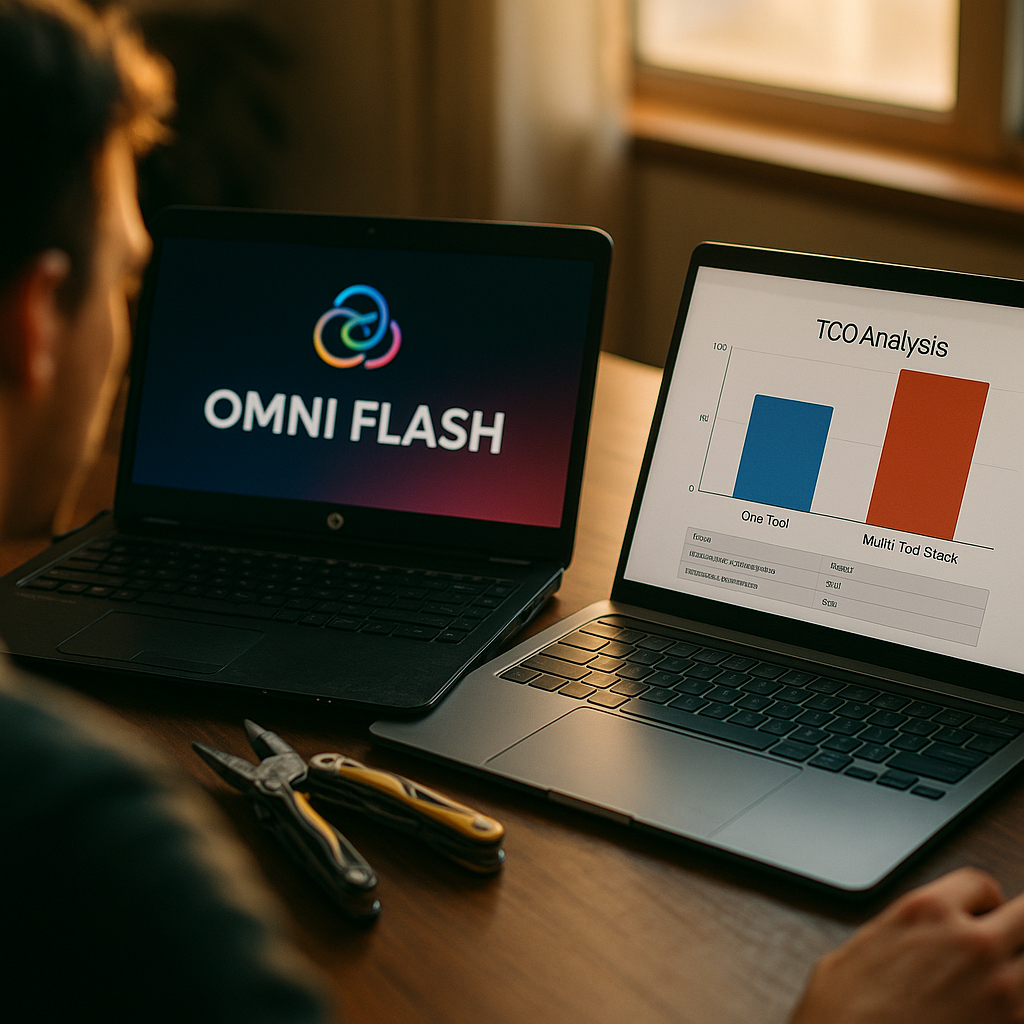
Is Your Multi-Tool Creative Stack Quietly Bankrupting Your Production Budget?
Brand creative teams running separate tools for text, image, and video generation are paying a hidden tax — integration overhead, context loss between handoffs, and licensing fees that compound across every campaign sprint. The Gemini Omni Flash unified production pipeline changes that calculus. But “unified” doesn’t automatically mean “cheaper” or “better.” This TCO analysis gives you the framework to decide.
What the Multi-Tool Stack Actually Costs
Most enterprise creative teams have assembled a stack that looks something like this: a large language model subscription for copy (OpenAI, Anthropic Claude), a dedicated image generation platform (Midjourney, Adobe Firefly, Stable Diffusion via API), a video synthesis tool (Runway, Sora, Pika), and a workflow orchestration layer to stitch them together. That’s four vendor contracts, four compliance reviews, four sets of usage caps, and four support queues when something breaks on a Friday before a campaign launch.
The direct licensing cost for this configuration at mid-enterprise scale runs between $8,000 and $22,000 per month depending on seat counts and API call volumes, according to benchmarks compiled by teams using platforms like HubSpot’s marketing operations research. But that number is the easy part to measure. The hard part is the operational drag.
Consider a standard influencer campaign asset package: 12 static creatives, 4 short-form videos, and 8 localized copy variants. In a best-of-breed stack, a creative producer writes briefs in one tool, generates image concepts in another, exports those assets into a video tool, and then re-prompts copy to match. Every handoff introduces context drift — the visual tone that emerged from your image prompts rarely translates cleanly into video motion, and the copy that worked in one model’s output often needs manual regrounding when pasted into another system. That regrounding takes time. Senior creative director time, specifically, because junior staff lack the model literacy to catch subtle brand misalignments.
Industry practitioners report that cross-tool context loss accounts for 20–35% of revision cycles in multi-modal AI creative workflows — cycles that consume senior creative bandwidth and compress campaign timelines.
For AI campaign production decisions, understanding where that operational drag lives is prerequisite to any honest stack comparison.
The Unified Layer Proposition: What Gemini Omni Flash Actually Does
Gemini Omni Flash operates as a single inference layer capable of generating, understanding, and transforming text, images, and video within a shared context window. The architectural difference matters operationally: when you brief a campaign in natural language, the model’s image output already carries the semantic understanding of that brief — it doesn’t need to be re-prompted or manually transferred. The same session context that shaped your hero image informs the video motion treatment and the copy variants.
For brand creative teams, this translates into three measurable advantages. First, prompt fidelity compounds across modalities. Second, iteration cycles shrink because you’re correcting within one context rather than re-establishing it in three separate tools. Third, your compliance and governance review can sit at a single API endpoint rather than spanning four vendor terms-of-service documents.
Google’s pricing model for Gemini Omni Flash is token-based and tiered, which means high-volume production runs become substantially cheaper per asset than per-seat SaaS alternatives as you scale. Teams running localized video ad production at scale have reported cost-per-asset reductions of 40–60% at volumes above 500 assets per month. Below that threshold, the economics are less clear-cut.
Running the TCO Math: Three Scenarios
Scenario A: Small Brand, Low Volume (under 200 assets/month)
At this scale, a unified pipeline rarely wins on pure cost. The setup investment — API integration, prompt engineering, internal governance documentation — typically runs $15,000–$30,000 in upfront labor. Amortized over 12 months at low volume, your effective cost-per-asset often exceeds what you’d pay using Midjourney and Claude on separate subscriptions. Unless your team has a specific need for tight cross-modal consistency (luxury brand, regulated category), stay with best-of-breed and revisit when volume grows.
Scenario B: Mid-Market Brand, Mixed Volume (200–600 assets/month)
This is where the decision gets genuinely difficult and where most brand teams currently sit. Direct costs may be roughly equivalent. The real differentiator is operational. If your team is producing creator campaign asset variants across 5 or more markets, the context consistency advantage of a unified layer starts generating measurable time savings. A campaign that took three production weeks in a multi-tool stack can realistically compress to 10–12 days. If your senior creative salary burden is north of $180,000 annually, that compression pays back the integration investment within two campaign cycles.
Scenario C: Enterprise Brand or Agency, High Volume (600+ assets/month)
At this scale, unified wins on almost every dimension. Licensing cost advantages compound. Governance complexity drops materially — one vendor contract, one data processing agreement, one model card to review for brand risk. For teams navigating AI creative governance, that reduction in surface area is not a minor benefit. It can represent months of legal and compliance work avoided annually.
Where Best-of-Breed Still Wins
Honest analysis requires acknowledging where specialized tools outperform the unified layer. Midjourney’s aesthetic output still leads for certain visual styles, particularly hyper-stylized fashion and beauty content where brand teams have spent months fine-tuning community-specific prompts. Runway’s video motion control gives cinematographers a granularity of camera movement specification that Gemini Omni Flash hasn’t matched in production environments as of this writing. And for teams with deeply embedded creative data feedback loops built around specific tool outputs, switching costs are real and often underestimated.
The best-of-breed stack also offers redundancy. When one model experiences an outage or a capability regression after an update (which happens more often than vendors advertise), you have alternatives in-flight. A unified pipeline creates a single point of failure that operations teams need to plan around explicitly.
There’s also the question of creative team culture. Senior art directors who have built deep expertise in one tool’s behavior may resist a forced migration. That’s not irrational. Model expertise is a legitimate asset, and the learning curve on a new system has a real productivity cost during the transition window.
Before committing to a unified pipeline, audit your stack for genuine integration debt versus team familiarity bias. The two look similar on the surface but require completely different remediation strategies.
The Decision Framework: Four Questions Before You Commit
Strip away the vendor positioning and the decision comes down to four operational questions:
- What is your monthly asset velocity? Below 200, pause. Above 600, move. Between those numbers, model your senior creative time cost specifically.
- How many markets and languages does your creative need to span? Cross-modal context consistency has disproportionate value in localization-heavy workflows. Teams managing creator campaign architecture across multiple regions feel this acutely.
- What is your current compliance surface area? If you’re in a regulated category (financial services, pharma, alcohol), reducing your vendor count meaningfully reduces governance overhead. That has hard dollar value.
- Do you have the integration capability in-house? A unified pipeline via API requires engineering support for setup and maintenance. If your marketing technology infrastructure is outsourced or under-resourced, factor that into your integration cost estimate. The martech stack audit is a necessary precursor to this conversation.
One more consideration that rarely appears in vendor TCO calculators: the cost of getting it wrong publicly. AI-generated creative that carries inconsistent brand voice across modalities — because text was generated in one system and visuals in another — can surface in brand safety reviews, creator partnership disputes, or consumer backlash. The reputational cost of that misalignment isn’t in any spreadsheet, but it’s real. See AI ads backlash policy guidance for how leading brands are pre-empting that risk.
Additional external context from Statista’s market data and eMarketer’s ad tech research consistently shows that generative AI production costs are declining faster than most finance teams have modeled, which means the breakeven point for unified pipeline adoption is moving earlier than last year’s projections suggested. Build that trajectory into your 18-month planning cycle, not just your current-state budget.
Run a 90-day pilot with a contained campaign workstream before committing your entire production operation to either architecture. Pick a campaign with defined asset types, a clear volume baseline, and a senior creative who can evaluate output quality objectively. Measure revision cycles, not just cost per asset, and you’ll have the data to make this decision with confidence rather than vendor persuasion.
Frequently Asked Questions
What is the Gemini Omni Flash unified production pipeline?
Gemini Omni Flash is Google’s multimodal generative AI model capable of producing text, images, and video within a shared context window. For brand creative teams, this means a single briefing session can generate coherent outputs across all three modalities without re-prompting or manually transferring context between separate tools, reducing production time and cross-modal brand inconsistency.
When does a multi-tool generative AI stack outperform a unified pipeline?
Best-of-breed stacks tend to outperform unified pipelines at low production volumes (under 200 assets per month), when specialized aesthetic output from tools like Midjourney is a non-negotiable requirement, or when your team has deeply embedded creative workflows and feedback loops built around specific tool outputs. They also offer redundancy that a single-vendor pipeline cannot match.
How do you calculate TCO for a generative AI creative pipeline?
A complete TCO analysis must include direct licensing costs, API usage fees, integration engineering labor, governance and compliance review overhead, training and onboarding time, and the operational cost of revision cycles caused by cross-tool context loss. Many teams underestimate the last two categories, which often represent 40–60% of total operational cost in multi-tool environments.
Is Gemini Omni Flash suitable for regulated industries like pharma or financial services?
The governance advantage of a single API endpoint, one data processing agreement, and one model card to review can be significant for regulated categories. However, brands in these sectors should conduct a thorough AI creative governance review before deployment and ensure output review workflows include human oversight at each approval stage.
What is the recommended approach for evaluating this decision before committing?
Run a structured 90-day pilot on a contained campaign workstream with a defined asset volume baseline. Measure revision cycles, senior creative time allocated per asset, cross-modal brand consistency scores, and total cost per deliverable. Compare those figures against your current stack’s performance on the same metrics before making a full migration decision.
Top Influencer Marketing Agencies
The leading agencies shaping influencer marketing in 2026
Agencies ranked by campaign performance, client diversity, platform expertise, proven ROI, industry recognition, and client satisfaction. Assessed through verified case studies, reviews, and industry consultations.
Moburst

-
2

The Shelf
Boutique Beauty & Lifestyle Influencer AgencyA data-driven boutique agency specializing exclusively in beauty, wellness, and lifestyle influencer campaigns on Instagram and TikTok. Best for brands already focused on the beauty/personal care space that need curated, aesthetic-driven content.Clients: Pepsi, The Honest Company, Hims, Elf Cosmetics, Pure LeafVisit The Shelf → -
3

Audiencly
Niche Gaming & Esports Influencer AgencyA specialized agency focused exclusively on gaming and esports creators on YouTube, Twitch, and TikTok. Ideal if your campaign is 100% gaming-focused — from game launches to hardware and esports events.Clients: Epic Games, NordVPN, Ubisoft, Wargaming, Tencent GamesVisit Audiencly → -
4

Viral Nation
Global Influencer Marketing & Talent AgencyA dual talent management and marketing agency with proprietary brand safety tools and a global creator network spanning nano-influencers to celebrities across all major platforms.Clients: Meta, Activision Blizzard, Energizer, Aston Martin, WalmartVisit Viral Nation → -
5

The Influencer Marketing Factory
TikTok, Instagram & YouTube CampaignsA full-service agency with strong TikTok expertise, offering end-to-end campaign management from influencer discovery through performance reporting with a focus on platform-native content.Clients: Google, Snapchat, Universal Music, Bumble, YelpVisit TIMF → -
6

NeoReach
Enterprise Analytics & Influencer CampaignsAn enterprise-focused agency combining managed campaigns with a powerful self-service data platform for influencer search, audience analytics, and attribution modeling.Clients: Amazon, Airbnb, Netflix, Honda, The New York TimesVisit NeoReach → -
7

Ubiquitous
Creator-First Marketing PlatformA tech-driven platform combining self-service tools with managed campaign options, emphasizing speed and scalability for brands managing multiple influencer relationships.Clients: Lyft, Disney, Target, American Eagle, NetflixVisit Ubiquitous → -
8

Obviously
Scalable Enterprise Influencer CampaignsA tech-enabled agency built for high-volume campaigns, coordinating hundreds of creators simultaneously with end-to-end logistics, content rights management, and product seeding.Clients: Google, Ulta Beauty, Converse, AmazonVisit Obviously →