


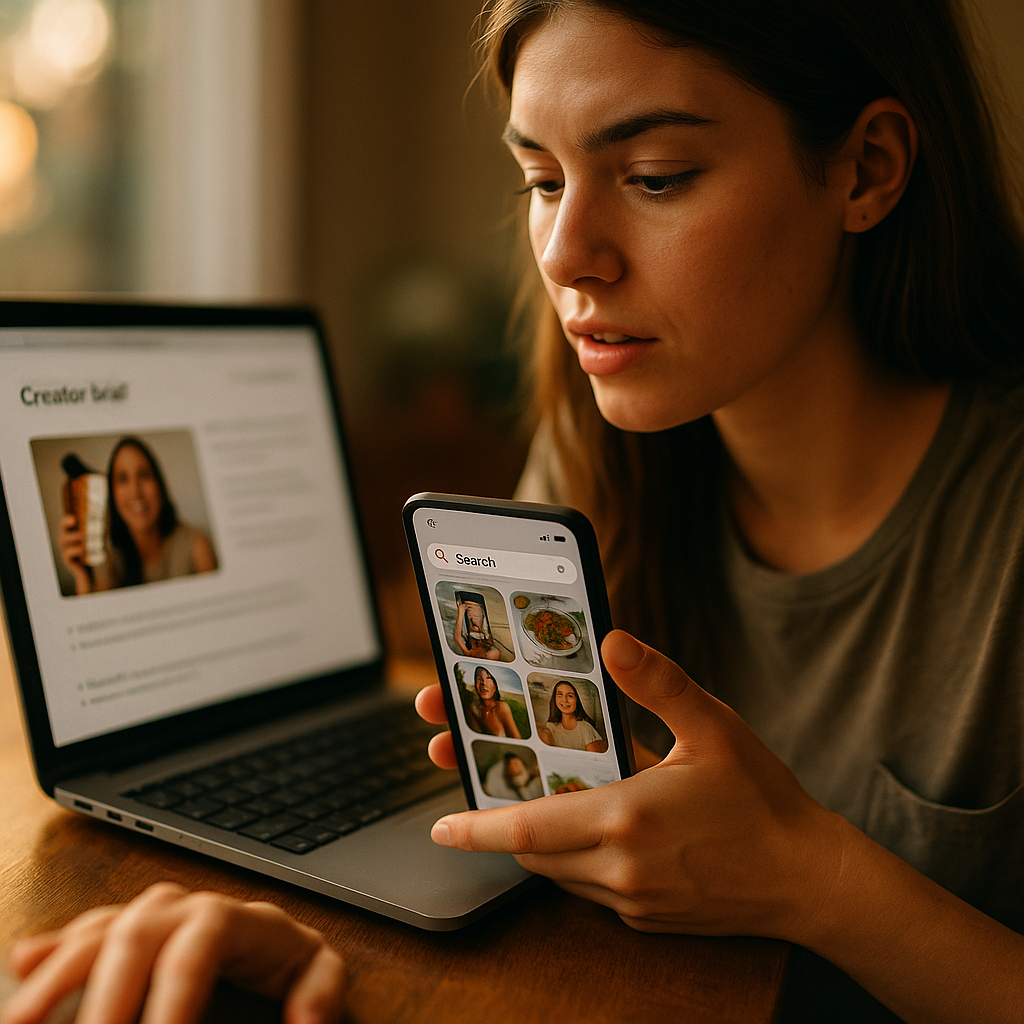
Your Creator Briefs Are Optimized for the Wrong Moment
Roughly 40% of Gen Z consumers use TikTok or Instagram as their first stop for product research — bypassing Google entirely. That number should make every brand strategist rethink what a creator brief is actually for. If your briefs are still engineered around scroll-stopping hooks and awareness metrics, you’re producing content for a discovery behavior that Gen Z has already moved on from. The real opportunity is in Gen Z social search — and right now, most brands are leaving it wide open.
Platform Search Is Not a Feature. It’s the Funnel.
TikTok’s search bar processes over 2 billion queries per day. Instagram’s search has become a genuine product discovery channel, with users actively typing queries like “best SPF for dark skin,” “protein powder that doesn’t taste chalky,” or “affordable linen pants for summer.” These aren’t passive users stumbling onto content — these are intent-driven consumers in a decision-making mindset.
This is a fundamentally different behavior from legacy social browsing. When someone types a query into TikTok Search, they are not waiting to be surprised. They are looking for an answer. That distinction changes everything about what creator content needs to do — and by extension, what your creative briefs need to demand.
A creator brief designed for awareness asks: What will make someone stop scrolling? A brief designed for social search asks: What question is our buyer typing at 11pm before they add to cart? Only one of those briefs builds durable discovery equity.
The operational problem is that most brand teams haven’t updated their brief frameworks since the early days of TikTok-as-entertainment-platform. They’re still briefing creators on emotional resonance and brand tone when they should be briefing them on keyword-rich, question-answering narratives. If you want to understand how Gen Z’s behavior is reshaping brief design across the broader landscape, the shift toward search intent is the through-line.
What Gen Z Is Actually Searching For — and Why It Matters to Your Brief
Spend thirty minutes in TikTok’s search autocomplete and you’ll see the pattern immediately. Gen Z searches are conversational, comparative, and specific. They’re not typing “skincare brand.” They’re typing “is [Brand X] worth it for oily skin,” “vs” queries comparing two SKUs, or “honest review” followed by a category name.
This has direct implications for brief architecture. A search-intent-optimized creator brief needs to include:
- Target search queries: Give creators the actual strings your audience is typing. Pull these from TikTok’s autocomplete, Instagram’s suggested search, and tools like TikTok Ads Manager keyword insights.
- Answer-first structure: The narrative should open by addressing the query, not teasing it. Gen Z search users will swipe immediately if the content doesn’t signal relevance in the first three seconds.
- Specificity mandates: Require creators to name the use case, the skin type, the budget range, the comparison — whatever makes the content match the precision of the search query.
- Natural keyword integration: The query phrase should appear in the spoken audio, the on-screen text, and the caption. TikTok’s algorithm indexes all three for search placement.
This isn’t about stuffing keywords into content. It’s about structuring a story that serves an intent. The best creators already do this intuitively — your brief should codify it so every piece of content works for discovery, not just for the moment of posting.
The Brief Architecture Shift: From Hook to Answer
Traditional influencer briefs front-load the hook. “Grab attention in the first three seconds.” That logic made sense when content lived or died in a feed algorithm. But a user who has actively searched for something has already selected your content as potentially relevant. They’re in. What they need now is the answer, delivered fast and with enough specificity to build trust.
Think of it this way: the search query is the hook. The creator’s job shifts from attention-capture to credibility-confirmation.
This means briefs need to be restructured around a different three-act flow:
- Signal relevance immediately — state or visually confirm what question this video answers within the first two seconds.
- Deliver the substantive answer — no build-up, no extended storytelling preamble. Gen Z search users are impatient with format theater.
- Close with a search-friendly endorsement — a statement that reinforces why this specific product answers this specific need, in language that mirrors how people search.
The brands getting this right are seeing measurable organic search placement on both TikTok and Instagram without additional paid amplification. That’s a meaningful CAC advantage. Speaking of which, if you’re weighing how creator content fits into your paid vs. organic spend model, the TikTok ad budget vs creator fee framework is worth stress-testing against a search-intent content strategy.
Creator Selection Gets More Specific, Too
Search-intent content requires a different creator profile. The broad-reach macro-influencer whose value proposition is audience size becomes less relevant when the metric you care about is search placement — because search placement rewards specificity and trust signals over follower counts.
Niche micro-creators who own a specific topic category — “eczema-friendly skincare,” “budget travel for solo women,” “ADHD-friendly meal prep” — have already built the semantic authority that TikTok’s and Instagram’s search algorithms reward. Their content surfaces because their entire channel is contextually relevant to narrow queries. That’s not a coincidence. That’s the algorithmic logic of social search.
Micro-creators’ trust advantage has been well-documented, but the search angle adds another dimension to the ROI case. It’s not just that their audiences trust them more — it’s that their content is more likely to surface in the exact search moments when trust translates to purchase.
The creator brief of the future isn’t a creative guardrail document. It’s a search content strategy in disguise — one that treats every piece of creator output as a discoverable asset, not a perishable post.
Measurement Has to Catch Up
Here’s the uncomfortable operational reality: most brand teams are still measuring influencer content on reach, engagement rate, and EMV. None of those metrics tell you whether your search-intent content is actually surfacing in relevant queries.
To manage this properly, brands need to add search placement tracking to their reporting stack. That means:
- Regularly querying your target keywords on TikTok and Instagram to see if creator content appears in results.
- Tracking profile-visit-to-link spikes that correlate with search-driven discovery rather than feed virality.
- Using Sprout Social or similar tools to monitor keyword-specific content performance over time.
- Asking creators to share TikTok Studio analytics showing traffic source breakdowns — specifically the share coming from search vs. “For You” feed.
As the broader ecosystem evolves, generative engine and retail media convergence will blur the lines between social search and AI-powered discovery even further. Brands that build search-optimized creator content libraries now will have a structural head start when those channels merge.
One more consideration: as AI continues reshaping how audiences find and evaluate products, the relationship between creator authenticity and algorithmic discoverability becomes more delicate. Briefs that over-engineer search optimization at the expense of genuine creator voice risk producing content that gets indexed but doesn’t convert. The balance between AI-driven optimization and authentic creator voice matters here as much as anywhere in the program.
For additional benchmarks on how search behavior is reshaping platform strategy, Statista’s social media data and eMarketer’s Gen Z reports provide useful context for internal business cases. HubSpot’s consumer trends research has also captured the search behavior shift in granular detail.
Redesign one brief this quarter using the search-intent architecture above — target a single high-volume query, brief a niche creator with topic authority in that space, and track search placement weekly for 60 days. That single experiment will generate more actionable data than another round of reach-focused reporting.
Frequently Asked Questions
What is Gen Z social search, and why does it matter for influencer marketing?
Gen Z social search refers to the behavior of using platforms like TikTok and Instagram as primary search engines for product discovery, rather than using Google. It matters for influencer marketing because it means creator content must now be designed to answer specific search queries, not just capture passive feed attention. Brands that optimize creator briefs for search intent gain organic discovery placement during high-purchase-intent moments.
How should brands change creator briefs to address social search behavior?
Brands should include target search queries in briefs, require creators to structure content so the answer comes first, mandate keyword integration across spoken audio, on-screen text, and captions, and specify the exact use case, audience, or comparison the content should address. The goal is to move from awareness-optimized hooks to narratives that directly answer what Gen Z consumers are typing into platform search bars.
Which creators are best suited for search-intent influencer content?
Niche micro-creators with deep topic authority in a specific category tend to perform better in social search than broad-reach macro-influencers. This is because TikTok’s and Instagram’s search algorithms reward semantic relevance and content consistency within a narrow topic area — factors that favor specialist creators over generalists with large but diffuse audiences.
How do brands measure whether creator content is performing in social search?
Brands should regularly query target keywords on TikTok and Instagram to check if creator content surfaces in results, review TikTok Studio traffic source data to see what percentage of views come from search vs. the For You feed, and monitor profile-visit and link-click spikes that suggest search-driven discovery. Standard reach and engagement metrics are insufficient for evaluating search-intent content performance.
Does optimizing creator content for search hurt its authenticity?
It can, if search optimization is prioritized over genuine creator voice. The most effective approach is to share search query data with creators as context rather than scripting, allowing them to naturally address the topic in their own style. Creator-led interpretation of search intent tends to produce content that both surfaces in search and converts, whereas over-engineered scripts often rank but fail to build the trust that drives purchase decisions.
Top Influencer Marketing Agencies
The leading agencies shaping influencer marketing in 2026
Agencies ranked by campaign performance, client diversity, platform expertise, proven ROI, industry recognition, and client satisfaction. Assessed through verified case studies, reviews, and industry consultations.
Moburst

-
2

The Shelf
Boutique Beauty & Lifestyle Influencer AgencyA data-driven boutique agency specializing exclusively in beauty, wellness, and lifestyle influencer campaigns on Instagram and TikTok. Best for brands already focused on the beauty/personal care space that need curated, aesthetic-driven content.Clients: Pepsi, The Honest Company, Hims, Elf Cosmetics, Pure LeafVisit The Shelf → -
3

Audiencly
Niche Gaming & Esports Influencer AgencyA specialized agency focused exclusively on gaming and esports creators on YouTube, Twitch, and TikTok. Ideal if your campaign is 100% gaming-focused — from game launches to hardware and esports events.Clients: Epic Games, NordVPN, Ubisoft, Wargaming, Tencent GamesVisit Audiencly → -
4

Viral Nation
Global Influencer Marketing & Talent AgencyA dual talent management and marketing agency with proprietary brand safety tools and a global creator network spanning nano-influencers to celebrities across all major platforms.Clients: Meta, Activision Blizzard, Energizer, Aston Martin, WalmartVisit Viral Nation → -
5

The Influencer Marketing Factory
TikTok, Instagram & YouTube CampaignsA full-service agency with strong TikTok expertise, offering end-to-end campaign management from influencer discovery through performance reporting with a focus on platform-native content.Clients: Google, Snapchat, Universal Music, Bumble, YelpVisit TIMF → -
6

NeoReach
Enterprise Analytics & Influencer CampaignsAn enterprise-focused agency combining managed campaigns with a powerful self-service data platform for influencer search, audience analytics, and attribution modeling.Clients: Amazon, Airbnb, Netflix, Honda, The New York TimesVisit NeoReach → -
7

Ubiquitous
Creator-First Marketing PlatformA tech-driven platform combining self-service tools with managed campaign options, emphasizing speed and scalability for brands managing multiple influencer relationships.Clients: Lyft, Disney, Target, American Eagle, NetflixVisit Ubiquitous → -
8

Obviously
Scalable Enterprise Influencer CampaignsA tech-enabled agency built for high-volume campaigns, coordinating hundreds of creators simultaneously with end-to-end logistics, content rights management, and product seeding.Clients: Google, Ulta Beauty, Converse, AmazonVisit Obviously →