


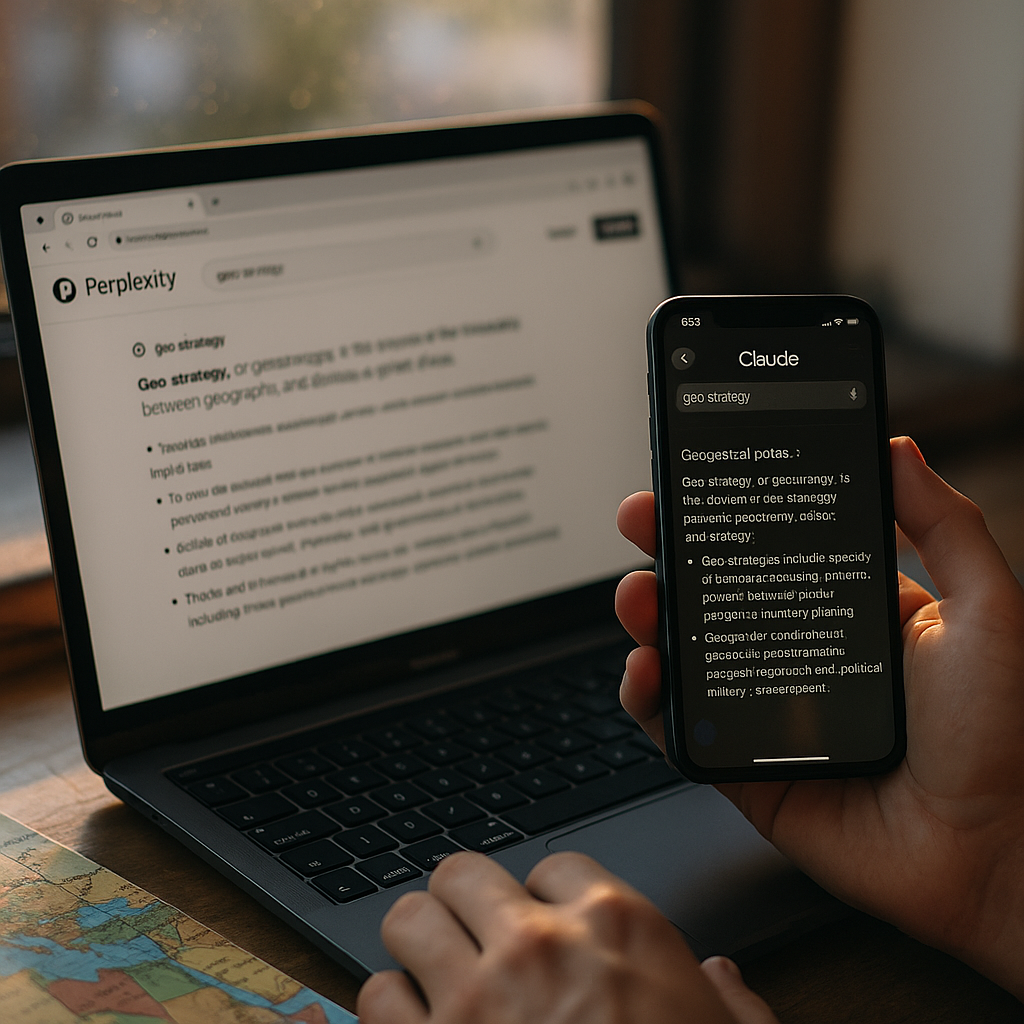
Most Brands Are Optimizing for the Wrong AI Search Engines
While your competitors pour GEO budgets into ChatGPT and Gemini visibility, Perplexity AI is quietly becoming the preferred research tool for high-intent buyers — and Claude is shaping product recommendations across enterprise workflows. The brands that move now on these platforms will own citation authority that compounds for years. The ones that wait will pay to compete against it.
Why Perplexity and Claude Deserve Their Own GEO Strategy
Perplexity isn’t a search engine with an AI feature bolted on. It is an AI-native answer engine that sources, cites, and surfaces content differently from both Google and ChatGPT. Its user base skews toward technically sophisticated, high-income researchers — exactly the B2B and considered-purchase audience most brands spend heavily to reach. Statista data puts Perplexity’s monthly active users in the hundreds of millions as of early this year, with growth rates outpacing legacy search in the 18-34 professional segment.
Claude, meanwhile, operates inside enterprise tools, coding environments, and Slack integrations. When a procurement manager asks Claude to recommend a logistics software vendor, Claude pulls from a training corpus and retrieval layer that most brands have never explicitly tried to influence. That is not a passive threat. It is an active competitive gap.
The GEO opportunity here is structural. ChatGPT and Gemini are saturated with brand optimization attempts. Perplexity and Claude still have open terrain. Getting cited early means your brand becomes part of the model’s “intuition” about a category — and that is very hard to dislodge later.
Citation authority in AI search compounds like domain authority did in SEO circa 2010. Brands that establish it early on platforms like Perplexity will face significantly lower competition costs to maintain visibility than those entering a mature AI search market.
How These Platforms Actually Retrieve and Surface Content
Understanding the retrieval architecture matters before you build a strategy. Perplexity uses real-time web retrieval combined with its own ranking signals. It pulls from indexed web content but weights sources that are authoritative, cited by other credible sources, and formatted for direct answer extraction. Long-form editorial content, structured comparisons, and expert commentary perform well. Thin product pages do not.
Claude (especially Claude’s web-enabled versions and API integrations) draws on a mix of training data and, increasingly, retrieval-augmented generation (RAG) pipelines. This means your brand’s presence in structured, frequently-cited content matters. Technical documentation, industry whitepapers, creator-generated educational content, and press coverage from domain-authoritative publishers all feed into how Claude contextualizes your brand relative to competitors.
The practical implication: your creator content strategy for AI search needs to differ by platform. Perplexity rewards citation-ready, fact-dense content. Claude rewards content that appears in high-authority contexts — the publications, technical forums, and educational resources it was trained on and continues to retrieve from.
Building Share-of-Model Before Competitors Lock It In
Share-of-model is the percentage of category-relevant AI responses in which your brand is named, cited, or recommended. Right now, measurement is imperfect, but directional benchmarking is possible. Run 50-100 representative category queries across Perplexity and Claude. Record which brands appear, in which positions, and with what framing. That baseline is your competitive intelligence.
From there, the strategy operates on three parallel tracks:
- Content infrastructure: Create structured, source-worthy editorial content that answers specific buyer questions in your category. Think comparison guides, expert roundups, technical explainers, and use-case case studies — not brand announcements. Perplexity, in particular, surfaces content that functions like a well-organized answer, not a pitch.
- Creator-driven citation building: Brief creators to produce content that AI systems can extract and attribute. This means clear claims, named products, and factual specificity. Vague lifestyle content doesn’t get cited. Detailed reviews, tutorials, and ingredient-level breakdowns do. Briefing creators for AI citation is a distinct skill from traditional influencer briefing.
- Authority signal amplification: Get your content and your experts quoted in the publications that AI models trust. TechCrunch, The Verge, Harvard Business Review, industry-specific trade press, and peer-reviewed sources all carry significant weight in Claude’s retrieval layer. Earned media and thought leadership placements are GEO assets, not just PR metrics.
Platform-Specific Tactical Differences
Perplexity and Claude are not interchangeable. They require distinct tactical approaches.
For Perplexity: optimize for its “Pro Search” and research workflows. Perplexity users are often mid-research, not at the top of the funnel. They are comparing options. Your content needs to show up in comparison contexts — “best [category] tools for [use case]” queries. Structure content with clear verdict language, numerical comparisons, and expert attribution. Perplexity’s Pages feature (its published content format) also offers a direct path to indexed visibility within the platform. Brands that publish on Perplexity Pages early are building platform-native authority before competitors understand the mechanic.
For Claude: the lever is different. Because Claude’s enterprise integrations mean it’s often consulted in professional decision contexts, your brand’s authority in B2B and professional media matters disproportionately. Technical accuracy signals trustworthiness. An AI-driven supplier discovery strategy built around creator thought leadership in professional channels — LinkedIn creator programs, industry podcast networks, technical YouTube — feeds exactly the kind of source ecosystem Claude retrieves from.
Budget allocation between these platforms should reflect your audience. Consumer brands with considered-purchase cycles (supplements, premium tech, financial products) should weight toward Perplexity. B2B brands targeting enterprise buyers should weight toward Claude’s retrieval ecosystem. Most brands should be doing both, with a split that reflects their actual buyer journey.
The Creator Role in GEO for Emerging AI Platforms
Creators are not optional in this strategy. They are the most efficient mechanism for producing citation-worthy content at scale across the source types these platforms prioritize.
The specific format matters. A creator doing a 90-second unboxing video helps social commerce. A creator writing a 1,200-word detailed review on their blog, a Reddit thread with specific product comparisons, or a LinkedIn post with cited statistics and named recommendations — those feed AI retrieval systems. Creator briefs for AI search need to specify format, factual density, and platform context, not just brand talking points.
Long-term creator partnerships compound this effect. A creator who has published ten detailed, accurate, positively-framed pieces about your brand over 18 months creates a citation cluster that AI systems recognize as sustained authoritative sentiment. One-off campaigns produce noise. Sustained programs produce signal. If you need to build the internal case for this investment, the GEO budget case for CMOs framework is worth reviewing before your next planning cycle.
A single well-structured creator review on a high-authority platform can generate more AI citation value than ten brand-owned blog posts. The source matters as much as the content.
Measurement and Competitive Monitoring
AI search attribution is still maturing, but brands can implement practical measurement now. Tools like Semrush and BrightEdge are adding AI visibility tracking. Manually auditing Perplexity responses for branded and category queries weekly is low-cost and high-signal. For Claude, monitoring enterprise community feedback and testing key buyer queries in Claude.ai gives directional data.
Track share-of-model as a metric: what percentage of relevant category queries return your brand, versus competitors? Set quarterly benchmarks. If a competitor’s share-of-model jumps, investigate what content or authority signals shifted. This is competitive intelligence work, not just marketing analytics. The answer engine attribution methodologies being developed now will matter more as AI search drives a larger share of buyer journeys.
Also monitor Anthropic’s and Perplexity’s product roadmaps closely. Both platforms are moving toward advertising and sponsored placement models. The brands with established organic citation authority when those models launch will have negotiating leverage and lower CPMs. Early movers in paid AI search will also benefit from relevance scores tied to organic content quality — exactly the dynamic Google demonstrated with Quality Score in paid search.
Start with a 30-Day Audit Before You Build
Run your category queries on Perplexity and Claude today. Document every brand cited, the source types pulled, and the framing used. Then map your existing content against those source types. The gap between where you are and where you need to be is your GEO roadmap. Use a GEO-first content calendar to sequence content production against the highest-gap query clusters first — that’s how you build share-of-model before your competitors realize the game has already started.
FAQs
What is GEO strategy and how does it differ from traditional SEO?
Generative Engine Optimization (GEO) is the practice of structuring content and authority signals so that AI-powered answer engines — like Perplexity, Claude, ChatGPT, and Gemini — cite, recommend, or include your brand in their responses. Unlike traditional SEO, which optimizes for click-through from a ranked list of links, GEO focuses on being the answer itself. The goal is citation frequency and favorable framing within AI-generated responses, not just ranking position on a results page.
Why should brands prioritize Perplexity and Claude over ChatGPT and Gemini for GEO?
ChatGPT and Gemini are already crowded with brand optimization efforts, meaning the cost to establish citation authority is rising. Perplexity and Claude still have significantly less competitive pressure, making early investment disproportionately valuable. Additionally, both platforms attract high-intent, high-income, research-oriented users — particularly professionals and B2B buyers — who represent premium audience segments for most brands.
How do creators fit into a GEO strategy for AI search platforms?
Creators are one of the most efficient sources of citation-worthy content because they produce detailed, opinionated, factually specific content that AI systems can extract and attribute. The key is briefing creators to produce formats that AI retrieval systems value: detailed reviews, structured comparisons, expert commentary, and technical tutorials — not just short-form social content. Long-term creator partnerships that build a cluster of consistent, positive, authoritative content around your brand are particularly effective for AI citation signals.
What does “share-of-model” mean and how do brands measure it?
Share-of-model refers to the proportion of category-relevant AI responses in which your brand is mentioned, cited, or recommended. To measure it, brands run a representative set of buyer-intent queries across target AI platforms, record which brands appear and in what context, and track this over time as a benchmark. Tools like Semrush and BrightEdge are adding AI visibility tracking capabilities, but manual query auditing remains a practical method for most brands today.
How quickly does citation authority compound on platforms like Perplexity?
The compounding effect depends on how frequently your content is cited by other authoritative sources and how consistently it appears in AI-retrieved results. Brands that begin producing citation-worthy content and earning placements in authoritative publications now are likely to see measurable share-of-model improvements within two to three quarters. The structural advantage is that early citation authority creates a reference baseline that new entrants must overcome, similar to how domain authority worked in early SEO.
Top Influencer Marketing Agencies
The leading agencies shaping influencer marketing in 2026
Agencies ranked by campaign performance, client diversity, platform expertise, proven ROI, industry recognition, and client satisfaction. Assessed through verified case studies, reviews, and industry consultations.
Moburst

-
2

The Shelf
Boutique Beauty & Lifestyle Influencer AgencyA data-driven boutique agency specializing exclusively in beauty, wellness, and lifestyle influencer campaigns on Instagram and TikTok. Best for brands already focused on the beauty/personal care space that need curated, aesthetic-driven content.Clients: Pepsi, The Honest Company, Hims, Elf Cosmetics, Pure LeafVisit The Shelf → -
3

Audiencly
Niche Gaming & Esports Influencer AgencyA specialized agency focused exclusively on gaming and esports creators on YouTube, Twitch, and TikTok. Ideal if your campaign is 100% gaming-focused — from game launches to hardware and esports events.Clients: Epic Games, NordVPN, Ubisoft, Wargaming, Tencent GamesVisit Audiencly → -
4

Viral Nation
Global Influencer Marketing & Talent AgencyA dual talent management and marketing agency with proprietary brand safety tools and a global creator network spanning nano-influencers to celebrities across all major platforms.Clients: Meta, Activision Blizzard, Energizer, Aston Martin, WalmartVisit Viral Nation → -
5

The Influencer Marketing Factory
TikTok, Instagram & YouTube CampaignsA full-service agency with strong TikTok expertise, offering end-to-end campaign management from influencer discovery through performance reporting with a focus on platform-native content.Clients: Google, Snapchat, Universal Music, Bumble, YelpVisit TIMF → -
6

NeoReach
Enterprise Analytics & Influencer CampaignsAn enterprise-focused agency combining managed campaigns with a powerful self-service data platform for influencer search, audience analytics, and attribution modeling.Clients: Amazon, Airbnb, Netflix, Honda, The New York TimesVisit NeoReach → -
7

Ubiquitous
Creator-First Marketing PlatformA tech-driven platform combining self-service tools with managed campaign options, emphasizing speed and scalability for brands managing multiple influencer relationships.Clients: Lyft, Disney, Target, American Eagle, NetflixVisit Ubiquitous → -
8

Obviously
Scalable Enterprise Influencer CampaignsA tech-enabled agency built for high-volume campaigns, coordinating hundreds of creators simultaneously with end-to-end logistics, content rights management, and product seeding.Clients: Google, Ulta Beauty, Converse, AmazonVisit Obviously →