


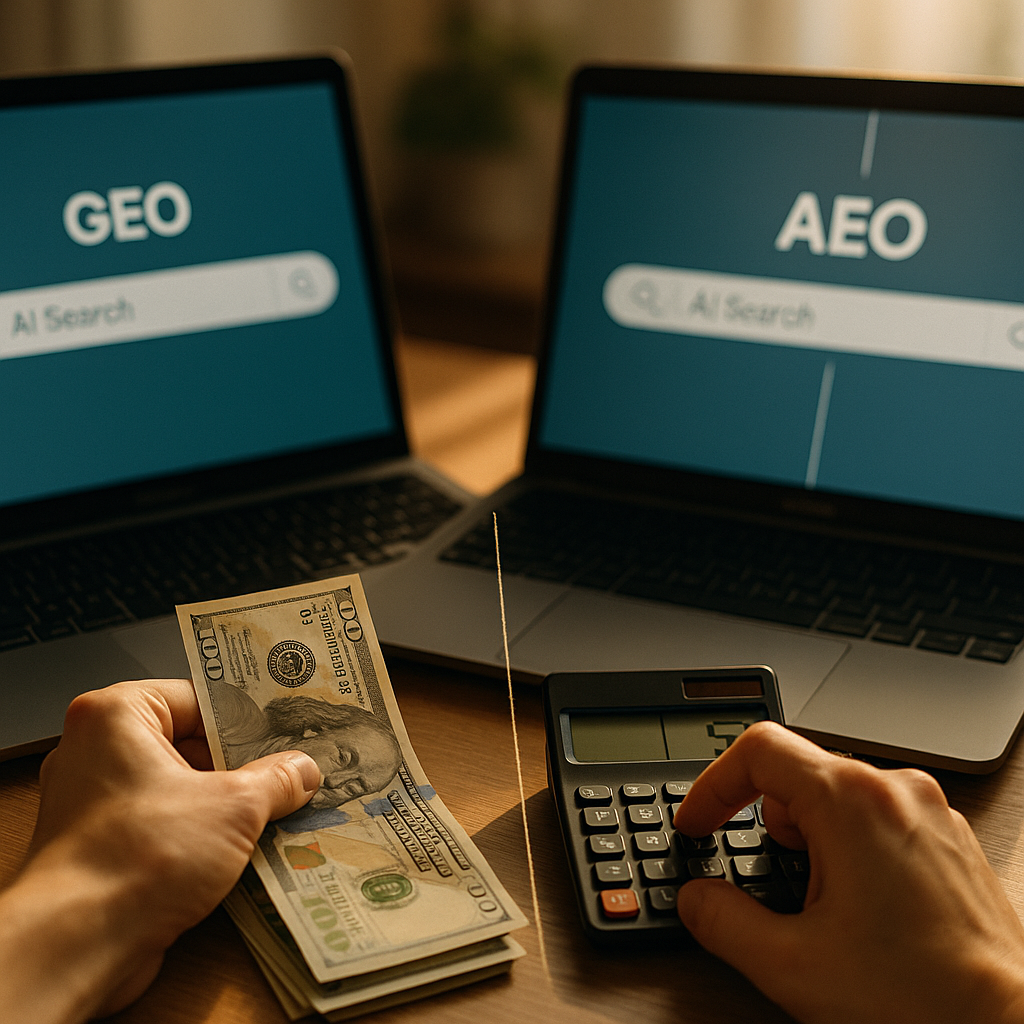
Sixty percent of marketers say they’re investing in AI search visibility, according to eMarketer data. But ask ten of them to define generative engine optimization versus answer engine optimization, and you’ll get ten different answers. That confusion is costing budget lines their precision. Here’s the technical split your finance team actually needs.
Two Acronyms, One Budget Meeting Gone Wrong
Walk into any planning session right now and you’ll hear GEO and AEO used interchangeably. They aren’t the same discipline, and treating them as one line item is how brands end up overpaying for tools that solve the wrong problem.
Generative Engine Optimization (GEO) is the practice of getting your brand cited, quoted, or recommended inside AI-generated responses from tools like ChatGPT, Perplexity, Google’s AI Overviews, and Claude. It’s about surviving inside a synthesized answer that pulls from dozens of sources at once.
Answer Engine Optimization (AEO) is narrower. It’s the discipline of structuring content so it gets pulled directly into a single, definitive answer box, think featured snippets, voice assistant replies, and the “position zero” answer cards that predate the generative AI wave but still matter enormously.
The overlap is real. Both care about structured data, both reward clarity over keyword density, both punish thin content. But the mechanics of ranking differ enough that a single vendor rarely does both well.
If your GEO vendor can’t explain how their tool handles retrieval-augmented generation versus a simple answer-extraction algorithm, you’re buying a rebranded SEO tool with an AI label slapped on it.
What Actually Separates the Two Disciplines
Think of AEO as optimizing for extraction. A search engine or voice assistant scans a page, finds a tight, well-structured answer, and lifts it verbatim (or close to it) into a box. The winning content is concise, often under 60 words, formatted with clear headers, lists, or schema markup that flags “this is the answer.”
GEO is optimizing for synthesis. Large language models don’t lift one answer, they blend information from multiple sources, weigh authority signals, and generate an original sentence that may or may not cite you by name. Getting cited here depends less on snippet formatting and more on whether your brand shows up repeatedly across the training data and real-time retrieval sources the model trusts: Reddit threads, review sites, industry publications, Wikipedia, and increasingly, structured data feeds.
That distinction matters for budget allocation because the tactics diverge sharply:
- AEO tactics: schema markup, FAQ formatting, concise definitional content, featured-snippet tracking tools, voice-search keyword research.
- GEO tactics: earned media and PR to build third-party mentions, citation monitoring across LLM outputs, brand mention frequency audits, and content designed to be quotable rather than extractable.
Our earlier breakdown of how citation logic differs across platforms goes deeper into why a page that ranks well in Google’s answer box can still get ignored entirely by ChatGPT’s response engine. The retrieval layer isn’t the same, and neither is the reward function.
Why Your 2026 Budget Split Can’t Be 50/50
Here’s the uncomfortable part for budget owners: most brands are still allocating spend as if GEO and AEO share equal weight in the buyer journey. They don’t, at least not yet.
Traditional answer engines (Google’s featured snippets, Bing’s answer cards) still drive a massive share of zero-click search traffic. HubSpot’s research on search behavior consistently shows that snippet-style answers remain the dominant discovery format for transactional and how-to queries. AEO isn’t dying. It’s just no longer the only game.
Generative engines, meanwhile, are eating a growing share of research-phase and comparison-phase queries, exactly the queries B2B buyers use when evaluating vendors, agencies, and platforms. If your target customer is asking ChatGPT “what’s the best influencer marketing platform for a mid-size DTC brand,” and your brand never comes up, that’s a pipeline leak no amount of snippet optimization fixes.
A reasonable starting split for 2026, based on what we’re seeing across mid-market B2B and consumer brands with active AI visibility programs:
- 60% GEO / 40% AEO for brands where research-heavy, consideration-stage queries dominate the buyer journey (software, agencies, high-consideration retail).
- 40% GEO / 60% AEO for brands still winning most of their traffic from transactional, how-to, or local queries where snippet capture drives direct conversion.
Neither split is static. Run a quarterly audit. If your branded mention rate inside AI Overviews and ChatGPT responses is climbing but your featured snippet share is flat, that’s a signal to shift more budget toward AEO maintenance and less toward speculative GEO experiments.
The Measurement Problem Nobody’s Solved
Here’s where budget owners get stuck. AEO has mature, if imperfect, measurement: rank tracking tools show snippet ownership, click-through data shows whether zero-click answers are cannibalizing traffic. You can build a dashboard and defend it in a QBR.
GEO measurement is still catching up. There’s no universal “citation share” metric the way there’s a “share of voice” metric in traditional SEO. Most brands are cobbling together visibility using a mix of manual prompt testing, third-party monitoring tools (Profound, Otterly, and a handful of newer entrants), and GA4 referral data from AI platforms where available.
That last piece is more useful than most marketers realize. If you haven’t already, build out dashboards that isolate AI assistant referral traffic so you can at least prove downstream conversion value, even if you can’t yet prove citation frequency with certainty.
Attribution for AI-sourced traffic is where influencer marketing was five years ago: directionally useful, technically messy, and improving fast. Budget for the mess.
Probabilistic attribution models are starting to fill the gap for delayed-conversion scenarios where a user sees a brand mentioned in an AI response, doesn’t click, but converts days later through a branded search. That pattern shows up constantly in creator-driven purchase paths too, and the modeling techniques overlap. Worth reviewing how probabilistic models track AI search purchases before you commit to a specific attribution vendor for either discipline.
Vendor Selection: Ask These Questions Before Signing
The GEO/AEO tooling market is flooded with rebrands. Legacy SEO platforms bolted “AI visibility” features onto existing rank trackers, and some genuinely useful upgrades are buried among a lot of vaporware. Before signing anything, get answers to:
- Does the tool distinguish between citation and mention? Being named in an AI response is different from being the source the response links back to. Vendors who blur this distinction are selling you vanity metrics.
- How does it handle model-specific behavior? ChatGPT, Claude, Gemini, and Perplexity all weight sources differently. A tool that reports a single blended “AI visibility score” across all four is hiding useful nuance. Our comparison of grounding behavior across Claude and OpenAI shows just how differently these systems verify and cite source material.
- Can it track prompt variation? Real buyers don’t type identical queries. A tool that only tracks a fixed prompt list will miss the long tail where most citation opportunity actually lives.
- What’s the refresh cadence? LLM outputs shift as models update. Weekly refreshes are the minimum for anything you’d present to leadership as current.
If a vendor can’t answer at least three of these clearly, treat their pricing as a red flag rather than a bargain. The trust gap around AI optimization spend we’ve covered before stems exactly from this: teams buy tools they can’t fully audit, then can’t defend the ROI when finance asks.
Where the Two Disciplines Actually Converge
It’s not all separation. Structured data remains the shared foundation. Schema markup, clean information architecture, and authoritative third-party validation (reviews, press mentions, expert citations) feed both AEO snippet extraction and GEO source retrieval. Neglect either and you weaken both.
Content depth also does double duty. Long-form, well-sourced content that answers a question thoroughly tends to get mined for snippet-worthy fragments (AEO win) while also serving as retrieval fodder for LLMs building a synthesized answer (GEO win). The days of writing separate content for “featured snippet bait” and “AI citation bait” are largely over. One well-built page, formatted for both extraction and synthesis, does the job.
Where they diverge hardest is in earned media strategy. GEO rewards brands that show up across a wide surface area, third-party review sites, Reddit, trade publications, comparison articles. That’s a PR and content-distribution problem more than a technical SEO problem. Teams that have historically treated distribution as a trust-building exercise rather than a reach play are better positioned for GEO than teams optimizing purely for snippet capture.
Setting the Split for Next Year
Don’t lock your 2026 budget on a static ratio. Set a quarterly review, tied to actual citation and snippet-share data, and shift 10-15% of spend between GEO and AEO based on which discipline is showing measurable pipeline impact. Start the year at 55/45 in favor of GEO if your buyers are research-heavy, and let the data move it from there.
Frequently Asked Questions
Is generative engine optimization replacing answer engine optimization?
No. AEO still drives significant zero-click traffic through featured snippets and voice assistant answers. GEO is an additional discipline addressing how AI chatbots and generative search tools cite or recommend brands, not a wholesale replacement for snippet optimization.
How much of a marketing budget should go toward GEO versus AEO?
It depends on your buyer journey. Brands with research-heavy, consideration-stage queries typically benefit from a 55-60% GEO allocation, while brands winning most traffic from transactional or local queries should weight AEO higher, around 55-60%. Review the split quarterly against citation and snippet-share data.
What tools measure GEO performance accurately?
The market is still maturing. Tools like Profound and Otterly offer prompt-based monitoring across multiple LLMs, but no single tool yet offers a universally trusted “citation share” metric comparable to traditional SEO rank tracking. Combine third-party monitoring with GA4 referral data from AI platforms for a fuller picture.
Does schema markup help both GEO and AEO?
Yes. Structured data remains foundational to both disciplines. It helps answer engines extract concise responses and helps generative engines validate and retrieve accurate source information during synthesis.
Why do GEO and AEO require different vendors?
AEO vendors typically specialize in snippet tracking, schema auditing, and voice-search keyword research. GEO vendors focus on citation monitoring across LLM outputs, brand mention frequency, and earned media visibility. Few platforms currently do both with equal depth, so most mature programs use separate tools for each.
Frequently Asked Questions
Is generative engine optimization replacing answer engine optimization?
No. AEO still drives significant zero-click traffic through featured snippets and voice assistant answers. GEO is an additional discipline addressing how AI chatbots and generative search tools cite or recommend brands, not a wholesale replacement for snippet optimization.
How much of a marketing budget should go toward GEO versus AEO?
It depends on your buyer journey. Brands with research-heavy, consideration-stage queries typically benefit from a 55-60% GEO allocation, while brands winning most traffic from transactional or local queries should weight AEO higher, around 55-60%. Review the split quarterly against citation and snippet-share data.
What tools measure GEO performance accurately?
The market is still maturing. Tools like Profound and Otterly offer prompt-based monitoring across multiple LLMs, but no single tool yet offers a universally trusted “citation share” metric comparable to traditional SEO rank tracking. Combine third-party monitoring with GA4 referral data from AI platforms for a fuller picture.
Does schema markup help both GEO and AEO?
Yes. Structured data remains foundational to both disciplines. It helps answer engines extract concise responses and helps generative engines validate and retrieve accurate source information during synthesis.
Why do GEO and AEO require different vendors?
AEO vendors typically specialize in snippet tracking, schema auditing, and voice-search keyword research. GEO vendors focus on citation monitoring across LLM outputs, brand mention frequency, and earned media visibility. Few platforms currently do both with equal depth, so most mature programs use separate tools for each.
Top Influencer Marketing Agencies
The leading agencies shaping influencer marketing in 2026
Agencies ranked by campaign performance, client diversity, platform expertise, proven ROI, industry recognition, and client satisfaction. Assessed through verified case studies, reviews, and industry consultations.
Moburst

-
2

The Shelf
Boutique Beauty & Lifestyle Influencer AgencyA data-driven boutique agency specializing exclusively in beauty, wellness, and lifestyle influencer campaigns on Instagram and TikTok. Best for brands already focused on the beauty/personal care space that need curated, aesthetic-driven content.Clients: Pepsi, The Honest Company, Hims, Elf Cosmetics, Pure LeafVisit The Shelf → -
3

Audiencly
Niche Gaming & Esports Influencer AgencyA specialized agency focused exclusively on gaming and esports creators on YouTube, Twitch, and TikTok. Ideal if your campaign is 100% gaming-focused — from game launches to hardware and esports events.Clients: Epic Games, NordVPN, Ubisoft, Wargaming, Tencent GamesVisit Audiencly → -
4

Viral Nation
Global Influencer Marketing & Talent AgencyA dual talent management and marketing agency with proprietary brand safety tools and a global creator network spanning nano-influencers to celebrities across all major platforms.Clients: Meta, Activision Blizzard, Energizer, Aston Martin, WalmartVisit Viral Nation → -
5

The Influencer Marketing Factory
TikTok, Instagram & YouTube CampaignsA full-service agency with strong TikTok expertise, offering end-to-end campaign management from influencer discovery through performance reporting with a focus on platform-native content.Clients: Google, Snapchat, Universal Music, Bumble, YelpVisit TIMF → -
6

NeoReach
Enterprise Analytics & Influencer CampaignsAn enterprise-focused agency combining managed campaigns with a powerful self-service data platform for influencer search, audience analytics, and attribution modeling.Clients: Amazon, Airbnb, Netflix, Honda, The New York TimesVisit NeoReach → -
7

Ubiquitous
Creator-First Marketing PlatformA tech-driven platform combining self-service tools with managed campaign options, emphasizing speed and scalability for brands managing multiple influencer relationships.Clients: Lyft, Disney, Target, American Eagle, NetflixVisit Ubiquitous → -
8

Obviously
Scalable Enterprise Influencer CampaignsA tech-enabled agency built for high-volume campaigns, coordinating hundreds of creators simultaneously with end-to-end logistics, content rights management, and product seeding.Clients: Google, Ulta Beauty, Converse, AmazonVisit Obviously →