


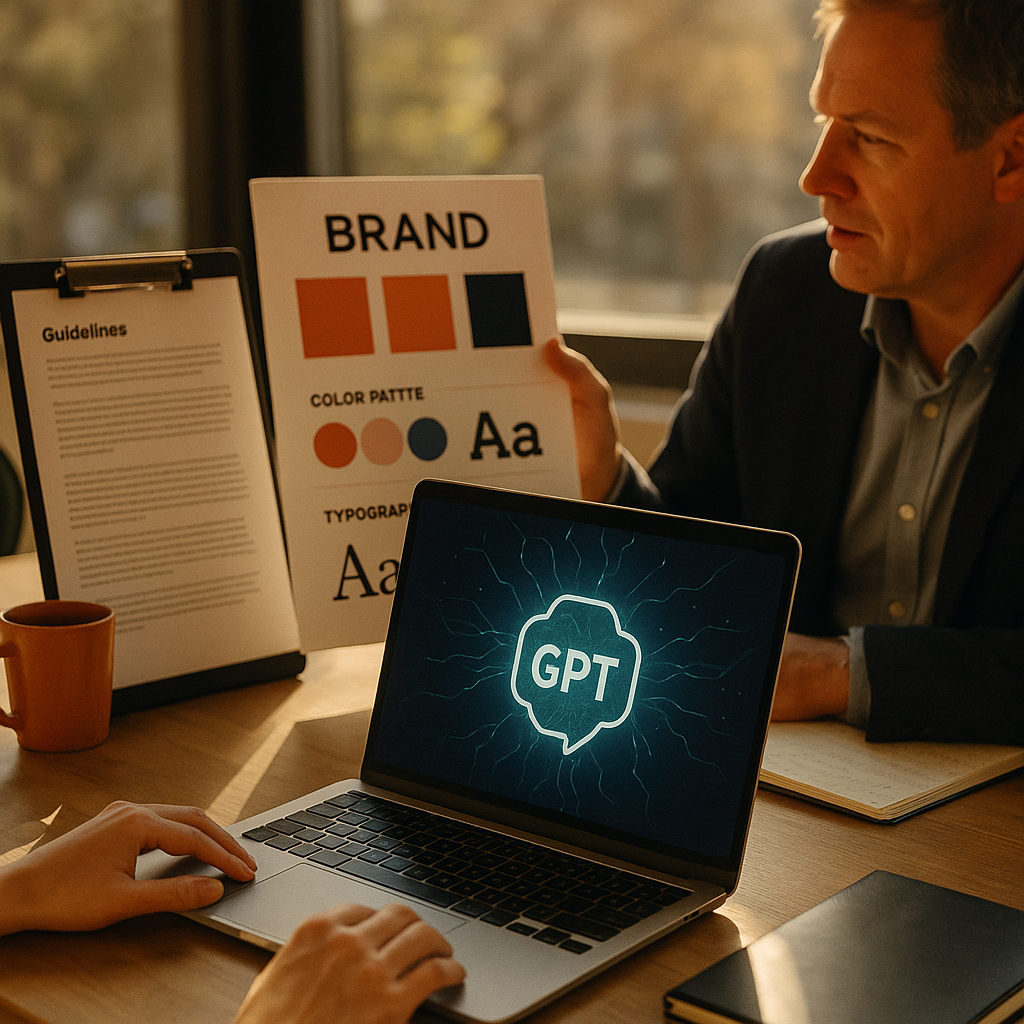
Only 23% of marketing organizations have a formal policy for how brand assets get fed into AI training pipelines, yet nearly every large brand is already doing it. That gap between adoption and governance is where lawsuits, off-brand chatbot responses, and compliance nightmares get born. Training AI models on brand identity isn’t a technical side project anymore. It’s a governance problem with legal, creative, and reputational stakes attached.
Marketing teams are quietly feeding years of brand guidelines, tone-of-voice documents, product copy, and creative assets into custom GPTs, fine-tuned models, and AI agents meant to generate on-brand content at scale. Few of those teams have asked the harder question first: who decides what the model learns, and who’s accountable when it learns the wrong thing?
Why Every Brand Is Suddenly an AI Trainer
The shift happened fast. Two years ago, “brand voice” lived in a PDF that got opened once during onboarding and never again. Now it’s a dataset. Agencies build custom GPTs to draft creator briefs. In-house teams fine-tune models on past campaign copy to speed up social captions. Customer service bots get trained on brand tone so a support interaction doesn’t read like a legal disclaimer.
This isn’t optional anymore either. As AI-generated answers increasingly mediate how customers discover and evaluate brands, the content that trains those models (and the content those models cite) directly shapes brand perception. Influencers Time has covered how earned creator content quietly trains what large language models say about a brand, often without marketing teams realizing their owned channels are part of the training signal.
The problem is speed outpacing structure. Teams are moving quickly to stay competitive, and governance usually arrives only after something breaks: a chatbot that invents a product claim, a fine-tuned model that reproduces a retired tagline, or a vendor that trained on brand assets without a data rights clause in the contract.
What “Training on Brand Identity” Actually Means
Let’s be precise, because the phrase gets used loosely. Training AI models on brand identity can mean several distinct things, each with different risk profiles:
- Fine-tuning: Adjusting a base model’s weights using proprietary brand content, usually done by a vendor or in-house data science team.
- Retrieval-augmented generation (RAG): Feeding a model a live document store (style guides, product specs, approved messaging) that it references at generation time without altering the base model.
- Custom instructions or system prompts: Lightweight configuration, like a custom GPT, that shapes tone and constraints without true training.
- Third-party model training: When a platform or AI vendor uses your brand content as part of a broader training corpus, sometimes without explicit opt-out.
Each of these requires a different governance response. RAG setups are easier to audit and update. Fine-tuned models are harder to “un-teach” if something goes wrong. Third-party training is the riskiest because brand teams often have the least visibility into what data went in and how it’s being reused.
If your legal team hasn’t reviewed the data rights clause in your AI vendor contract, assume your brand assets are training someone else’s model right now, with no way to opt out retroactively.
The Governance Gap: Where It Breaks
Most brand governance failures with AI don’t come from malicious intent. They come from nobody owning the decision. A creative director approves a tone-of-voice doc for human writers, not realizing it’s been uploaded into a vendor’s fine-tuning pipeline. A growth marketer builds a custom GPT over a weekend to speed up ad copy, trains it on last year’s campaign assets, and nobody checks whether those assets included discontinued claims or outdated pricing.
Six months later, the model is still generating copy based on stale inputs because nobody owns version control.
This is the same pattern Influencers Time flagged in coverage of clean creator data deciding whether AI co-pilots actually help or just scale errors faster. Garbage in, garbage out isn’t a cliché here, it’s a liability. If your brand identity training data includes inconsistent claims, legacy messaging, or unreviewed creator content, the model will reproduce that inconsistency at a volume no single editor can catch.
Building a Governance Framework That Actually Works
A workable governance structure for brand identity training doesn’t need to be bureaucratic. It needs four things: a clear data source of truth, an approval chain, version control, and an audit trail.
1. Establish a single source of truth. Before anything gets fed into a model, designate the canonical brand documents: approved style guide, current product claims, legal-cleared messaging, and a list of prohibited phrases or deprecated claims. If this doesn’t exist in one place, start there. Most brand governance failures trace back to multiple “versions” of brand truth floating around different teams.
2. Define who approves training inputs. This should sit with a small cross-functional group, typically brand marketing, legal, and whoever owns the AI tooling. No single department should have unilateral authority to add content to a training set. Treat it like publishing: if it wouldn’t go out under the brand name without review, it shouldn’t train a model that speaks under the brand name either.
3. Version everything. Every time a model gets retrained or its reference documents updated, log what changed and why. This matters enormously if a model starts producing off-brand output and you need to trace it back to a specific data addition. It also matters for compliance: regulators increasingly want to know not just what an AI system does, but how it was trained and whether consumer data was involved.
4. Build an audit cadence. Quarterly is a reasonable minimum for most mid-size brands. Review what the model is generating against current brand guidelines, flag drift, and retrain or adjust the reference set as needed. This is similar in spirit to the audit checklists brands now use to track citation accuracy across AI search tools, applied internally instead of externally.
Who Owns the Model? (Nobody Wants to Answer This)
Ask most marketing teams who’s accountable if their brand chatbot says something wrong, and you’ll get a shrug or three different answers from three different people. That ambiguity is the governance gap in its purest form.
Ownership should be explicit and documented, not assumed. A practical structure:
- Brand marketing owns the content of what gets trained: tone, messaging, claims.
- Legal/compliance owns the risk review: FTC disclosure requirements, data privacy, IP clearance on any creator or third-party content used in training.
- IT/data owns the technical pipeline: where data lives, how it’s secured, how retraining gets executed.
- A single accountable executive (often a CMO or VP of brand) signs off on major model updates and owns the escalation path if something goes wrong publicly.
Institutional guidelines matter here more than most teams expect. Influencers Time’s coverage of how institutional guidelines keep brand chatbots on message is a useful blueprint: the brands getting this right treat the guidelines document itself as a living governance artifact, not a static PDF nobody revisits.
The FTC Angle Nobody’s Prepping For
Regulatory exposure is the part of this conversation that gets the least attention and deserves the most. If a brand trains a model on creator content, customer data, or influencer partnership assets without clear rights and disclosures, that’s a compliance problem waiting to surface. The FTC has been increasingly vocal about AI-generated content and synthetic endorsements, and brands that can’t document their training data provenance will struggle to defend themselves if a model generates a misleading claim that traces back to unreviewed inputs.
This connects directly to the broader detection and disclosure conversation happening across the industry. Influencers Time’s reporting on detection stacks flagging synthetic content before it becomes FTC risk applies just as much to internally trained brand models as it does to external creator content. If you can’t show your work on how a model learned to represent your brand, regulators and consumers alike will assume the worst.
A governance framework isn’t about slowing down AI adoption. It’s about making sure you can explain, in plain language, why your model said what it said, to a regulator, a journalist, or your own CMO.
Measuring Whether Governance Is Actually Working
Governance without measurement is just paperwork. Track these on a recurring basis:
- Drift rate: How often does model output deviate from current approved messaging? Spot-check monthly.
- Time-to-correction: When drift is flagged, how long until the model or its reference data is updated?
- Approval compliance: What percentage of training data additions went through the formal sign-off process versus getting added informally?
- Incident count: Track flagged off-brand or legally risky outputs over time. This number should trend down as governance matures, not up.
Teams that treat this like a dashboard metric, not a one-time compliance checkbox, catch problems before they become press cycles. It’s the same discipline Influencers Time described in coverage of turning AI citations into a monthly KPI: what gets measured regularly gets managed, what gets reviewed annually gets forgotten until it breaks.
For benchmarking context on how fast AI adoption is moving inside marketing organizations, data from eMarketer and HubSpot consistently shows AI tool adoption outpacing formal policy creation by a wide margin, which is exactly the gap this governance framework is meant to close.
Frequently Asked Questions
FAQs
What does it mean to train an AI model on brand identity?
It means using brand assets, such as style guides, approved messaging, product claims, and past creative content, to shape how an AI model generates output. This can happen through fine-tuning, retrieval-augmented generation, or lightweight custom instructions, each with different levels of risk and reversibility.
Who should be responsible for approving AI training data at a brand?
A cross-functional group typically works best: brand marketing to vet messaging accuracy, legal to review compliance and data rights, and IT or data teams to manage the technical pipeline. A single accountable executive should sign off on major updates and own escalation if something goes wrong.
What happens if a brand doesn’t govern its AI training data?
Without governance, models can reproduce outdated claims, inconsistent tone, or legally risky statements at scale. Since there’s often no clear ownership or audit trail, these errors can go undetected for months and are harder to trace back to their source once discovered.
How often should brand AI models be audited?
Quarterly is a reasonable baseline for most mid-size brands, though teams with high content output or frequent model updates should audit monthly. The goal is to catch drift between model output and current brand guidelines before it compounds.
Does training AI on creator or customer content create legal risk?
Yes, if rights and disclosures aren’t clearly documented. Regulators including the FTC have scrutinized AI-generated content and synthetic endorsements closely, and brands need to be able to show provenance for any third-party content used in training.
FAQs (Structured Data)
See schema markup below for search engine consumption.
The brands that win with AI-generated content won’t be the ones with the biggest models. They’ll be the ones who can explain, with a paper trail, exactly what their models learned and why. Start by naming one accountable owner for your brand identity training data this quarter. Everything else in this framework builds from that single decision.
Top Influencer Marketing Agencies
The leading agencies shaping influencer marketing in 2026
Agencies ranked by campaign performance, client diversity, platform expertise, proven ROI, industry recognition, and client satisfaction. Assessed through verified case studies, reviews, and industry consultations.
Moburst

-
2

The Shelf
Boutique Beauty & Lifestyle Influencer AgencyA data-driven boutique agency specializing exclusively in beauty, wellness, and lifestyle influencer campaigns on Instagram and TikTok. Best for brands already focused on the beauty/personal care space that need curated, aesthetic-driven content.Clients: Pepsi, The Honest Company, Hims, Elf Cosmetics, Pure LeafVisit The Shelf → -
3

Audiencly
Niche Gaming & Esports Influencer AgencyA specialized agency focused exclusively on gaming and esports creators on YouTube, Twitch, and TikTok. Ideal if your campaign is 100% gaming-focused — from game launches to hardware and esports events.Clients: Epic Games, NordVPN, Ubisoft, Wargaming, Tencent GamesVisit Audiencly → -
4

Viral Nation
Global Influencer Marketing & Talent AgencyA dual talent management and marketing agency with proprietary brand safety tools and a global creator network spanning nano-influencers to celebrities across all major platforms.Clients: Meta, Activision Blizzard, Energizer, Aston Martin, WalmartVisit Viral Nation → -
5

The Influencer Marketing Factory
TikTok, Instagram & YouTube CampaignsA full-service agency with strong TikTok expertise, offering end-to-end campaign management from influencer discovery through performance reporting with a focus on platform-native content.Clients: Google, Snapchat, Universal Music, Bumble, YelpVisit TIMF → -
6

NeoReach
Enterprise Analytics & Influencer CampaignsAn enterprise-focused agency combining managed campaigns with a powerful self-service data platform for influencer search, audience analytics, and attribution modeling.Clients: Amazon, Airbnb, Netflix, Honda, The New York TimesVisit NeoReach → -
7

Ubiquitous
Creator-First Marketing PlatformA tech-driven platform combining self-service tools with managed campaign options, emphasizing speed and scalability for brands managing multiple influencer relationships.Clients: Lyft, Disney, Target, American Eagle, NetflixVisit Ubiquitous → -
8

Obviously
Scalable Enterprise Influencer CampaignsA tech-enabled agency built for high-volume campaigns, coordinating hundreds of creators simultaneously with end-to-end logistics, content rights management, and product seeding.Clients: Google, Ulta Beauty, Converse, AmazonVisit Obviously →