


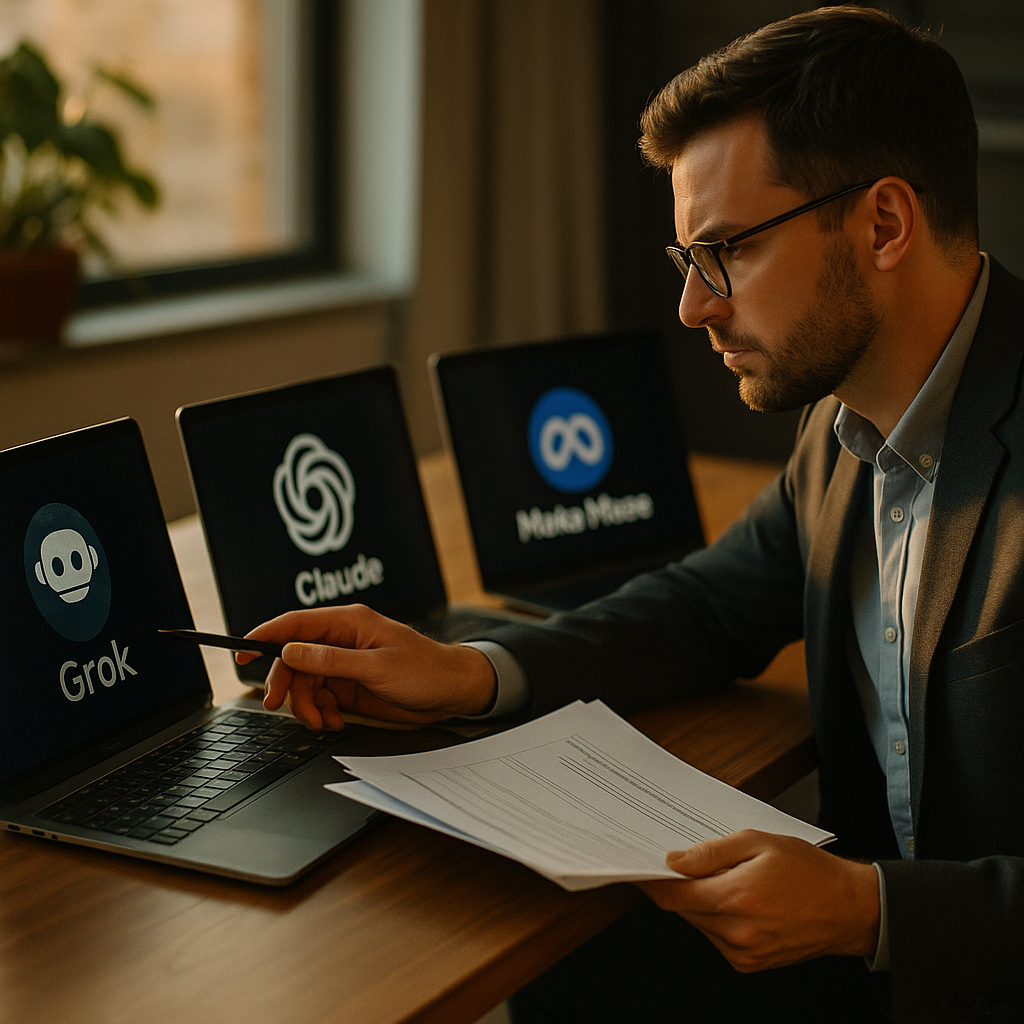
Seventy one percent of agency leaders say they are piloting a generative AI assistant right now, according to recent HubSpot survey data on marketing workflows. Yet almost none of them have settled on a single tool. The emerging agency AI assistant race now has a third real contender beyond ChatGPT and Gemini: Grok, Claude, and Meta Muse are all pitching themselves as the brain behind your next influencer campaign. The question isn’t which one is smartest. It’s which one won’t get your agency sued, fired, or embarrassed in front of a client.
Why Agencies Are Suddenly Shopping for a New AI Brain
For the last two years, most agencies defaulted to ChatGPT for briefs, Midjourney for mood boards, and whatever native tool their creator CRM shipped with. That stack is starting to look thin. Clients now ask pointed questions about data provenance, IP ownership, and whether the AI-generated brief language could trigger a FTC disclosure issue. Add in the fact that creator matching platforms have gotten dramatically more sophisticated (see our take on AI creator matching), and the pressure is on general purpose assistants to prove they belong in a professional workflow, not just a brainstorming sandbox.
Grok, Claude, and Meta Muse each answer that pressure differently. One leans into real time cultural data. One leans into reasoning and compliance discipline. One leans into native platform integration. None of them is a complete replacement for a dedicated influencer marketing operating system, and if you’re evaluating those too, it’s worth reading our breakdown on vetting lock in before you sign anything.
Grok: Fast, Opinionated, and a Little Reckless
Grok’s pitch to agencies is speed and cultural fluency. Because it’s trained on a continuous feed of X platform conversation, it can surface trending audio, slang, and creator controversies faster than almost anything else on the market. For a social team scrambling to brief a reactive campaign before a trend dies, that’s genuinely useful. Ask Grok to draft talking points around a trending meme and it will have context most assistants simply don’t have yet.
The tradeoff is predictable: speed over precision. Grok has a documented tendency to generate confident, occasionally inflammatory responses, which is a real liability when you’re using it to draft public facing copy or client communications. Agencies piloting Grok report needing a human review layer on nearly every output, which somewhat defeats the efficiency pitch. It’s also worth noting Grok’s data handling has drawn scrutiny from privacy advocates, something compliance teams should flag before connecting it to any creator PII or contract data.
The real cost of an “always fast” AI assistant isn’t the subscription fee. It’s the hours your team spends fact checking and softening everything it produces before a client sees it.
Where Grok earns its keep is ideation, not execution. Use it to generate options, not final drafts. If your agency already struggles with brand safety reviews, pair it with stronger governance elsewhere, like the rights tracking frameworks discussed in UGC rights licensing vetting.
Claude: The Compliance Minded Choice
Claude, built by Anthropic, has carved out a reputation as the assistant agencies trust with sensitive material. It’s noticeably more conservative in tone, better at following long, structured instructions, and far less likely to hallucinate a statistic or invent a creator’s engagement rate out of thin air. For agencies drafting contracts, usage rights language, or FTC-adjacent disclosure copy, that caution is a feature, not a bug.
Claude’s longer context window also makes it genuinely strong at processing lengthy creator contracts or campaign recaps in one pass, something that matters if your team is still manually cross referencing terms. That pairs well with the kind of due diligence we cover in contract management and IP ownership gaps. Several mid-size agencies we’ve spoken with now use Claude specifically for first-pass contract review before routing to legal, not to replace legal, but to flag obvious gaps faster.
The downside? Claude is slower to pick up fast-moving cultural trends and tends to be more expensive at scale for high volume use cases. It’s also less flashy in demos, which matters more than it should when agency leadership is choosing what to greenlight. If your priority is risk mitigation over raw cultural speed, Claude is the safer bet. If you need real time trend detection, it will frustrate you.
Meta Muse: The Platform Native Bet
Meta Muse is the newest of the three and arguably the most strategically interesting for anyone running influencer programs through Instagram or Facebook. Because it’s built natively into Meta’s ad and creator tools, Muse has direct access to campaign performance data, creator insights, and platform specific formatting guidance that outside tools have to approximate or scrape.
That native integration is Muse’s whole value proposition. It can suggest creator briefs that are already optimized for Reels algorithm behavior, flag when a caption is likely to get throttled, and pull performance benchmarks without you exporting a single CSV. For agencies heavily invested in Meta’s ecosystem, that’s a real operational time save, echoing the kind of workflow compression we discussed in cutting creator launch time in half.
The obvious catch: Muse is Meta’s assistant, optimized for Meta’s goals. It has little reason to recommend a TikTok-first strategy or flag when Instagram simply isn’t the best channel for a given brief. Agencies that rely on it exclusively risk a subtle but real platform bias creeping into strategy decisions. Treat Muse as a specialist tool for Meta-specific execution, not a neutral strategic advisor. If your brand runs a cross platform program, you still need something channel-agnostic sitting above it, which is exactly where composable stack thinking from our piece on build vs buy creator martech becomes useful.
Head to Head: Where Each Tool Actually Wins
- Speed and trend detection: Grok, with a mandatory human review layer.
- Contract review, compliance copy, long document analysis: Claude, consistently the most cautious and accurate.
- Meta-specific brief optimization and performance data access: Meta Muse, but only within Meta’s walled garden.
- Cross platform strategic neutrality: none of them, which is the point worth repeating.
None of these tools were built specifically for influencer marketing workflows. They’re general purpose or platform specific assistants that agencies are bending into shape. That’s a meaningfully different category from purpose built creator CRMs and attribution platforms, the kind we’ve reviewed in agentic influencer CRM features. If your agency is weighing a generalist assistant against a specialist platform, the honest answer is you probably need both, used for different jobs.
What This Means for Budget and Headcount Decisions
Here’s the uncomfortable part for agency leadership: none of these tools reduce headcount in a straightforward way yet. They compress drafting time, sure. But every agency we’ve talked to still routes AI output through a human editor before it reaches a client, which means the labor savings show up in hours per deliverable, not in fewer people on payroll. Budget conversations should reflect that nuance rather than overselling AI as a staffing replacement to clients who will eventually ask hard questions about it.
There’s also a vendor lock in question lurking underneath all of this. Meta Muse ties you more tightly to Meta’s ecosystem. Grok ties you to X’s data feed and whatever moderation policy changes next quarter. Claude is the most portable but also the most generic, meaning it offers less platform specific intelligence out of the box. Agencies should treat these tools the way they’d treat any martech vendor: with a contract review, a data handling audit, and an exit plan, the same diligence outlined in vetting unified data claims.
Industry data from eMarketer suggests marketing teams are increasing AI tool spend faster than they’re increasing measurement rigor around that spend, a gap that tends to catch up with budgets eventually.
A Practical Rollout Checklist
- Pilot each tool against a single real brief, not a hypothetical one, and compare editing time required before client delivery.
- Run a data privacy audit before connecting any assistant to creator contact information or contract terms.
- Assign one tool per job function rather than trying to force a single assistant to do everything.
- Document a human review step for every AI-generated deliverable, with a named owner, not a vague “team will check.”
- Revisit the comparison quarterly. This category is moving fast enough that today’s leader can slip in two quarters.
Frequently Asked Questions
FAQs
Which AI assistant is best for influencer marketing agencies right now?
There isn’t a single best option. Claude tends to win for compliance and contract related tasks, Grok wins for fast trend detection with review, and Meta Muse wins specifically for Instagram and Facebook campaign execution. Most agencies end up using more than one.
Can Grok, Claude, or Meta Muse replace a creator CRM?
No. These are general purpose or platform specific assistants, not dedicated influencer marketing operating systems. They can draft, summarize, and analyze, but they don’t manage payouts, contracts, or attribution the way purpose built platforms do.
Is it safe to feed creator contracts into these AI tools?
Only after a data handling review. Claude has generally stronger data governance messaging, but every agency should confirm retention policies and confidentiality terms before uploading sensitive creator or client data to any assistant.
Does Meta Muse work for non-Meta platforms like TikTok or YouTube?
Muse is optimized for Meta’s own platforms and has limited visibility into performance data elsewhere. Agencies running cross platform programs need a separate, platform-neutral tool for strategic decisions.
Will these AI assistants reduce agency staffing needs?
Not meaningfully yet. They compress the time spent drafting and reviewing content but most agencies still require human oversight on every deliverable, which limits direct headcount savings for now.
Next step: pick one live brief this month, run it through two of these three assistants in parallel, and time your editing hours. The data from that single test will tell you more than any vendor demo will.
Top Influencer Marketing Agencies
The leading agencies shaping influencer marketing in 2026
Agencies ranked by campaign performance, client diversity, platform expertise, proven ROI, industry recognition, and client satisfaction. Assessed through verified case studies, reviews, and industry consultations.
Moburst

-
2

The Shelf
Boutique Beauty & Lifestyle Influencer AgencyA data-driven boutique agency specializing exclusively in beauty, wellness, and lifestyle influencer campaigns on Instagram and TikTok. Best for brands already focused on the beauty/personal care space that need curated, aesthetic-driven content.Clients: Pepsi, The Honest Company, Hims, Elf Cosmetics, Pure LeafVisit The Shelf → -
3

Audiencly
Niche Gaming & Esports Influencer AgencyA specialized agency focused exclusively on gaming and esports creators on YouTube, Twitch, and TikTok. Ideal if your campaign is 100% gaming-focused — from game launches to hardware and esports events.Clients: Epic Games, NordVPN, Ubisoft, Wargaming, Tencent GamesVisit Audiencly → -
4

Viral Nation
Global Influencer Marketing & Talent AgencyA dual talent management and marketing agency with proprietary brand safety tools and a global creator network spanning nano-influencers to celebrities across all major platforms.Clients: Meta, Activision Blizzard, Energizer, Aston Martin, WalmartVisit Viral Nation → -
5

The Influencer Marketing Factory
TikTok, Instagram & YouTube CampaignsA full-service agency with strong TikTok expertise, offering end-to-end campaign management from influencer discovery through performance reporting with a focus on platform-native content.Clients: Google, Snapchat, Universal Music, Bumble, YelpVisit TIMF → -
6

NeoReach
Enterprise Analytics & Influencer CampaignsAn enterprise-focused agency combining managed campaigns with a powerful self-service data platform for influencer search, audience analytics, and attribution modeling.Clients: Amazon, Airbnb, Netflix, Honda, The New York TimesVisit NeoReach → -
7

Ubiquitous
Creator-First Marketing PlatformA tech-driven platform combining self-service tools with managed campaign options, emphasizing speed and scalability for brands managing multiple influencer relationships.Clients: Lyft, Disney, Target, American Eagle, NetflixVisit Ubiquitous → -
8

Obviously
Scalable Enterprise Influencer CampaignsA tech-enabled agency built for high-volume campaigns, coordinating hundreds of creators simultaneously with end-to-end logistics, content rights management, and product seeding.Clients: Google, Ulta Beauty, Converse, AmazonVisit Obviously →