


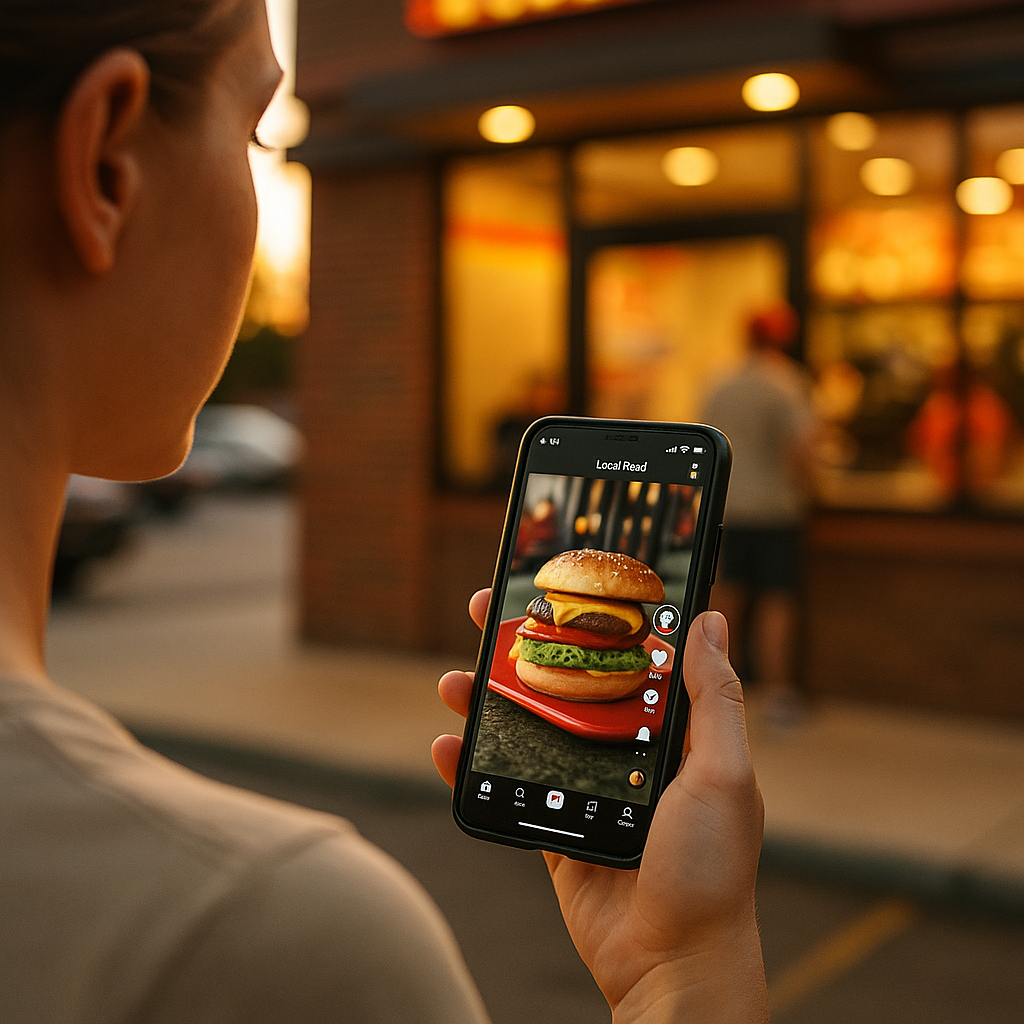
Seventy-three percent of TikTok users say they’ve discovered a local business on the app, according to TikTok’s own business data. So why do most restaurant chains still pour national ad budgets into content nobody near the store ever sees? One 42-unit regional QSR chain flipped that script, ditched broad-reach spend, and used TikTok’s Local Feed to fill parking lots one zip code at a time. Here’s how they did it, and what it means for anyone running a multi-location brand on a flat marketing budget.
The Problem With National Spend at a Regional Scale
The chain in question — a fast-casual burger and shake operator with locations across three Midwest states — had a familiar headache. Corporate marketing wanted brand lift. Franchisees wanted butts in booths. National TikTok ad campaigns satisfied neither group particularly well, because impressions in Seattle don’t sell a double cheeseburger in Terre Haute.
Their previous approach: a modest national Spark Ads budget spread thin across all markets, optimized for video views. It generated decent engagement and almost no measurable traffic lift at individual stores. Franchisees, who fund a chunk of local marketing co-ops, started asking the question every regional operator eventually asks: what are we actually paying for?
Franchise-level marketing dollars die a quiet death when they’re spent on national reach metrics that never translate into a single additional car in the drive-thru line.
What TikTok’s Local Feed Actually Does
TikTok’s Local Feed (sometimes called Nearby, depending on your market rollout) surfaces content based on proximity, not just interest graph signals. It’s TikTok’s answer to the reality that a huge share of intent-driven searches — “food near me,” “what’s open late,” “best tacos downtown” — are now happening natively inside the app instead of on Google. TikTok has leaned into this, expanding local business tools, map integrations, and geo-tagged discovery features specifically to compete for that local-intent traffic.
For a QSR chain, that’s the whole game. Nobody in Cleveland cares about a limited-time shake flavor at a store in Springfield. But someone scrolling three miles from that Springfield location, at 4 p.m. with an empty stomach, absolutely does.
The chain’s marketing lead put it bluntly in an internal memo later shared with their agency partner: “We’d been treating TikTok like a brand awareness channel when it’s actually a local intent engine hiding in plain sight.”
The Playbook: Store-Level Content, Not Corporate Polish
Instead of one national content calendar, the chain restructured around a hub-and-spoke model. Corporate produced a monthly content framework — trending audio ideas, menu spotlight templates, employee-generated content prompts — and store-level managers or designated “content leads” (usually a shift supervisor with a decent phone camera and zero fear of the camera) executed locally.
- Each of the 42 locations got its own TikTok handle, geo-tagged to its physical address and linked to Google Business Profile and Apple Maps listings.
- Content leaned heavily on nano-creator energy: employees doing taste tests, regulars getting shouted out by name, behind-the-counter chaos during rush hour.
- Every post included a location tag and a soft CTA — “swing by before 8” or “we’re two minutes off the highway exit” — rather than generic brand messaging.
This mirrors a pattern seen across other retail and CPG playbooks that skip paid amplification entirely. Cava’s nano-creator approach to menu rollouts worked for similar reasons: hyper-local, low-production content outperforms polished national spots when the goal is action, not awareness. Similarly, REI’s trail-review strategy proved that content tied to a specific place and specific intent converts better than generalized brand storytelling.
Why Employee Content Outperformed Paid Creator Deals
The chain tested a handful of paid nano-creator partnerships early on — local college students and food bloggers getting a free meal for a video. Results were mixed. The content felt like an ad, because it was one.
What actually moved foot traffic was unscripted employee content. A shift manager doing a rapid-fire “what we’re 86’d on tonight” video got more saves and shares than any paid post. Why? Because it read as authentic operational reality, not marketing. TikTok users, especially Gen Z and younger millennials, have developed a sharp radar for anything that smells like a brand deal. Sprout Social’s research on platform trust consistently shows audiences favor content that feels native to the platform over polished ad creative, and QSR is a category where that gap is especially wide.
The Numbers That Made Franchisees Pay Attention
Over a 90-day pilot across 12 test locations, the chain tracked three metrics: geo-tagged video views, store page visits via TikTok’s map link, and — critically — POS data cross-referenced with local promo codes seeded exclusively through location-tagged content.
- Test locations saw a 19% increase in weekday afternoon transactions (2 p.m.–5 p.m.), historically the slowest window.
- Promo code redemption tied to local TikTok posts outperformed the same codes distributed via email by roughly 3x.
- Cost per incremental visit came in at a fraction of what the national Spark Ads campaign had produced the previous quarter — no paid media spend required for the organic Local Feed content.
None of this required a media buy. It required reallocating time — store managers spending 20-30 minutes a few times a week filming and posting — and a modest stipend for the handful of stores that wanted to do occasional paid boosts on top of organic Local Feed performance.
A 19% lift in the slowest part-time window, achieved with zero national ad spend, is the kind of number that gets a franchisee association to fund the program company-wide.
Operational Lessons for Multi-Location Brands
Running 42 TikTok accounts instead of one is not free. It’s operationally messier, and it requires guardrails corporate marketing teams often underestimate.
The chain built three non-negotiables into their franchise marketing agreement:
- Brand voice guidelines, not scripts. Store leads got tone guardrails (no disparaging competitors, no unapproved menu claims, FTC-compliant disclosure language for any incentivized content) but were free to film whatever felt authentic to their location.
- A shared content library. Corporate uploaded trending sounds, caption templates, and B-roll so under-resourced stores weren’t starting from zero every week.
- Weekly performance snapshots. Store managers got a simple dashboard showing views, saves, and estimated local reach, tied loosely to sales during the same window. Gamifying it across the franchise group did more for adoption than any corporate mandate could.
This decentralized-but-guided model resembles what worked for Chomps’ creator seeding strategy, where a consistent framework let dozens of small content creators move faster than a centralized approval process ever could. The lesson generalizes well beyond QSR: give local operators a framework, not a script, and get out of the way.
Compliance Still Matters, Even Without Paid Spend
Just because there’s no ad spend doesn’t mean there’s no regulatory exposure. Employee-generated content promoting free food or incentives still falls under FTC endorsement guidance, and any location running giveaways tied to TikTok engagement needs to document eligibility rules clearly. The chain’s legal team built a one-page compliance checklist that every store lead had to review before posting anything involving a prize, discount code, or contest. It’s a small operational step that saved them from a headache once a regional promo went semi-viral and drew attention beyond the intended radius.
Where This Fits in the Bigger Local-Marketing Shift
QSR isn’t the only category discovering that hyper-local organic content can outperform paid national reach. Grocery, fitness studios, and regional retail chains are running the same playbook: let the location, not the brand, be the main character. It tracks with broader eMarketer data on local social discovery showing younger consumers increasingly bypass search entirely in favor of short-form video for “near me” decisions.
For brand teams evaluating budget for the next fiscal cycle, the calculus is getting harder to ignore: national paid reach still has a role for big launches, but for driving physical traffic to a specific address, geo-native organic content is punching well above its weight. Chains sitting on dozens or hundreds of locations already have their best media asset on payroll — they just haven’t handed them a phone and a content calendar yet.
Next Step
If your brand operates multiple physical locations, audit whether your TikTok strategy is built for national reach or local intent — then pilot the Local Feed approach in five stores before rolling it chain-wide.
FAQs
What is TikTok’s Local Feed and how is it different from the main For You Page?
Local Feed (or Nearby) surfaces content based on geographic proximity to the viewer rather than purely interest-based signals. It’s designed to capture local intent searches like “food near me” that increasingly happen inside TikTok instead of on search engines.
Do brands need paid ads to appear in TikTok’s Local Feed?
No. Organic, geo-tagged content from a location-specific account can surface in Local Feed without any media spend. Paid boosts can extend reach further, but the core mechanic runs on organic proximity and engagement signals.
How many TikTok accounts should a multi-location chain run?
Most successful regional rollouts use one account per physical location rather than a single national handle. This allows geo-tagging, localized content, and location-specific CTAs that a centralized account can’t replicate.
Is employee-generated content risky from a compliance standpoint?
It carries some risk, particularly around FTC endorsement rules if incentives, giveaways, or discounts are involved. Brands should provide clear disclosure guidelines and a lightweight compliance checklist before store-level teams post promotional content.
What metrics matter most for measuring Local Feed performance?
Geo-tagged video views, map-link clicks, and POS data tied to location-specific promo codes are more useful than vanity metrics like follower count or national impressions when the goal is store-level foot traffic.
FAQs
What is TikTok’s Local Feed and how is it different from the main For You Page?
Local Feed (or Nearby) surfaces content based on geographic proximity to the viewer rather than purely interest-based signals. It’s designed to capture local intent searches like “food near me” that increasingly happen inside TikTok instead of on search engines.
Do brands need paid ads to appear in TikTok’s Local Feed?
No. Organic, geo-tagged content from a location-specific account can surface in Local Feed without any media spend. Paid boosts can extend reach further, but the core mechanic runs on organic proximity and engagement signals.
How many TikTok accounts should a multi-location chain run?
Most successful regional rollouts use one account per physical location rather than a single national handle. This allows geo-tagging, localized content, and location-specific CTAs that a centralized account can’t replicate.
Is employee-generated content risky from a compliance standpoint?
It carries some risk, particularly around FTC endorsement rules if incentives, giveaways, or discounts are involved. Brands should provide clear disclosure guidelines and a lightweight compliance checklist before store-level teams post promotional content.
What metrics matter most for measuring Local Feed performance?
Geo-tagged video views, map-link clicks, and POS data tied to location-specific promo codes are more useful than vanity metrics like follower count or national impressions when the goal is store-level foot traffic.
Top Influencer Marketing Agencies
The leading agencies shaping influencer marketing in 2026
Agencies ranked by campaign performance, client diversity, platform expertise, proven ROI, industry recognition, and client satisfaction. Assessed through verified case studies, reviews, and industry consultations.
Moburst

-
2

The Shelf
Boutique Beauty & Lifestyle Influencer AgencyA data-driven boutique agency specializing exclusively in beauty, wellness, and lifestyle influencer campaigns on Instagram and TikTok. Best for brands already focused on the beauty/personal care space that need curated, aesthetic-driven content.Clients: Pepsi, The Honest Company, Hims, Elf Cosmetics, Pure LeafVisit The Shelf → -
3

Audiencly
Niche Gaming & Esports Influencer AgencyA specialized agency focused exclusively on gaming and esports creators on YouTube, Twitch, and TikTok. Ideal if your campaign is 100% gaming-focused — from game launches to hardware and esports events.Clients: Epic Games, NordVPN, Ubisoft, Wargaming, Tencent GamesVisit Audiencly → -
4

Viral Nation
Global Influencer Marketing & Talent AgencyA dual talent management and marketing agency with proprietary brand safety tools and a global creator network spanning nano-influencers to celebrities across all major platforms.Clients: Meta, Activision Blizzard, Energizer, Aston Martin, WalmartVisit Viral Nation → -
5

The Influencer Marketing Factory
TikTok, Instagram & YouTube CampaignsA full-service agency with strong TikTok expertise, offering end-to-end campaign management from influencer discovery through performance reporting with a focus on platform-native content.Clients: Google, Snapchat, Universal Music, Bumble, YelpVisit TIMF → -
6

NeoReach
Enterprise Analytics & Influencer CampaignsAn enterprise-focused agency combining managed campaigns with a powerful self-service data platform for influencer search, audience analytics, and attribution modeling.Clients: Amazon, Airbnb, Netflix, Honda, The New York TimesVisit NeoReach → -
7

Ubiquitous
Creator-First Marketing PlatformA tech-driven platform combining self-service tools with managed campaign options, emphasizing speed and scalability for brands managing multiple influencer relationships.Clients: Lyft, Disney, Target, American Eagle, NetflixVisit Ubiquitous → -
8

Obviously
Scalable Enterprise Influencer CampaignsA tech-enabled agency built for high-volume campaigns, coordinating hundreds of creators simultaneously with end-to-end logistics, content rights management, and product seeding.Clients: Google, Ulta Beauty, Converse, AmazonVisit Obviously →