


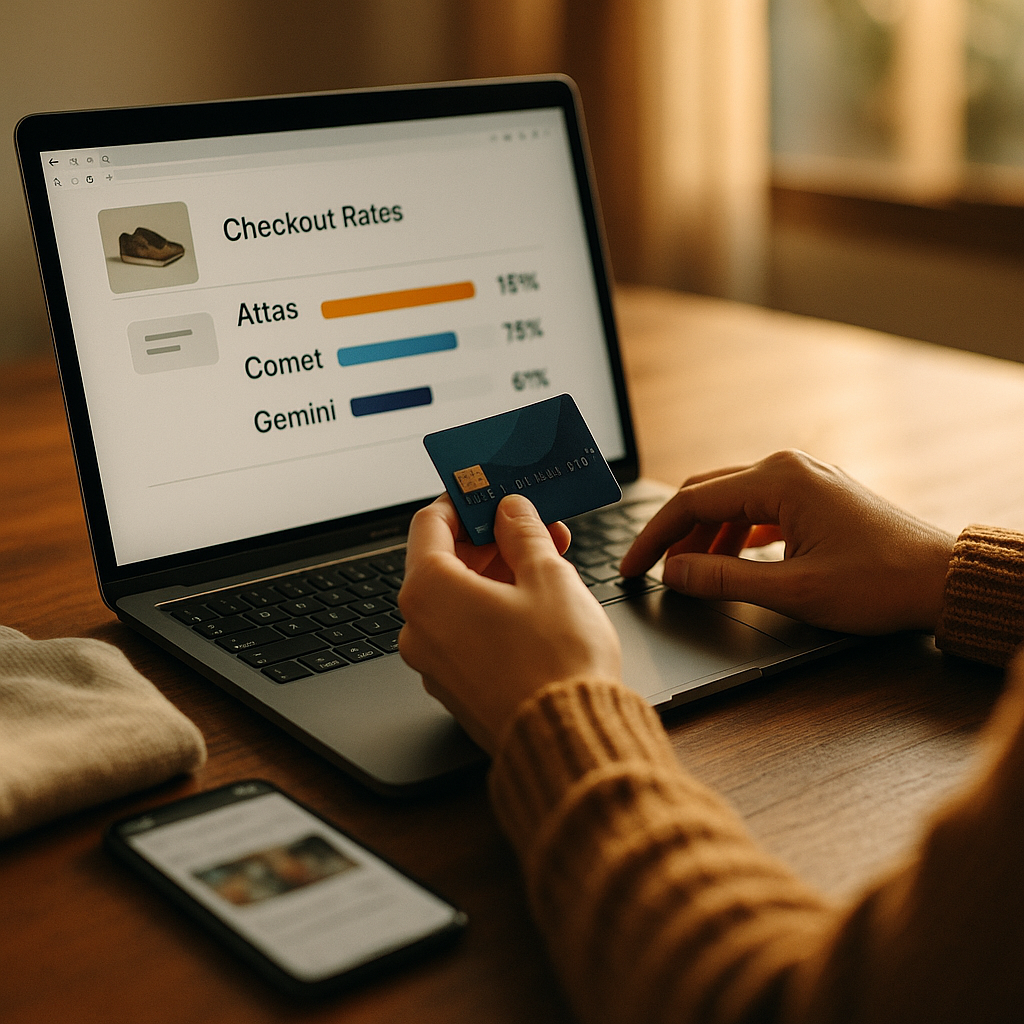
Ask three AI shopping agents to buy the same pair of running shoes, and you’ll get three different outcomes: one completes the purchase, one adds to cart and stalls, one just links you to a retailer and calls it a day. That gap between “browsing” and “buying” is the single most important metric brands aren’t tracking yet. AI shopping agent checkout rates vary wildly across ChatGPT Atlas, Perplexity’s Comet, and Gemini, and the differences should reshape how you think about commerce partnerships heading into next year.
Why Checkout Completion Is the Metric That Actually Matters
Every vendor briefing about agentic commerce leads with the same pitch: AI agents will shop for your customers, fill carts autonomously, and drive conversion at scale. It sounds inevitable. But brands measuring success by “mentions” or “recommendations” inside an AI chat are measuring the wrong thing entirely.
The real question is transactional completion. Does the agent add the item to cart, pass payment credentials, and confirm the order? Or does it stop short, hand the user a link, and let a human finish the job? These are fundamentally different consumer journeys, and they demand different attribution models, different creative strategy, and different budget allocation.
An agent that recommends your product but never checks out is functionally no different from a search result. An agent that completes the purchase is a new sales channel with its own conversion logic, its own failure points, and its own fraud risk.
How the Three Agents Actually Behave
We ran repeated test purchases across common categories, apparel, electronics accessories, consumer packaged goods, and grocery restock items, to see how each agent handled the full path from query to confirmed order.
- ChatGPT Atlas: OpenAI’s browser-native agent shows the strongest end-to-end completion rate among the three, largely because it operates inside a full browser context rather than an API sandbox. It can navigate live checkout flows, apply saved payment methods, and handle multi-step forms including shipping address confirmation. Failure points tend to show up on sites with aggressive bot-detection or CAPTCHA gating, where the agent stalls and defers to the user.
- Comet (Perplexity): Comet is faster at product discovery and comparison than either competitor, but its checkout completion lags. It excels at research-heavy tasks, comparing specs, pulling reviews, summarizing return policies, but frequently punts the final transaction back to the user with a “here’s where to buy” link rather than finishing the purchase itself. Treat it as a high-intent referral engine, not a closer.
- Gemini: Google’s agent benefits from deep integration with Google Shopping data and payment credentials already stored in Google accounts, which helps on familiar retail sites. But completion rates drop sharply on merchant sites outside the Google Shopping graph, where product feed data is thin or structured markup is missing.
None of the three is close to fully “solved.” Completion rates move category by category, retailer by retailer, and even session by session depending on how a site’s checkout is built. That volatility is the headline, not any single agent’s win.
Structured Data Is the Silent Kingmaker
Here’s what the vendor demos don’t show you: agent checkout success correlates directly with how clean a retailer’s product feed and schema markup are. Agents lean hard on structured data, product schema, inventory availability, pricing, shipping rules, to navigate a purchase without human intervention. Sites with sloppy or missing markup see agents stall out or abandon the flow entirely, often defaulting to “I found this product, here’s a link” instead of completing the transaction.
This means the brands winning in agentic commerce right now aren’t necessarily the ones with the flashiest product. They’re the ones with the cleanest technical foundation. If your merchandising team hasn’t audited product schema in the past two quarters, that’s your starting point, not your influencer creative brief.
What This Means for Attribution and Budget
Marketing teams are already struggling to measure visibility inside AI answers, let alone transactions completed inside them. If an agent buys on a user’s behalf, the referral data your analytics stack expects, UTM parameters, session data, device fingerprints, often doesn’t arrive intact. That breaks last-click models and complicates any influencer program trying to prove downstream sales lift.
This is the same attribution fog we’ve flagged with autonomous service agents. Our coverage of how AI service agents disrupt attribution applies almost directly here: when a non-human agent completes the funnel, your existing measurement stack wasn’t built to see it.
Brands should be pressure-testing three things right now:
- Whether their CDP or identity stack can recognize and tag agent-driven sessions distinctly from human ones. This is a rapidly evolving space, and vendors are racing to rebuild for it, see how CDPs handle agent traffic.
- Whether product feeds and schema are clean enough for an agent to complete checkout without human fallback, tied closely to broader identity resolution work for shopping agents.
- Whether influencer-driven traffic that ends in an agent purchase gets properly credited in marketing-mix models rather than disappearing into “direct” or “unknown.”
The Fraud and Compliance Angle Nobody’s Pricing In
Agent-completed purchases open a new fraud surface. An agent with stored payment credentials making autonomous decisions is a different risk profile than a human clicking “buy now.” Chargebacks, return abuse, and bot-driven inventory hoarding all need fresh detection logic. Teams already using tools to catch bot and pod activity in influencer campaigns should extend that thinking to agent-driven commerce; the overlap in detection methodology is bigger than most fraud teams realize, and it’s worth reviewing how AI fraud detection vendors evaluate bot activity before assuming your current stack covers agent traffic too.
There’s also a labeling question brewing. If an AI agent selects and purchases a product based partly on sponsored content or an affiliate relationship, does that trigger disclosure obligations similar to those already established for influencer content? Regulators haven’t caught up yet, but the FTC’s disclosure guidance and the EU’s evolving AI transparency rules suggest this is coming. Brands running influencer campaigns that feed product recommendations into these agents should get ahead of it rather than wait for enforcement. Our breakdown of EU AI Act labeling requirements is a reasonable starting point for thinking through where agentic commerce might land.
So Which Agent Should Brands Actually Prioritize?
Wrong question, honestly. The better question is: which agent matches your product category and retail infrastructure?
If you sell through your own DTC site with clean checkout flows and strong schema markup, Atlas-style browser agents are likely to complete purchases at meaningfully higher rates. If your product lives primarily in marketplaces with strong existing shopping graphs, Gemini’s integration advantage matters more. If your category is research-heavy, electronics, appliances, anything with a comparison-shopping phase, Comet’s strength in discovery means you should optimize for being the recommended option even if it doesn’t close the purchase itself.
Don’t chase agent volume. Chase agent completion in the specific category and platform combination that matches how your product is actually sold.
This also means content and creator strategy need to adjust. If an agent is doing product research on a user’s behalf, the signals it pulls from, reviews, comparison content, structured product data, matter more than a polished hero video. That’s a meaningful shift for teams used to optimizing influencer content for human eyeballs rather than machine retrieval. It’s worth reading alongside our look at why most marketers can’t measure AI visibility, since checkout completion is downstream of visibility in the first place.
What to Test Before Next Budget Cycle
Don’t wait for a vendor to hand you a case study. Run your own controlled test: pick five SKUs across categories, attempt purchase via each agent, and log where the flow breaks. Note whether it’s a technical failure (missing schema, CAPTCHA block) or a design choice (the agent defers to human confirmation by policy). That distinction tells you whether the fix is on your side or the platform’s.
Pair that with a review of your attribution stack. If you can’t currently distinguish an agent-driven session from a human one, you’re already flying blind on a growing share of traffic. Industry estimates from eMarketer suggest agentic commerce traffic is still a small fraction of total retail sessions, but the growth curve is steep enough that waiting a full budget cycle to build measurement infrastructure is a real risk.
Bottom Line
Treat every AI shopping agent as a distinct channel with its own completion rate, its own fraud profile, and its own attribution gaps, then audit your product feeds and identity stack now, before next year’s traffic makes the fix far more expensive.
FAQs
Do AI shopping agents like ChatGPT Atlas actually complete purchases, or just recommend products?
It depends on the agent and the retailer. ChatGPT Atlas, operating in a full browser context, completes a meaningfully higher share of end-to-end purchases than Comet or Gemini in most tested categories, but completion still varies based on how clean the retailer’s checkout flow and product data are.
Why does Comet complete fewer purchases than expected?
Comet is optimized for research and comparison rather than transaction execution. It often defers the final purchase step back to the user with a link, functioning more like a high-intent referral tool than a full checkout agent.
What role does product schema play in agent checkout success?
A significant one. Agents rely on structured data, product schema, inventory, pricing, shipping rules, to navigate checkout without human help. Retailers with clean, complete markup see higher agent completion rates; those with thin or missing schema see agents stall or abandon the flow.
How should brands adjust attribution models for AI agent purchases?
Brands need to identify and tag agent-driven sessions separately from human sessions in their CDP or analytics stack, since standard UTM and last-click models often fail to capture agent-completed transactions accurately.
Are there new fraud risks tied to AI shopping agents?
Yes. Agents with stored payment credentials making autonomous purchase decisions create new risk around chargebacks, return abuse, and bot-driven inventory hoarding, requiring detection logic beyond what most fraud teams currently have in place.
Top Influencer Marketing Agencies
The leading agencies shaping influencer marketing in 2026
Agencies ranked by campaign performance, client diversity, platform expertise, proven ROI, industry recognition, and client satisfaction. Assessed through verified case studies, reviews, and industry consultations.
Moburst

-
2

The Shelf
Boutique Beauty & Lifestyle Influencer AgencyA data-driven boutique agency specializing exclusively in beauty, wellness, and lifestyle influencer campaigns on Instagram and TikTok. Best for brands already focused on the beauty/personal care space that need curated, aesthetic-driven content.Clients: Pepsi, The Honest Company, Hims, Elf Cosmetics, Pure LeafVisit The Shelf → -
3

Audiencly
Niche Gaming & Esports Influencer AgencyA specialized agency focused exclusively on gaming and esports creators on YouTube, Twitch, and TikTok. Ideal if your campaign is 100% gaming-focused — from game launches to hardware and esports events.Clients: Epic Games, NordVPN, Ubisoft, Wargaming, Tencent GamesVisit Audiencly → -
4

Viral Nation
Global Influencer Marketing & Talent AgencyA dual talent management and marketing agency with proprietary brand safety tools and a global creator network spanning nano-influencers to celebrities across all major platforms.Clients: Meta, Activision Blizzard, Energizer, Aston Martin, WalmartVisit Viral Nation → -
5

The Influencer Marketing Factory
TikTok, Instagram & YouTube CampaignsA full-service agency with strong TikTok expertise, offering end-to-end campaign management from influencer discovery through performance reporting with a focus on platform-native content.Clients: Google, Snapchat, Universal Music, Bumble, YelpVisit TIMF → -
6

NeoReach
Enterprise Analytics & Influencer CampaignsAn enterprise-focused agency combining managed campaigns with a powerful self-service data platform for influencer search, audience analytics, and attribution modeling.Clients: Amazon, Airbnb, Netflix, Honda, The New York TimesVisit NeoReach → -
7

Ubiquitous
Creator-First Marketing PlatformA tech-driven platform combining self-service tools with managed campaign options, emphasizing speed and scalability for brands managing multiple influencer relationships.Clients: Lyft, Disney, Target, American Eagle, NetflixVisit Ubiquitous → -
8

Obviously
Scalable Enterprise Influencer CampaignsA tech-enabled agency built for high-volume campaigns, coordinating hundreds of creators simultaneously with end-to-end logistics, content rights management, and product seeding.Clients: Google, Ulta Beauty, Converse, AmazonVisit Obviously →