


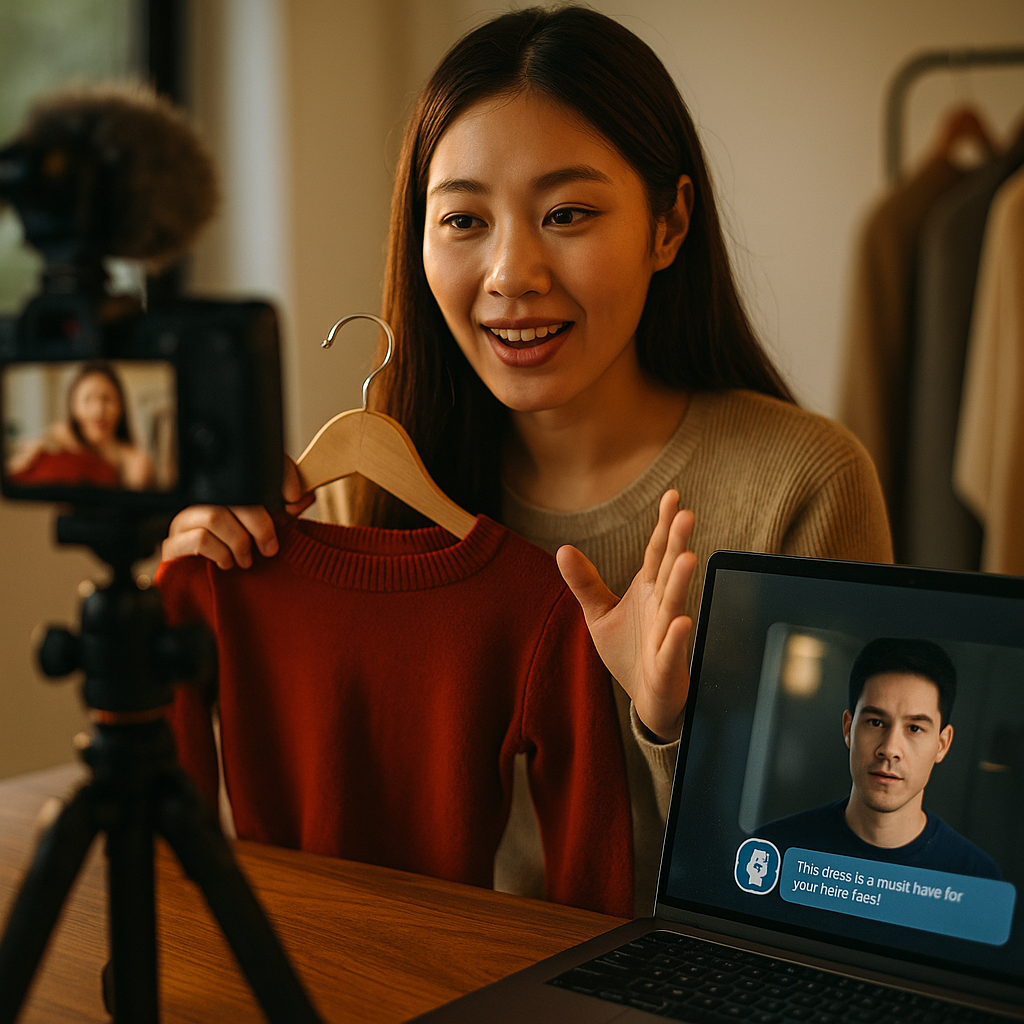
Livestream hosts who miss a buying signal by even ten seconds can lose the sale entirely. That is the brutal math of live commerce, and it is why AI copilots for livestream hosts have moved from novelty to necessity. Brands running live shopping events now report double digit conversion lifts when hosts get real time prompts telling them exactly what to say, show, or discount next.
The question for brand strategists is no longer whether to adopt this tech. It is how fast you can operationalize it before competitors lock in the top hosts and the best data.
Why Live Commerce Needed a Copilot in the First Place
Live shopping puts enormous cognitive load on a single person. A host is reading chat, tracking inventory, managing pacing, and trying to sound natural, all while a producer might be screaming SKU numbers in their earpiece. Something always slips. Usually it is the thing that matters most: the buying signal.
AI copilots solve this by sitting between the platform’s data layer and the host’s earpiece or screen overlay. They ingest live chat sentiment, viewer count spikes, add to cart events, and question frequency, then surface a short, actionable prompt. Think “37 viewers just asked about sizing, address it now” or “cart abandonment rising, offer the bundle discount.” The host stays human. The machine just tells them where to look.
Brands piloting AI-prompted livestream hosts have seen conversion rates climb by 15 to 30 percent compared to unassisted sessions, according to vendor case studies shared across the live commerce space.
This mirrors what we have already seen in adjacent areas of the creator stack. Real time AI optimization is already reshaping how creator video gets edited mid campaign. Livestream copilots are the natural extension: same real time logic, applied to a human voice instead of a video timeline.
What’s Actually Inside the Prompt Engine
Strip away the marketing language and most livestream copilots are running three layers simultaneously.
- Signal detection: Natural language processing scans chat and comments for intent markers like “does this come in blue” or “is this still in stock.” This is not sentiment analysis in the vague sense. It is intent classification, tuned specifically for purchase language.
- Behavioral tracking: The platform monitors viewer drop off points, click through on product cards, and add to cart velocity. A sudden dip usually means the host lost the room. The system flags it before the numbers craters.
- Prompt generation: A lightweight language model translates raw signals into a short instruction, delivered via teleprompter overlay, earpiece audio, or a producer dashboard the host can glance at.
None of this works without clean data feeding it. That is the same lesson we keep seeing across the industry: AI purchase intent scoring only holds up when the underlying signals are structured well enough for a model to act on them without hallucinating a recommendation.
Real Time Prompts Change Host Behavior, Not Just Output
Here is something vendors do not advertise loudly: the best hosts get better at their job because of the prompts, not just during them. Over repeated sessions, hosts internalize the patterns the AI keeps surfacing. They start noticing sizing questions on their own. They pre-empt cart abandonment moments before the system even flags them.
Is that the AI training the human, or the human learning to read the AI’s read of the room? Honestly, it is both, and that is fine. The goal was never to replace the host’s charisma. It was to remove the guesswork around timing.
One mid-size beauty brand running weekly TikTok Shop lives told us their top host went from a 4.2 percent conversion rate to 6.8 percent over eight weeks of copilot-assisted streams, largely because she stopped missing the “is this cruelty free” question that kept stalling purchases in the comment section. That is not a flashy AI story. It is a boring, repeatable operational fix, which is exactly why it works.
The ROI Case Brands Actually Care About
Let’s talk numbers, because that is what gets budget approved. Live commerce in the US remains smaller than in China, but eMarketer has repeatedly flagged live shopping as one of the fastest growing segments of social commerce spend. Brands are not investing in copilots because it’s trendy. They are investing because the unit economics improve fast.
Consider the typical cost structure of a live shopping event: host fee, production time, platform fee, promoted placement. If a copilot lifts conversion by even 10 percent without adding headcount, the payback period on the software license is usually measured in weeks, not quarters. That is a far easier pitch to finance teams than most creator marketing line items.
A 10 percent conversion lift on a $50,000 monthly live commerce program translates to roughly $60,000 in incremental annual revenue, often for a software cost under $2,000 a month.
There is also a risk mitigation angle that gets underrated. Hosts operating without prompts are more likely to make unsupported product claims under pressure, especially when viewers push back in chat. A copilot that surfaces approved messaging in real time reduces the chance a host improvises a claim that gets the brand in trouble with the FTC. That is a compliance benefit, not just a conversion one, and it deserves its own line in the business case.
Where This Overlaps With Creator Vetting and Compliance
Livestream copilots do not operate in isolation. They sit downstream of decisions your team already makes about which hosts to book and how much creative freedom to give them. If you are already using AI fit scores to vet creators before signing them, the same data infrastructure should feed the live session copilot. Disconnected systems mean the host walks into a stream without the brand context the vetting process already gathered.
Contract language matters here too. Some hosts push back on real time prompting because it can feel like surveillance, or like the brand does not trust their instincts. Smart agencies are now writing copilot usage terms directly into talent agreements, similar to how they handle disclosure requirements. If your legal team is not already reviewing this, it is worth looping in the same process used for AI contract redlining, since prompt data collection during a live stream raises its own consent questions.
There is a genuine tension worth naming: hosts are performers, and performers resent being micromanaged. The brands getting this right frame the copilot as a safety net, not a script. Nobody wants to sound like they are reading off a teleprompter mid pitch. The prompt should trigger a natural reaction, not a recitation.
Platform Differences Are Bigger Than They Look
Not every live commerce platform supports copilot integration the same way. TikTok Shop’s live API exposes engagement data with relatively low latency, which makes real time prompting more viable. Amazon Live and Instagram’s live shopping tools lag behind on data access, which limits how sophisticated a copilot can get without custom integration work.
This matters for procurement. Before signing a copilot vendor contract, ask specifically which platforms they support natively versus which require workaround integrations. A tool that promises “real time” prompts but is actually pulling data on a 90 second delay is not solving the problem you are paying it to solve.
It’s also worth checking whether the vendor’s model was trained on your vertical. A copilot tuned on beauty and fashion live commerce data will misfire badly in a home goods or electronics stream, where buyer questions skew technical rather than emotional. Ask for vertical-specific case studies before you commit budget, not generic conversion lift claims.
What to Ask Before You Buy
- Does the tool integrate natively with your live commerce platform, or does it rely on screen scraping and delayed webhooks?
- How is prompt data retained, and does it comply with the same privacy standards your ICO or FTC obligations require for consumer data collection during a live broadcast?
- Can hosts see and reject prompts, or is the system forcing scripted language onto talent contracts prohibit?
- What is the actual latency between a chat signal and a delivered prompt? Anything over five seconds defeats the purpose.
- Does the vendor offer vertical-specific training data, or is the model generic across categories?
Agencies managing multiple brand relationships should also check whether the copilot data plays nicely with broader orchestration tools. If you are already juggling multi brand creator deals across platforms, a live commerce copilot that dumps data into a proprietary silo just adds another reporting headache your team does not need.
The Next Six Months
Expect consolidation. Right now the live commerce copilot space is fragmented, with point solutions built by small startups riding the live shopping wave. That will not last. Larger martech platforms are already eyeing acquisition, the same pattern we have seen with agentic marketing stacks promising unified dashboards that rarely deliver on day one.
Brands that wait for a “perfect” all-in-one platform will lose ground to competitors running scrappy point solutions today. The data advantage compounds. Every live session run through a copilot generates training data that makes the next session’s prompts sharper. Sitting on the sidelines means starting from zero when you finally do adopt.
Frequently Asked Questions
FAQs
What is an AI copilot for livestream hosts?
It is a software layer that monitors live chat, viewer behavior, and inventory data during a live shopping stream, then delivers real time prompts to the host through an earpiece, teleprompter overlay, or producer dashboard so they can respond to buying signals immediately.
How much can AI prompts actually improve live commerce conversion?
Reported lifts range from 15 to 30 percent depending on the vertical and platform, with the largest gains coming from faster responses to sizing, availability, and pricing questions that previously stalled purchases in chat.
Do hosts need special training to use a copilot system?
Most hosts adapt within two or three sessions. The learning curve is less about technical skill and more about trusting the prompt enough to act on it naturally rather than reading it verbatim.
Are there compliance risks with using AI prompts during live streams?
Yes. Prompts that suggest unverified claims can create FTC exposure, and data collected from viewer chat during prompting raises consent questions. Brands should route copilot usage through the same legal review used for creator contracts.
Which live commerce platforms support real time copilot integration best?
TikTok Shop currently offers the lowest latency data access for third party copilot tools. Amazon Live and Instagram require more custom integration work, which can introduce delays that undercut the “real time” value proposition.
Will AI copilots eventually replace live commerce hosts entirely?
Unlikely in the near term. The tools are designed to augment timing and information delivery, not replace the personality and trust a human host builds with a live audience, which remains the core driver of live commerce sales.
The brands winning at live commerce right now are not the ones with the flashiest hosts. They are the ones treating every stream as a data pipeline, feeding a copilot that gets sharper with each session. Start with one platform, one host, and one clean data feed before you scale.
Top Influencer Marketing Agencies
The leading agencies shaping influencer marketing in 2026
Agencies ranked by campaign performance, client diversity, platform expertise, proven ROI, industry recognition, and client satisfaction. Assessed through verified case studies, reviews, and industry consultations.
Moburst

-
2

The Shelf
Boutique Beauty & Lifestyle Influencer AgencyA data-driven boutique agency specializing exclusively in beauty, wellness, and lifestyle influencer campaigns on Instagram and TikTok. Best for brands already focused on the beauty/personal care space that need curated, aesthetic-driven content.Clients: Pepsi, The Honest Company, Hims, Elf Cosmetics, Pure LeafVisit The Shelf → -
3

Audiencly
Niche Gaming & Esports Influencer AgencyA specialized agency focused exclusively on gaming and esports creators on YouTube, Twitch, and TikTok. Ideal if your campaign is 100% gaming-focused — from game launches to hardware and esports events.Clients: Epic Games, NordVPN, Ubisoft, Wargaming, Tencent GamesVisit Audiencly → -
4

Viral Nation
Global Influencer Marketing & Talent AgencyA dual talent management and marketing agency with proprietary brand safety tools and a global creator network spanning nano-influencers to celebrities across all major platforms.Clients: Meta, Activision Blizzard, Energizer, Aston Martin, WalmartVisit Viral Nation → -
5

The Influencer Marketing Factory
TikTok, Instagram & YouTube CampaignsA full-service agency with strong TikTok expertise, offering end-to-end campaign management from influencer discovery through performance reporting with a focus on platform-native content.Clients: Google, Snapchat, Universal Music, Bumble, YelpVisit TIMF → -
6

NeoReach
Enterprise Analytics & Influencer CampaignsAn enterprise-focused agency combining managed campaigns with a powerful self-service data platform for influencer search, audience analytics, and attribution modeling.Clients: Amazon, Airbnb, Netflix, Honda, The New York TimesVisit NeoReach → -
7

Ubiquitous
Creator-First Marketing PlatformA tech-driven platform combining self-service tools with managed campaign options, emphasizing speed and scalability for brands managing multiple influencer relationships.Clients: Lyft, Disney, Target, American Eagle, NetflixVisit Ubiquitous → -
8

Obviously
Scalable Enterprise Influencer CampaignsA tech-enabled agency built for high-volume campaigns, coordinating hundreds of creators simultaneously with end-to-end logistics, content rights management, and product seeding.Clients: Google, Ulta Beauty, Converse, AmazonVisit Obviously →