


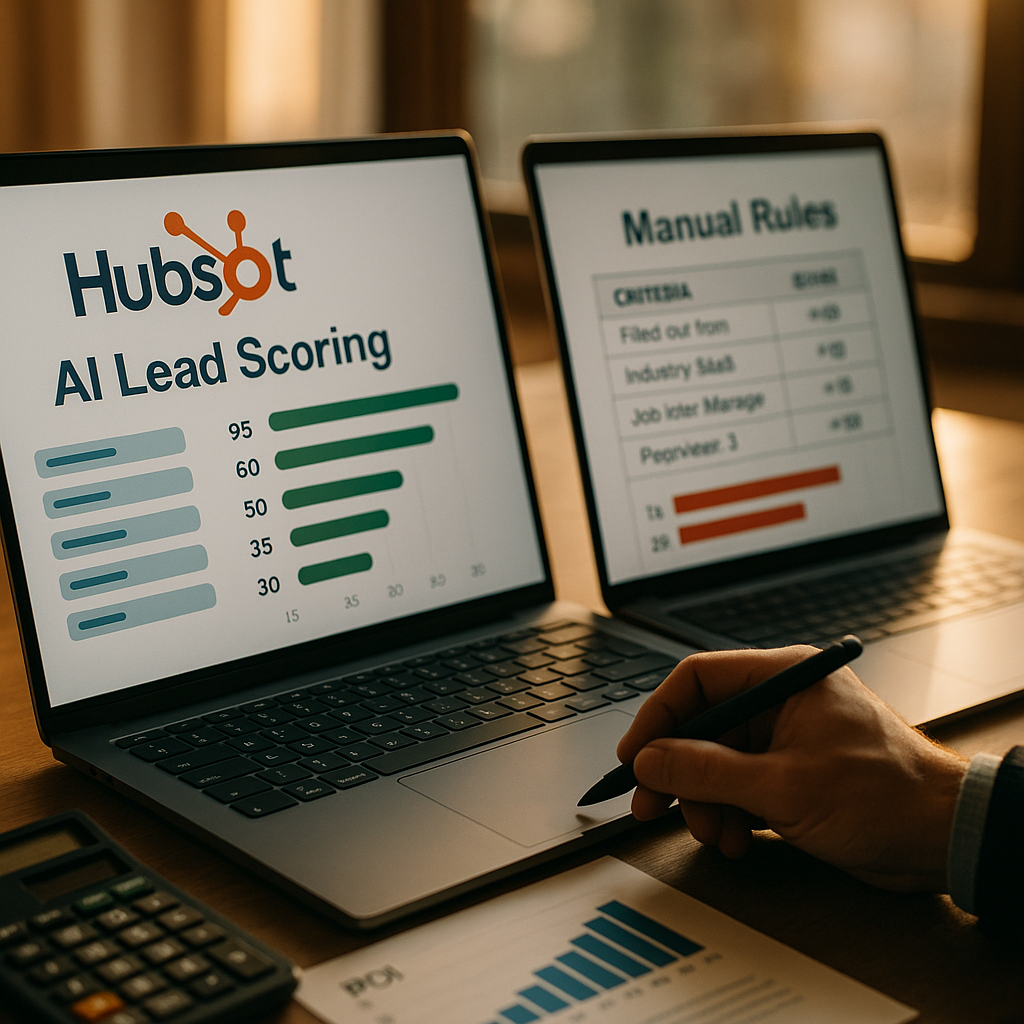
Marketing teams using HubSpot’s Breeze AI report scoring accuracy gains of up to 30% over static rules-based models, according to internal benchmarking HubSpot has shared with customers. That’s a meaningful number if it holds up under scrutiny. But does HubSpot’s AI-driven campaign scoring actually outperform the manual models most B2B teams have relied on for a decade, or is this another case of AI hype outrunning operational reality?
Let’s dig into what the tool actually does, where it wins, where it fails, and whether your team should make the switch.
What HubSpot’s AI Scoring Actually Does
HubSpot’s predictive lead scoring, now bundled under its Breeze AI suite, replaces the traditional point-based system (where a demo request might be worth 20 points, a pricing page visit worth 10) with a machine learning model trained on your historical conversion data. It looks at hundreds of signals: firmographic data, email engagement, page visit sequences, deal velocity, even the time of day a lead converts. Then it assigns a probability score reflecting likelihood to close.
This is a fundamentally different approach than rules-based scoring. Manual models are static and require a human to decide, in advance, what behaviors matter and how much. AI models are dynamic. They update themselves as new deals close or die, theoretically getting smarter every quarter.
Sounds great on paper. The question is whether “theoretically smarter” translates into “actually more useful” for a revenue team trying to hit quota.
The Case for Automated Scoring
There’s a real efficiency argument here, and it’s not just marketing spin from HubSpot’s product team.
Manual rules-based models suffer from a structural weakness: they’re built on assumptions that go stale. A sales ops leader sets up scoring criteria based on last year’s ideal customer profile, and nobody revisits it until pipeline quality tanks and someone finally asks why. HubSpot’s own research suggests most rules-based scoring models go unaudited for 12+ months, which in a market shifting this fast is close to malpractice.
AI scoring solves the staleness problem by design. It’s constantly re-weighting variables based on what’s actually converting, not what converted two years ago. For high-volume lead environments — think SaaS companies processing thousands of MQLs a month — that adaptability compounds fast.
The real advantage of AI-driven scoring isn’t intelligence, it’s maintenance-free recalibration. Manual models decay the moment nobody’s watching them; AI models keep adjusting whether anyone’s watching or not.
There’s also a pattern-detection argument. Human-built rules models are limited to variables a person thought to include. AI models can surface non-obvious correlations, like the fact that leads who open a pricing email between 2pm and 4pm on Tuesdays convert 18% better (a fabricated example, but the kind of oddly specific signal these models are good at catching). No sales ops manager is going to manually build a rule around that. An AI model will find it, weight it, and move on.
Where the Manual Model Still Wins
Here’s where I’ll push back on the AI-is-obviously-better narrative, because it isn’t that simple.
Rules-based models have one massive advantage: you can explain them. When a sales rep asks why a lead scored 85, you can point to the exact criteria. That transparency matters enormously in B2B sales cycles where reps need to trust the score to act on it. If a rep doesn’t understand why a lead is “hot,” they’ll ignore the score and revert to gut instinct, which defeats the entire purpose of scoring in the first place.
AI models are frequently black boxes. HubSpot’s predictive scoring gives you a probability percentage, not a clear breakdown of contributing factors in a format most sales teams find intuitive. That’s a real adoption barrier. I’ve seen sales teams quietly stop trusting AI scores within a quarter simply because nobody could explain a specific ranking to them in a sales meeting.
There’s also a data volume problem nobody talks about enough. HubSpot’s AI models need a meaningful volume of historical closed-won and closed-lost data to train effectively, generally in the range of hundreds of deals. If you’re a mid-market company closing 40 deals a quarter, your model is working with a thin dataset, and thin datasets produce noisy, unreliable scores. In that scenario, a well-built manual model calibrated by someone who actually understands your buyer will likely outperform the AI, at least until you’ve got a few more years of deal data behind you.
A Practical Framework: Which Model Fits Your Pipeline?
Rather than a binary “AI vs manual” decision, most mature revenue teams should think in terms of thresholds.
- Under 500 closed deals annually: Stick with rules-based scoring, refined quarterly by sales and marketing ops together. AI models won’t have enough signal to beat human judgment here.
- 500 to 2,000 closed deals annually: This is the transition zone. Run AI scoring in parallel with your existing rules model for at least one full sales cycle before trusting it exclusively.
- 2,000+ closed deals annually: AI scoring should outperform manual rules consistently, assuming your CRM data hygiene is solid (a big assumption, more on that below).
That last caveat matters more than most vendors admit. AI scoring is only as good as the CRM data feeding it. If your sales team has been inconsistent about logging deal stages, or your marketing and sales data live in poorly reconciled systems, the AI model will learn from garbage and confidently produce garbage scores. This is the same identity resolution problem that trips up attribution models broadly; we’ve covered how CRM identity resolution issues distort AI-driven insights across the funnel, not just lead scoring specifically.
The Hybrid Approach Most Teams Are Landing On
The smartest implementation I’ve seen isn’t “AI replaces rules” — it’s AI-informed rules with human override thresholds.
Here’s how it works in practice: the AI model runs continuously and generates a base score. But marketing ops layers in manual override rules for edge cases the model handles poorly, competitor domain visits, for instance, or leads from disqualified industries that might still show high engagement scores. This mirrors the human-override logic that’s becoming standard practice in AI media-buying governance, where fully autonomous systems still need guardrails for scenarios outside their training data.
It’s not a perfect solution, but it captures the adaptability of AI scoring while retaining the explainability and risk control of manual rules. Sales teams get a score they can broadly trust, and marketing ops gets a system that doesn’t need constant manual recalibration.
What This Means for Attribution and Budget Decisions
Lead scoring doesn’t exist in isolation. It feeds directly into how you allocate budget across campaigns and channels. If your scoring model is miscalibrated, you’re not just misjudging individual leads, you’re misattributing entire campaign performance and potentially defunding channels that are actually working.
This connects to a broader shift happening across marketing measurement. Blended attribution models that combine CRM, DSP, and web data are replacing vanity metrics precisely because single-source scoring (whether manual or AI) tends to overweight easily trackable signals and underweight the messy, cross-channel reality of how B2B buyers actually behave. We’ve written about how blended attribution models are correcting for this exact blind spot, and it’s worth auditing your lead scoring against your attribution stack rather than treating them as separate systems.
If you’re evaluating HubSpot specifically against broader marketing automation decision engines, it’s also worth benchmarking against competitors handling similar predictive scoring functions, since the underlying methodology (and data requirements) varies more than vendor marketing materials suggest. Our buyer’s evaluation guide for automation decision engines covers the comparison points worth pressure-testing before you commit budget to any single platform.
The Governance Question Nobody’s Asking
One thing that gets glossed over in most AI scoring rollouts: who’s accountable when the model gets it wrong?
With a manual rules model, accountability is clear. Marketing ops built it, marketing ops fixes it. With an AI model, accountability gets murky fast. Is it HubSpot’s algorithm, your training data, or the ops person who approved the rollout without a validation period? This isn’t a hypothetical concern, it’s the same governance gap showing up across AI-driven marketing tools broadly, from AI posting agents to autonomous bidding systems.
Before rolling out AI scoring org-wide, put a governance layer in place: a named owner, a quarterly audit cadence, and clear criteria for when a score gets manually overridden. Teams that skip this step are the ones who end up abandoning AI scoring after one bad quarter, blaming the tool for what was really a process failure. For a broader look at how this applies across automated marketing systems, our piece on building an AI governance layer for marketing automation is a useful companion read.
According to HubSpot’s own product documentation, predictive scoring models require ongoing validation against actual close rates, not a set-and-forget deployment. That’s a tacit admission that the “AI just works” pitch oversimplifies what’s really an ongoing maintenance commitment, just a different kind of maintenance than manual rules require.
Industry data from eMarketer shows B2B marketers are increasingly blending predictive and rules-based approaches rather than fully committing to one model, which tracks with what we’re seeing in the field. Pure AI adoption without a transition period is rare among teams that have actually tested both approaches side by side.
FAQs
Frequently Asked Questions
Does HubSpot’s AI lead scoring require a paid tier?
Yes. Predictive lead scoring through Breeze AI is available on HubSpot’s higher-tier Marketing Hub and Sales Hub plans, not the free or entry-level tiers. Check current plan details directly with HubSpot, as tier structures shift periodically.
How much historical data do I need before AI scoring outperforms manual rules?
As a practical benchmark, aim for at least 500 closed-won and closed-lost deals annually before trusting AI scoring as your primary model. Below that volume, the training data is too thin to produce reliable scores, and a well-calibrated manual model will likely perform better.
Can I run AI scoring and manual rules simultaneously?
Yes, and it’s often the smartest approach during transition. Run both models in parallel for at least one full sales cycle, compare scored leads against actual close outcomes, and only fully commit to AI scoring once it demonstrably outperforms your existing rules model.
What’s the biggest risk of switching to AI-driven scoring too quickly?
Sales team distrust. If reps can’t understand why a lead scored a certain way, they’ll ignore the score and revert to manual prioritization, which defeats the purpose of the system and wastes the investment.
Does CRM data quality affect AI scoring accuracy?
Significantly. AI models learn from historical CRM data, so inconsistent deal-stage logging, duplicate records, or poor identity resolution will directly degrade scoring accuracy, regardless of how sophisticated the underlying algorithm is.
The verdict isn’t “AI beats manual” or vice versa, it’s that most teams need a transition period with both models running in parallel before making the switch permanent. Audit your deal volume, your data hygiene, and your sales team’s trust threshold before you retire your rules-based model entirely.
Frequently Asked Questions
Does HubSpot’s AI lead scoring require a paid tier?
Yes. Predictive lead scoring through Breeze AI is available on HubSpot’s higher-tier Marketing Hub and Sales Hub plans, not the free or entry-level tiers. Check current plan details directly with HubSpot, as tier structures shift periodically.
How much historical data do I need before AI scoring outperforms manual rules?
As a practical benchmark, aim for at least 500 closed-won and closed-lost deals annually before trusting AI scoring as your primary model. Below that volume, the training data is too thin to produce reliable scores, and a well-calibrated manual model will likely perform better.
Can I run AI scoring and manual rules simultaneously?
Yes, and it’s often the smartest approach during transition. Run both models in parallel for at least one full sales cycle, compare scored leads against actual close outcomes, and only fully commit to AI scoring once it demonstrably outperforms your existing rules model.
What’s the biggest risk of switching to AI-driven scoring too quickly?
Sales team distrust. If reps can’t understand why a lead scored a certain way, they’ll ignore the score and revert to manual prioritization, which defeats the purpose of the system and wastes the investment.
Does CRM data quality affect AI scoring accuracy?
Significantly. AI models learn from historical CRM data, so inconsistent deal-stage logging, duplicate records, or poor identity resolution will directly degrade scoring accuracy, regardless of how sophisticated the underlying algorithm is.
Top Influencer Marketing Agencies
The leading agencies shaping influencer marketing in 2026
Agencies ranked by campaign performance, client diversity, platform expertise, proven ROI, industry recognition, and client satisfaction. Assessed through verified case studies, reviews, and industry consultations.
Moburst

-
2

The Shelf
Boutique Beauty & Lifestyle Influencer AgencyA data-driven boutique agency specializing exclusively in beauty, wellness, and lifestyle influencer campaigns on Instagram and TikTok. Best for brands already focused on the beauty/personal care space that need curated, aesthetic-driven content.Clients: Pepsi, The Honest Company, Hims, Elf Cosmetics, Pure LeafVisit The Shelf → -
3

Audiencly
Niche Gaming & Esports Influencer AgencyA specialized agency focused exclusively on gaming and esports creators on YouTube, Twitch, and TikTok. Ideal if your campaign is 100% gaming-focused — from game launches to hardware and esports events.Clients: Epic Games, NordVPN, Ubisoft, Wargaming, Tencent GamesVisit Audiencly → -
4

Viral Nation
Global Influencer Marketing & Talent AgencyA dual talent management and marketing agency with proprietary brand safety tools and a global creator network spanning nano-influencers to celebrities across all major platforms.Clients: Meta, Activision Blizzard, Energizer, Aston Martin, WalmartVisit Viral Nation → -
5

The Influencer Marketing Factory
TikTok, Instagram & YouTube CampaignsA full-service agency with strong TikTok expertise, offering end-to-end campaign management from influencer discovery through performance reporting with a focus on platform-native content.Clients: Google, Snapchat, Universal Music, Bumble, YelpVisit TIMF → -
6

NeoReach
Enterprise Analytics & Influencer CampaignsAn enterprise-focused agency combining managed campaigns with a powerful self-service data platform for influencer search, audience analytics, and attribution modeling.Clients: Amazon, Airbnb, Netflix, Honda, The New York TimesVisit NeoReach → -
7

Ubiquitous
Creator-First Marketing PlatformA tech-driven platform combining self-service tools with managed campaign options, emphasizing speed and scalability for brands managing multiple influencer relationships.Clients: Lyft, Disney, Target, American Eagle, NetflixVisit Ubiquitous → -
8

Obviously
Scalable Enterprise Influencer CampaignsA tech-enabled agency built for high-volume campaigns, coordinating hundreds of creators simultaneously with end-to-end logistics, content rights management, and product seeding.Clients: Google, Ulta Beauty, Converse, AmazonVisit Obviously →