


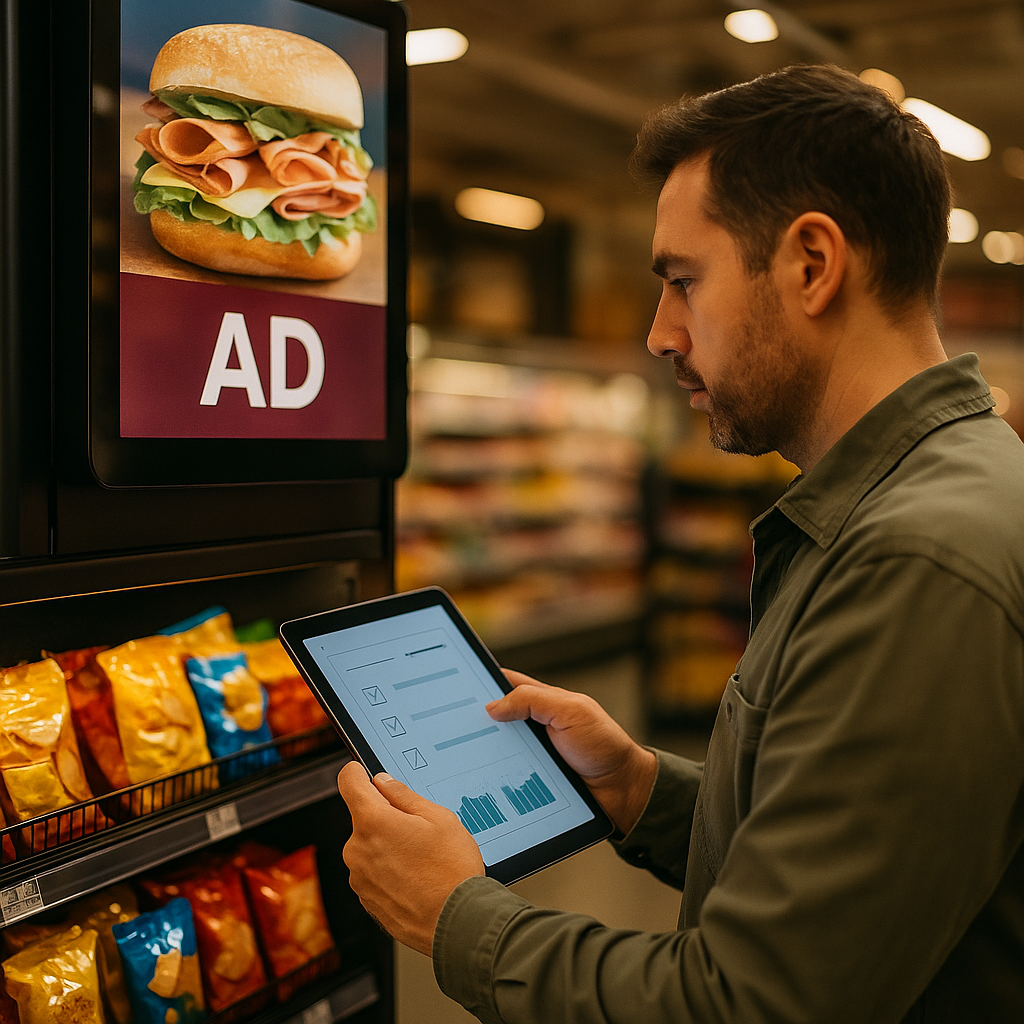
Retail media networks generated an estimated $60 billion in 2026, and a growing slice of that spend now flows into in-store digital screens triggered by shoppers’ own loyalty data. Here’s the uncomfortable question: does your in-store digital ads compliance framework actually hold up when a regulator asks how you linked a face detection camera to a loyalty ID? For most retail media teams, the honest answer is “we’re not sure.”
That uncertainty is the business risk. Not the technology. Not the ad inventory. The gap between what your vendors claim they’re doing with aggregated foot-traffic data and what your legal team can actually defend in an audit.
Why This Suddenly Matters to Every Retail Marketer
In-store retail media used to mean a static screen near the checkout lane, running whatever the CPG brand paid for. Now it’s dynamic. Sensors detect a loyalty member entering an aisle, pull their purchase history, and trigger a personalized offer on a nearby display within seconds. Walmart Connect, Kroger Precision Marketing, and Albertsons Media Collective have all built businesses around exactly this kind of targeting.
The mechanics are elegant. The compliance exposure is not.
Loyalty identifiers are personal data under nearly every modern privacy statute. Foot-traffic data, even when aggregated, can often be re-identified when it’s cross-referenced against loyalty purchase histories, timestamps, and store layouts. Combine the two, and you’ve built something that regulators increasingly treat as a de facto profile, whether you called it that internally or not.
Aggregation doesn’t erase risk. If a dataset can be re-linked to an individual through a loyalty ID, timestamp, or purchase pattern, regulators will treat it as personal data, aggregated label or not.
Where the Legal Exposure Actually Lives
Three failure points show up again and again in vendor contracts and internal audits.
- Consent scope creep. A shopper agreed to loyalty program terms in 2019. Does that consent cover real-time in-store ad targeting triggered by Bluetooth beacons and camera-based footfall counters today? Usually not, unless the terms were rewritten and re-served.
- Vendor data commingling. Many in-store media vendors pool foot-traffic sensor data with loyalty files from multiple retailer clients on shared infrastructure. That’s a data processing arrangement that needs its own agreement, audit rights, and breach protocol, similar to what we’ve covered in server-side tracking vendor DPAs.
- Re-identification through aggregation gaps. “Aggregated” is doing a lot of work in most vendor pitch decks. If the dataset can be sliced by store, hour, and loyalty tier down to a handful of shoppers, it’s not really aggregated. It’s pseudonymized at best.
The FTC has made clear, repeatedly, that it treats de-identification claims skeptically when the underlying data retains any linkage path back to an individual. Retailers who can’t explain their re-identification risk assessment in plain language are exposed the moment a state AG or the FTC comes asking.
What a Real Framework Looks Like
Forget the 40-page policy document nobody reads. A working framework needs five components, and each one maps to a specific operational owner.
1. Data Minimization at Collection
Don’t collect what you don’t need. If the ad trigger only requires “loyalty tier + dwell time,” don’t also ingest raw camera footage or precise MAC address trails. Every additional data point widens your breach surface and your legal exposure. Retail media teams often default to “collect everything, decide later” because storage is cheap. That instinct is exactly backwards from a compliance standpoint.
2. Identity Resolution With a Documented Match-Rate Ceiling
If your vendor is stitching loyalty IDs to anonymous sensor pings, you need to know the match rate and the false-positive rate. A vendor claiming 95% match confidence with no methodology behind it is a red flag, not a selling point. This is the same diligence gap we outlined in our identity resolution vendor vetting checklist, and it applies just as directly to in-store sensor-to-loyalty matching as it does to digital identity graphs.
3. Purpose Limitation, Written Into the Contract
Loyalty data collected for personalization shouldn’t silently migrate into a media measurement product sold to third-party CPG brands without a separate legal basis. Purpose limitation clauses need to specify: what the data can be used for, who can access it, and what happens when a brand partner wants to layer it with their own first-party CRM data.
4. Consumer-Facing Transparency That Matches Reality
Signage near in-store cameras helps, but it’s not sufficient on its own. Loyalty app privacy notices need a specific, readable section covering in-store ad personalization, not a buried clause under “we may use your data to improve services.” Regulators in the UK and EU have been explicit that vague catch-all language doesn’t satisfy transparency obligations; the ICO has flagged this pattern in retail contexts specifically.
5. Ongoing Audit Trail, Not a One-Time Assessment
Compliance isn’t a launch-day checkbox. You need continuous logging of what data triggered which ad, when, and under what consent basis, mirroring the approach described in our piece on audit trails for AI marketing decisions. In-store ad triggering is, functionally, an automated decision system. Treat it like one.
The Age Verification Blind Spot Nobody’s Pricing In
Here’s a wrinkle most retail media teams haven’t thought through: loyalty programs don’t reliably segment by age at the point of in-store ad delivery. A teenager using a parent’s loyalty card, or a household account, could trigger targeted alcohol, gambling-adjacent, or age-restricted product ads on a screen they happen to be standing near.
This isn’t hypothetical. It’s the same regulatory pressure point we’ve documented in the global youth age-verification compliance matrix, just relocated from social platforms to the physical store floor. If your in-store ad logic can’t account for who’s actually standing in front of the screen versus whose loyalty ID triggered it, you have a gap that’s easy for a regulator to spot and hard for you to explain away.
State Privacy Law Is Already Ahead of Retail Media Practice
California, Colorado, Connecticut, and now a growing list of states classify precise geolocation and behavioral profiling data under stricter consent and opt-out standards. Some of these statutes explicitly cover data used to build a profile “reflecting a consumer’s … economic situation, … behavior, location, or movements.” In-store foot-traffic linked to loyalty purchase history checks every one of those boxes.
Vermont’s data broker and privacy statute, covered in our Vermont privacy law DPA framework, offers a useful template for the kind of granular processing agreement retailers should be pushing their in-store media vendors to sign. Most current vendor contracts weren’t written with this level of scrutiny in mind, because the technology outpaced the paperwork.
If your in-store media vendor can’t produce a data processing agreement that names specific retention periods, deletion triggers, and sub-processor lists, you’re not compliant. You’re hoping.
Building the Vendor Scorecard
Procurement teams evaluating in-store retail media platforms should score vendors against a short, non-negotiable list before signing anything:
- Can they document the legal basis for combining sensor data with loyalty identifiers, jurisdiction by jurisdiction?
- Do they provide a re-identification risk assessment, updated at least annually?
- Is there a documented data retention and deletion schedule tied to specific triggers, not vague “as needed” language?
- Can they demonstrate opt-out mechanisms that actually stop ad personalization, not just suppress reporting?
- Do their sub-processors (often ad-tech partners handling the actual targeting logic) sign the same obligations as the primary vendor?
Retail media buyers are used to scoring vendors on CPMs and inventory quality. This scorecard needs to sit next to that, not after it. According to eMarketer, retail media ad spend continues to outpace overall digital ad growth, which means the volume of loyalty-linked targeting is scaling faster than most legal teams can review it.
What This Costs You If You Skip It
Regulatory fines are the headline risk, but they’re not the only one. Brand partners running campaigns on your retail media network will increasingly ask for compliance documentation before they book spend, the same way agencies now ask creators for FTC disclosure proof before greenlighting a campaign, a pattern well established in our FTC video disclosure compliance checklist. Retail media networks that can’t produce a clean compliance answer will lose deals to competitors who can, quietly, before any regulator gets involved.
There’s also a trust cost. Loyalty programs run on the implicit promise that shoppers get value in exchange for data. Stack too many undisclosed uses on top of that exchange, and churn follows. HubSpot’s research on consumer trust in marketing consistently shows transparency as a top driver of retained loyalty engagement, not a nice-to-have.
Next Step
Pull your top three in-store media vendor contracts this quarter and check them against the five-part framework above. If none of them can produce a documented re-identification risk assessment, that’s your starting point, not a footnote.
FAQs
What counts as “aggregated” foot-traffic data under current privacy law?
Data is only meaningfully aggregated if it can’t be reasonably re-linked to an individual, even when cross-referenced with loyalty IDs, timestamps, or store-level detail. Most vendor datasets fail this test once you narrow by store, hour, and loyalty tier.
Do in-store digital ads triggered by loyalty data require separate consumer consent?
In most cases, yes. Standard loyalty program enrollment consent rarely covers real-time in-store ad personalization explicitly, especially under state privacy laws that treat behavioral profiling as a distinct processing purpose.
Who is liable if a vendor mishandles loyalty-linked foot-traffic data?
Liability typically extends to both the retailer and the vendor, depending on the data processing agreement. Retailers that fail to secure adequate contractual protections and audit rights carry significant exposure regardless of vendor fault.
How often should retailers audit their in-store retail media vendors?
At minimum annually, though continuous audit logging of ad-trigger events is the stronger practice, particularly as state privacy laws add new profiling and opt-out requirements.
Does GDPR or UK data law apply to US-based in-store retail media programs?
Only if the retailer operates in or processes data from EU/UK residents. However, many US retailers use the stricter EU/UK framework as their baseline standard to simplify multi-jurisdiction compliance.
FAQs
What counts as “aggregated” foot-traffic data under current privacy law?
Data is only meaningfully aggregated if it can’t be reasonably re-linked to an individual, even when cross-referenced with loyalty IDs, timestamps, or store-level detail. Most vendor datasets fail this test once you narrow by store, hour, and loyalty tier.
Do in-store digital ads triggered by loyalty data require separate consumer consent?
In most cases, yes. Standard loyalty program enrollment consent rarely covers real-time in-store ad personalization explicitly, especially under state privacy laws that treat behavioral profiling as a distinct processing purpose.
Who is liable if a vendor mishandles loyalty-linked foot-traffic data?
Liability typically extends to both the retailer and the vendor, depending on the data processing agreement. Retailers that fail to secure adequate contractual protections and audit rights carry significant exposure regardless of vendor fault.
How often should retailers audit their in-store retail media vendors?
At minimum annually, though continuous audit logging of ad-trigger events is the stronger practice, particularly as state privacy laws add new profiling and opt-out requirements.
Does GDPR or UK data law apply to US-based in-store retail media programs?
Only if the retailer operates in or processes data from EU/UK residents. However, many US retailers use the stricter EU/UK framework as their baseline standard to simplify multi-jurisdiction compliance.
Top Influencer Marketing Agencies
The leading agencies shaping influencer marketing in 2026
Agencies ranked by campaign performance, client diversity, platform expertise, proven ROI, industry recognition, and client satisfaction. Assessed through verified case studies, reviews, and industry consultations.
Moburst

-
2

The Shelf
Boutique Beauty & Lifestyle Influencer AgencyA data-driven boutique agency specializing exclusively in beauty, wellness, and lifestyle influencer campaigns on Instagram and TikTok. Best for brands already focused on the beauty/personal care space that need curated, aesthetic-driven content.Clients: Pepsi, The Honest Company, Hims, Elf Cosmetics, Pure LeafVisit The Shelf → -
3

Audiencly
Niche Gaming & Esports Influencer AgencyA specialized agency focused exclusively on gaming and esports creators on YouTube, Twitch, and TikTok. Ideal if your campaign is 100% gaming-focused — from game launches to hardware and esports events.Clients: Epic Games, NordVPN, Ubisoft, Wargaming, Tencent GamesVisit Audiencly → -
4

Viral Nation
Global Influencer Marketing & Talent AgencyA dual talent management and marketing agency with proprietary brand safety tools and a global creator network spanning nano-influencers to celebrities across all major platforms.Clients: Meta, Activision Blizzard, Energizer, Aston Martin, WalmartVisit Viral Nation → -
5

The Influencer Marketing Factory
TikTok, Instagram & YouTube CampaignsA full-service agency with strong TikTok expertise, offering end-to-end campaign management from influencer discovery through performance reporting with a focus on platform-native content.Clients: Google, Snapchat, Universal Music, Bumble, YelpVisit TIMF → -
6

NeoReach
Enterprise Analytics & Influencer CampaignsAn enterprise-focused agency combining managed campaigns with a powerful self-service data platform for influencer search, audience analytics, and attribution modeling.Clients: Amazon, Airbnb, Netflix, Honda, The New York TimesVisit NeoReach → -
7

Ubiquitous
Creator-First Marketing PlatformA tech-driven platform combining self-service tools with managed campaign options, emphasizing speed and scalability for brands managing multiple influencer relationships.Clients: Lyft, Disney, Target, American Eagle, NetflixVisit Ubiquitous → -
8

Obviously
Scalable Enterprise Influencer CampaignsA tech-enabled agency built for high-volume campaigns, coordinating hundreds of creators simultaneously with end-to-end logistics, content rights management, and product seeding.Clients: Google, Ulta Beauty, Converse, AmazonVisit Obviously →