


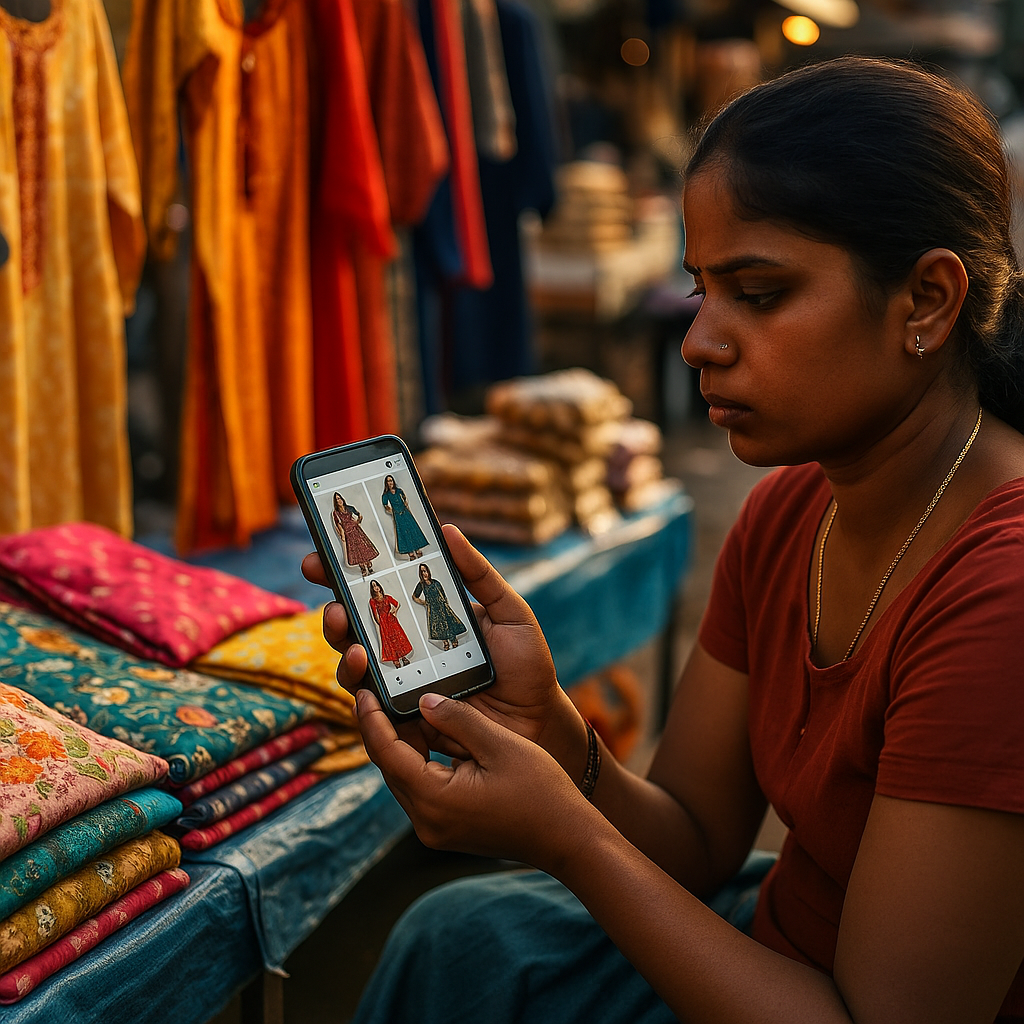
19%. That’s the share of India’s online shoppers now buying directly through social platforms, according to Kantar’s latest ICUBE report. For a market of roughly 900 million internet users, that single digit represents a shopper base larger than the entire population of most countries. India’s social commerce moment isn’t coming — it’s already reshaping how brands need to think about market entry.
If you’re a CMO or growth lead eyeing India as the next big geographic bet, this stat should reframe your entire go-to-market plan. Not because 19% sounds huge on its own, but because of the velocity behind it and what it implies about consumer behavior in tier-2 and tier-3 cities — markets most Western brands still treat as an afterthought.
What the ICUBE Number Actually Tells Us
Kantar’s ICUBE study has tracked India’s internet adoption for years, and this release marks a clear inflection point. The 19% figure isn’t measuring who’s seen a product on Instagram or WhatsApp. It’s measuring who completed a purchase through a social channel — no redirect to a separate e-commerce app required.
That distinction matters enormously for brand strategists. Social commerce in the West still largely functions as a discovery-to-website funnel. In India, the funnel is collapsing into a single screen. WhatsApp catalogs, Instagram Shops, and regional platforms like ShareChat and Meesho are closing the loop between “I saw this” and “I bought this” without ever leaving the app.
India’s social commerce shoppers aren’t a niche early-adopter segment anymore — they’re a mainstream cohort large enough to justify a dedicated go-to-market budget line, not a test campaign.
Compare this to the broader shift documented in livestream commerce conversion data, where in-platform buying consistently outperforms traditional paid social by a wide margin. India is essentially fast-forwarding through the adoption curve that took China nearly a decade to build, and it’s doing so with mobile-first infrastructure that never had to unlearn desktop habits.
Why Global Brands Keep Getting India Wrong
Most international brands enter India with a playbook built for the US or UK: a polished D2C website, a handful of celebrity or macro-influencer tie-ups, and paid media pushing traffic to that site. It’s a reasonable approach almost everywhere else. In India, it’s increasingly the wrong one.
Here’s the problem. Website-first strategies assume reliable broadband, low data costs per session, and shoppers comfortable entering card details on unfamiliar domains. India’s reality looks different: prepaid mobile data, trust built through social proof rather than brand websites, and a payment ecosystem dominated by UPI rather than credit cards. A brand that ignores this mismatch burns budget on traffic that never converts.
- Trust is social, not institutional. Indian shoppers trust a creator’s recommendation inside WhatsApp more than a banner ad on a brand site.
- Regional language content converts better. English-only creative caps your addressable audience to metro markets.
- Micro and nano creators dominate ROI. Reach matters less than relatability in tier-2 and tier-3 cities.
- Payment friction kills conversion. If checkout requires leaving the app, expect drop-off rates far above Western benchmarks.
This is the same lesson emerging from the broader shift covered in India’s social commerce boom and its implications for Western markets — the country isn’t a smaller version of a mature market. It’s a preview of where mobile-native commerce is headed everywhere.
The Tiered Creator Model India Demands
Brands that have cracked India’s social commerce puzzle tend to share one operational trait: they’ve built tiered creator programs rather than relying on a handful of big-name partnerships. This mirrors a pattern already validated at scale by enterprise marketers globally, as outlined in how tiered influencer models became the enterprise standard.
In practice, that means running parallel layers: a small set of macro-influencers for awareness, a much larger bench of micro and nano creators for conversion, and regional-language specialists who can speak authentically to Tamil Nadu, Maharashtra, or Uttar Pradesh audiences without a generic Hindi-English blend. Estée Lauder’s approach to structured creator tiers, detailed in Estée Lauder’s tiered influencer infrastructure, offers a useful blueprint — swap Western regional nuance for India’s linguistic and cultural diversity, and the framework holds.
Budget allocation should follow accordingly. Rather than funneling 70% of spend into two or three big names, brands entering India are finding better ROI spreading budget across 50-100 smaller creators who each carry deep trust with a specific regional or demographic audience.
Measurement Can’t Be an Afterthought
Here’s where a lot of otherwise smart India entries fall apart: attribution. If your measurement stack was built for a single-market, single-language funnel, it will choke on India’s fragmented reality — multiple platforms, multiple languages, multiple payment rails, often within the same campaign.
The measurement gaps already threatening budgets in mature markets, as detailed in recent creator spend and measurement data, get significantly worse in a market as fragmented as India. Brands need multi-touch attribution that can stitch together a WhatsApp click, an Instagram Shop purchase, and a UPI payment confirmation into one coherent customer journey. Off-the-shelf Western MTA tools frequently miss regional platforms entirely.
This is where AI-driven attribution frameworks earn their keep. The approach detailed in AI multi-touch attribution for global brands applies directly here: brands need attribution models flexible enough to ingest data from ShareChat, Meesho, WhatsApp Business API, and mainstream platforms simultaneously, without forcing analysts to manually reconcile five separate dashboards every week.
Compliance Risk Nobody’s Talking About Enough
Regulatory scrutiny on influencer marketing is tightening globally, and India is no exception. The Advertising Standards Council of India (ASCI) has issued increasingly specific disclosure guidelines for sponsored content, and enforcement has picked up pace. Brands used to navigating FTC disclosure requirements in the US can’t assume those same practices translate cleanly.
India’s guidelines require clear, prominent disclosure in the same language as the primary content — a detail that trips up brands running multilingual creator campaigns without a localized compliance checklist. Add in data localization requirements for payment processing, and India’s regulatory environment demands its own dedicated legal review, not a copy-paste of your US or EU influencer contracts.
Treating India as a “light localization” of an existing global playbook is the single most common — and most expensive — mistake brands make when they see the ICUBE numbers and rush to scale.
What This Means for Budget Planning
So what does an actual India entry budget look like once you internalize the ICUBE data? Three shifts stand out.
First, shift spend from top-funnel awareness toward mid-funnel social commerce enablement — meaning WhatsApp catalog setup, Instagram Shop integration, and creator partnerships that can drive in-app checkout, not just impressions. Second, budget for regional-language content production as a core line item, not a “nice to have” localization afterthought. Third, allocate meaningfully more toward measurement infrastructure than you would in a mature market, because the fragmentation tax in India is real and it compounds quarter over quarter if left unaddressed.
Brands should also look at how influencer manager roles are evolving to meet this complexity. As covered in how influencer manager jobs now require CAC and LTV skills, the people running these programs increasingly need to think like performance marketers, not just relationship managers. India’s social commerce environment demands exactly that hybrid skill set — someone who can negotiate a creator deal in the morning and interrogate a CAC dashboard in the afternoon.
Industry data from eMarketer’s retail and commerce research and Statista’s India digital market tracking both point to continued acceleration in mobile commerce adoption across South and Southeast Asia, reinforcing that India isn’t an isolated case — it’s a leading indicator.
A Quick Gut Check Before You Greenlight India
Before finalizing an India market entry plan, ask your team honestly:
- Does our attribution stack actually support WhatsApp and regional platforms, or just Meta and Google?
- Have we budgeted for regional-language creative as a first-class deliverable?
- Does our creator program include a nano/micro tier, or are we still thinking in terms of two or three big names?
- Has legal reviewed ASCI disclosure requirements separately from our existing FTC-based playbook?
If you’re answering “no” to more than one of these, the ICUBE data should be a wake-up call rather than a green light.
Tools like Sprout Social and platforms supporting Meta’s commerce integrations are adding India-specific features faster than most brands are adapting their strategy to use them — a gap worth closing before competitors do.
The takeaway: India’s 19% social commerce shopper base isn’t a market to test with leftover budget — it’s a distinct operating model requiring its own creator tiers, attribution stack, and compliance review. Brands that build for India’s mobile-native, in-app checkout reality now will be positioned to capture the next wave of growth before the market matures and acquisition costs climb.
Frequently Asked Questions
What does Kantar ICUBE’s 19% social commerce stat actually measure?
It measures the share of India’s online shoppers who have completed a purchase directly through a social platform — such as WhatsApp, Instagram Shops, or regional apps like Meesho and ShareChat — rather than being redirected to a separate e-commerce website.
Why can’t global brands use their existing influencer playbook in India?
Most Western playbooks assume website-first funnels, credit card payments, and English-language creative. India’s shoppers rely more on UPI payments, in-app checkout, and regional-language trust signals from micro and nano creators, making a direct copy-paste approach far less effective.
How is India’s social commerce different from China’s model?
India is compressing the adoption curve China took roughly a decade to build, but it’s doing so on a mobile-first, multi-language, multi-platform foundation (WhatsApp, Instagram, regional apps) rather than a single dominant super-app ecosystem.
What compliance risks should brands watch for in India?
ASCI’s influencer disclosure guidelines require clear, prominent disclosures in the same language as the content itself. Brands also need to account for data localization rules tied to payment processing, both of which differ meaningfully from FTC requirements.
Should brands prioritize macro-influencers or micro-influencers in India?
Data increasingly favors a tiered model: a small layer of macro-influencers for awareness, supported by a much larger bench of micro and nano creators who drive regional trust and conversion at lower cost per acquisition.
What’s the biggest attribution challenge for brands entering India?
Stitching together customer journeys that span WhatsApp catalogs, Instagram Shops, and UPI payment confirmations. Standard Western multi-touch attribution tools often don’t natively support India’s regional platform mix, requiring more flexible, AI-driven measurement infrastructure.
Frequently Asked Questions
What does Kantar ICUBE’s 19% social commerce stat actually measure?
It measures the share of India’s online shoppers who have completed a purchase directly through a social platform — such as WhatsApp, Instagram Shops, or regional apps like Meesho and ShareChat — rather than being redirected to a separate e-commerce website.
Why can’t global brands use their existing influencer playbook in India?
Most Western playbooks assume website-first funnels, credit card payments, and English-language creative. India’s shoppers rely more on UPI payments, in-app checkout, and regional-language trust signals from micro and nano creators, making a direct copy-paste approach far less effective.
How is India’s social commerce different from China’s model?
India is compressing the adoption curve China took roughly a decade to build, but it’s doing so on a mobile-first, multi-language, multi-platform foundation (WhatsApp, Instagram, regional apps) rather than a single dominant super-app ecosystem.
What compliance risks should brands watch for in India?
ASCI’s influencer disclosure guidelines require clear, prominent disclosures in the same language as the content itself. Brands also need to account for data localization rules tied to payment processing, both of which differ meaningfully from FTC requirements.
Should brands prioritize macro-influencers or micro-influencers in India?
Data increasingly favors a tiered model: a small layer of macro-influencers for awareness, supported by a much larger bench of micro and nano creators who drive regional trust and conversion at lower cost per acquisition.
What’s the biggest attribution challenge for brands entering India?
Stitching together customer journeys that span WhatsApp catalogs, Instagram Shops, and UPI payment confirmations. Standard Western multi-touch attribution tools often don’t natively support India’s regional platform mix, requiring more flexible, AI-driven measurement infrastructure.
Top Influencer Marketing Agencies
The leading agencies shaping influencer marketing in 2026
Agencies ranked by campaign performance, client diversity, platform expertise, proven ROI, industry recognition, and client satisfaction. Assessed through verified case studies, reviews, and industry consultations.
Moburst

-
2

The Shelf
Boutique Beauty & Lifestyle Influencer AgencyA data-driven boutique agency specializing exclusively in beauty, wellness, and lifestyle influencer campaigns on Instagram and TikTok. Best for brands already focused on the beauty/personal care space that need curated, aesthetic-driven content.Clients: Pepsi, The Honest Company, Hims, Elf Cosmetics, Pure LeafVisit The Shelf → -
3

Audiencly
Niche Gaming & Esports Influencer AgencyA specialized agency focused exclusively on gaming and esports creators on YouTube, Twitch, and TikTok. Ideal if your campaign is 100% gaming-focused — from game launches to hardware and esports events.Clients: Epic Games, NordVPN, Ubisoft, Wargaming, Tencent GamesVisit Audiencly → -
4

Viral Nation
Global Influencer Marketing & Talent AgencyA dual talent management and marketing agency with proprietary brand safety tools and a global creator network spanning nano-influencers to celebrities across all major platforms.Clients: Meta, Activision Blizzard, Energizer, Aston Martin, WalmartVisit Viral Nation → -
5

The Influencer Marketing Factory
TikTok, Instagram & YouTube CampaignsA full-service agency with strong TikTok expertise, offering end-to-end campaign management from influencer discovery through performance reporting with a focus on platform-native content.Clients: Google, Snapchat, Universal Music, Bumble, YelpVisit TIMF → -
6

NeoReach
Enterprise Analytics & Influencer CampaignsAn enterprise-focused agency combining managed campaigns with a powerful self-service data platform for influencer search, audience analytics, and attribution modeling.Clients: Amazon, Airbnb, Netflix, Honda, The New York TimesVisit NeoReach → -
7

Ubiquitous
Creator-First Marketing PlatformA tech-driven platform combining self-service tools with managed campaign options, emphasizing speed and scalability for brands managing multiple influencer relationships.Clients: Lyft, Disney, Target, American Eagle, NetflixVisit Ubiquitous → -
8

Obviously
Scalable Enterprise Influencer CampaignsA tech-enabled agency built for high-volume campaigns, coordinating hundreds of creators simultaneously with end-to-end logistics, content rights management, and product seeding.Clients: Google, Ulta Beauty, Converse, AmazonVisit Obviously →