


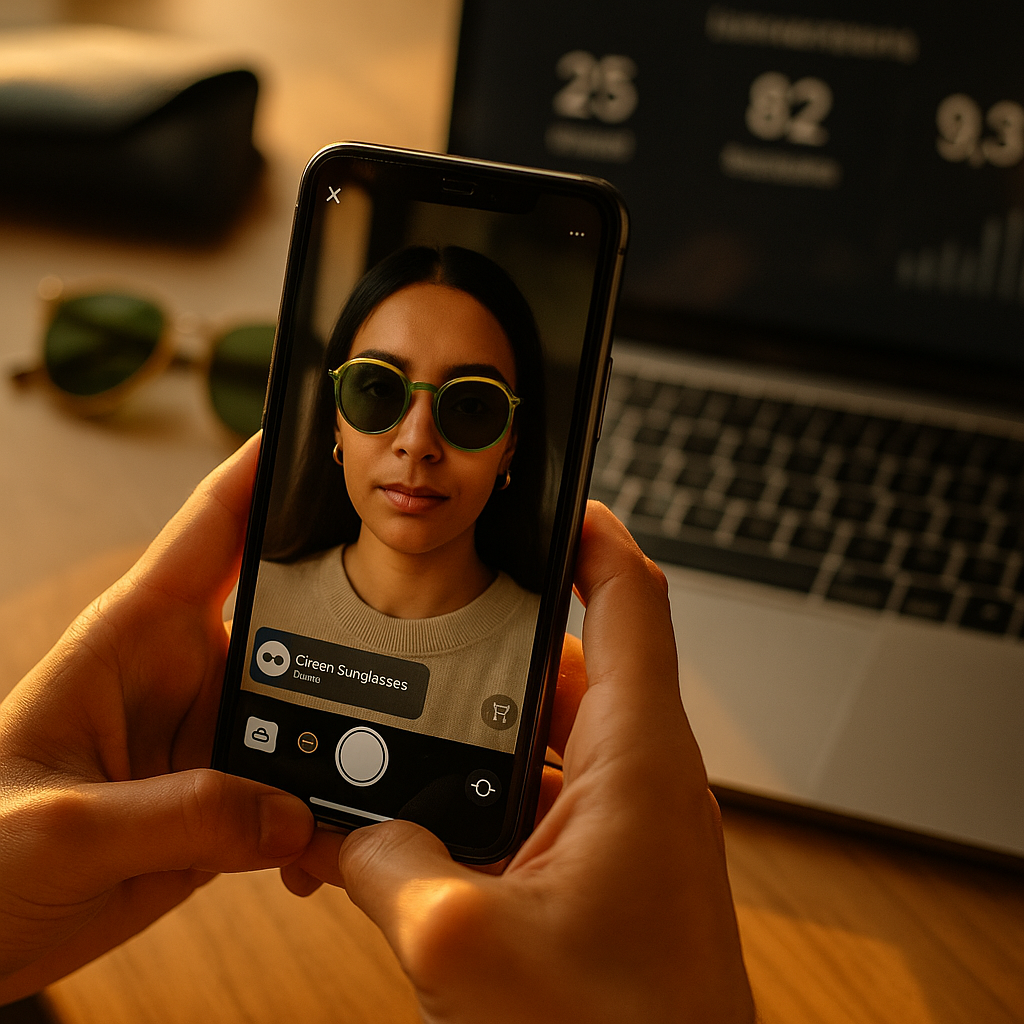
Shoppers who use AR try-on features convert at rates brands used to dream about, yet most influencer briefs still treat AR filters as a novelty add-on. Instagram AR try-on conversion data tells a different story: this is a shoppable commerce channel with its own rules, and brands ignoring the structure behind it are leaving revenue on the table.
Meta has been quietly feeding performance data back to advertisers who use AR try-on in shopping ads and creator content. The pattern is consistent enough now to build a playbook around. Here’s what the numbers actually mean for how you brief creators, tag products, and measure success.
Why AR Try-On Data Suddenly Matters
For years, AR filters on Instagram were treated as engagement bait. Fun face filter, branded lens, maybe a giveaway tie-in. Nobody expected them to close sales. That’s changed. Meta’s shopping infrastructure now supports true product try-on (makeup, glasses, footwear, watches) directly inside shoppable posts and creator Reels, with checkout links attached to the AR session itself.
The result is a measurable funnel: impression, AR session start, session completion, add-to-cart, purchase. Brands running beauty and eyewear campaigns are reporting that users who complete an AR try-on session convert at meaningfully higher rates than those who only view static product images or standard video demos. Meta’s own advertiser guidance on shopping ad formats increasingly nudges brands toward interactive try-on placements precisely because the completion-to-purchase data backs it up.
Brands treating AR try-on as a gimmick are missing the point: it’s the closest thing Instagram has to an in-store fitting room, and fitting rooms have always driven higher purchase intent than a glance at a shelf.
That’s not a small distinction. It changes how you should brief creators, what you ask them to show, and how you tag the products underneath.
The conversion gap between passive and interactive content
Static product posts still work for awareness. But when eMarketer and other analysts have tracked interactive shopping formats against passive ones, interactive consistently wins on add-to-cart rate, even if raw reach is lower. AR try-on sits at the top of that interactivity ladder. A creator holding up a lipstick and saying “this shade is gorgeous” is a recommendation. A creator letting followers try that same shade on their own face, live inside the app, is a transaction on the way to happening.
This mirrors what we’ve seen across other platforms chasing the same conversion logic. TikTok Shop’s checkout speed improvements exist for the same reason: friction kills purchase intent, and interactivity reduces friction by letting the shopper “experience” the product before they buy it. See our breakdown of checkout speed and creative structure for the parallel on TikTok’s side.
What the Data Actually Shows Brands
Strip away the marketing-speak and the pattern from Meta’s shopping and AR performance reporting boils down to a few consistent signals:
- Completion rate predicts purchase intent better than view count. A creator video with fewer views but a high AR session completion rate often outperforms a viral post with low interaction depth.
- Product category changes the ceiling. Beauty, eyewear, and footwear see the strongest try-on-to-purchase correlation. Apparel and home goods lag behind because AR fit accuracy is still catching up.
- Creator framing affects session length. Creators who narrate the try-on experience (“watch how this shifts in different lighting”) keep users in the AR session longer than creators who just apply the filter and move on.
- Repeat try-on sessions correlate with lower return rates. Users who try multiple shades or styles before buying return the product less often than those who buy off a single static image.
That last point should matter to anyone running a P&L, not just a marketing dashboard. Lower returns mean better margin, not just better top-line conversion.
Where most brands still get the brief wrong
Most influencer briefs for AR content are still written like they’re briefing a standard product post: show the product, mention three benefits, tag the brand. That template doesn’t work for try-on formats. The brief needs to account for the AR session as the actual conversion moment, not the video around it.
A better brief structure asks the creator to:
- Open with the AR try-on trigger clearly visible (tap, swipe, or link prompt) within the first three seconds.
- Narrate through at least two variations (colors, styles, sizes) to extend session length.
- Point verbally and visually to the shoppable tag before the video ends, not just in the caption.
- Avoid over-editing the AR segment. Heavy cuts during the try-on moment reduce perceived realism and, per creator testing, hurt completion rates.
This is a fundamentally different creative ask than a standard unboxing or demo video. It requires creators who understand the mechanics of Instagram’s AR tools, not just ones who look good on camera.
Structuring Shoppable AR Content: A Practical Framework
Think of shoppable AR creator content in three layers: trigger, experience, and exit. Each layer has its own failure points, and each one shows up separately in Meta’s reporting.
Trigger layer. This is the moment a viewer decides to tap into the AR experience. If your creator buries the try-on prompt at the 20-second mark of a 30-second Reel, you’ve already lost most of the audience. Front-load it. Instagram’s own creator tools documentation, referenced through Meta’s business resources, recommends surfacing interactive elements within the first few seconds for exactly this reason.
Experience layer. This is the AR session itself, and it’s where completion rate lives or dies. Brands should test their AR effects across lighting conditions and skin tones before creators ever touch them. Nothing kills conversion faster than a filter that looks broken on half the audience trying it.
Exit layer. This is the handoff from AR session to checkout. The tag needs to be visible before the user exits the try-on experience, not buried in a swipe-up link three screens later. Every extra tap between “I like how this looks” and “buy” costs you conversions.
The brands seeing the strongest AR try-on ROI aren’t the ones with the flashiest filters. They’re the ones who shortened the distance between trying and buying to almost nothing.
Tagging discipline is non-negotiable
A surprising number of brands still run AR creator campaigns with inconsistent product tagging, using a generic brand tag instead of the specific SKU shown in the try-on session. That mismatch shows up as a conversion leak in the data: high try-on engagement, disappointing purchase numbers, because the shopper landed on the wrong product page or a category page instead of the exact shade or model they just tried.
Every AR creator post needs SKU-level tagging that matches exactly what’s on screen. This sounds obvious. It’s still the most common technical error brands make when scaling AR campaigns past a single pilot creator.
Measurement: What to Actually Track
Standard influencer KPIs (views, likes, engagement rate) don’t tell you much about AR try-on performance. You need a funnel-specific measurement set:
- AR session start rate (impressions to session opens)
- Session completion rate (opens to full try-on experience)
- Tag click-through from within the AR session
- Add-to-cart rate post-session
- Return rate segmented by AR-assisted vs. non-AR-assisted purchases
Most brands can pull the first four through Meta’s native ads and shopping reporting, especially when creator content runs as a boosted partnership ad rather than an organic-only post. The return-rate data typically requires pulling from your own commerce platform and matching order IDs against campaign UTMs or Meta’s conversion API events.
If you’re not currently boosting creator AR content through Partnership Ads, you’re likely underreporting your own results. Organic-only posts give you surface metrics; boosted placements unlock the full funnel view Meta uses internally to justify the format’s ROI. For a broader look at how Instagram’s ranking and distribution changes affect what creator content even gets seen in the first place, see our coverage of credibility-weighted distribution.
Benchmarking against other shoppable formats
It helps to put AR try-on performance in context against other shoppable creator formats brands are already running. Livestream shopping, for instance, drives strong conversion through urgency and countdown mechanics rather than product visualization. If you’re comparing where AR fits in a broader creator commerce mix, our guide on commission tiers and countdown livestreams is a useful counterpoint, since it shows a completely different conversion mechanism working toward the same bottom line. Similarly, the side-by-side in shopping format comparisons across platforms is worth reviewing before you allocate budget across AR-specific placements versus livestream or link-in-bio models.
Compliance and Disclosure Don’t Disappear Because It’s a Filter
AR try-on content is still sponsored content. The FTC’s endorsement guidance applies regardless of whether the creator is holding a product or letting a filter apply it virtually. Brands running AR creator campaigns need the same #ad and #sponsored disclosure discipline they’d apply to any paid post, ideally reinforced through Meta’s built-in branded content tags. Review the FTC’s endorsement guidelines before scaling any AR creator program, particularly if creators are making claims about product performance (skin tone matching, fit accuracy) that the AR effect itself can’t fully guarantee.
There’s also a subtler risk: AR effects that visually misrepresent product color or fit can create returns and complaint spikes that erode the very conversion lift you’re chasing. Test rigorously before creators publish.
Next Step
Audit your last three AR creator campaigns against the trigger-experience-exit framework above, then pull session completion and SKU-level tag data before you brief the next one. If those numbers aren’t in your current reporting stack, that’s the gap to close before spending another dollar on AR creative.
FAQs
What is Instagram AR try-on conversion data used for in influencer marketing?
It measures how many users who engage with an AR try-on experience inside creator content go on to add products to cart and purchase, helping brands evaluate whether interactive AR content outperforms static product posts.
Which product categories perform best with AR try-on creator content?
Beauty, eyewear, and footwear currently show the strongest try-on-to-purchase correlation on Instagram, largely because AR rendering accuracy is more mature in those categories than in apparel or home goods.
Do brands need to boost AR creator content to get full performance data?
Organic posts show surface-level engagement, but running creator AR content through Partnership Ads typically unlocks funnel-level metrics like session completion rate and post-session add-to-cart data.
How should brands brief creators for shoppable AR content?
Briefs should specify that the AR trigger appear within the first few seconds, require narration through multiple product variations, and mandate visible shoppable tags before the video ends, rather than relying on caption links alone.
Does AR try-on content still require FTC disclosure?
Yes. Sponsored AR try-on content is subject to the same endorsement and disclosure rules as any other paid creator post, and brands should also verify AR effects don’t misrepresent product color or fit.
FAQs
What is Instagram AR try-on conversion data used for in influencer marketing?
It measures how many users who engage with an AR try-on experience inside creator content go on to add products to cart and purchase, helping brands evaluate whether interactive AR content outperforms static product posts.
Which product categories perform best with AR try-on creator content?
Beauty, eyewear, and footwear currently show the strongest try-on-to-purchase correlation on Instagram, largely because AR rendering accuracy is more mature in those categories than in apparel or home goods.
Do brands need to boost AR creator content to get full performance data?
Organic posts show surface-level engagement, but running creator AR content through Partnership Ads typically unlocks funnel-level metrics like session completion rate and post-session add-to-cart data.
How should brands brief creators for shoppable AR content?
Briefs should specify that the AR trigger appear within the first few seconds, require narration through multiple product variations, and mandate visible shoppable tags before the video ends, rather than relying on caption links alone.
Does AR try-on content still require FTC disclosure?
Yes. Sponsored AR try-on content is subject to the same endorsement and disclosure rules as any other paid creator post, and brands should also verify AR effects don’t misrepresent product color or fit.
Top Influencer Marketing Agencies
The leading agencies shaping influencer marketing in 2026
Agencies ranked by campaign performance, client diversity, platform expertise, proven ROI, industry recognition, and client satisfaction. Assessed through verified case studies, reviews, and industry consultations.
Moburst

-
2

The Shelf
Boutique Beauty & Lifestyle Influencer AgencyA data-driven boutique agency specializing exclusively in beauty, wellness, and lifestyle influencer campaigns on Instagram and TikTok. Best for brands already focused on the beauty/personal care space that need curated, aesthetic-driven content.Clients: Pepsi, The Honest Company, Hims, Elf Cosmetics, Pure LeafVisit The Shelf → -
3

Audiencly
Niche Gaming & Esports Influencer AgencyA specialized agency focused exclusively on gaming and esports creators on YouTube, Twitch, and TikTok. Ideal if your campaign is 100% gaming-focused — from game launches to hardware and esports events.Clients: Epic Games, NordVPN, Ubisoft, Wargaming, Tencent GamesVisit Audiencly → -
4

Viral Nation
Global Influencer Marketing & Talent AgencyA dual talent management and marketing agency with proprietary brand safety tools and a global creator network spanning nano-influencers to celebrities across all major platforms.Clients: Meta, Activision Blizzard, Energizer, Aston Martin, WalmartVisit Viral Nation → -
5

The Influencer Marketing Factory
TikTok, Instagram & YouTube CampaignsA full-service agency with strong TikTok expertise, offering end-to-end campaign management from influencer discovery through performance reporting with a focus on platform-native content.Clients: Google, Snapchat, Universal Music, Bumble, YelpVisit TIMF → -
6

NeoReach
Enterprise Analytics & Influencer CampaignsAn enterprise-focused agency combining managed campaigns with a powerful self-service data platform for influencer search, audience analytics, and attribution modeling.Clients: Amazon, Airbnb, Netflix, Honda, The New York TimesVisit NeoReach → -
7

Ubiquitous
Creator-First Marketing PlatformA tech-driven platform combining self-service tools with managed campaign options, emphasizing speed and scalability for brands managing multiple influencer relationships.Clients: Lyft, Disney, Target, American Eagle, NetflixVisit Ubiquitous → -
8

Obviously
Scalable Enterprise Influencer CampaignsA tech-enabled agency built for high-volume campaigns, coordinating hundreds of creators simultaneously with end-to-end logistics, content rights management, and product seeding.Clients: Google, Ulta Beauty, Converse, AmazonVisit Obviously →