


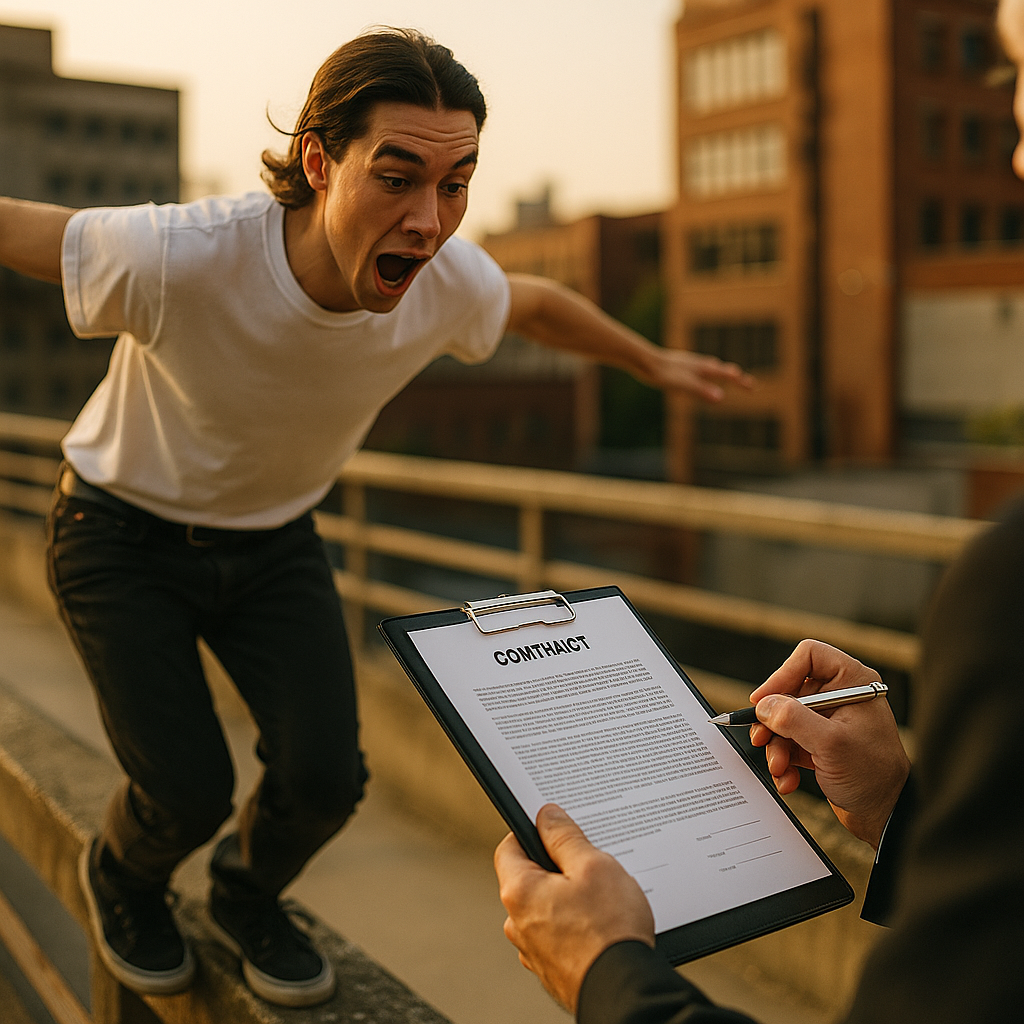
One uninsured stunt gone wrong can wipe out a full year’s marketing budget. As brands push creators into skydives, off-road shoots, and packed festival stages, the standard influencer contract and its boilerplate liability clause are no longer enough. Getting the insurance rider for high-risk creator activations right is now a core part of campaign planning, not an afterthought legal formality.
Talk to any risk manager who has handled a creator campaign gone sideways, and you’ll hear the same complaint: nobody read the exclusions until after the ambulance showed up. That’s the gap this article closes.
Why Standard Creator Contracts Don’t Cover Physical Risk
Most influencer agreements are written by teams who think in terms of disclosure compliance, usage rights, and exclusivity windows. They’re built for a world where the biggest risk is an FTC disclosure violation, not a broken collarbone. That mindset made sense when “high risk” meant a creator forgetting to say #ad. It doesn’t hold up when your activation involves a moving vehicle, a body of water, international travel, or a stage in front of ten thousand people.
General commercial liability policies typically exclude “hazardous activities” by default. Stunts, extreme sports, aerial work, and anything involving animals or pyrotechnics usually fall outside standard coverage unless specifically endorsed. Brands that assume their existing media liability or event insurance automatically extends to creator-driven stunt content are making a costly assumption. It doesn’t.
A standard commercial general liability policy will almost never cover a creator-performed stunt unless a specific rider names the activity, the location, and the individual performer.
What a Rider Actually Needs to Name
An insurance rider isn’t a checkbox, it’s a scoping exercise. Vague language is the enemy here. “Physical activity” or “adventure content” won’t cut it with an underwriter, and it definitely won’t cut it when a claim gets disputed.
For 2026 activations, brand legal and risk teams should insist riders explicitly name:
- The specific activity — not “extreme sports” but “tandem skydiving from a fixed-wing aircraft at a licensed drop zone.”
- The individual performer, including whether it’s the creator themselves or a stunt double.
- Location and jurisdiction, since coverage terms shift dramatically between, say, a controlled US soundstage and an unregulated cliffside shoot abroad.
- Equipment and third-party vendors involved, including drone operators, rigging crews, and transportation providers.
- Duration and rehearsal windows, because most claims happen during setup or practice runs, not the final take.
Skip any one of these and you’ve created an exclusion loophole. Underwriters look for reasons to deny claims; vague riders hand them one on a plate.
Travel Activations Bring a Different Risk Profile
Stunt riders get the headlines, but travel-based creator campaigns quietly generate more claims. Think brand trips to remote destinations, influencer press junkets in politically unstable regions, or “van life” style content shot across multiple countries in a single trip.
Travel risk isn’t just medical evacuation, though that matters enormously. It’s also:
- Trip cancellation and interruption tied to the creator’s schedule, not just the brand’s.
- Equipment loss or damage across customs checkpoints.
- Kidnap and ransom coverage for activations in higher-risk regions.
- Local liability requirements that differ from the creator’s home country and the brand’s country of incorporation.
Brands often default to a generic corporate travel policy and assume it extends to contracted creators. It usually doesn’t, because creators are independent contractors, not employees. That distinction matters enormously to an insurer. A rider needs to explicitly extend named-peril travel coverage to the creator as a covered party, not just to internal staff traveling alongside them.
This is also where jurisdiction stacking becomes a real headache. A creator based in the UK, shooting for a US brand, on location in Southeast Asia, creates three overlapping regulatory environments. Brands already navigating state-level privacy frameworks know how quickly jurisdiction complexity multiplies compliance work. Insurance is no different, and riders should specify governing law for claims resolution up front.
Live Events: The Crowd Is the Variable You Can’t Control
Live event activations, think brand-sponsored meet-and-greets, festival appearances, or in-store creator takeovers, introduce a variable that stunt shoots don’t: an uncontrolled crowd. You can rehearse a stunt. You cannot rehearse a few thousand fans rushing a barricade.
Event organizers typically carry their own general liability policy, but that policy protects the venue and the event, not necessarily the brand’s specific creator activation happening within it. Brands need a rider that addresses:
- Crowd-crush and trampling liability specific to the creator’s appearance zone.
- Third-party injury claims tied to meet-and-greet interactions, autograph lines, or photo ops.
- Cancellation coverage if the creator is a no-show due to illness, travel disruption, or a viral controversy that forces a pullout.
- Liability for user-generated content captured by attendees during the event, which can create its own disclosure and defamation exposure.
That last point connects directly to broader disclosure risk. If attendee-captured footage ends up boosted or reposted by the brand later, it can trigger the same FTC disclosure obligations covered in the FTC video disclosure standard. Insurance and compliance risk aren’t separate conversations anymore, they’re the same conversation happening in two departments that rarely talk to each other.
Who Pays When the Creator Isn’t Technically “Working”?
Here’s a question that trips up a lot of legal teams: what happens if the injury occurs during downtime, not during the actual filmed activity? A creator twists an ankle exploring the set between takes. A creator gets food poisoning at the hotel the brand booked. Is that a covered activation risk or a personal travel incident?
The answer depends entirely on how the rider defines “covered period.” Best practice for 2026 is to define coverage as running from arrival at the first brand-directed location through departure from the last one, inclusive of all brand-organized transportation and lodging. Anything the creator does entirely on their own time, outside brand direction, typically falls outside the rider. Get this window wrong and you’ll either overpay for coverage you don’t need or discover a gap exactly when you need it filled.
Waivers, Riders, and the Indemnification Trap
Brands sometimes assume a signed liability waiver from the creator eliminates the need for a robust rider. It doesn’t. Waivers reduce the creator’s ability to sue the brand directly, they don’t create a funding source for medical costs, third-party claims, or production shutdown losses. A waiver and a rider solve different problems, and treating them as interchangeable is one of the most common mistakes brand legal teams make.
There’s also a growing trend of brands pushing indemnification language onto creators or their agencies, effectively asking the talent to insure the brand against its own campaign. This is getting pushback, and rightly so. Creators, especially mid-tier ones without dedicated legal counsel, are increasingly refusing contracts that shift disproportionate risk onto them. Expect this tension to show up more in contract negotiations, similar to how liability clauses around AI agent use have forced brands to rethink who bears risk in automated workflows.
Building the Rider Into the Production Timeline
The biggest operational failure isn’t bad rider language, it’s timing. Riders get requested two weeks before shoot day, when there’s no time to properly underwrite named-peril coverage for a specific stunt or location. Underwriters need lead time to assess activity-specific risk, especially for anything involving aerial work, water, or international travel.
Build insurance procurement into the production timeline the same way you’d build in location scouting or talent contracts. A workable cadence looks like:
- Concept lock, 6-8 weeks out: risk team reviews the creative brief and flags any activity requiring specialty coverage.
- Underwriting submission, 4-6 weeks out: full activity, location, and performer details go to the broker.
- Rider draft review, 2-3 weeks out: legal and risk teams confirm exclusions, covered period, and named parties.
- Final sign-off, 1 week out: certificate of insurance issued and shared with all vendors and the venue.
This isn’t bureaucratic overkill. It’s the same discipline brands have had to apply to disclosure sign-off processes, as outlined in the sign-off matrix for creator scripts. Physical risk deserves at least the same rigor as reputational risk, arguably more, since the downside includes actual human harm.
Vetting the Broker, Not Just the Policy
Not every insurance broker understands creator economy risk. Many still price these activations like traditional celebrity endorsement shoots from a decade ago, which massively underestimates variables like travel frequency, platform-specific content demands (think TikTok Shop livestream events requiring on-site crowds), and the reputational spillover risk of a viral incident.
Ask prospective brokers directly: how many creator or influencer-specific riders have you underwritten in the past year? Do they have relationships with specialty markets like Lloyd’s syndicates that handle stunt and adventure risk? A generalist broker will often just decline to quote hazardous activities rather than find proper coverage, leaving brand teams to either cancel the concept or proceed uninsured. Neither outcome should be acceptable in 2026.
Data from eMarketer continues to show creator marketing budgets climbing year over year, and with bigger budgets comes bigger, riskier concepts. Insurance sophistication needs to scale at the same pace as creative ambition, or brands are simply gambling with production budgets.
The Takeaway
Treat the insurance rider as a creative brief for your risk team: the more specific the activity, location, and performer detail you hand your broker, the tighter and more enforceable the coverage will be. Start underwriting conversations at concept lock, not at shoot week, and you’ll never again find out what’s excluded after something has already gone wrong.
FAQs
What’s the difference between an insurance rider and a standard liability waiver?
A waiver limits a creator’s ability to sue the brand; a rider provides actual funded coverage for medical costs, third-party injury, or production losses. Brands need both, they solve different problems.
Does general commercial liability insurance cover stunt-based creator content?
Almost never. Standard commercial general liability policies typically exclude hazardous activities like stunts, extreme sports, and aerial work unless a specific endorsement or rider names the activity.
Who should pay for the insurance rider, the brand or the creator’s agency?
The brand directing the activation should carry primary responsibility, since it controls the concept, location, and vendors. Pushing indemnification entirely onto creators is increasingly seen as disproportionate risk-shifting.
How far in advance should brands start the insurance underwriting process?
At concept lock, typically six to eight weeks before shoot day, especially for anything involving travel, stunts, or live events with public crowds.
Does travel insurance for staff automatically extend to contracted creators?
No. Creators are independent contractors, and corporate travel policies rarely extend named coverage to them automatically. A rider must explicitly list the creator as a covered party.
FAQs
Structured data version below.
Top Influencer Marketing Agencies
The leading agencies shaping influencer marketing in 2026
Agencies ranked by campaign performance, client diversity, platform expertise, proven ROI, industry recognition, and client satisfaction. Assessed through verified case studies, reviews, and industry consultations.
Moburst

-
2

The Shelf
Boutique Beauty & Lifestyle Influencer AgencyA data-driven boutique agency specializing exclusively in beauty, wellness, and lifestyle influencer campaigns on Instagram and TikTok. Best for brands already focused on the beauty/personal care space that need curated, aesthetic-driven content.Clients: Pepsi, The Honest Company, Hims, Elf Cosmetics, Pure LeafVisit The Shelf → -
3

Audiencly
Niche Gaming & Esports Influencer AgencyA specialized agency focused exclusively on gaming and esports creators on YouTube, Twitch, and TikTok. Ideal if your campaign is 100% gaming-focused — from game launches to hardware and esports events.Clients: Epic Games, NordVPN, Ubisoft, Wargaming, Tencent GamesVisit Audiencly → -
4

Viral Nation
Global Influencer Marketing & Talent AgencyA dual talent management and marketing agency with proprietary brand safety tools and a global creator network spanning nano-influencers to celebrities across all major platforms.Clients: Meta, Activision Blizzard, Energizer, Aston Martin, WalmartVisit Viral Nation → -
5

The Influencer Marketing Factory
TikTok, Instagram & YouTube CampaignsA full-service agency with strong TikTok expertise, offering end-to-end campaign management from influencer discovery through performance reporting with a focus on platform-native content.Clients: Google, Snapchat, Universal Music, Bumble, YelpVisit TIMF → -
6

NeoReach
Enterprise Analytics & Influencer CampaignsAn enterprise-focused agency combining managed campaigns with a powerful self-service data platform for influencer search, audience analytics, and attribution modeling.Clients: Amazon, Airbnb, Netflix, Honda, The New York TimesVisit NeoReach → -
7

Ubiquitous
Creator-First Marketing PlatformA tech-driven platform combining self-service tools with managed campaign options, emphasizing speed and scalability for brands managing multiple influencer relationships.Clients: Lyft, Disney, Target, American Eagle, NetflixVisit Ubiquitous → -
8

Obviously
Scalable Enterprise Influencer CampaignsA tech-enabled agency built for high-volume campaigns, coordinating hundreds of creators simultaneously with end-to-end logistics, content rights management, and product seeding.Clients: Google, Ulta Beauty, Converse, AmazonVisit Obviously →