


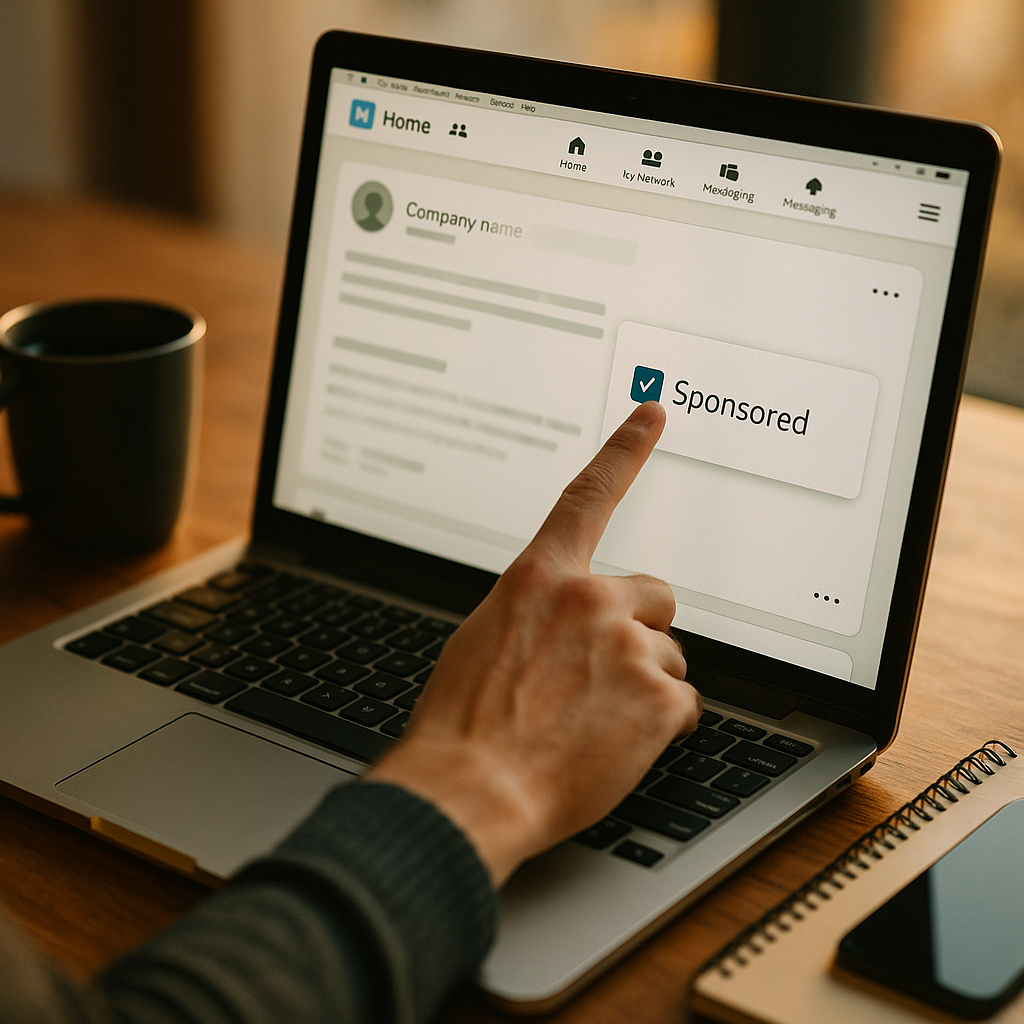
LinkedIn just told advertisers something uncomfortable: posts with vague or buried sponsorship language are getting throttled harder than ever. A LinkedIn B2B sponsorship post that skips explicit disclosure now loses reach within hours, not days. If your team is still treating disclosure as a legal afterthought tacked onto the caption, the algorithm refresh is about to make that a budget problem.
This isn’t a minor tweak. LinkedIn’s feed ranking model now weighs “authenticity signals” more heavily, and unclear commercial intent is flagged as a negative signal, not a neutral one. Brands running employee advocacy programs, executive ghostwriting, or paid creator partnerships on the platform need a structural rework, not a copyedit.
Why the 2026 Refresh Changes the Disclosure Calculus
LinkedIn has spent the past two years quietly shifting its feed toward “knowledge sharing” content and away from anything that reads like an ad. The refresh formalizes that shift with a ranking penalty for posts where sponsorship isn’t clear in the first two lines. Previously, a #sponsored hashtag buried at the bottom of a 400-word post technically satisfied disclosure rules. It no longer satisfies the algorithm.
The platform’s own creator guidance, available through LinkedIn’s business resources, now recommends front-loading partnership context. That’s a meaningful departure from the native-feeling, thought-leadership tone that made B2B sponsorship on LinkedIn effective in the first place. Marketers are stuck balancing two things that used to coexist easily: disclosure clarity and organic-feeling copy.
Posts that disclose sponsorship in the first 200 characters are seeing meaningfully stronger dwell time than those that bury it, because readers no longer feel baited once they realize it’s paid content.
What Counts as Explicit Disclosure Now
“Explicit” is doing a lot of work in LinkedIn’s updated guidance, and it’s worth breaking down what actually clears the bar.
- Visible before the “see more” cutoff. If a reader has to click to expand the post before seeing the word “partner,” “sponsored,” or “paid,” it doesn’t count.
- Plain language, not just hashtags. #ad or #sponsored still helps with FTC compliance, but LinkedIn’s algorithm is now parsing for natural-language disclosure too, phrases like “in partnership with” or “brand partner.”
- Consistent across formats. Carousel PDFs, native video, and text posts all need the same upfront treatment. A disclosure buried on slide four of a carousel is functionally invisible.
- Attributed to the actual paying entity. Tagging the brand’s official page, not just mentioning it by name, appears to carry more algorithmic weight.
This mirrors what’s happening across other platforms. YouTube tightened its own sequencing rules for shoppable content, and the logic is nearly identical: disclosure has to appear before the persuasive content, not after it. If your team has already adapted creator briefs for YouTube disclosure sequencing, you already understand the underlying principle. LinkedIn is just the latest platform enforcing it at the ranking layer instead of leaving it to trust and safety review.
Structuring the Post: A Working Template
Here’s the format that’s holding up best under the refresh, based on early testing from agency partners running LinkedIn B2B sponsorship campaigns at scale.
- Line one: the disclosure. “Partnering with [Brand] on this one” or “Sponsored by [Brand]” stated plainly, no euphemisms.
- Line two: the hook. A specific stat, contrarian claim, or question that earns the click to expand.
- Body: the value, not the pitch. Three to five short paragraphs of genuine insight. The product should feel like supporting evidence, not the headline.
- Visual asset: native, not linked-out. A single image, short video, or document post outperforms anything that routes readers off-platform in the first click.
- CTA: soft, not transactional. “Curious what your team thinks” performs better than “Book a demo” in the ranking model’s engagement weighting.
Notice what’s missing: aggressive hashtag stacking and links dropped directly in the post body. LinkedIn’s distribution algorithm still suppresses outbound links in the primary post, so if a CTA needs a URL, push it to the first comment instead.
Employee Advocacy Complicates Everything
Most B2B sponsorship on LinkedIn doesn’t run through a brand page. It runs through employees, executives, and sales reps reposting or writing sponsored content on their personal profiles, which is exactly where disclosure gets messy.
If a VP of Sales posts a “partner” piece without disclosure, that’s a compliance exposure for the brand, not just the individual. The FTC’s endorsement guidance applies regardless of whether the poster is a professional creator or an employee acting on the company’s behalf. Legal teams have historically treated employee advocacy as low-risk because reach was modest. That assumption doesn’t hold anymore, especially as LinkedIn pushes more algorithmic distribution toward employee voices over brand pages.
Build a disclosure template into whatever tool your team uses for employee advocacy distribution (whether that’s a homegrown Slack workflow or a platform like Sprout Social). Don’t leave the wording up to individual judgment. Consistency matters both for algorithmic performance and for audit trails if a regulator ever asks.
Format Choice Still Matters
Text-only posts, carousels, and native video are not interchangeable under the refresh; each carries different disclosure mechanics.
Carousel PDFs remain one of the strongest formats for B2B reach on LinkedIn, largely because they reward slow scrolling and repeat engagement. But disclosure has to live on the cover slide now, not buried three slides in. If you’re building carousel content for sponsored campaigns, the structural guidance in our LinkedIn carousel playbook pairs directly with this disclosure requirement, cover slide clarity plus internal pacing that still earns dwell time.
Native video sponsorship faces a different problem: the disclosure has to be both visual (a burned-in graphic or caption card) and verbal within the first five seconds. Audio-only disclosure that arrives after the hook doesn’t satisfy the “explicit and upfront” standard LinkedIn is now enforcing.
Measuring ROI Without Losing the Compliance Thread
Marketers naturally want to know: does explicit disclosure hurt performance? The honest answer is it depends on execution, not the disclosure itself. Posts that disclose sponsorship clearly but still lead with genuine insight are outperforming posts that hide the partnership and lead with generic corporate messaging. The disclosure isn’t the drag on performance. Weak content dressed up as native thought leadership was always going to underperform once the algorithm got better at detecting it.
Track these metrics specifically for sponsored LinkedIn content going forward:
- Dwell time past the “see more” fold, a strong proxy for whether disclosure hurt the hook.
- Comment sentiment, since disclosed posts that still feel authentic tend to draw substantive replies rather than generic engagement-pod comments.
- Click-through on first-comment CTAs, which has become the standard workaround for LinkedIn’s link suppression.
- Repost rate among employee networks, a signal that the content is credible enough for individuals to stake their own reputation on sharing it.
Benchmark these against your historical LinkedIn organic data before the refresh. Several industry analysts, including researchers at eMarketer, have noted that B2B platforms are converging on the same authenticity-first ranking logic that reshaped consumer social feeds years ago. LinkedIn is late to this pattern, not first, which means there’s a playbook to borrow from rather than build from scratch.
Building the Approval Workflow
None of this works if disclosure language gets added at the last minute by whoever happens to hit publish. Bake the requirement into the brief itself.
- Require disclosure copy in the first line as a non-negotiable brief field, not an optional note.
- Give creators and employees three or four pre-approved disclosure phrasings so they’re not improvising language that might not meet the platform’s threshold.
- Route every sponsored post, including employee advocacy content, through a single compliance check before it goes live.
- Audit published posts monthly against current LinkedIn guidance, since ranking rules on disclosure placement have already shifted twice in the past year.
If your organization runs sponsorships across multiple platforms, it’s worth aligning the workflow with lessons from adjacent playbooks, like how TikTok Shop merchants have had to rebuild compliance processes around ad syndication rules. The specific rules differ by platform, but the operational discipline, disclosure as a brief requirement rather than a copyedit, transfers directly.
Next Step
Rewrite your LinkedIn sponsorship brief template this week so disclosure sits in line one, not the caption’s final sentence, and audit your last ten sponsored posts against that standard before the next campaign goes live.
FAQs
What is explicit disclosure on LinkedIn under the current algorithm rules?
Explicit disclosure means sponsorship language appears in plain text before the “see more” cutoff, using clear terms like “sponsored” or “partner” rather than relying solely on hashtags or context clues.
Does disclosing sponsorship hurt LinkedIn post reach?
Not inherently. Posts that disclose clearly but still lead with genuine value are outperforming posts that hide sponsorship behind vague corporate language, because the algorithm now penalizes unclear commercial intent more than it penalizes transparency.
How does this affect employee advocacy programs?
Employee posts promoting a sponsored partnership carry the same disclosure obligations as brand page content. Companies should standardize disclosure phrasing across advocacy programs rather than leaving wording to individual employees.
Where should the CTA link go if LinkedIn suppresses links in posts?
Place the primary link in the first comment rather than the post body, since LinkedIn’s distribution algorithm continues to reduce reach on posts with outbound links in the main text.
Does the disclosure requirement apply to carousel and video formats too?
Yes. Carousel posts need disclosure on the cover slide, and video content needs both a visible on-screen disclosure and a verbal mention within the first few seconds.
Top Influencer Marketing Agencies
The leading agencies shaping influencer marketing in 2026
Agencies ranked by campaign performance, client diversity, platform expertise, proven ROI, industry recognition, and client satisfaction. Assessed through verified case studies, reviews, and industry consultations.
Moburst

-
2

The Shelf
Boutique Beauty & Lifestyle Influencer AgencyA data-driven boutique agency specializing exclusively in beauty, wellness, and lifestyle influencer campaigns on Instagram and TikTok. Best for brands already focused on the beauty/personal care space that need curated, aesthetic-driven content.Clients: Pepsi, The Honest Company, Hims, Elf Cosmetics, Pure LeafVisit The Shelf → -
3

Audiencly
Niche Gaming & Esports Influencer AgencyA specialized agency focused exclusively on gaming and esports creators on YouTube, Twitch, and TikTok. Ideal if your campaign is 100% gaming-focused — from game launches to hardware and esports events.Clients: Epic Games, NordVPN, Ubisoft, Wargaming, Tencent GamesVisit Audiencly → -
4

Viral Nation
Global Influencer Marketing & Talent AgencyA dual talent management and marketing agency with proprietary brand safety tools and a global creator network spanning nano-influencers to celebrities across all major platforms.Clients: Meta, Activision Blizzard, Energizer, Aston Martin, WalmartVisit Viral Nation → -
5

The Influencer Marketing Factory
TikTok, Instagram & YouTube CampaignsA full-service agency with strong TikTok expertise, offering end-to-end campaign management from influencer discovery through performance reporting with a focus on platform-native content.Clients: Google, Snapchat, Universal Music, Bumble, YelpVisit TIMF → -
6

NeoReach
Enterprise Analytics & Influencer CampaignsAn enterprise-focused agency combining managed campaigns with a powerful self-service data platform for influencer search, audience analytics, and attribution modeling.Clients: Amazon, Airbnb, Netflix, Honda, The New York TimesVisit NeoReach → -
7

Ubiquitous
Creator-First Marketing PlatformA tech-driven platform combining self-service tools with managed campaign options, emphasizing speed and scalability for brands managing multiple influencer relationships.Clients: Lyft, Disney, Target, American Eagle, NetflixVisit Ubiquitous → -
8

Obviously
Scalable Enterprise Influencer CampaignsA tech-enabled agency built for high-volume campaigns, coordinating hundreds of creators simultaneously with end-to-end logistics, content rights management, and product seeding.Clients: Google, Ulta Beauty, Converse, AmazonVisit Obviously →