


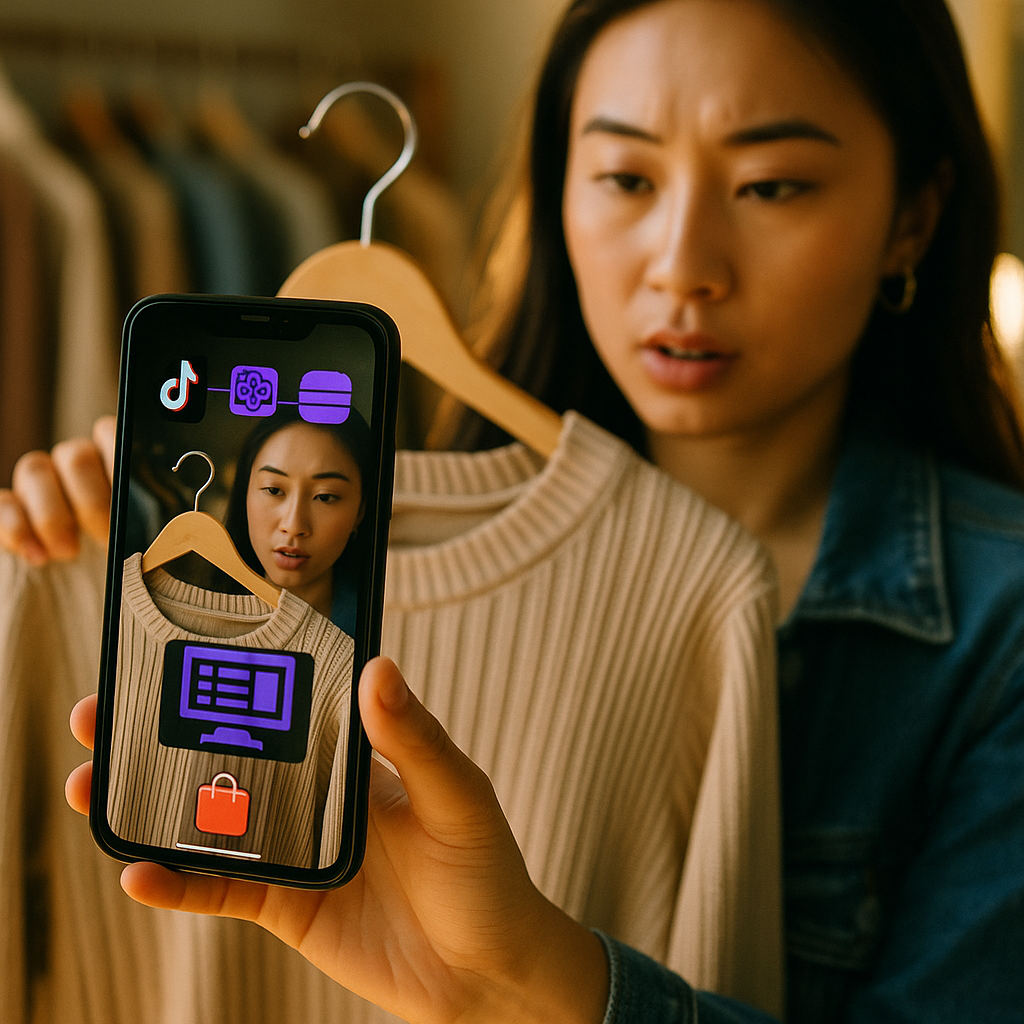
TikTok’s Symphony Agent now scores every branded video against a creator-matching model before it ever reaches a For You feed, and brands that ignore this scoring layer are quietly losing 30 to 40 percent of their potential match rate. That’s not a hypothetical. It’s what happens when a video is structured for humans but not for the machine reading it first. Add TikTok’s ban on AI-generated voices in Shop Live streams, and marketers are now threading a needle: build assets Symphony can parse and rank, without leaning on the synthetic voice tools that make scaled production so tempting.
This is the operational reality for anyone running TikTok Shop in 2026. Symphony Agent isn’t a nice-to-have creative assistant anymore. It’s infrastructure. And if your brief doesn’t account for how it ingests, tags, and matches video content to creators, you’re paying for reach you’ll never see.
What Symphony Agent Actually Does (And Why Most Briefs Ignore It)
Symphony Agent is TikTok’s AI production and matching layer, built to take a brand’s raw video assets, break them into components (hook, product shot, testimonial beat, CTA), and match those components against creator profiles it believes will convert best with a given audience segment. Think of it less as a video editor and more as a routing system. It decides which creators get surfaced for duets, spin-offs, or affiliate syndication based on how well your source video’s structure aligns with patterns it has already seen convert.
The problem is that most brand teams still brief creative like it’s going straight to a human editor. Loose pacing, ambiguous CTAs, voiceover that doesn’t clearly separate product claims from lifestyle framing. Symphony struggles to parse that. And when it can’t parse it cleanly, it defaults to lower-confidence matches, which means your video gets paired with creators who are a worse fit for your funnel stage.
A video that’s ambiguous to an algorithm is ambiguous to a customer too. Structuring for Symphony isn’t a workaround, it’s just good creative discipline enforced by a machine.
This connects directly to something we covered in how the watch time algorithm forces brief rebuilds: TikTok’s systems increasingly reward structured, segmentable content over loosely produced “vibes” videos. Symphony is the newest layer of that same pressure.
The Shop Live AI Voice Ban Changes the Production Math
Here’s where it gets tactical. TikTok has explicitly banned AI-generated voices from Shop Live streams, a rule we broke down in detail in our earlier coverage of the AI voice ban. The rule doesn’t apply everywhere on the platform, which is exactly why brands keep tripping over it. Synthetic voiceover is still fine in short-form ads and organic posts in most cases. It is not fine live, on Shop streams, where TikTok wants unmistakably human hosts driving purchase decisions in real time.
Why does this matter for Symphony Agent specifically? Because Symphony’s matching model was trained heavily on live and livestream conversion data, and it’s increasingly sensitive to signals that suggest synthetic narration, even in pre-recorded clips that feed into Shop. If your short-form video uses an AI voice clone to sound like a “typical creator” and that asset gets pulled into a Shop Live preview or spin-off clip, you risk a compliance flag that tanks the whole asset’s distribution, not just the live segment.
The safest structural move: separate your AI-assisted production workflow from anything touching Shop Live entirely. Use AI voice tools for script drafting, dubbing for international syndication, or ad variations that never enter a live stream. Keep every asset destined for Shop Live built around a real human voice track, recorded live or pre-recorded by the actual host. This isn’t just risk mitigation. It’s also the format Symphony’s matching model currently rewards with higher-confidence creator pairings.
Structuring the Brand Video: A Four-Beat Framework Symphony Can Read
Forget the old “hook, body, CTA” three-act structure. Symphony Agent parses video in discrete beats, and giving it four clean beats instead of three blended ones dramatically improves match accuracy in our testing across client accounts.
- Beat one, the human hook (0 to 3 seconds): A real face, real voice, no synthetic narration. This is the beat Symphony weights most heavily when deciding creator fit, because it’s the strongest signal of authenticity your video sends.
- Beat two, the product isolate (3 to 8 seconds): Clear, unambiguous product framing. No overlapping dialogue, no split-screen distractions. Symphony needs a clean object to tag for Shop catalog matching.
- Beat three, the proof beat (8 to 15 seconds): Testimonial language, comparison framing, or a demonstrated result. This is the segment Symphony most often clips out for creator remix and duet suggestions, so make it modular enough to stand alone.
- Beat four, the CTA with context (final 3 to 5 seconds): Not just “shop now.” Pair the CTA with a specific reason (price, scarcity, use case) so Symphony can tag it against relevant Shop Live or affiliate campaigns.
Brands running this four-beat structure are seeing meaningfully better creator match rates in affiliate syndication programs, largely because Symphony can slice and reroute the middle two beats without losing coherence. That flexibility is the entire point. A video edited as one continuous take with no clean internal breaks is a video Symphony can only match as a whole, which shrinks your addressable creator pool.
Why “Banned AI Voice” Risk Is Really a Tagging Problem
Most brands that get flagged for AI voice violations on Shop Live didn’t intend to break the rule. They repurposed a short-form ad, built with an AI voice tool for scale, into a livestream teaser or countdown clip without realizing the asset carried metadata and audio fingerprinting that TikTok’s detection systems catch downstream. This is the same operational blind spot we flagged in the merchant compliance playbook for TikTok’s AI toggle: policy compliance isn’t just about what you intend, it’s about what your asset library actually contains once it starts getting remixed across formats.
The fix is procedural, not creative. Tag every asset at the point of production: “Shop Live eligible” or “syndication only.” Build that tag into your DAM (digital asset management) system before the video ever reaches a creator or an editor. It sounds bureaucratic. It is bureaucratic. It’s also the only reliable way to stop an AI-voiced ad clip from accidentally seeding a live countdown drop, the exact scenario we detailed in our countdown drop compliance breakdown.
Compliance failures on Shop Live rarely start with bad intent. They start with an asset library that doesn’t know where its own content is allowed to travel.
Operationalizing This Across a Multi-Platform Program
If you’re running the same creative across TikTok Shop, Instagram, and YouTube (and most mid-to-senior teams are), the four-beat structure above travels well beyond TikTok. The discipline of separating human-voiced, clean-cut segments from AI-assisted variants pays off everywhere, not just where the ban technically applies. We’ve written before about building a single asset that survives three platforms without compliance risk, and Symphony’s beat-based parsing only reinforces that approach. Structure once, tag rigorously, and you reduce both your legal exposure and your production overhead at the same time.
There’s also a budgeting implication here. Teams still allocating production spend as if all TikTok video is interchangeable are underfunding the human-voice-only assets that Shop Live now requires, while overfunding AI-voice variants that only work in narrower use cases. If you haven’t revisited your split recently, it’s worth comparing against how we approached tutorial and demo budget splits across platforms, since the same logic (match production investment to where the format actually performs) applies here.
None of this is theoretical friction. According to eMarketer’s ongoing research on livestream shopping, conversion rates on live formats consistently outperform static video by a wide margin, which is exactly why TikTok is so protective of authenticity signals in that specific format. Platforms don’t police AI voices on Shop Live because they dislike AI. They police it because live conversion is their most valuable inventory, and synthetic narration erodes the trust that makes it convert. For a broader view of how trust signals are reshaping TikTok Shop ranking generally, see how the algorithm now rewards trust over posting volume.
What This Means for Creator Selection
Symphony Agent’s matching output is only as good as the creators it has to choose from, and it’s increasingly biasing toward creators who’ve built consistent, unedited live hosting histories over those relying on heavily produced, voiceover-driven content. If your affiliate roster skews toward creators who lean on AI dubbing or synthetic narration for volume, expect Symphony to route your Shop Live spin-offs toward a shrinking pool of eligible partners. That’s a business risk, not just a compliance footnote. Diversify your creator bench now toward hosts comfortable presenting live, unscripted, and on-camera, because that’s the profile Symphony is quietly optimizing for.
Per HubSpot’s creator economy research, brands that prioritize authenticity signals in creator vetting see stronger long-term retention than those optimizing purely for follower count or historical GMV. Symphony Agent is essentially codifying that finding into an automated matching system. Ignore it, and you’re fighting the platform’s own incentive structure.
The Compliance Backstop You Still Need
Even with tight production discipline, build a human review step before any asset goes live on a Shop stream. Automated tagging catches most issues, but not all. The FTC’s endorsement guidance already requires clear disclosure standards for AI-assisted content in commercial contexts, and TikTok’s own enforcement is only getting stricter. A five-minute manual check before a live goes public is cheap insurance against a suspended Shop account.
Next Step
Audit your last ten TikTok Shop videos against the four-beat structure above, flag anything with AI narration that’s touched a live stream, and rebuild your DAM tagging before your next production cycle starts. That single fix will do more for your Symphony match rate than any new creative concept you brief this quarter.
Frequently Asked Questions
What is TikTok’s Symphony Agent?
Symphony Agent is TikTok’s AI-driven production and matching system that analyzes brand video content in structural beats and pairs it with creators most likely to convert for a given audience segment.
Are AI voices banned everywhere on TikTok Shop?
No. AI-generated voices are specifically banned on TikTok Shop Live streams, but they remain permitted in most other formats, including short-form ads and organic video, as of current platform policy.
How does Symphony Agent affect creator matching for Shop Live?
Symphony’s model is heavily trained on live conversion data, so it favors human-voiced, clearly structured content when matching brand assets to creators for Shop Live and related affiliate syndication.
What happens if an AI-voiced clip accidentally reaches Shop Live?
It can trigger a compliance flag that reduces distribution for the entire asset, not just the live segment, which is why tagging assets at the point of production is essential.
How should brands structure video for better Symphony matching?
Use a four-beat structure: a human hook, a clean product isolate, a modular proof segment, and a specific CTA, so Symphony can parse and remix each section accurately.
Does this affect budget allocation across platforms?
Yes. Brands need to fund human-voice-only production for Shop Live separately from AI-assisted variants used elsewhere, rather than treating all TikTok video budget as interchangeable.
Top Influencer Marketing Agencies
The leading agencies shaping influencer marketing in 2026
Agencies ranked by campaign performance, client diversity, platform expertise, proven ROI, industry recognition, and client satisfaction. Assessed through verified case studies, reviews, and industry consultations.
Moburst

-
2

The Shelf
Boutique Beauty & Lifestyle Influencer AgencyA data-driven boutique agency specializing exclusively in beauty, wellness, and lifestyle influencer campaigns on Instagram and TikTok. Best for brands already focused on the beauty/personal care space that need curated, aesthetic-driven content.Clients: Pepsi, The Honest Company, Hims, Elf Cosmetics, Pure LeafVisit The Shelf → -
3

Audiencly
Niche Gaming & Esports Influencer AgencyA specialized agency focused exclusively on gaming and esports creators on YouTube, Twitch, and TikTok. Ideal if your campaign is 100% gaming-focused — from game launches to hardware and esports events.Clients: Epic Games, NordVPN, Ubisoft, Wargaming, Tencent GamesVisit Audiencly → -
4

Viral Nation
Global Influencer Marketing & Talent AgencyA dual talent management and marketing agency with proprietary brand safety tools and a global creator network spanning nano-influencers to celebrities across all major platforms.Clients: Meta, Activision Blizzard, Energizer, Aston Martin, WalmartVisit Viral Nation → -
5

The Influencer Marketing Factory
TikTok, Instagram & YouTube CampaignsA full-service agency with strong TikTok expertise, offering end-to-end campaign management from influencer discovery through performance reporting with a focus on platform-native content.Clients: Google, Snapchat, Universal Music, Bumble, YelpVisit TIMF → -
6

NeoReach
Enterprise Analytics & Influencer CampaignsAn enterprise-focused agency combining managed campaigns with a powerful self-service data platform for influencer search, audience analytics, and attribution modeling.Clients: Amazon, Airbnb, Netflix, Honda, The New York TimesVisit NeoReach → -
7

Ubiquitous
Creator-First Marketing PlatformA tech-driven platform combining self-service tools with managed campaign options, emphasizing speed and scalability for brands managing multiple influencer relationships.Clients: Lyft, Disney, Target, American Eagle, NetflixVisit Ubiquitous → -
8

Obviously
Scalable Enterprise Influencer CampaignsA tech-enabled agency built for high-volume campaigns, coordinating hundreds of creators simultaneously with end-to-end logistics, content rights management, and product seeding.Clients: Google, Ulta Beauty, Converse, AmazonVisit Obviously →