


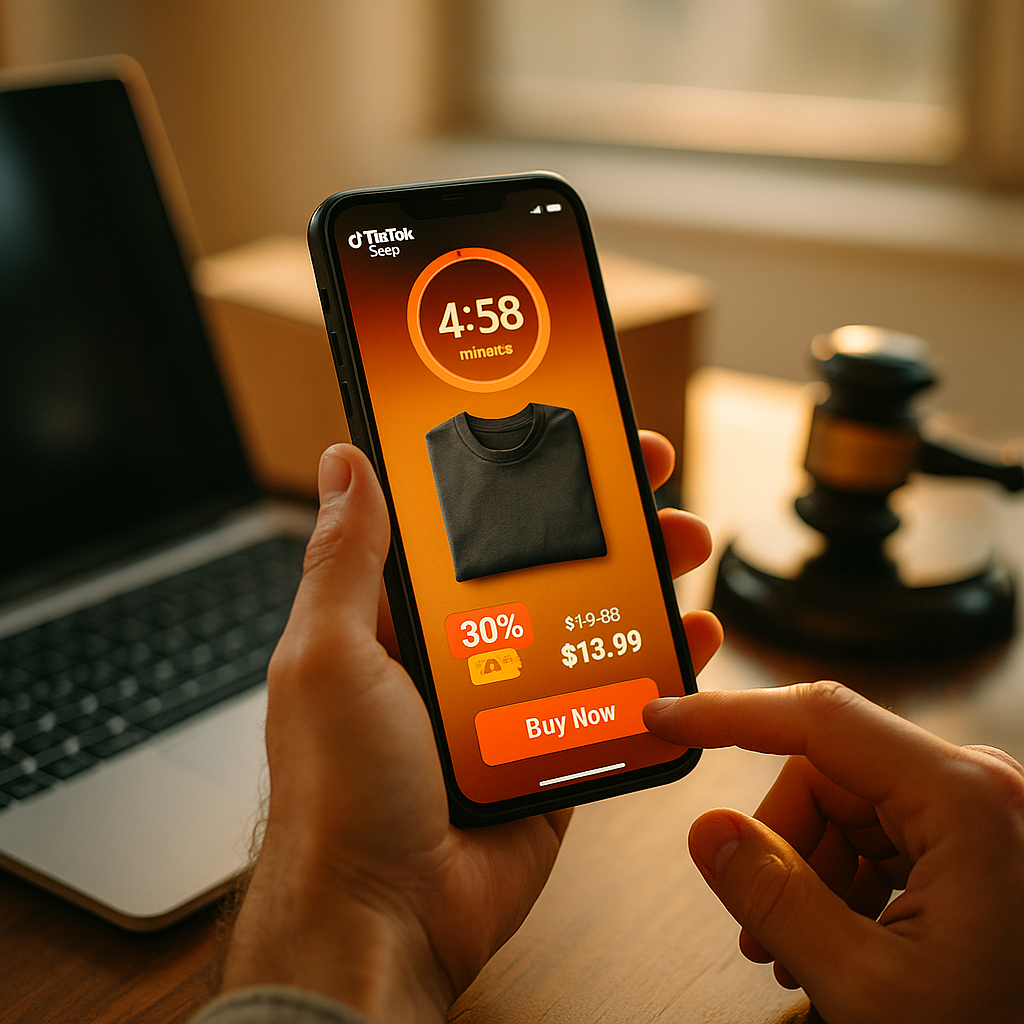
Sellers running TikTok Shop lives with fake “only 3 left” countdowns are one FTC complaint away from a consent decree. TikTok Shop live selling is now the fastest-growing checkout channel on the platform, but the same urgency tactics that spike conversion rates are triggering regulatory scrutiny. Here’s how to structure a 60-minute broadcast that converts without the legal exposure.
Why This Matters Right Now
The FTC’s stance on scarcity claims hasn’t changed in decades: if you say something is running out, it actually has to be running out. What’s changed is enforcement appetite. Livestream shopping generated an estimated $68 billion in the US alone, according to eMarketer, and regulators have made clear that fast-growing channels get fast-tracked scrutiny.
TikTok Shop hosts have built entire scripts around countdown timers, flashing “sold out” banners, and repeated “only X units at this price” claims that reset every ten minutes. Some of it is real. A lot of it isn’t. And the platform itself has already started cracking down, as we covered in our breakdown of countdown timer compliance.
If your countdown resets after every “sold out” moment, you’re not creating urgency. You’re creating a paper trail for a false advertising claim.
The 60-Minute Structure That Actually Converts
Forget the idea that a live has to be one long, breathless sales pitch. The highest-converting TikTok Shop broadcasts we’ve studied follow a segmented structure, closer to a TV infomercial block than a single continuous countdown. Here’s the framework:
- Minutes 0 to 8: Hook and context. Introduce the host, the product line, and what’s coming. No countdown yet. This is where you build trust, not urgency.
- Minutes 8 to 20: First drop. Introduce a genuinely limited batch (real inventory number, tied to your actual TikTok Shop stock feed) with a hard start and end time.
- Minutes 20 to 28: Cooldown and education. No countdown. Answer comments, do a demo, talk ingredients or specs. This is the section FTC-conscious brands skip and shouldn’t.
- Minutes 28 to 40: Second drop. A different SKU or bundle, with its own real inventory cap. Never reuse the same countdown clock for a “new” batch that’s actually the same stock.
- Minutes 40 to 48: Social proof segment. Show real order notifications, read out UGC, feature comments. This substitutes for fake urgency with real evidence of demand.
- Minutes 48 to 58: Final drop, higher stakes. Your best offer, again with an honest cap tied to live inventory.
- Minutes 58 to 60: Close and redirect. Push viewers to follow, join the next live, or check the shop tab for restocks.
This rhythm matters because a single 60-minute countdown that never lets up reads as manufactured. Segmented drops with genuine breaks look like what they are: real inventory events happening in real time.
What Actually Counts as a Deceptive Scarcity Claim
The FTC’s guidance on deceptive practices doesn’t name TikTok specifically, but the principles map directly onto livestream commerce. Three patterns get sellers flagged most often:
- Phantom countdowns. A timer hits zero, then resets to the same duration with no actual change in price or stock. This is the single most common violation on TikTok Shop lives.
- Inflated scarcity numbers. Claiming “only 12 left” when the seller’s own backend shows 400+ units available. TikTok’s Seller Center inventory sync makes this discoverable during a platform audit.
- Fake urgency language without a mechanism. Saying “prices go up in 5 minutes” when there’s no actual price change scheduled in the product listing.
None of these require intent to deceive under FTC standards. If the claim is objectively false, that’s enough. Brands often assume “everyone does it” is a defense. It isn’t, and the FTC has said as much in guidance around dark patterns and manufactured urgency.
Building Countdown Drops on Real Inventory Logic
The fix isn’t to abandon urgency. It’s to tie every countdown to something verifiable. Structure your drops so the countdown timer is a display layer sitting on top of your actual TikTok Shop inventory feed, not a standalone graphic your host controls manually.
Practically, that means:
- Set a hard SKU allocation per drop (say, 150 units) before the broadcast starts, and don’t top it up mid-stream.
- Let the countdown clock be genuinely tied to a fixed window (10 minutes) rather than something a producer can extend if sales are slow.
- If a drop sells out early, say so and stop selling it. Don’t quietly keep the listing live under a new “flash restock” framing five minutes later unless it’s a legitimately new allocation.
- Document your inventory numbers before, during, and after the live for your own compliance file. TikTok Shop’s backend reporting makes this straightforward to export.
This is the same operational discipline we outlined for grocery category sellers in our grocery livestream playbook, where perishable-goods urgency claims face similarly tight scrutiny because “limited stock” is often literally true and easy to verify.
Scripting Hosts Without Scripting Violations
Hosts are the actual liability surface here. A well-built inventory system means nothing if your host ad-libs “we’re almost sold out” when the dashboard says otherwise. Brief every host, whether in-house or an affiliate creator, on specific do-not-say language:
- No absolute claims (“this will sell out”) unless the number is confirmed live on screen.
- No comparative price urgency (“this price is gone after today”) unless the price change is scheduled in the actual listing.
- No borrowed urgency from other platforms (“it sold out on Amazon so grab it here”) unless verifiably true and timestamped.
This is the same brief-hardening logic we’ve pushed for other fast-moving formats, including the algorithm-driven rebuilds covered in TikTok’s watch-time brief overhaul. Compliance language belongs in the brief, not in a post-live correction.
If you’re using affiliate creators rather than owned talent, this gets harder to enforce, because you don’t control the mic in real time. Build compliance clauses into affiliate agreements specifically for live commerce, with defined penalties for scarcity misrepresentation, and monitor a sample of lives weekly rather than assuming good faith.
AI Hosts and the New Compliance Wrinkle
Some sellers have started using AI-generated hosts or voice overlays to run overnight lives, and TikTok has already drawn a hard line on where that’s allowed. If your countdown drop strategy involves any synthetic voice or avatar work, read the platform’s specific carve-outs before you build a 24-hour rotation around it, covered in detail in our piece on AI voice restrictions on Shop lives. The same AI disclosure logic applies to countdown graphics generated automatically. If a bot is triggering your “low stock” banner based on a rule rather than real-time inventory, that’s a compliance risk even if no human said anything false on camera.
Measuring the Right Thing Post-Broadcast
Brands obsessed with GMV per minute often ignore the metric that actually predicts regulatory risk: complaint rate relative to viewer count. If your comments section is full of “wait, I thought you said only 20 left an hour ago,” that’s a signal before it becomes a formal complaint. Track:
- Ratio of units claimed “limited” versus units actually sold in that window.
- Repeat countdown resets per broadcast (should be zero for the same SKU).
- Comment sentiment flags around trust or skepticism language.
Pair this with the trust-scoring shifts TikTok has already built into its ranking system, detailed in how the algorithm rewards trust over volume. Platforms are increasingly penalizing sellers who game urgency, independent of whether the FTC ever gets involved. A Sprout Social analysis of livestream commerce trust factors found buyer confidence, not urgency intensity, was the stronger predictor of repeat purchase in social commerce.
Next Step
Rebuild your next broadcast around segmented, inventory-verified drops instead of one continuous countdown, and put your compliance language into the host brief this week, not after your first FTC inquiry letter.
FAQs
What makes a TikTok Shop countdown timer FTC-compliant?
The countdown must reflect a real, verifiable change in price, stock, or offer availability. If the timer resets without a genuine change to inventory or pricing, it’s a deceptive scarcity claim regardless of intent.
Can I reuse the same countdown for multiple drops in one live?
Only if each drop represents a distinct, real inventory allocation. Reusing a countdown graphic for the same SKU after it “sells out” without an actual new stock event is the most common violation pattern.
Does the FTC actually enforce rules on livestream shopping specifically?
The FTC hasn’t issued livestream-specific rules, but its existing deceptive advertising and dark patterns guidance applies directly. Enforcement priority tends to follow fast-growing channels, and livestream commerce fits that profile.
How many units should I allocate per countdown drop?
There’s no fixed number. The requirement is that whatever number you state on screen matches your actual backend inventory allocation for that specific drop, documented before the broadcast starts.
What’s the risk if an affiliate host makes a false scarcity claim during my live?
Brands can still bear liability for claims made during branded livestreams, even by third-party affiliates. Build scarcity compliance language into affiliate contracts and monitor live broadcasts on a sampling basis.
Top Influencer Marketing Agencies
The leading agencies shaping influencer marketing in 2026
Agencies ranked by campaign performance, client diversity, platform expertise, proven ROI, industry recognition, and client satisfaction. Assessed through verified case studies, reviews, and industry consultations.
Moburst

-
2

The Shelf
Boutique Beauty & Lifestyle Influencer AgencyA data-driven boutique agency specializing exclusively in beauty, wellness, and lifestyle influencer campaigns on Instagram and TikTok. Best for brands already focused on the beauty/personal care space that need curated, aesthetic-driven content.Clients: Pepsi, The Honest Company, Hims, Elf Cosmetics, Pure LeafVisit The Shelf → -
3

Audiencly
Niche Gaming & Esports Influencer AgencyA specialized agency focused exclusively on gaming and esports creators on YouTube, Twitch, and TikTok. Ideal if your campaign is 100% gaming-focused — from game launches to hardware and esports events.Clients: Epic Games, NordVPN, Ubisoft, Wargaming, Tencent GamesVisit Audiencly → -
4

Viral Nation
Global Influencer Marketing & Talent AgencyA dual talent management and marketing agency with proprietary brand safety tools and a global creator network spanning nano-influencers to celebrities across all major platforms.Clients: Meta, Activision Blizzard, Energizer, Aston Martin, WalmartVisit Viral Nation → -
5

The Influencer Marketing Factory
TikTok, Instagram & YouTube CampaignsA full-service agency with strong TikTok expertise, offering end-to-end campaign management from influencer discovery through performance reporting with a focus on platform-native content.Clients: Google, Snapchat, Universal Music, Bumble, YelpVisit TIMF → -
6

NeoReach
Enterprise Analytics & Influencer CampaignsAn enterprise-focused agency combining managed campaigns with a powerful self-service data platform for influencer search, audience analytics, and attribution modeling.Clients: Amazon, Airbnb, Netflix, Honda, The New York TimesVisit NeoReach → -
7

Ubiquitous
Creator-First Marketing PlatformA tech-driven platform combining self-service tools with managed campaign options, emphasizing speed and scalability for brands managing multiple influencer relationships.Clients: Lyft, Disney, Target, American Eagle, NetflixVisit Ubiquitous → -
8

Obviously
Scalable Enterprise Influencer CampaignsA tech-enabled agency built for high-volume campaigns, coordinating hundreds of creators simultaneously with end-to-end logistics, content rights management, and product seeding.Clients: Google, Ulta Beauty, Converse, AmazonVisit Obviously →