


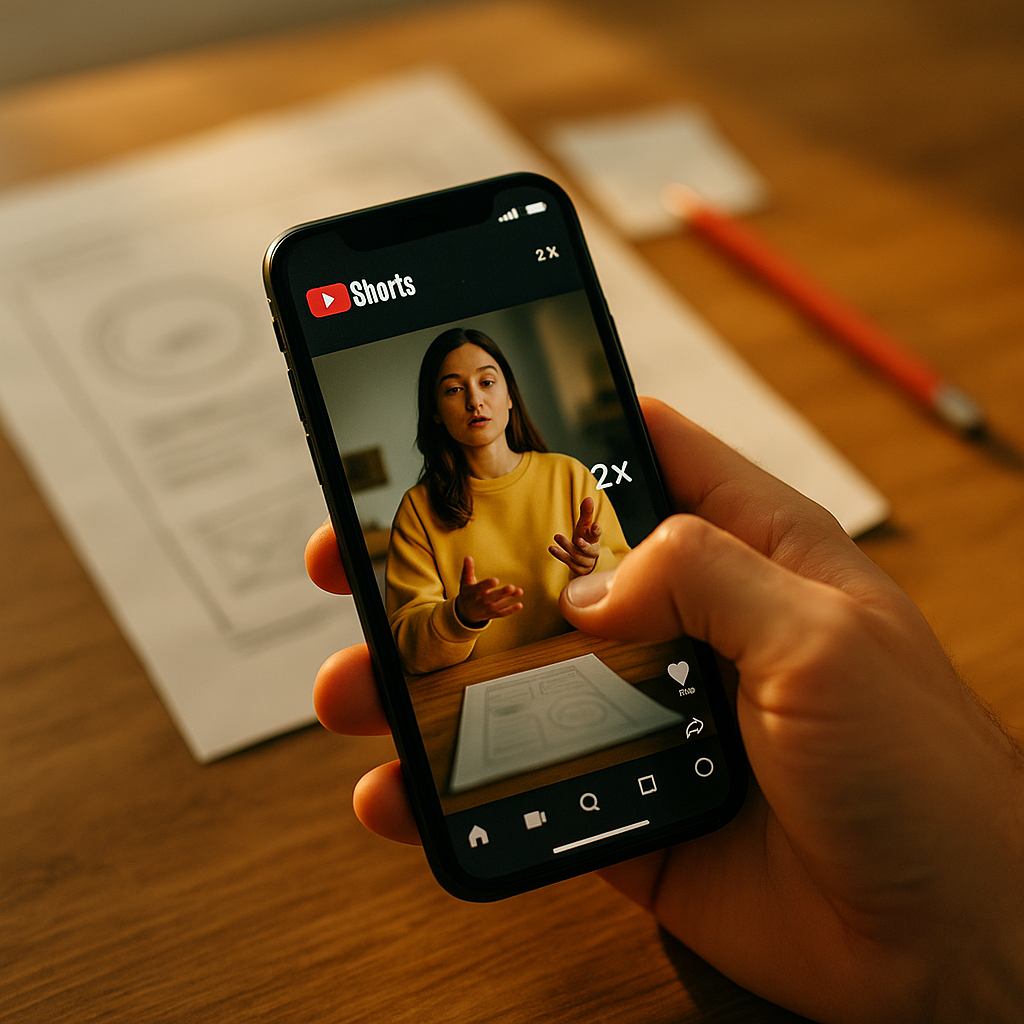
Roughly one in three YouTube Shorts viewers now toggle playback speed above 1x, and a growing share default straight to 2x. If your YouTube Shorts double-playback-speed viewer sees a mushy three-second intro instead of a payoff, they’re gone before your logo even loads. This isn’t a niche behavior anymore. It’s a design constraint you need to build around.
Why 2x Watching Broke the Old Hook Formula
For years, the standard advice was “hook in the first three seconds.” That guidance assumed normal playback speed. At 2x, three seconds becomes 1.5 seconds of real viewing time. Your slow zoom-in, your throat-clearing intro line, your logo bumper: all of it gets compressed into a blur that the viewer’s brain barely registers before deciding to swipe.
Playback speed controls have existed on YouTube for a while, but Shorts made them a habit rather than an occasional tool. Viewers speed-run long-form tutorials, sure, but they’re increasingly applying the same instinct to short-form feeds, especially on Android devices where the speed toggle sits one tap away from the share button.
A hook engineered for 1x playback and tested only at 1x is, functionally, an untested hook for a meaningful chunk of your audience.
What Actually Happens to Pacing at 2x
Speed doesn’t just compress time. It changes how the brain parses information. At double speed, dialogue gets harder to follow, but visual cuts and on-screen text remain fully legible, sometimes even more scannable because the eye jumps faster between frames. This asymmetry matters enormously for scripting.
Here’s the practical fallout for creators and brand teams:
- Voiceover-heavy openers lose comprehension fast. Complex sentences with subordinate clauses become mush at 2x.
- Text overlays gain relative importance. A punchy on-screen headline survives speed changes better than narration.
- Jump cuts read as intentional rhythm, not chaos. Fast cutting at 1x becomes propulsive at 2x rather than jarring.
- Static B-roll dies. Any shot held more than a second and a half starts to feel like dead air, even if it looked fine in the edit bay.
Brands running influencer briefs that were written for TikTok’s algorithm often assume the same pacing rules transfer directly to Shorts. They mostly do, but the speed-toggle behavior is more pronounced on YouTube’s Shorts shelf than on TikTok’s default feed, according to creator analytics teams tracking watch-time curves across platforms. If your team hasn’t already adjusted briefs for platform-specific viewing habits, the TikTok watch time algorithm shifts are a useful parallel case study in how quickly pacing assumptions go stale.
Engineering the Hook: A Practical Framework
Forget “hook in three seconds.” The new target is: deliver a comprehensible value proposition within 1.5 seconds of perceived time, assuming half your audience is watching at 2x. That’s brutal, but it’s achievable with a few structural changes.
Start with the frame, not the sentence. Your first visual frame should telegraph the topic without needing audio. A before/after split screen, a bold product shot, a shocking number pasted across the screen: these communicate instantly, even blurred by speed. Compare that to a talking head saying “so today I want to talk about…” which is functionally silent at 2x until the sentence resolves.
Second, front-load the payoff, not the setup. If the video is a comparison, show the winner first, then explain why. If it’s a tutorial, show the finished result before the steps. This isn’t just a speed-watching accommodation, it’s generally better retention practice, but it becomes non-negotiable once you accept that a third of your audience is fast-forwarding through your logic.
Third, treat your text overlay as the primary script and your voiceover as the supporting track. Write the on-screen text first. Make it stand alone. Then build narration around it rather than the reverse. This flips how most brand teams currently brief creators, where voiceover script comes first and captions get auto-generated as an afterthought.
Rebuilding Your Creative Brief for Speed-Agnostic Pacing
Most influencer briefs still specify hook timing in seconds: “grab attention in the first 3 seconds.” That instruction needs an addendum specifying frame-count and text-legibility requirements, not just time-based cues.
A workable brief update looks like this:
- Specify that the first visual frame must communicate topic and stakes without audio.
- Cap any single static shot at 1.5 seconds of screen time.
- Require on-screen text for every key claim, not just the hook.
- Ask creators to review their own edit at 2x speed before submission, treating it as a comprehension test, not just a stylistic check.
- Build in a mid-video “second hook,” a fresh visual or claim around the 40 to 50 percent mark, since speed watchers often bail earlier and a mid-roll re-engagement point recovers some of that drop-off.
This last point matters more than people assume. Data from Sprout Social’s creator content research consistently shows retention curves for short vertical video drop hardest in the first quarter, then stabilize, then dip again near the two-thirds mark. Speed watching compresses that entire curve, meaning your mid-video re-hook needs to arrive proportionally earlier than you’d plan for a 1x viewer.
If your team already reworked briefs around TikTok’s watch-time weighting, much of that structural thinking, especially the emphasis on rewatch triggers and loopable endings, carries over directly. The playbook detailed in fixing briefs for watch time versus autoplay is a solid template to adapt for Shorts-specific speed behavior.
Sound Design Still Matters, Just Differently
It’s tempting to conclude that audio is dead weight for speed watchers. It isn’t. Music and sound effects survive 2x playback far better than spoken dialogue because rhythm and beat drops remain perceptible even when pitch-corrected speech turns choppy. A well-placed sound effect timed to a visual reveal still lands as a payoff cue at double speed.
This means brands should stop treating trending audio as a vibe choice and start treating it as a pacing tool. A beat drop synced to your product reveal works at 1x and at 2x. A punchline that depends on comedic timing in spoken delivery often doesn’t survive the compression.
Captions deserve a second mention here too, not as an accessibility afterthought but as a core creative asset. YouTube’s own Shorts creator support documentation recommends auto-captions for accessibility, but from a brand performance lens, captions are doing double duty: they’re the fallback script for speed watchers and muted viewers alike, two overlapping but distinct audience segments.
Measurement: What to Track Once You’ve Rebuilt for Speed
Standard view counts won’t tell you whether your speed-agnostic pacing is working. A few sharper metrics matter more:
- Average percentage viewed segmented where possible by device type, since Android speed-toggle usage tends to run higher than iOS.
- Drop-off timestamp clustering, watching for whether your mid-video re-hook actually recovers attention or just delays the exit.
- Comment sentiment referencing pacing or speed, a surprisingly reliable qualitative signal. Viewers openly say “had to slow this down to understand” or “good thing this moves fast,” and both comments tell you something about hook design.
- Completion rate relative to loop rate, since Shorts’ looping playback means a video that ends cleanly and re-hooks into its own opening frame can accumulate replays that standard completion metrics undercount.
None of this replaces the fundamentals of ROI tracking for sponsored content, but it does mean your post-campaign reporting needs an added layer. If your measurement stack still treats a “view” as a flat unit regardless of playback speed or completion depth, you’re working from the same blind spot that forced brands to rebuild CPV models after YouTube’s instant-play view counting changes. Speed watching is a similar quiet shift in what a “view” actually represents.
Where This Intersects With Creator Rates and Briefs
There’s a compliance and payment angle here too, worth flagging for brand teams managing multiple creator contracts. If your performance-based deals tie payment to completion rate or average view duration, speed watching muddies those benchmarks. A creator’s video might be technically well-paced but still underperform completion metrics simply because the viewer sped through it, comprehended the message, and left satisfied. That’s not a failure, but it can look like one on a dashboard.
Brands renegotiating creator rates in light of platform monetization shifts, like those covered in the nano-creator rate rebuild analysis, should fold speed-watching behavior into how they define success metrics in contracts. A pure completion-rate KPI penalizes creators whose content is so clear it doesn’t need full-speed viewing to land.
The Bigger Shift: Designing for Comprehension, Not Just Attention
The old short-form mantra was “stop the scroll.” That’s still true, but it’s incomplete. The real target now is “communicate instantly, at any speed.” That’s a subtly different design goal, and it rewards clarity over cleverness. A hook that depends on a delayed reveal, a slow build, or vocal inflection for its punch is a hook built for a viewing mode that’s shrinking.
This isn’t unique to YouTube. Cross-platform strategy increasingly needs to account for viewing speed as a variable, alongside sound-on versus sound-off and vertical versus horizontal framing. Teams mapping content across platforms, as outlined in matching format to funnel stage, should now add “playback speed resilience” as a filter alongside format and funnel position when briefing creators.
Next step: pull your last ten Shorts campaign assets, watch each one at 2x, and flag anywhere the message stops making sense. If more than two or three fail that test, your briefs need the frame-first, text-first rebuild outlined above before your next flight goes live.
Frequently Asked Questions
What percentage of YouTube Shorts viewers actually use playback speed controls?
Exact platform-wide figures aren’t publicly broken out by YouTube, but creator analytics tools and third-party studies tracking short-form video behavior consistently show a meaningful minority, often cited around a quarter to a third of viewers on certain devices, adjusting speed above 1x, with Android users showing higher adoption than iOS due to easier access to the control.
Does watching at 2x speed hurt ad performance or brand recall?
It can reduce recall for dialogue-dependent messaging but has less impact on visual branding, on-screen text, and music-synced moments. Brands relying heavily on spoken calls to action should reinforce the same message in text overlay to protect comprehension at higher speeds.
Should creators design two versions of a video, one for normal speed and one for 2x?
Generally no, that’s operationally unrealistic for most influencer programs. The better approach is designing a single version that holds up at both speeds by front-loading visual payoffs, using text overlays as the primary script, and keeping any single shot brief.
How does speed watching affect YouTube Shorts algorithm performance?
The algorithm weighs watch time and completion signals heavily. If speed watching helps viewers complete the video faster and rewatch it (looping), that can actually support distribution, since Shorts’ algorithm doesn’t penalize a shorter perceived watch session if the completion and loop signals remain strong.
Is this trend specific to YouTube Shorts or does it apply across TikTok and Reels too?
Speed controls exist on TikTok and Reels as well, but adoption patterns differ by platform and device. YouTube’s Shorts shelf shows a more pronounced speed-toggle habit, partly because YouTube’s broader long-form ecosystem already trained users to expect and use speed controls, a habit that’s carried over into Shorts consumption.
Frequently Asked Questions (Schema)
Top Influencer Marketing Agencies
The leading agencies shaping influencer marketing in 2026
Agencies ranked by campaign performance, client diversity, platform expertise, proven ROI, industry recognition, and client satisfaction. Assessed through verified case studies, reviews, and industry consultations.
Moburst

-
2

The Shelf
Boutique Beauty & Lifestyle Influencer AgencyA data-driven boutique agency specializing exclusively in beauty, wellness, and lifestyle influencer campaigns on Instagram and TikTok. Best for brands already focused on the beauty/personal care space that need curated, aesthetic-driven content.Clients: Pepsi, The Honest Company, Hims, Elf Cosmetics, Pure LeafVisit The Shelf → -
3

Audiencly
Niche Gaming & Esports Influencer AgencyA specialized agency focused exclusively on gaming and esports creators on YouTube, Twitch, and TikTok. Ideal if your campaign is 100% gaming-focused — from game launches to hardware and esports events.Clients: Epic Games, NordVPN, Ubisoft, Wargaming, Tencent GamesVisit Audiencly → -
4

Viral Nation
Global Influencer Marketing & Talent AgencyA dual talent management and marketing agency with proprietary brand safety tools and a global creator network spanning nano-influencers to celebrities across all major platforms.Clients: Meta, Activision Blizzard, Energizer, Aston Martin, WalmartVisit Viral Nation → -
5

The Influencer Marketing Factory
TikTok, Instagram & YouTube CampaignsA full-service agency with strong TikTok expertise, offering end-to-end campaign management from influencer discovery through performance reporting with a focus on platform-native content.Clients: Google, Snapchat, Universal Music, Bumble, YelpVisit TIMF → -
6

NeoReach
Enterprise Analytics & Influencer CampaignsAn enterprise-focused agency combining managed campaigns with a powerful self-service data platform for influencer search, audience analytics, and attribution modeling.Clients: Amazon, Airbnb, Netflix, Honda, The New York TimesVisit NeoReach → -
7

Ubiquitous
Creator-First Marketing PlatformA tech-driven platform combining self-service tools with managed campaign options, emphasizing speed and scalability for brands managing multiple influencer relationships.Clients: Lyft, Disney, Target, American Eagle, NetflixVisit Ubiquitous → -
8

Obviously
Scalable Enterprise Influencer CampaignsA tech-enabled agency built for high-volume campaigns, coordinating hundreds of creators simultaneously with end-to-end logistics, content rights management, and product seeding.Clients: Google, Ulta Beauty, Converse, AmazonVisit Obviously →