


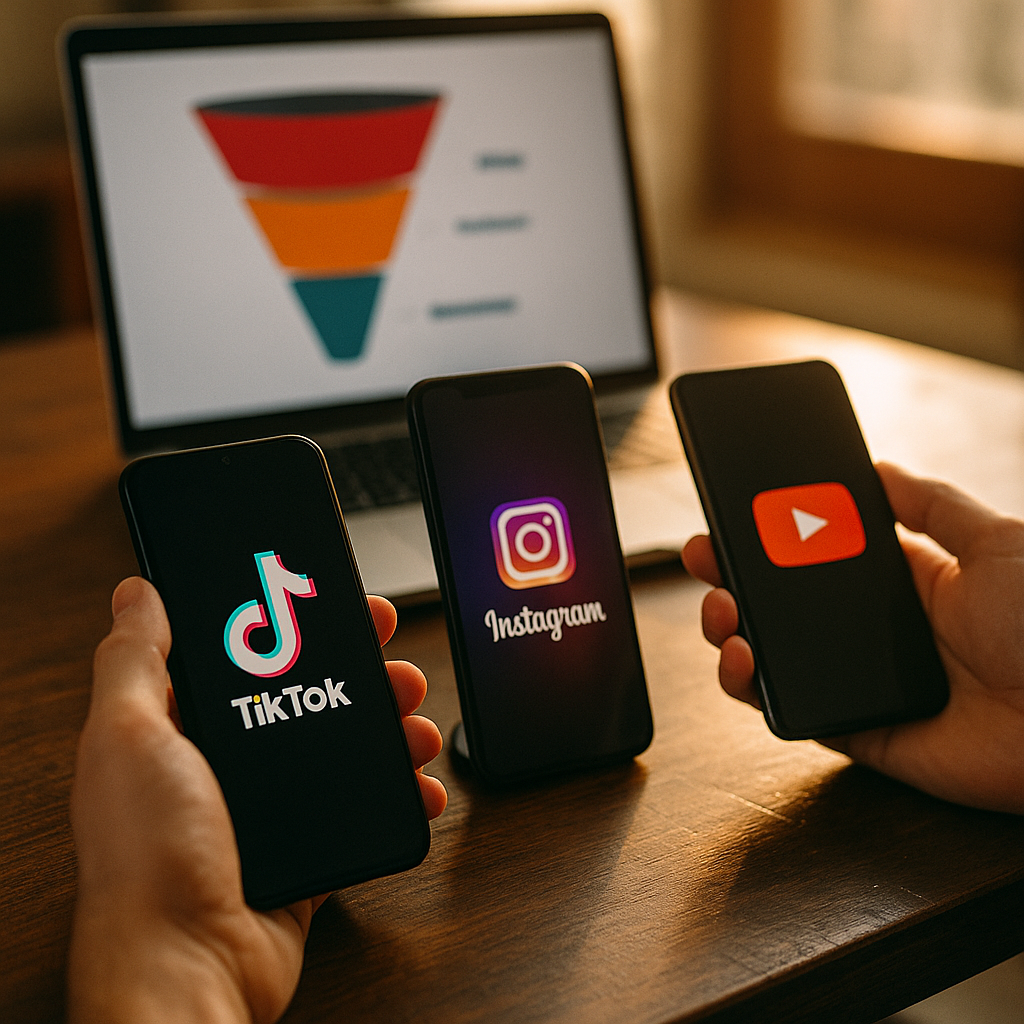
78% of shoppers now say short-form video has directly influenced a purchase, yet most brands still run the same creator brief across three platforms that behave nothing alike. That’s the core problem with Instagram vs TikTok vs YouTube for product discovery content: treating them as interchangeable inventory instead of distinct funnel stages wearing different costumes.
This playbook breaks down which platform earns which job in 2026, and why forcing a YouTube-style deep dive into a TikTok slot (or vice versa) quietly torches your CPA.
The Funnel Isn’t Dead, It’s Just Distributed
Marketers love declaring the funnel obsolete. It’s not obsolete, it’s fragmented across platforms that each specialize in one or two stages. TikTok owns the top: cold discovery, trend-driven attention, algorithmic serendipity. Instagram dominates the middle: consideration, validation, aesthetic fit, and increasingly, direct shopping. YouTube owns the bottom: deep research, comparison, and the final “convince me” moment before checkout.
Get the mapping wrong and you pay for it twice. Once in wasted production budget, and again in a CAC that never quite makes sense to finance.
The biggest budget leak in influencer programs isn’t overpaying creators, it’s paying top-of-funnel creators to produce bottom-of-funnel content and expecting bottom-of-funnel results.
TikTok: Built for Discovery, Not Deliberation
TikTok’s For You Page still runs on interest signals rather than social graphs, which is exactly why it’s the best cold-discovery engine of the three. A well-hooked 15 to 30 second video can reach someone who has never heard of your brand and get them to swipe, tap, or search within seconds. That’s the platform’s superpower, and it’s also its ceiling.
TikTok content converts best when it triggers curiosity, not when it explains ingredient lists. Save the spec sheet. Lead with a transformation, a problem-reaction shot, or a “wait, what” moment in the first two seconds. The watch-time algorithm shift has made hook quality even more decisive since completion rate now weighs more heavily than raw views in distribution.
Where TikTok gets misused: brands asking creators to cram a full product walkthrough, three use cases, and a discount code into one clip. That’s a YouTube Shorts job wearing a TikTok costume, and it performs like it.
If you’re running paid amplification behind organic hits, understand that Spark Ads premium pricing has changed the math on when boosting is actually worth the markup.
What Actually Works on TikTok for Discovery
- POV and problem/solution formats that dramatize a pain point in under 3 seconds
- Trend or sound-jacking that borrows existing momentum instead of building attention from zero
- Unboxing with a twist, not just an unboxing
- Native, lo-fi production. Overly polished content gets algorithmically penalized for feeling like an ad
Instagram: The Consideration Layer Nobody Talks About Enough
Instagram doesn’t discover the way TikTok does anymore, and it doesn’t convert with intent the way YouTube does. What it does exceptionally well is validate. Someone sees a product on TikTok, then searches the brand on Instagram to check if it’s “real,” if the aesthetic matches their taste, and if other people they trust (or want to look like) are also buying it.
This is why Instagram Reels perform best when they function as social proof rather than fresh discovery bait. Grid aesthetics, Story highlights, and carousel breakdowns all serve the mid-funnel shopper who’s already curious and just needs confirmation.
The platform’s shift toward shared-scrolling and TV-style consumption is also worth tracking closely. It changes how content gets surfaced in group and household viewing contexts, which matters for categories like home goods, food, and family products where purchase decisions aren’t made solo.
For visually-driven categories specifically, Instagram remains the strongest consideration engine on the market. If you haven’t revisited how you structure discovery content for lifestyle or ecommerce SKUs, the visual discovery playbook is worth a rebuild session with your creative team.
Reels vs Carousels: A Quick Reality Check
Carousels still outperform for detailed consideration content like ingredient breakdowns, before/afters, and styling options, because users control pacing. Reels win for anything emotional or aspirational. Smart teams are now repurposing static carousels into Reels to catch both algorithmic reach and consideration depth, a tactic covered well in this carousel-to-Reels breakdown.
YouTube: Where Purchase Intent Actually Lives
Here’s an uncomfortable truth for brands chasing TikTok virality: YouTube viewers convert at a meaningfully higher rate because they arrive with intent, not because the platform is “better.” Someone searching “best budget espresso machine” has already decided to buy something in that category. They’re choosing which one.
That’s a fundamentally different psychological moment than someone doom-scrolling TikTok at midnight.
Long-form comparison and review content remains YouTube’s unmatched strength. Comparison videos that turn browsers into buyers work because they resolve the exact objection stopping a purchase: “is this actually better than the alternative?” No other platform format answers that question as credibly, largely because YouTube’s format allows for actual side-by-side testing on camera.
Shorts complicate the picture a bit. They’re technically YouTube inventory but behave more like TikTok content in consumption pattern. Don’t assume a Shorts view carries the same intent signal as a long-form watch. The platform’s own view count methodology changes and the shift toward zero-second view counting mean sponsors need to rebuild CPV benchmarks rather than assume Shorts and long-form are fungible in a media plan.
If your rate cards haven’t caught up with these changes, they’re producing misleading ROAS numbers right now.
A YouTube view is not a TikTok view is not an Instagram view. Treating them as equivalent units in a media plan is the fastest way to misattribute performance.
Matching Format to Funnel Stage: The Practical Framework
Strip away the platform mythology and you get a fairly clean operational framework:
- Top of funnel (cold audiences, brand awareness): TikTok first, Instagram Reels second. Prioritize hook rate and completion rate over polish.
- Mid funnel (consideration, social proof): Instagram carousels, Stories, and saved-post content. Prioritize aesthetic fit and creator credibility over reach.
- Bottom of funnel (comparison, final decision): YouTube long-form and detailed Shorts. Prioritize demonstrated expertise and specificity over entertainment value.
Budget allocation should follow this logic too, not just creative briefing. If you’re still splitting spend evenly across three platforms regardless of funnel intent, you’re likely overspending on TikTok relative to its actual bottom-funnel contribution. The TikTok vs Instagram budget split question comes up constantly with clients, and the honest answer is: it depends entirely on what stage you’re actually trying to move people through.
For categories where tutorial or demo content spans all three platforms, like beauty, tech, and home goods, the tutorial demo budget split guide offers a more granular allocation model than the blunt “equal thirds” approach most teams default to.
A Note on Watch Time and Autoplay Behavior
Autoplay defaults differ enough across platforms that the same asset genuinely performs differently depending on where it’s uploaded natively versus reposted. TikTok’s watch-time weighting versus Instagram’s autoplay behavior isn’t a minor technical footnote, it directly affects which cut of a video you should be using where. Teams re-briefing creators around this distinction are documented in this watch-time versus autoplay breakdown, and it’s a useful gut check before your next creative brief goes out.
Where Brands Get the Allocation Wrong
The most common mistake isn’t picking the wrong platform, it’s picking the right platform and then briefing the wrong content type for it. A skincare brand running a “10 reasons why” long-form breakdown on TikTok is fighting the platform’s native behavior. Same brand running a 12-second before/after on YouTube Shorts is underselling a channel built for depth.
Second most common mistake: measuring all three platforms against the same conversion window. TikTok-driven discovery often converts on a delay, sometimes weeks later, after a consideration touch on Instagram and a final search on YouTube. Attribution models that credit only last-touch will systematically undervalue TikTok and overvalue YouTube, when in reality they were working together across the same customer journey.
Per eMarketer’s ongoing research into multi-platform video consumption, cross-platform journeys are now the norm rather than the exception for product discovery, which makes single-platform attribution increasingly misleading for budget decisions.
The Takeaway
Stop asking “which platform should we be on” and start asking “which funnel stage are we trying to move someone through right now.” Audit your last quarter of creator briefs against the TikTok/Instagram/YouTube framework above, and you’ll likely find at least a third of your budget was misallocated by funnel stage, not by platform choice.
Fix the mapping before you fix the media spend.
Frequently Asked Questions
Which platform is best for product discovery content?
TikTok generally performs best for cold, top-of-funnel discovery because of its interest-based algorithm, but “best” depends on what stage of the funnel you’re targeting. Instagram wins for consideration and social proof, while YouTube wins for bottom-funnel comparison and final purchase decisions.
Should brands use the same content across Instagram, TikTok, and YouTube?
Repurposing raw footage across platforms is fine, but the edit, pacing, and hook need to change. Native-feeling content that matches each platform’s consumption pattern consistently outperforms cross-posted content that ignores platform-specific viewing behavior.
How long should product discovery videos be on each platform?
TikTok discovery content performs best under 30 seconds with a hook in the first 2 to 3 seconds. Instagram Reels follow similar rules but allow slightly more narrative. YouTube rewards longer, 5 to 15 minute comparison and review formats when the audience already has purchase intent.
Why does the same creator perform differently on TikTok versus YouTube?
Audience intent differs by platform, not just format. A creator’s TikTok audience is often there for entertainment and discovery, while their YouTube audience arrives actively researching a purchase decision, which changes what kind of content converts.
How should budget be split across the three platforms for product discovery?
There’s no universal ratio, it depends on your funnel stage priorities and category. Brands focused on new customer acquisition typically weight TikTok and Instagram more heavily, while brands with considered-purchase products (electronics, appliances, big-ticket items) should weight YouTube more heavily for its higher-intent audience.
Does Instagram still matter for discovery if TikTok drives more reach?
Yes, because Instagram’s role isn’t primarily discovery anymore, it’s validation. Shoppers who discover a product elsewhere frequently check Instagram before purchasing to confirm brand legitimacy and aesthetic fit, making it a critical mid-funnel touchpoint even when it’s not the first exposure.
Top Influencer Marketing Agencies
The leading agencies shaping influencer marketing in 2026
Agencies ranked by campaign performance, client diversity, platform expertise, proven ROI, industry recognition, and client satisfaction. Assessed through verified case studies, reviews, and industry consultations.
Moburst

-
2

The Shelf
Boutique Beauty & Lifestyle Influencer AgencyA data-driven boutique agency specializing exclusively in beauty, wellness, and lifestyle influencer campaigns on Instagram and TikTok. Best for brands already focused on the beauty/personal care space that need curated, aesthetic-driven content.Clients: Pepsi, The Honest Company, Hims, Elf Cosmetics, Pure LeafVisit The Shelf → -
3

Audiencly
Niche Gaming & Esports Influencer AgencyA specialized agency focused exclusively on gaming and esports creators on YouTube, Twitch, and TikTok. Ideal if your campaign is 100% gaming-focused — from game launches to hardware and esports events.Clients: Epic Games, NordVPN, Ubisoft, Wargaming, Tencent GamesVisit Audiencly → -
4

Viral Nation
Global Influencer Marketing & Talent AgencyA dual talent management and marketing agency with proprietary brand safety tools and a global creator network spanning nano-influencers to celebrities across all major platforms.Clients: Meta, Activision Blizzard, Energizer, Aston Martin, WalmartVisit Viral Nation → -
5

The Influencer Marketing Factory
TikTok, Instagram & YouTube CampaignsA full-service agency with strong TikTok expertise, offering end-to-end campaign management from influencer discovery through performance reporting with a focus on platform-native content.Clients: Google, Snapchat, Universal Music, Bumble, YelpVisit TIMF → -
6

NeoReach
Enterprise Analytics & Influencer CampaignsAn enterprise-focused agency combining managed campaigns with a powerful self-service data platform for influencer search, audience analytics, and attribution modeling.Clients: Amazon, Airbnb, Netflix, Honda, The New York TimesVisit NeoReach → -
7

Ubiquitous
Creator-First Marketing PlatformA tech-driven platform combining self-service tools with managed campaign options, emphasizing speed and scalability for brands managing multiple influencer relationships.Clients: Lyft, Disney, Target, American Eagle, NetflixVisit Ubiquitous → -
8

Obviously
Scalable Enterprise Influencer CampaignsA tech-enabled agency built for high-volume campaigns, coordinating hundreds of creators simultaneously with end-to-end logistics, content rights management, and product seeding.Clients: Google, Ulta Beauty, Converse, AmazonVisit Obviously →