


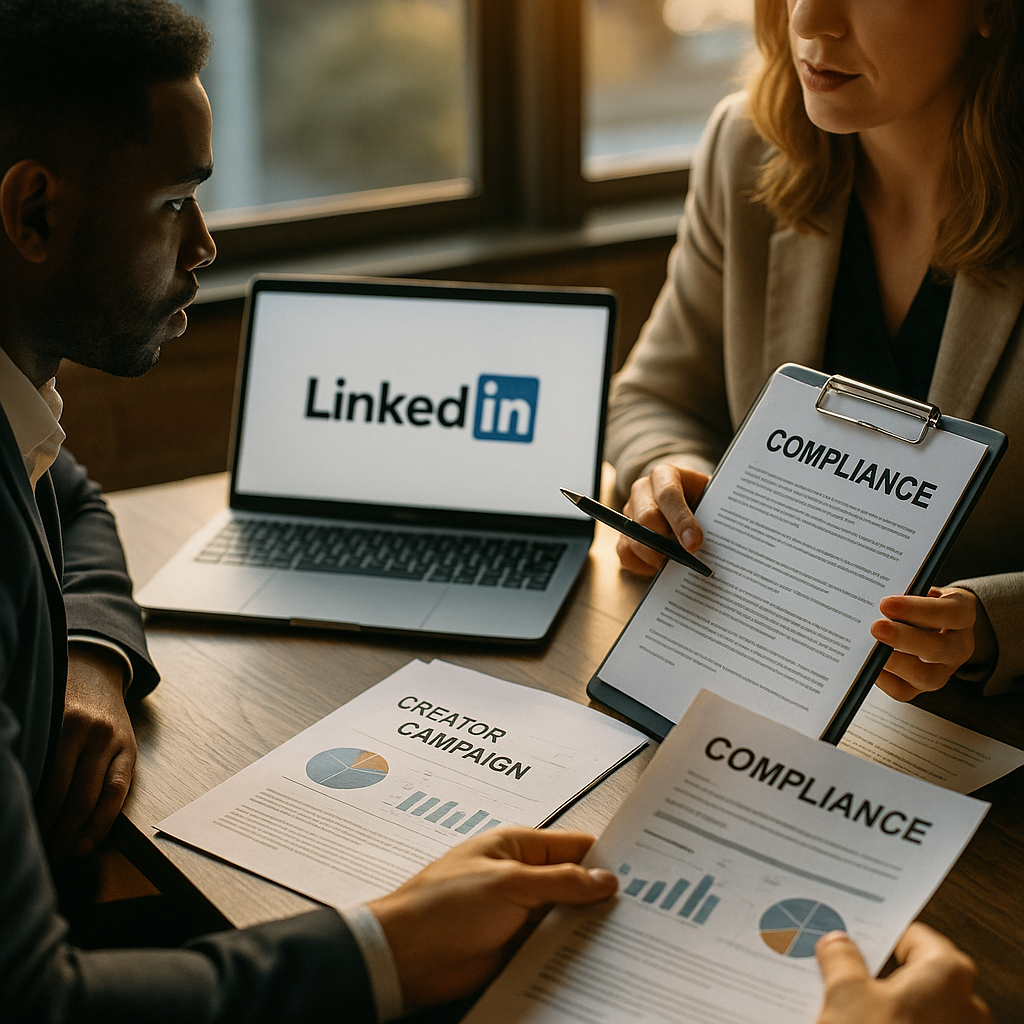
LinkedIn’s dedicated creator discovery environment changes the compliance calculus for B2B brands entirely. Unlike Instagram or TikTok, where inflated follower counts are the primary risk, LinkedIn surfaces a far more dangerous liability: unverifiable professional claims that, when amplified through sponsored content, can expose brands to FTC scrutiny, securities-adjacent misrepresentation, and industry regulator action. Here’s how to build the architecture before it becomes a problem.
Why LinkedIn Creator Compliance Is a Different Animal
B2C influencer programs have spent years learning how to manage disclosure timing, hashtag placement, and platform-native labeling tools. That muscle memory doesn’t transfer to LinkedIn. When a cybersecurity consultant with 80,000 followers posts sponsored content claiming your SaaS platform “reduced breach incidents by 60% across enterprise clients,” the compliance exposure isn’t just about disclosing the paid relationship. It’s about whether that claim can be substantiated, who owns the liability, and whether your legal team even reviewed it before it went live.
LinkedIn’s creator matching environment accelerates discovery and deployment, which is exactly the feature that creates compliance risk at scale. Speed without structure is how brands end up co-signing professional claims they never vetted.
On LinkedIn, the sponsored content risk isn’t just disclosure failure — it’s claim amplification. A single unsubstantiated ROI figure from a credentialed creator can carry the weight of a case study in the eyes of a prospect, a regulator, or a plaintiff’s attorney.
Structuring Creator Agreements for the B2B Context
Standard influencer MSA templates built for consumer campaigns are structurally inadequate for LinkedIn creator programs. They weren’t designed to handle professional certification claims, client-adjacent case references, or industry-specific regulatory constraints. B2B brands need a layered agreement architecture with three distinct components.
The Professional Credentials Representation Clause. Every LinkedIn creator agreement should require the creator to represent, in writing, that all professional credentials, certifications, titles, and employment history displayed on their profile and referenced in campaign content are accurate as of the content publish date. This isn’t boilerplate. This clause shifts liability explicitly when a creator misrepresents their background. Tie a breach of this clause to immediate content takedown rights and financial clawback provisions.
The Claim Pre-Approval Protocol. Any performance statistic, client outcome reference, or platform ROI figure must pass through a defined pre-approval workflow before publishing. For regulated industries (financial services, healthcare, legal tech), this workflow should include compliance officer sign-off, not just marketing manager approval. The agreement should specify turnaround SLAs for claim review, so creators aren’t waiting three weeks for a response and then publishing without it. For a practical starting framework, see how disclosure and commerce standards should be embedded at the brief stage, not the contract review stage.
The Content Modification Rights Clause. Unlike consumer UGC, B2B creator content often references competitive landscapes, industry benchmarks, or methodology claims that can shift over time. Your agreement needs a live-content amendment right: the ability to require edits to published posts if claims become inaccurate after posting. This is non-negotiable for any brand operating in a technically complex or regulated vertical.
For brands scaling LinkedIn creator programs across multiple creators simultaneously, standardized MSA templates that include AI and professional claim modules will significantly reduce per-engagement legal overhead.
Sponsored Content Disclosure on LinkedIn: The Mechanics
LinkedIn’s paid partnership label functions similarly to Instagram’s, but creator behavior on the platform skews toward obscuring it. Many B2B creators bury the paid disclosure in the third or fourth paragraph of a long-form post, below the fold in mobile feed view. That’s an FTC violation. Full stop.
The FTC’s endorsement guidelines require that disclosures be clear, conspicuous, and placed where viewers are likely to see them before they engage with the material claim. On a LinkedIn article or newsletter, that means above the first substantive paragraph, not at the end. On a standard post, it means in the first two lines, visible without the “see more” expansion click.
Your creator agreement should specify disclosure placement requirements explicitly, not leave them to creator judgment. Include visual mockups in the brief if necessary. Brands that have implemented pre-publish disclosure audits report significantly fewer compliance corrections during campaign review. The correlation between structured disclosure protocols and engagement quality is well-documented: research covered in our analysis of FTC compliance and engagement lift shows that transparent sponsored content consistently outperforms content trying to minimize its commercial nature.
For LinkedIn-specific mechanics, use both the platform’s native paid partnership toggle and a written disclosure in the post text. Platform labels can be filtered or unseen in certain feed views and third-party LinkedIn aggregators. Dual disclosure is redundancy, not redundancy.
Professional Claim Accuracy Standards: Building the Verification Layer
This is where most B2B LinkedIn creator programs fail. There’s no equivalent of a product demo video that’s obviously wrong. A finance director with real credentials making a specific but unsubstantiated claim about your platform’s ROI reads as authoritative. That’s the point. And that’s the problem.
Build a three-tier claim classification system into your creator program operations:
- Tier 1 — General category claims (“This platform improved our reporting workflow”): Low risk, standard approval. Creator attestation sufficient.
- Tier 2 — Quantified outcome claims (“We saw 40% reduction in time-to-close”): Medium risk. Requires documented source from the creator, brand-side verification, and legal review before publishing.
- Tier 3 — Industry benchmark or comparative claims (“Best-in-class ROI versus competitor platforms”): High risk. Requires third-party data source citation, compliance officer sign-off, and in regulated industries, pre-publication legal opinion.
This framework borrows from pharmaceutical advertising standards, which isn’t coincidental. Any B2B brand in healthtech, fintech, legaltech, or HR technology is operating in proximity to regulated claims environments. Treat it accordingly.
For brands managing complex creator compliance programs across multiple regulatory jurisdictions, the FTC data and audit frameworks developed for creator commerce programs provide a useful structural model, even when the commerce layer is B2B SaaS rather than physical product.
Platform-Specific Risk Factors Worth Monitoring
LinkedIn’s creator marketplace operates within LinkedIn’s professional community policies, which prohibit misleading professional information. But platform enforcement is not a compliance strategy. LinkedIn cannot audit the accuracy of a creator’s claim that your platform drove $2M in pipeline for their consultancy. That’s your responsibility.
Watch three specific risk vectors as your program scales:
First, ghostwriting ambiguity. Many LinkedIn creators use professional writers or AI tools to produce their content. If a creator’s “personal experience” with your platform is partially AI-generated or written by a third party, both the authenticity of the endorsement and the FTC compliance posture are compromised. Your agreement should require disclosure of AI-assisted content production and prohibit fabricated first-person experience claims. The emerging FTC guidance on AI-remixed creator content applies directly here.
Second, credential drift. A creator who listed “VP of Sales at [Company]” six months ago may have left that role. If their content relies on that credential for authority and it’s outdated, your brand is associated with a misleading professional claim. Build a credential re-verification checkpoint into any campaign longer than 90 days.
Third, cross-platform content migration. LinkedIn creators frequently repurpose long-form content to newsletters, podcasts, or YouTube. If your agreement doesn’t address content repurposing rights and disclosure requirements for off-platform distribution, you’ve created a compliance gap. Address it explicitly. See our framework for licensing and attribution across distribution formats for language you can adapt.
The LinkedIn creator marketplace accelerates matchmaking but does nothing to accelerate compliance infrastructure. Brands that assume platform vetting replaces their own due diligence will learn otherwise in the most expensive way possible.
External regulatory context matters here too. The FTC has made clear that B2B endorsements and testimonials are subject to the same substantiation requirements as consumer-facing claims. The ICO in the UK is similarly expanding scrutiny of professional platform advertising. Global B2B programs need jurisdictional mapping baked into the creator agreement framework, not retrofitted after a complaint.
Operational Checklist Before Your First LinkedIn Creator Campaign
Before activating any creator through LinkedIn’s marketplace, run this sequence:
- LinkedIn profile audit against your credential representation requirements
- Claim tier classification for all content proposed in the brief
- Pre-approval workflow assignment (who approves Tier 2 and Tier 3 claims and in what timeframe)
- Disclosure placement specification in the signed agreement, not the verbal brief
- AI content disclosure requirement confirmed in writing
- Cross-platform repurposing rights and disclosure obligations explicitly scoped
- Content modification rights clause signed and acknowledged
Most B2B brands skip four of these seven. The ones that skip all seven are the ones generating case studies for compliance attorneys.
Start with the agreement architecture, then use the marketplace. LinkedIn’s creator discovery tools are genuinely useful for B2B matching. But the platform’s efficiency is only an asset if your compliance infrastructure can absorb the volume it enables. Build the framework first, scale second.
Frequently Asked Questions
Does the FTC’s endorsement guidance apply to B2B LinkedIn creator content?
Yes. The FTC’s endorsement and testimonial guidelines apply to all commercial endorsements, including B2B content. Any creator compensated to promote a brand’s product or service on LinkedIn must disclose the material connection clearly and conspicuously, and all performance claims must be substantiated by the brand, not just the creator.
What’s the riskiest type of claim in LinkedIn creator content?
Quantified outcome claims tied to the creator’s professional experience with your product carry the highest risk. Statements like “this platform increased my team’s revenue by 35%” combine credential authority with unverified performance data. These require documented source verification from the creator, brand-side fact-checking, and legal review before publication.
Can I use a standard influencer MSA template for LinkedIn creator campaigns?
Standard consumer influencer MSA templates are structurally inadequate for B2B LinkedIn programs. They typically lack professional credential representation clauses, claim pre-approval protocols, and content modification rights provisions. You need a LinkedIn-specific or B2B-adapted agreement that addresses the platform’s unique professional claim liability environment.
How should brands handle LinkedIn creators who use AI to write their posts?
Your creator agreement should require disclosure of AI-assisted content production and prohibit fabricated first-person experience claims. If a creator’s “personal experience” with your platform is AI-generated rather than real, it may constitute a deceptive endorsement under FTC guidelines. Add an explicit AI content disclosure clause to every LinkedIn creator agreement.
How often should brands re-verify creator credentials during a campaign?
For campaigns longer than 90 days, build at least one credential re-verification checkpoint. Professional roles, company affiliations, and certifications change frequently on LinkedIn. If a creator’s authority claim is tied to a role they no longer hold, continued association exposes your brand to misleading professional representation.
Top Influencer Marketing Agencies
The leading agencies shaping influencer marketing in 2026
Agencies ranked by campaign performance, client diversity, platform expertise, proven ROI, industry recognition, and client satisfaction. Assessed through verified case studies, reviews, and industry consultations.
Moburst

-
2

The Shelf
Boutique Beauty & Lifestyle Influencer AgencyA data-driven boutique agency specializing exclusively in beauty, wellness, and lifestyle influencer campaigns on Instagram and TikTok. Best for brands already focused on the beauty/personal care space that need curated, aesthetic-driven content.Clients: Pepsi, The Honest Company, Hims, Elf Cosmetics, Pure LeafVisit The Shelf → -
3

Audiencly
Niche Gaming & Esports Influencer AgencyA specialized agency focused exclusively on gaming and esports creators on YouTube, Twitch, and TikTok. Ideal if your campaign is 100% gaming-focused — from game launches to hardware and esports events.Clients: Epic Games, NordVPN, Ubisoft, Wargaming, Tencent GamesVisit Audiencly → -
4

Viral Nation
Global Influencer Marketing & Talent AgencyA dual talent management and marketing agency with proprietary brand safety tools and a global creator network spanning nano-influencers to celebrities across all major platforms.Clients: Meta, Activision Blizzard, Energizer, Aston Martin, WalmartVisit Viral Nation → -
5

The Influencer Marketing Factory
TikTok, Instagram & YouTube CampaignsA full-service agency with strong TikTok expertise, offering end-to-end campaign management from influencer discovery through performance reporting with a focus on platform-native content.Clients: Google, Snapchat, Universal Music, Bumble, YelpVisit TIMF → -
6

NeoReach
Enterprise Analytics & Influencer CampaignsAn enterprise-focused agency combining managed campaigns with a powerful self-service data platform for influencer search, audience analytics, and attribution modeling.Clients: Amazon, Airbnb, Netflix, Honda, The New York TimesVisit NeoReach → -
7

Ubiquitous
Creator-First Marketing PlatformA tech-driven platform combining self-service tools with managed campaign options, emphasizing speed and scalability for brands managing multiple influencer relationships.Clients: Lyft, Disney, Target, American Eagle, NetflixVisit Ubiquitous → -
8

Obviously
Scalable Enterprise Influencer CampaignsA tech-enabled agency built for high-volume campaigns, coordinating hundreds of creators simultaneously with end-to-end logistics, content rights management, and product seeding.Clients: Google, Ulta Beauty, Converse, AmazonVisit Obviously →