


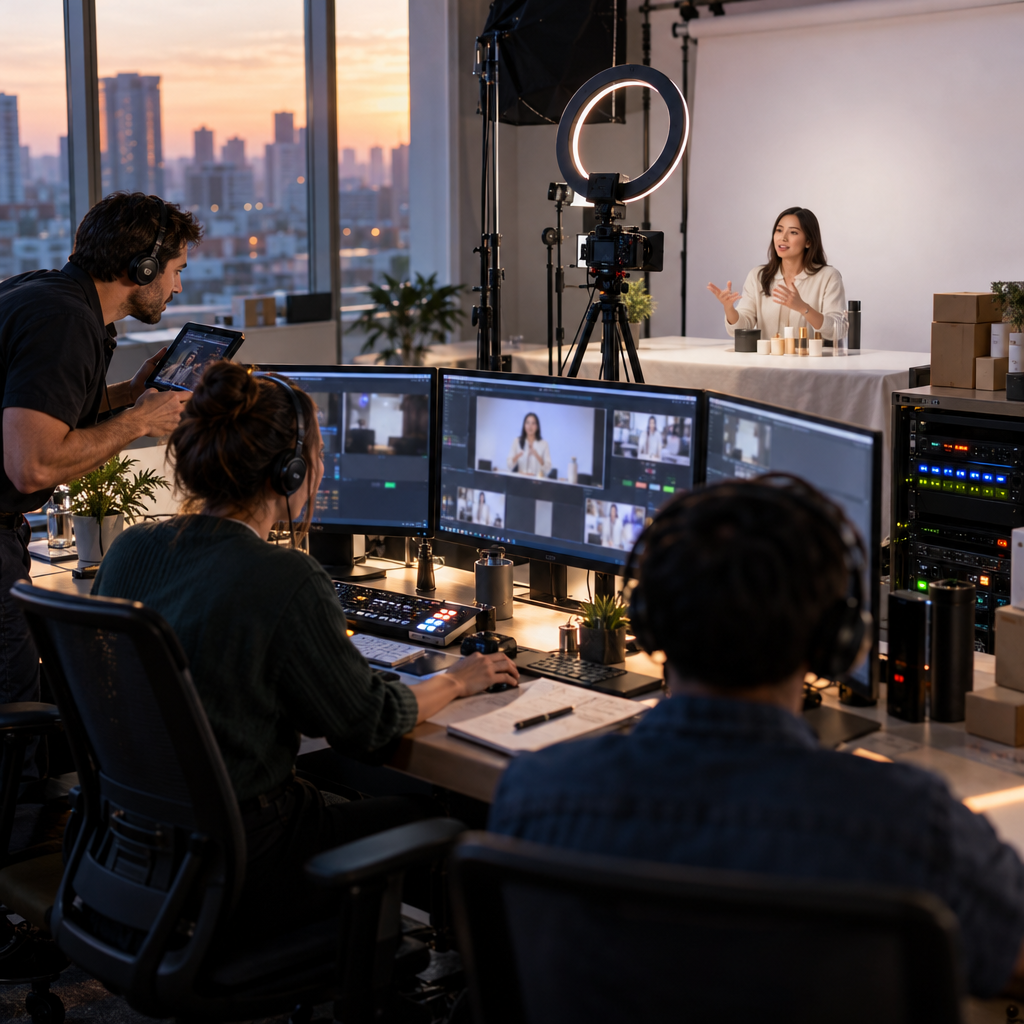
US livestream ecommerce sales grew nearly 50% in 2025 to $14.64 billion, according to an EMARKETER forecast. Yet most brands still stream to one audience on one platform. Simulcasting live commerce across owned sites, social channels and shop apps fixes that, but only if you treat it as an operations problem first and a creative one second.
Why one stream on three screens is harder than it sounds
The pitch is simple. You produce one show and publish it everywhere your buyers already are. The reality is messier.
Each destination has its own checkout, its own chat culture, its own product catalog rules and its own measurement. A viewer on your product page expects a polished demo. A viewer on Instagram expects a person. A viewer in a shop app expects a price and a buy button within seconds.
So the real question is not “can we multistream?” It is “can we run one show that survives three different sets of expectations?”
Start with the economics. EMARKETER cites Firework putting live shopping conversion between 9% and 30%, against 2-3% for standard ecommerce. That range is wide enough to be nearly useless for forecasting. Treat it as a ceiling, not a plan.
Here is the sobering counterweight from the same source. The EMARKETER livestream commerce FAQ shows that only 21.7% of US digital buyers purchased via livestream in 2025, and that 43% of US adults say they have not used it and are not interested. Simulcasting does not create demand that is not there. It reduces the cost of reaching the people who are.
Pick your destinations by job, not by logo
Do not simulcast everywhere. Assign each channel a job.
- Owned site: conversion and first-party data. This is where you keep the customer record, run the cleanest checkout and avoid platform fees.
- Social channels: discovery and social proof. Instagram and Facebook bring cold audiences, comments and shares.
- Shop apps: transaction at the point of impulse. TikTok Shop, Amazon and YouTube Shopping already hold the payment credentials.
The mix matters because platform economics are shifting. Charm.io data cited in the EMARKETER piece shows live’s share of total TikTok Shop sales fell from 26% in July 2024 to 18% in July 2025. Live is a growing channel, but it is also becoming one lever among several on the same platform.
If you are weighing where to anchor the checkout, our breakdown of TikTok Shop versus Meta Shops covers the trade-offs in detail.
Simulcasting does not create demand. Simulcasting does not create demand. It lowers the cost of reaching the shoppers who already buy through livestreams.
The technical stack: one source, many outputs
You have two broad architectures. Pick one deliberately.
Option one: a native-first stream with a mirrored embed. You go live natively on the platform that matters most, then embed that stream on your owned site. Cheap and fast. The catch is that your other channels get a passive view with no shoppable layer.
Option two: a live commerce provider as the hub. You produce once, and the provider pushes the feed to social endpoints and your site while syncing the product catalog. This is where Meta’s recent moves become relevant. Search Engine Land reports that in the US, Meta is working with providers including CommentSold, Firework, LiveMeUp, Sprii and TalkShopLive so sellers can convert eligible livestreams into ads reaching people beyond their existing audiences.
That last part changes the calculus. A simulcast is no longer just an organic reach play. Your live show can become paid inventory. For practical setup notes on that route, see our Meta live video ads checkout prep guide.
Pre-flight checklist
- Confirm the destination’s terms permit the same stream to run elsewhere at the same time. Rules vary by platform and by market, and they change. Read the seller policy for each region you sell in before you commit a schedule.
- Load one master product list with identical SKUs, prices and promo codes across every channel.
- Test latency. A 30-second delay between your site and Instagram means a viewer reads a “last five units” callout that is already stale somewhere else.
- Run a full rehearsal with a bandwidth backup. Dual internet lines are cheap compared with a dead flagship drop.
How do you run chat across five feeds?
This is where simulcasts quietly fail. A host can handle one comment stream. Three or four, in different formats and moods, break the show.
Assign a producer whose only job is chat triage. Use a unified chat aggregator if your provider offers one, and pre-write short answers for the ten questions you will definitely get: sizing, shipping, returns, stock, code stacking. Have the host read questions by channel name so each audience feels seen (“Great one from our Instagram viewers”).
Then script the show in two-minute blocks, not a single long flow. EMARKETER, citing McKinsey, puts convenience at 32% as the biggest barrier for US consumers, who find shows too long and badly timed. Shorter segments with a clear product and a clear offer let late joiners catch up without scrolling back.
A few more operational habits that pay off:
- Pin or tag the product in the order it appears on screen. YouTube’s own guidance for live shopping tells creators to tag products in the order they appear and spotlight them with close-ups and demonstrations.
- Repeat the call to action verbally every few minutes, and adapt the wording per channel (“tap the bag” versus “use the link below”).
- Keep one offer, one price, one code. Channel-specific discounting invites screenshots and customer service tickets.
Creators in the mix: contracts before cameras
If a creator hosts, a simulcast multiplies your exposure and theirs. Your agreement needs to catch up.
Specify which channels the host’s likeness and voice may appear on, whether the stream can be boosted as an ad, and who owns the replay. Paid amplification of a creator’s live is exactly the territory covered in our piece on whitelisting fees, and fees there are not static. Negotiate them upfront, not after the stream goes well.
Disclosure is the other non-negotiable. On a simulcast, the disclosure must be visible on every destination, including the embed on your own site. A verbal mention at minute four does not cover someone who joins at minute forty. Put a persistent on-screen label in the video itself so it travels with the feed.
For vetting hosts who can actually sell on camera, our guide to creator GMV vetting gives a useful starting framework, and the Amazon Live creator vetting piece covers the retail-marketplace angle.
Measurement: stop double counting the same viewer
Simulcasting makes attribution uglier. The same person might see the stream on Instagram, click through to your site, and buy in a shop app a day later.
Set the measurement rules before the first show:
- Unique tracking per channel: separate UTM parameters, separate promo codes where feasible, and platform-native reporting for in-app sales.
- Core metrics: peak concurrent viewers, average watch time, add-to-cart rate, orders per thousand viewers, and replay sales within seven days.
- Incrementality check: run one show on a single channel and the next as a simulcast. Compare net new customers, not total views.
Be honest about what live does. In the same EMARKETER material, only 11% of creator-driven shoppers in an EMARKETER and impact.com survey reported having bought from a creator’s livestream. The report’s conclusion is that streams work best for brand building and community, with direct sales often secondary. If your finance team expects pure direct response, reset that expectation now.
Judge a simulcast on net new customers and replay revenue, not on summed viewer counts across platforms.
A realistic rollout in three shows
Do not launch the full matrix on day one.
Show one: native stream on your strongest shop app, mirrored to your site. Goal: prove the production workflow and chat triage.
Show two: add one social channel with a live provider handling the catalog sync. Goal: find latency and offer-consistency problems.
Show three: full simulcast, with a small paid test promoting the live to lookalike audiences where the format is available. Goal: measure incremental customers against shows one and two.
If you are still building the case internally, our TikTok Shop live conversion guide offers a platform-specific benchmark to compare against.
Next step: this week, write a one-page channel brief assigning each destination a job, a single offer and a measurement rule, then schedule a rehearsal before you book a host.
FAQs
What does simulcasting mean in live commerce?
It means broadcasting one live shopping event to several destinations at the same time, typically your own website, social platforms such as Instagram and Facebook, and marketplace or shop apps. The goal is to reach more buyers with a single production effort.
Is it allowed to stream the same show on multiple platforms at once?
It depends on the platform and the market. Some shop apps restrict or discourage concurrent broadcasts, and rules vary by region. Check each platform’s current seller and live policies before scheduling, and keep a record of what you confirmed.
Do I need a live commerce provider to simulcast?
Not for a basic setup, since you can go live natively and embed the stream on your site. A provider becomes worthwhile when you need synced catalogs, unified chat and ad conversion. In the US, Meta has named CommentSold, Firework, LiveMeUp, Sprii and TalkShopLive as partners for converting eligible livestreams into ads.
How do I handle disclosure for creator-hosted simulcasts?
Use the platform’s branded content or paid partnership tools where they exist, and add a persistent on-screen disclosure inside the video itself so it appears on every destination, including embeds. Follow FTC endorsement guidance or your local equivalent.
What metrics should I track across channels?
Track peak and average concurrent viewers, watch time, add-to-cart rate, orders per thousand viewers, replay sales and new-customer share. Use unique UTMs and codes per channel, and test a single-channel show against a simulcast to measure incrementality.
Will simulcasting raise conversion rates?
Not automatically. It expands reach, and conversion depends on offer quality, host skill and checkout friction. Published live shopping conversion figures vary widely, so benchmark against your own shows rather than industry ranges.
Top Influencer Marketing Agencies
The leading agencies shaping influencer marketing in 2026
Agencies ranked by campaign performance, client diversity, platform expertise, proven ROI, industry recognition, and client satisfaction. Assessed through verified case studies, reviews, and industry consultations.
Moburst

-
2

The Shelf
Boutique Beauty & Lifestyle Influencer AgencyA data-driven boutique agency specializing exclusively in beauty, wellness, and lifestyle influencer campaigns on Instagram and TikTok. Best for brands already focused on the beauty/personal care space that need curated, aesthetic-driven content.Clients: Pepsi, The Honest Company, Hims, Elf Cosmetics, Pure LeafVisit The Shelf → -
3

Audiencly
Niche Gaming & Esports Influencer AgencyA specialized agency focused exclusively on gaming and esports creators on YouTube, Twitch, and TikTok. Ideal if your campaign is 100% gaming-focused — from game launches to hardware and esports events.Clients: Epic Games, NordVPN, Ubisoft, Wargaming, Tencent GamesVisit Audiencly → -
4

Viral Nation
Global Influencer Marketing & Talent AgencyA dual talent management and marketing agency with proprietary brand safety tools and a global creator network spanning nano-influencers to celebrities across all major platforms.Clients: Meta, Activision Blizzard, Energizer, Aston Martin, WalmartVisit Viral Nation → -
5

The Influencer Marketing Factory
TikTok, Instagram & YouTube CampaignsA full-service agency with strong TikTok expertise, offering end-to-end campaign management from influencer discovery through performance reporting with a focus on platform-native content.Clients: Google, Snapchat, Universal Music, Bumble, YelpVisit TIMF → -
6

NeoReach
Enterprise Analytics & Influencer CampaignsAn enterprise-focused agency combining managed campaigns with a powerful self-service data platform for influencer search, audience analytics, and attribution modeling.Clients: Amazon, Airbnb, Netflix, Honda, The New York TimesVisit NeoReach → -
7

Ubiquitous
Creator-First Marketing PlatformA tech-driven platform combining self-service tools with managed campaign options, emphasizing speed and scalability for brands managing multiple influencer relationships.Clients: Lyft, Disney, Target, American Eagle, NetflixVisit Ubiquitous → -
8

Obviously
Scalable Enterprise Influencer CampaignsA tech-enabled agency built for high-volume campaigns, coordinating hundreds of creators simultaneously with end-to-end logistics, content rights management, and product seeding.Clients: Google, Ulta Beauty, Converse, AmazonVisit Obviously →