


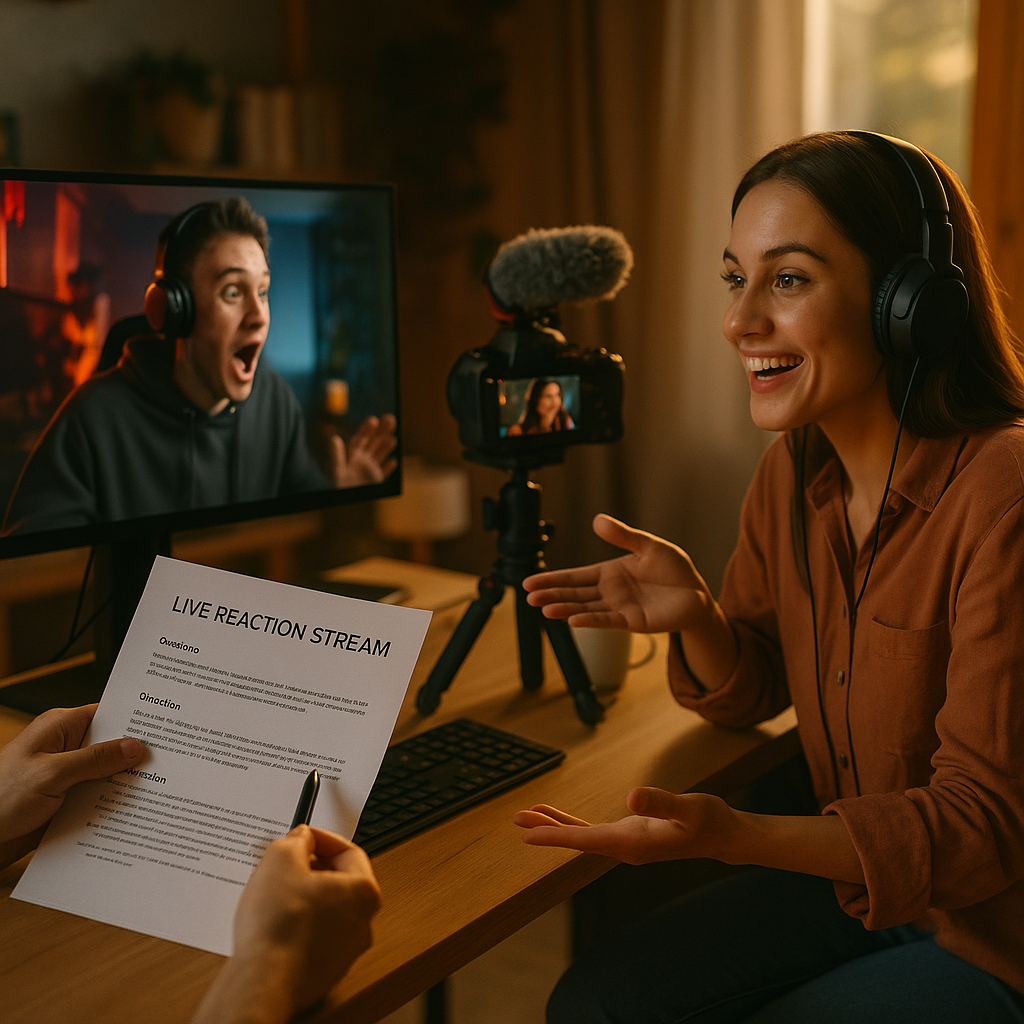
Live reaction streams drive 6x more comments per minute than pre-recorded creator content. So why are most brand-sponsored reaction events still being briefed like standard sponsored posts with a chat window bolted on?
Why the Live Reaction Format Deserves Its Own Brief
The live reaction stream is a distinct content format, not a variation of a standard livestream. It combines three mechanics that no other format packages together: real-time audience co-viewing, creator emotional response as entertainment, and structured product integration within an organic viewing moment. Briefing it like a TikTok Shop session or a podcast sponsorship read is a category error that brands make constantly.
The format has matured fast. Platforms including Twitch, YouTube Live, and TikTok have all introduced co-streaming and watch-party features that make simultaneous multi-platform distribution technically viable. reaction livestream briefs for commerce have evolved alongside this infrastructure, but the viewing-event variant has its own production logic that deserves dedicated documentation.
This article gives brand and agency teams a working production brief template they can adapt, plus the strategic rationale behind each section.
Setting the Campaign Frame Before You Brief Anyone
Before a single word of your creator brief is written, your team needs to resolve four strategic questions. Every production decision downstream depends on them.
- What is the anchor content? A product launch video, a trailer, a brand documentary, a live event feed, a music video. The reaction stream only works if the stimulus material is compelling enough to generate genuine emotional responses. Flat content produces flat reactions.
- Who owns the simulcast distribution? Decide upfront whether the creator hosts on their primary platform and you cross-post, or whether your brand channel carries the primary feed while creators simulcast. Rights, monetization, and FTC disclosure paths differ significantly between these models.
- What is the community interaction mechanism? Polls, live Q&A, chat-triggered reveals, discount unlocks, or community challenges. Pick one or two. More than that and the stream becomes chaotic to produce and confusing to watch.
- How does product integration sit inside the viewing event? Forced mid-stream ad reads kill the format. The best integrations are experiential: the creator uses the product during the reaction, demonstrates it as a natural response to the content, or reveals it as part of a community moment.
The most common live reaction brief failure is treating product integration as a scheduled interruption rather than a designed narrative beat within the viewing experience. Brands that solve this earn authenticity. Brands that don’t earn skip rates.
The Production Brief Template
What follows is a modular template. Use every section, but adapt the specifics to your creator tier, platform mix, and campaign objectives.
Section 1: Event Overview
State the anchor content, run time, scheduled date and time zone windows (critical for simulcast coordination), primary platform, and secondary distribution channels. Include the live link structure so creators are not improvising on stream.
Section 2: Creator Role Definition
Specify whether the creator is a sole host, a co-host, or part of a curated panel. Define their role during the reaction: commentator, product demonstrator, community moderator, or a combination. Ambiguity here creates dead air and off-brief moments that compliance teams will flag in post-review.
Section 3: Anchor Content Access and Embargo Protocol
Decide whether creators see the content before the stream. Pre-watch can improve production quality but sacrifices authentic first-reaction moments. A partial pre-watch (first 30 seconds only) is a workable middle position. Whatever you choose, document the embargo terms explicitly. An unintentional early reveal can torpedo a campaign launch.
Section 4: Product Integration Runsheet
Map every product moment to a specific timestamp in the anchor content. For example: at the 4-minute mark of the trailer, the brand’s product appears on screen. The creator holds up the physical product, delivers a single natural sentence of commentary, and places it visibly in frame for the remainder of that scene. No scripted read. No hard pivot. The runsheet keeps integration organic while ensuring it happens.
Section 5: Community Interaction Mechanics
List every planned interaction beat: the exact timestamp, the mechanism (poll, pinned comment, giveaway trigger, discount reveal), and the creator’s role in executing it. Platform-specific instructions matter here. A TikTok LIVE poll functions differently from a YouTube Live card. Cross-reference with your multi-platform livestream brief protocols if you are distributing across TikTok, Instagram, and Twitch simultaneously.
Section 6: FTC Disclosure and Platform Compliance
Live content creates specific disclosure challenges. The FTC requires that paid sponsorships be disclosed clearly and at the beginning of the stream, not buried in a description. Build verbal disclosure into the creator’s opening script, and require it to be on-screen as a graphic during the first 60 seconds. For multi-platform simulcast, each platform’s native disclosure tool must be activated independently. Refer to FTC guidelines for endorsements when briefing creators on live compliance requirements.
Section 7: Technical Production Requirements
Minimum bitrate, audio setup, camera framing (the product needs to be visible in-frame without looking like a staged prop), and streaming software. Specify whether the creator uses Restream or a comparable multi-destination tool for simulcast, or whether your production team manages the distribution layer. Leaving this to the creator’s discretion is how brands end up with vertical video on YouTube Live and misframed products on Twitch.
Section 8: Post-Stream Asset Capture
The VOD is not an afterthought. Specify clip extraction windows (which product moments become short-form clips), caption requirements, and which platform VODs you have rights to download and repurpose. This connects directly to your content repurposing strategy and significantly improves your cost-per-asset ratio across the campaign.
Multi-Platform Simulcast: What Actually Works
Simultaneous distribution across three or more platforms is achievable but requires explicit technical orchestration in the brief. The practical ceiling for most creator-led simulcasts is three platforms: their primary channel plus two secondary destinations. Beyond that, stream stability and chat management degrade.
Chat moderation is the underestimated operational load. A creator hosting a reaction stream while managing chat across YouTube, TikTok, and Twitch is performing three jobs at once. Budget for a dedicated moderator, or specify which platform’s chat the creator prioritizes and which ones get asynchronous responses. Leaving this undefined means your brand moments get interrupted by creators context-switching between chat windows.
Platform timing also matters. YouTube Live and Twitch carry real-time latency, while TikTok LIVE can run 5-15 seconds ahead or behind depending on viewer location. For synchronized community moments like discount unlocks or giveaway triggers, base your timing reference on the primary platform clock and accept that secondary platforms will be slightly off. Brief the creator on this explicitly so they do not overcorrect on stream.
Directing Authenticity Without Scripting It Away
The core tension in any reaction stream brief is between brand control and genuine creator response. Over-scripting a reaction event produces exactly the kind of stilted, obviously sponsored content that viewers abandon within two minutes. Under-briefing it produces off-brand moments that compliance teams spend days cleaning up.
The resolution is to script structure, not content. Give the creator a detailed runsheet with timestamps, product integration cues, and community interaction beats. Then give them complete freedom on how they respond to the anchor content between those beats. That freedom is the product. It is why audiences watch reaction streams instead of the original content alone.
For creators who are new to the format, pair the brief with a 20-minute pre-production call to walk through the runsheet, test the simulcast setup, and run a 60-second mock reaction. This reduces on-stream hesitation and ensures product moments land cleanly. For guidance on building briefs that preserve creator voice while meeting brand standards, the framework for authentic voice in creator briefs applies directly here.
Script the structure. Free the response. That is the entire creative philosophy of a well-produced reaction stream brief.
Measuring What Actually Matters
Brands that evaluate live reaction streams on reach alone are misreading the format’s value. The primary KPIs should be peak concurrent viewers, chat engagement rate during product integration timestamps, and conversion events tied to stream-specific discount codes or affiliate links. According to data aggregated by Sprout Social, live video generates significantly higher comment rates than static content, and reaction formats amplify this further through emotional contagion mechanics.
Measure the VOD separately. A well-clipped reaction moment can outperform the live stream in total views within 48 hours of publication. Track both metrics independently and attribute them separately in your reporting.
For CPM benchmarking against other live formats, the comparison with video podcast CPM rates is instructive. Live reaction streams typically command a premium over standard sponsored reads because of the community interaction layer and the multi-platform distribution value. Build that into your rate card negotiations.
Brand safety monitoring during live events requires a real-time solution. Tools like DoubleVerify offer livestream brand safety monitoring that flags problematic content as it happens, giving compliance teams a response window rather than a post-event cleanup job.
Start by auditing your last three live brand activations against this brief template. Identify which sections were missing or vague, and you will immediately see where authentic moments were lost and where product integration underperformed. Fix the brief before you book the creator.
FAQs
What is a live reaction stream format for brand campaigns?
A live reaction stream is a creator-hosted event in which the creator watches and responds in real time to specific anchor content, such as a product launch video or brand documentary, while simultaneously engaging their audience through chat interaction, polls, and community moments. For brand campaigns, product integration is embedded into the reaction experience through a structured runsheet rather than a scripted ad read.
How should brands handle FTC disclosure in a live reaction stream?
Brands must require verbal disclosure at the opening of the stream and a visible on-screen disclosure graphic during the first 60 seconds. For multi-platform simulcast events, each platform’s native paid partnership or sponsored content tool must be activated independently. The FTC’s endorsement guidelines apply to live content exactly as they do to pre-recorded sponsored posts.
How many platforms should a creator simulcast a reaction stream to?
Three platforms is the practical maximum for most creator-led simulcasts before stream stability and chat management quality degrade. Brands should specify the primary platform and up to two secondary destinations in the brief, and assign dedicated chat moderation for each channel rather than leaving the creator to manage all streams simultaneously.
What is the right way to integrate a product into a live reaction stream?
Product integration works best when it is mapped to a specific timestamp in the anchor content and designed to feel like a natural extension of the viewing moment rather than a scripted interruption. The creator should hold or use the product during a relevant scene, deliver one natural line of commentary, and keep it visibly in frame. Avoid hard pivots or mid-stream ad reads, which break viewing immersion and drive audience drop-off.
What KPIs should brands track for live reaction stream campaigns?
Primary KPIs should include peak concurrent viewers, chat engagement rate during product integration timestamps, and conversion events tied to stream-specific discount codes or affiliate links. VOD performance should be tracked separately from the live event, as clipped reaction moments frequently outperform the original live stream in total views within 48 hours of publication.
Top Influencer Marketing Agencies
The leading agencies shaping influencer marketing in 2026
Agencies ranked by campaign performance, client diversity, platform expertise, proven ROI, industry recognition, and client satisfaction. Assessed through verified case studies, reviews, and industry consultations.
Moburst

-
2

The Shelf
Boutique Beauty & Lifestyle Influencer AgencyA data-driven boutique agency specializing exclusively in beauty, wellness, and lifestyle influencer campaigns on Instagram and TikTok. Best for brands already focused on the beauty/personal care space that need curated, aesthetic-driven content.Clients: Pepsi, The Honest Company, Hims, Elf Cosmetics, Pure LeafVisit The Shelf → -
3

Audiencly
Niche Gaming & Esports Influencer AgencyA specialized agency focused exclusively on gaming and esports creators on YouTube, Twitch, and TikTok. Ideal if your campaign is 100% gaming-focused — from game launches to hardware and esports events.Clients: Epic Games, NordVPN, Ubisoft, Wargaming, Tencent GamesVisit Audiencly → -
4

Viral Nation
Global Influencer Marketing & Talent AgencyA dual talent management and marketing agency with proprietary brand safety tools and a global creator network spanning nano-influencers to celebrities across all major platforms.Clients: Meta, Activision Blizzard, Energizer, Aston Martin, WalmartVisit Viral Nation → -
5

The Influencer Marketing Factory
TikTok, Instagram & YouTube CampaignsA full-service agency with strong TikTok expertise, offering end-to-end campaign management from influencer discovery through performance reporting with a focus on platform-native content.Clients: Google, Snapchat, Universal Music, Bumble, YelpVisit TIMF → -
6

NeoReach
Enterprise Analytics & Influencer CampaignsAn enterprise-focused agency combining managed campaigns with a powerful self-service data platform for influencer search, audience analytics, and attribution modeling.Clients: Amazon, Airbnb, Netflix, Honda, The New York TimesVisit NeoReach → -
7

Ubiquitous
Creator-First Marketing PlatformA tech-driven platform combining self-service tools with managed campaign options, emphasizing speed and scalability for brands managing multiple influencer relationships.Clients: Lyft, Disney, Target, American Eagle, NetflixVisit Ubiquitous → -
8

Obviously
Scalable Enterprise Influencer CampaignsA tech-enabled agency built for high-volume campaigns, coordinating hundreds of creators simultaneously with end-to-end logistics, content rights management, and product seeding.Clients: Google, Ulta Beauty, Converse, AmazonVisit Obviously →