


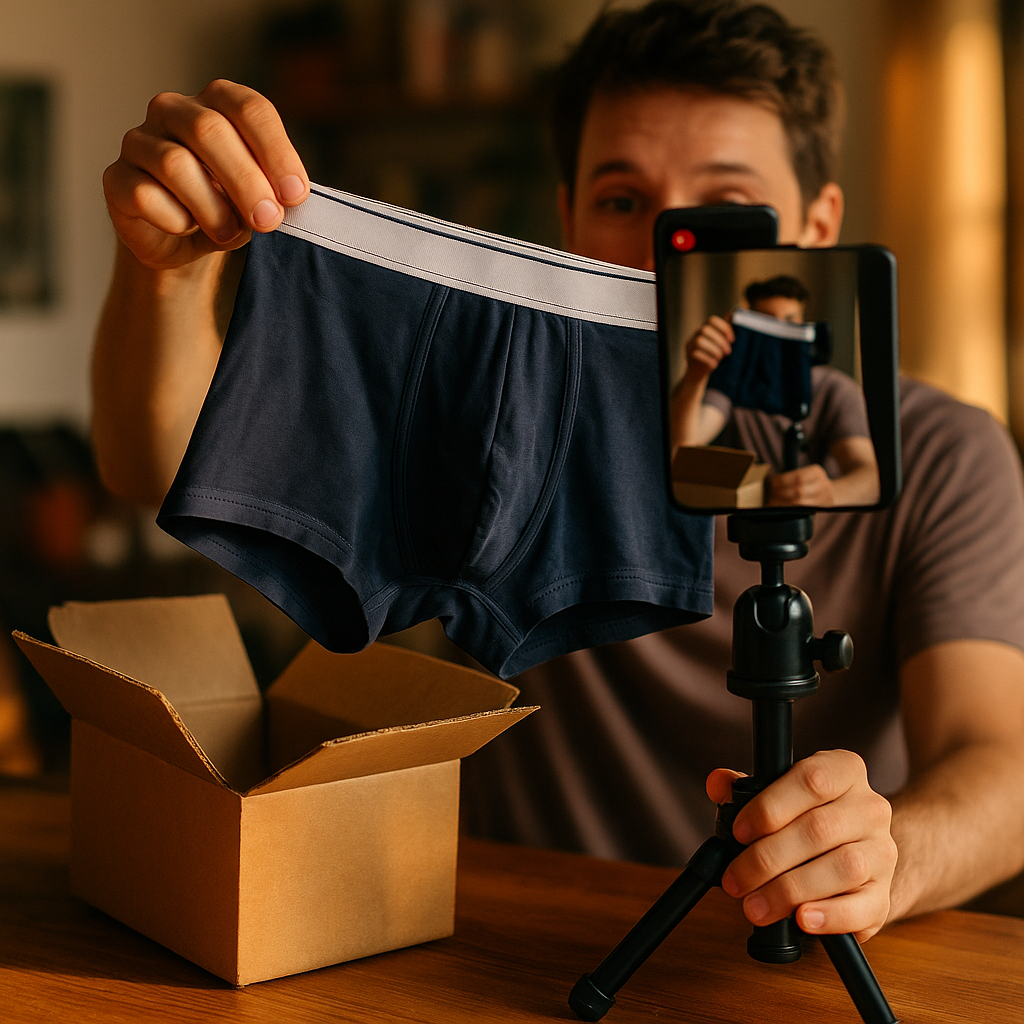
Viewers decide whether to keep watching an unboxing video within 10 seconds — often less. TikTok’s own internal research has repeatedly shown that hook performance in the first few seconds predicts completion rates better than almost any other variable. So why do so many brands still hand creators a script that saves the “wow” moment for the 30-second mark? The live-reaction unboxing format flips that logic: genuine first impressions, captured raw, up front. Done right, it’s one of the highest-converting formats in influencer marketing. Done wrong, it looks like every other bored creator holding a box to camera.
The Problem With Polished Unboxings
Most unboxing content still follows a tired template: creator sits at a desk, narrates calmly, opens the box, describes the contents like they’re reading a spec sheet. It’s fine. It’s also forgettable. Audiences have seen thousands of these videos, and their pattern recognition kicks in almost immediately. The moment a viewer senses “sponsored content, safe reaction,” they scroll.
The live-reaction format works because it rejects that composure. It asks creators to film their actual, unfiltered reaction — surprise, confusion, delight, even mild disappointment — within the opening seconds, before they’ve had time to compose a brand-safe response. That authenticity is exactly what audiences have been trained to distrust in traditional advertising, which is precisely why it performs.
A genuine gasp, laugh, or “wait, what?” in the first 10 seconds does more for watch-through rate than any amount of professional lighting or scripted narration.
Why the First 10 Seconds Are Non-Negotiable
Ten seconds isn’t arbitrary. It’s roughly the window before platform algorithms start weighing early drop-off against your content’s future distribution. TikTok, Instagram Reels, and YouTube Shorts all front-load their ranking signals around early retention. If a viewer bails at second six, the algorithm assumes your content isn’t worth pushing further, regardless of how strong the back half is.
This is the same logic that underpins hook-first strategies for paid social, which we’ve covered in detail in our breakdown of the first 3 seconds hook brief for app install campaigns. Unboxing content isn’t exempt from that pressure. If anything, it’s more vulnerable, because viewers have specifically learned to expect a slow build in this format and will punish anything that doesn’t front-load payoff.
Brands that still brief unboxings with a “build anticipation” arc are optimizing for a viewing pattern that no longer exists. Attention spans didn’t just shrink. They reorganized around instant gratification, and your creative brief needs to reorganize with them.
What “Genuine” Actually Means in a Directed Shoot
Here’s the tension every brand strategist has to sit with: you’re asking for authenticity, but you’re also paying for it, briefing it, and probably reviewing it before it posts. Can a reaction be genuine if it’s directed?
Yes — with the right approach. The trick isn’t scripting the reaction itself. It’s engineering the conditions that produce a real one. That means:
- Keeping the product reveal a surprise to the creator, not just to the audience. If your creator already knows what’s in the box, their reaction on camera three takes later will look exactly like what it is: a performance.
- Filming in one continuous take for the opening moment, no cuts, no retakes for the initial reaction. You can edit around it later, but that first unboxed reaction should be captured once, live.
- Briefing the emotion, not the words. Tell creators what feeling you’re hoping the product evokes, then let them find their own language for it.
- Avoiding pre-briefed product knowledge. Don’t send full spec sheets before the shoot. Send them after, for the follow-up explainer segment.
This is a fundamentally different creative operation than a standard sponsored post. You’re not directing performance — you’re directing circumstance. That distinction matters enormously for how you write the brief, and it’s worth cross-referencing against our guide on rewriting briefs for casual over polished content, which covers similar territory around manufactured spontaneity.
Building the Brief: Structure Without Scripting
The paradox of directing authenticity is that under-briefing produces worse results than over-briefing, just in a different way. A creator with zero guidance might ramble, forget to show the product clearly, or bury the brand name entirely. You still need structure. You just need to apply it around the reaction, not to it.
A workable brief for this format typically includes:
- Pre-shoot logistics only. Camera angle, lighting setup, framing so the product is visible when unboxed. None of this touches what the creator says or feels.
- A single reveal moment, clearly marked. Creators should know exactly when the box opens on camera, so there’s no fumbling that kills the pacing.
- A soft prompt, not a script. Something like “react however you actually feel” plus one or two optional discovery points (unexpected size, unusual packaging, a surprise inclusion) that you know will land.
- A no-retake rule for the opening beat. If the first reaction isn’t usable, don’t ask for a “more excited” version — that’s how you end up with performance instead of reaction.
- Post-reveal flexibility. After the first 10 seconds, hand control back to the creator for a natural walkthrough, informed now by the product info you withheld earlier.
This structure echoes what we outlined in the unboxing brief that turns reveals into impulse buys, but the live-reaction variant pushes further on timing discipline. It’s less about the reveal being dramatic and more about it being immediate.
Platform Differences Matter More Than You Think
A live-reaction unboxing built for TikTok and one built for YouTube Shorts aren’t interchangeable, even though the surface mechanics look similar. TikTok’s algorithm rewards extremely front-loaded hooks and tolerates rougher production. YouTube Shorts audiences, per eMarketer trend data on short-form consumption, skew slightly toward longer average watch times before drop-off, giving you marginally more room to build after the initial reaction — but not much.
Instagram Reels sits somewhere in between, and its algorithm has historically favored completion rate over raw view count, which means your live reaction needs a strong finish, not just a strong open. That’s a subtle but important shift in how you brief the back half of the video.
If you’re running the same unboxing concept across platforms, don’t just reformat aspect ratios. Rebrief the pacing. Our piece on one hero asset across every platform covers how to adapt a single concept without diluting what makes each platform’s algorithm respond.
The ROI Case: Why This Format Earns Its Budget
Live-reaction unboxings tend to outperform scripted alternatives on cost efficiency, mainly because they require less production overhead per usable asset. No elaborate set. No multiple takes. No heavy post-production narrative arc. You’re essentially paying for a well-managed moment of spontaneity, and spontaneity is cheap to produce but expensive to fake convincingly with paid media alone.
There’s also a secondary benefit that gets overlooked: this format generates strong raw footage for repurposing. A genuine reaction clip works as organic content, as a paid ad hook, and as UGC-style creative for retargeting campaigns. That’s three deliverables from one directed moment, assuming your usage rights and contracts are set up to allow it.
According to Sprout Social’s ongoing research into consumer trust in branded content, authenticity consistently ranks above production quality as a driver of purchase consideration. That’s the entire commercial argument for this format in one data point: viewers don’t need cinematic unboxings, they need believable ones.
Where Brands Get This Wrong
The most common failure mode isn’t a bad creator. It’s a brand that can’t resist tightening the leash. Legal wants disclosure language read verbatim in the opening line. Marketing wants three key messaging points hit before the ten-second mark. Compliance wants the reaction “on brand.” Stack enough requirements onto the opening beat and you’ve recreated the exact scripted stiffness this format exists to avoid.
The fix isn’t ignoring disclosure or compliance requirements — the FTC’s endorsement guidelines still apply regardless of how “unscripted” the content looks, and disclosure should appear early and clearly. The fix is separating disclosure from reaction. Put the disclosure as a caption, an on-screen tag, or a brief spoken line immediately before the reveal, not woven into the emotional moment itself. That satisfies compliance without hijacking the creative core of the format.
Multi-episode formats face a similar tension between structure and authenticity, and it’s worth reviewing how that balance gets handled in our guide on multi-episode creator series briefs, since the compliance-versus-spontaneity tradeoff shows up there too.
Measuring Whether It’s Actually Working
Don’t just track views. Track average watch time against your specific 10-second mark, retention curve shape (does it fall off a cliff or taper?), and completion rate relative to your other unboxing content. If your live-reaction videos aren’t outperforming scripted ones on retention past the first 10 seconds, something in the brief is still too controlled.
Comment sentiment is a surprisingly useful secondary signal here. Genuine reactions tend to generate comments referencing the creator’s specific words or facial expression (“the way she said ‘no way'” or similar). Scripted reactions generate generic comments about the product itself. If your comment section only talks about the product, you probably didn’t capture a real reaction, you captured a well-lit advertisement.
Start small: brief one creator for a true single-take reveal, withhold the product details until camera-on, and measure retention against your last three scripted unboxings. The data will tell you fast whether genuine beats polished for your audience.
FAQs
What makes the live-reaction unboxing format different from a standard unboxing video?
The core difference is timing and authenticity of emotion. Standard unboxings often build slowly toward a reveal with narration throughout. The live-reaction format puts the genuine, unscripted response to the product in the first 10 seconds, before the creator has had time to compose a brand-safe reaction.
How do you keep a reaction genuine when the creator is being paid to promote the product?
By controlling the conditions, not the words. Keep the product reveal a surprise to the creator until the camera is rolling, avoid pre-briefing specific talking points before the reaction, and capture the opening moment in a single take without retakes.
Does this format work on every platform?
It performs best on platforms with aggressive early-retention algorithms, particularly TikTok and Instagram Reels. YouTube Shorts allows slightly more room before drop-off, but the core principle — front-loading the emotional payoff — still applies everywhere.
How do you handle FTC disclosure without breaking the authentic moment?
Separate disclosure from the reaction itself. Use an on-screen caption, a brief spoken line before the reveal, or platform-native disclosure tags rather than scripting disclosure language into the emotional opening beat.
What metrics indicate the format is actually working?
Watch retention specifically past the 10-second mark, the shape of the drop-off curve, and comment sentiment. Comments referencing the creator’s specific reaction (words, expressions) suggest genuine engagement; comments only about the product suggest the reaction felt scripted.
Top Influencer Marketing Agencies
The leading agencies shaping influencer marketing in 2026
Agencies ranked by campaign performance, client diversity, platform expertise, proven ROI, industry recognition, and client satisfaction. Assessed through verified case studies, reviews, and industry consultations.
Moburst

-
2

The Shelf
Boutique Beauty & Lifestyle Influencer AgencyA data-driven boutique agency specializing exclusively in beauty, wellness, and lifestyle influencer campaigns on Instagram and TikTok. Best for brands already focused on the beauty/personal care space that need curated, aesthetic-driven content.Clients: Pepsi, The Honest Company, Hims, Elf Cosmetics, Pure LeafVisit The Shelf → -
3

Audiencly
Niche Gaming & Esports Influencer AgencyA specialized agency focused exclusively on gaming and esports creators on YouTube, Twitch, and TikTok. Ideal if your campaign is 100% gaming-focused — from game launches to hardware and esports events.Clients: Epic Games, NordVPN, Ubisoft, Wargaming, Tencent GamesVisit Audiencly → -
4

Viral Nation
Global Influencer Marketing & Talent AgencyA dual talent management and marketing agency with proprietary brand safety tools and a global creator network spanning nano-influencers to celebrities across all major platforms.Clients: Meta, Activision Blizzard, Energizer, Aston Martin, WalmartVisit Viral Nation → -
5

The Influencer Marketing Factory
TikTok, Instagram & YouTube CampaignsA full-service agency with strong TikTok expertise, offering end-to-end campaign management from influencer discovery through performance reporting with a focus on platform-native content.Clients: Google, Snapchat, Universal Music, Bumble, YelpVisit TIMF → -
6

NeoReach
Enterprise Analytics & Influencer CampaignsAn enterprise-focused agency combining managed campaigns with a powerful self-service data platform for influencer search, audience analytics, and attribution modeling.Clients: Amazon, Airbnb, Netflix, Honda, The New York TimesVisit NeoReach → -
7

Ubiquitous
Creator-First Marketing PlatformA tech-driven platform combining self-service tools with managed campaign options, emphasizing speed and scalability for brands managing multiple influencer relationships.Clients: Lyft, Disney, Target, American Eagle, NetflixVisit Ubiquitous → -
8

Obviously
Scalable Enterprise Influencer CampaignsA tech-enabled agency built for high-volume campaigns, coordinating hundreds of creators simultaneously with end-to-end logistics, content rights management, and product seeding.Clients: Google, Ulta Beauty, Converse, AmazonVisit Obviously →