


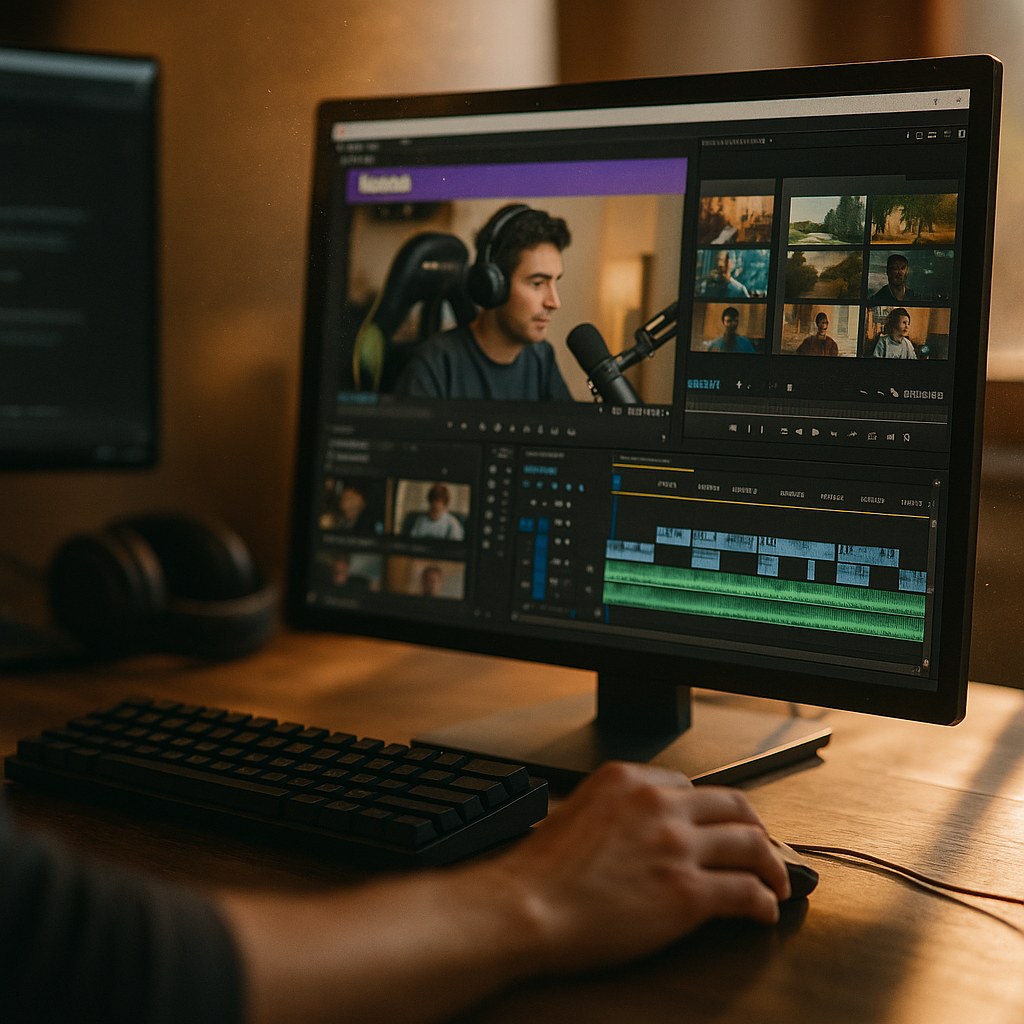
The average shopping livestream runs 90 minutes. Most brands clip it once, post a 60-second recap, and call it content. That’s leaving money on the table. A single stream can yield 30 to 50 distinct hooks, each one a potential paid acquisition asset, if you know how to mine it. Building a reusable hook library from livestream footage is quietly becoming one of the highest-leverage moves in performance creative.
Most teams treat livestreams as a sales channel and nothing else. Once the stream ends, the VOD sits in a folder until someone remembers it exists. Meanwhile, paid social teams are burning budget commissioning fresh UGC to test new hooks, unaware that the exact emotional beats they’re chasing already happened on camera, unscripted, during last month’s stream.
Why Livestreams Are an Untapped Hook Goldmine
Livestreams are uniquely good at producing hooks because they’re unscripted and high-volume. A host fielding real questions, reacting to live chat, and selling under time pressure generates dozens of micro-moments: genuine surprise, a sharp rebuttal to a skeptical comment, an unscripted comparison to a competitor product. These moments read as authentic because they are. Compare that to a traditional UGC shoot, where a creator delivers three scripted takes and you pick the cleanest one.
A 90-minute stream might contain:
- 8 to 12 moments of genuine reaction (surprise, delight, mild disbelief)
- 5 to 10 instances of objection handling pulled straight from live chat
- Several unscripted comparisons or “versus” moments
- Multiple price or value reveals with real audience reaction
- Candid product-in-hand demonstrations
Each category maps to a different hook archetype that performs differently depending on funnel stage and platform. That diversity is the whole point. A hook library built from a single stream often outperforms a month of dedicated hook shoots, simply because volume and authenticity compound.
A single 90-minute livestream can generate more usable paid-social hooks than a month of scripted UGC shoots, because volume and unscripted authenticity compound faster than any brief can engineer.
What Actually Counts as a “Hook” Here?
Define this narrowly or your library turns into a junk drawer. A hook, in the acquisition sense, is the first 1 to 3 seconds of a clip that has to stop a scroll or re-engage a wandering viewer. It’s not the whole clip, it’s the opening beat. For our work on hook libraries, we found that teams who separate the hook from the body of the ad, treating them as swappable modules rather than a single linear edit, see faster testing cycles and lower CPA over time.
From a livestream, that means scrubbing for moments where something changes abruptly: a price drops, a host gasps, a chat comment gets read aloud and reacted to. Those inflection points are your raw hook material. The rest of the stream (the steady explainer sections) becomes supporting footage you can cut in after the hook has earned the view.
The Five Hook Categories Worth Extracting
- Reaction hooks: genuine surprise or excitement, usually tied to a reveal or demo
- Objection hooks: a host directly addressing a skeptical chat comment (“someone just said this is a scam, let me show you why it’s not”)
- Comparison hooks: side-by-side or verbal comparisons to a known competitor or alternative
- Urgency hooks: stock counters, timer call-outs, “last one left” moments
- Social proof hooks: shout-outs to purchase counts, repeat buyers, or chat volume spikes
Each category tends to perform best at a different funnel stage. Reaction and urgency hooks are strong top-of-funnel scroll-stoppers. Objection and comparison hooks do heavier lifting mid-funnel, where the viewer already knows the product but needs a reason to stop scrolling past it again. Social proof hooks work well as retargeting creative for cart abandoners.
Building the Extraction Workflow
This only works if it’s a repeatable process, not a one-off editing favor. Here’s the workflow that’s held up across multiple brand accounts we’ve reviewed:
- Timestamp during the live stream, not after. Have a producer (even a junior one) log timestamps in real time whenever something hook-worthy happens. Reviewing a 90-minute VOD cold afterward wastes hours.
- Batch-export short clips (3 to 8 seconds) around each timestamp. Tools like Opus Clip, Descript, or a dedicated in-house editor using Premiere’s scene-detection can speed this up significantly.
- Tag by hook category and funnel stage. A spreadsheet or lightweight asset management tool (even Airtable works fine) keeps the library searchable instead of becoming another dumping ground.
- Re-cut vertical and add captions immediately. Don’t let raw clips sit untouched. A hook that isn’t vertical-ready and caption-burned isn’t actually reusable, it’s just footage. This matters because cropped, afterthought verticals pay a cost penalty in auction-based platforms.
- Pair each hook with 2 to 3 possible bodies. The hook gets you the stop, but you still need a coherent next 10 to 20 seconds. Borrow structure from existing multi-hook testing frameworks so you’re not reinventing the editorial logic each time.
Skip the tagging step and you’ll regret it in three months, when you have 400 clips and no idea which ones are objection hooks versus reaction hooks. Structure now saves hours later.
How Does This Change Your Paid Social Testing Cadence?
Most performance teams test creative in batches: commission five new ads, run them for a week, kill the losers, repeat. A hook library breaks that cadence open. Instead of waiting on new production, you’re recombining existing hooks with new bodies, new CTAs, new captions. That’s a fundamentally faster test loop.
Meta’s own creative guidance has consistently pointed toward higher creative velocity correlating with lower CPAs, and Meta Business tools like Advantage+ creative increasingly reward accounts that feed the algorithm more creative variations, not fewer. A hook library is essentially a supply chain for that variation. TikTok’s ad platform operates similarly: more creative diversity, tested faster, tends to outperform a handful of polished “hero” ads run on repeat. See TikTok for Business guidance on creative refresh cycles for more on this.
Where Livestream Hooks Fit Against Other UGC Formats
It’s worth being honest about the tradeoffs. Livestream-derived hooks are authentic but messier, lighting is inconsistent, audio can be rough, and you don’t control the framing. Dedicated UGC shoots, like the kind covered in our piece on product-in-hand UGC, give you more control but less spontaneity.
The smart move isn’t choosing one over the other. It’s using livestream hooks to identify which emotional beats actually resonate (the data is free, it already happened on camera), then briefing future scripted shoots to recreate those beats with better production value. Livestream footage becomes your research and development layer. Scripted UGC becomes your polished execution layer.
This pairs naturally with findings from our earlier coverage of livestream highlight clips, where we found that highlight-style edits already reduce CPA meaningfully on their own. A hook library takes that one step further by atomizing those highlights into testable, swappable creative units rather than fixed recap videos.
Treat livestream footage as free R&D. Let it tell you which emotional beats convert, then reinvest in scripted production only for the beats that already proved themselves on camera.
Compliance and Rights Management, Don’t Skip This
Here’s where legal and brand teams need a seat at the table early, not after the clips are already in a media buyer’s hands. Livestream hosts, especially affiliate creators, often have usage rights clauses that limit how clips can be repurposed into paid ads. A clip that’s fine for organic reposting might violate the terms if it ends up as a Meta ad spend driver.
Before you build a library at scale, confirm:
- Whether your creator agreements include paid usage rights, and for how long
- Whether FTC disclosure requirements are preserved when a clip is re-cut and recaptioned, see the FTC’s endorsement guidance for current disclosure standards
- Whether platform-specific ad policies require updated disclosures when organic content is converted to paid media
This isn’t a one-time check. Build it into your extraction workflow as a mandatory tagging field: usage rights confirmed, yes or no. It’s tedious. It’s also a lot cheaper than a legal dispute with a creator whose unscripted “I love this so much” moment just became the hook on a six-figure ad campaign.
Measuring Whether the Library Is Actually Working
Don’t just track CPA in isolation. Track hook-level performance across campaigns so you can see which categories of hooks are earning their keep over time. A simple dashboard noting hook category, funnel stage, platform, and CPA, refreshed weekly, tells you more than a single campaign report ever will. Over a quarter, patterns emerge: maybe objection hooks crush it on Meta but underperform on TikTok, where urgency hooks dominate instead. That kind of platform-specific nuance only shows up with consistent tagging and enough volume to compare.
Finance and performance teams increasingly want this kind of granular reporting anyway. Our coverage of finance-driven KPI demands covers why creative-level attribution is becoming a standard expectation, not a nice-to-have, in influencer program reporting.
Common Mistakes That Sink a Hook Library Before It Starts
A few patterns show up repeatedly when these libraries fail to deliver:
- Over-polishing clips during extraction. Heavy color grading or added music can strip out the raw authenticity that made the moment work in the first place.
- Treating the library as a one-time project. It needs a standing owner and a recurring intake process tied to every livestream, not a quarterly cleanup sprint.
- Ignoring caption and sound-off design. A huge share of feed viewing happens muted. If your extracted hooks don’t work without sound, you’ve cut your addressable inventory in half. Our piece on silent-first video design covers this in more depth.
- No tagging taxonomy. Without consistent categorization, the library becomes unsearchable within weeks.
None of these are hard to fix. They’re just easy to overlook when the priority is getting the next stream out the door rather than mining the last one properly.
Start small: pull the five most reaction-heavy moments from your last livestream VOD, re-cut them vertical with captions, and run them as a controlled hook test against your current top-performing ad this week. The data will tell you fast whether a full library build is worth the operational investment.
FAQs
How many livestreams do I need before a hook library becomes useful?
One stream can produce enough raw material for an initial test batch, but the library becomes genuinely powerful after three to five streams, once you have enough volume per hook category to spot performance patterns rather than one-off wins.
Do livestream hooks need the creator’s additional sign-off before running as paid ads?
In most cases, yes. Organic usage rights and paid usage rights are often separate clauses in creator agreements, so confirm this explicitly before converting any clip into an ad spend driver.
What’s the ideal length for an extracted hook clip?
Three to eight seconds for the hook itself, paired with a separate body section of 10 to 20 seconds that can be swapped independently during testing.
Can a hook library replace dedicated UGC production entirely?
No. It works best as a research layer that informs which emotional beats to prioritize in future scripted shoots, not a full replacement for controlled, high-production UGC.
Which platforms benefit most from this approach?
Meta and TikTok both reward creative diversity and refresh rate, making them the strongest fits, though the same library assets can be adapted for YouTube Shorts and connected TV with minor recropping.
FAQs
How many livestreams do I need before a hook library becomes useful?
One stream can produce enough raw material for an initial test batch, but the library becomes genuinely powerful after three to five streams, once you have enough volume per hook category to spot performance patterns rather than one-off wins.
Do livestream hooks need the creator’s additional sign-off before running as paid ads?
In most cases, yes. Organic usage rights and paid usage rights are often separate clauses in creator agreements, so confirm this explicitly before converting any clip into an ad spend driver.
What’s the ideal length for an extracted hook clip?
Three to eight seconds for the hook itself, paired with a separate body section of 10 to 20 seconds that can be swapped independently during testing.
Can a hook library replace dedicated UGC production entirely?
No. It works best as a research layer that informs which emotional beats to prioritize in future scripted shoots, not a full replacement for controlled, high-production UGC.
Which platforms benefit most from this approach?
Meta and TikTok both reward creative diversity and refresh rate, making them the strongest fits, though the same library assets can be adapted for YouTube Shorts and connected TV with minor recropping.
Top Influencer Marketing Agencies
The leading agencies shaping influencer marketing in 2026
Agencies ranked by campaign performance, client diversity, platform expertise, proven ROI, industry recognition, and client satisfaction. Assessed through verified case studies, reviews, and industry consultations.
Moburst

-
2

The Shelf
Boutique Beauty & Lifestyle Influencer AgencyA data-driven boutique agency specializing exclusively in beauty, wellness, and lifestyle influencer campaigns on Instagram and TikTok. Best for brands already focused on the beauty/personal care space that need curated, aesthetic-driven content.Clients: Pepsi, The Honest Company, Hims, Elf Cosmetics, Pure LeafVisit The Shelf → -
3

Audiencly
Niche Gaming & Esports Influencer AgencyA specialized agency focused exclusively on gaming and esports creators on YouTube, Twitch, and TikTok. Ideal if your campaign is 100% gaming-focused — from game launches to hardware and esports events.Clients: Epic Games, NordVPN, Ubisoft, Wargaming, Tencent GamesVisit Audiencly → -
4

Viral Nation
Global Influencer Marketing & Talent AgencyA dual talent management and marketing agency with proprietary brand safety tools and a global creator network spanning nano-influencers to celebrities across all major platforms.Clients: Meta, Activision Blizzard, Energizer, Aston Martin, WalmartVisit Viral Nation → -
5

The Influencer Marketing Factory
TikTok, Instagram & YouTube CampaignsA full-service agency with strong TikTok expertise, offering end-to-end campaign management from influencer discovery through performance reporting with a focus on platform-native content.Clients: Google, Snapchat, Universal Music, Bumble, YelpVisit TIMF → -
6

NeoReach
Enterprise Analytics & Influencer CampaignsAn enterprise-focused agency combining managed campaigns with a powerful self-service data platform for influencer search, audience analytics, and attribution modeling.Clients: Amazon, Airbnb, Netflix, Honda, The New York TimesVisit NeoReach → -
7

Ubiquitous
Creator-First Marketing PlatformA tech-driven platform combining self-service tools with managed campaign options, emphasizing speed and scalability for brands managing multiple influencer relationships.Clients: Lyft, Disney, Target, American Eagle, NetflixVisit Ubiquitous → -
8

Obviously
Scalable Enterprise Influencer CampaignsA tech-enabled agency built for high-volume campaigns, coordinating hundreds of creators simultaneously with end-to-end logistics, content rights management, and product seeding.Clients: Google, Ulta Beauty, Converse, AmazonVisit Obviously →