


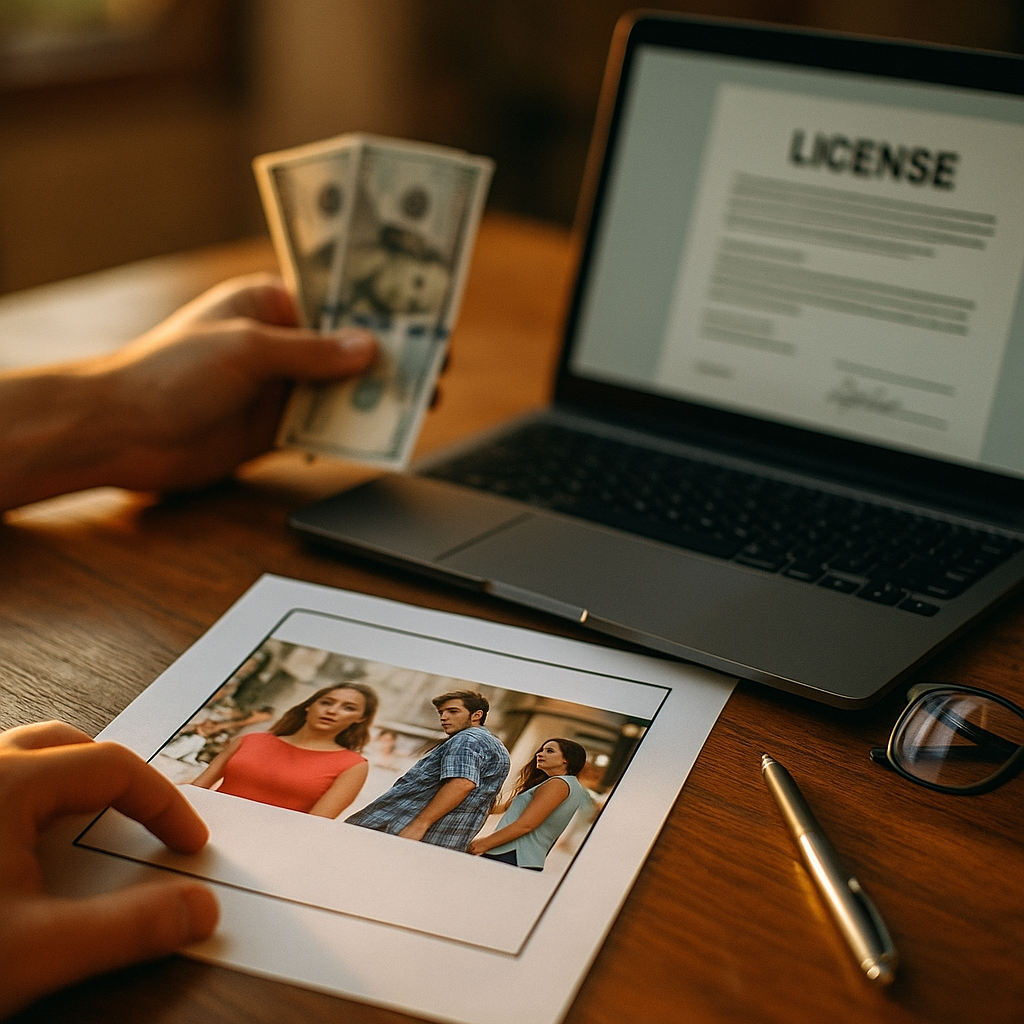
A single unlicensed meme cost a mid-size DTC brand $35,000 in a settlement last year. The format wasn’t even that funny. That’s the risk calculus every brand now faces: meme template licensing has quietly become a line item in influencer and social budgets, and the brands ignoring it are one screenshot away from a legal letter.
Memes move fast. Legal review doesn’t. That mismatch is exactly why licensing frameworks for viral formats exist now, and why smart marketing teams are building them into their content operations instead of treating every trending format as free real estate.
Why Meme Ownership Is Messier Than It Looks
Most marketers assume memes live in a copyright-free zone because they’re everywhere. That assumption is wrong, and it’s an expensive one. The underlying image, the original video clip, the specific caption format, sometimes even the font choice, can all carry separate ownership claims. Distracted Boyfriend was a licensed stock photo. Woman Yelling at Cat used a still from a Bravo TV show. Drake’s Hotline Bling reaction format required clearance from the label and the artist’s likeness rights before brands could touch it safely.
The person who originated a format rarely holds all the rights to it. Sometimes it’s a photographer, sometimes a production studio, sometimes a platform’s content licensing arm. When a brand slaps a logo on a trending template and pushes it live, they’re often stacking three or four separate risk exposures without realizing it.
The real danger isn’t getting caught using a meme. It’s getting caught profiting from one without a paper trail showing you tried to clear it.
The Legal Gray Area Brands Keep Stepping Into
Fair use protects commentary, parody, and criticism. It does not reliably protect a branded ad that uses someone else’s copyrighted image to sell a product. Courts have been inconsistent, but the trend leans toward stricter enforcement when a commercial entity profits from someone else’s creative work. The FTC’s guidance on endorsements and advertising also intersects here: if a meme format implies endorsement from the original creator or subject, disclosure obligations kick in too.
This is the same territory brands navigate when jumping on fast-moving trends generally. If your team already has a process for real-time trend response, meme licensing should slot right into it. Our meme-jacking playbook covers the speed-versus-legal-cover tradeoff in more depth, and it’s worth reading alongside this piece because the two problems are cousins.
What Licensing Actually Looks Like in Practice
Licensing a meme template isn’t like licensing a stock photo from a standard library, mostly because there isn’t one standard library. It happens through a patchwork of channels, and brands need to know which one applies to which format.
- Direct creator agreements: Reaching out to the original poster or creator for a paid usage agreement, often brokered through talent agencies now that meme creators have professionalized.
- Stock and licensing platforms: Some meme-adjacent imagery originates from stock libraries, meaning a standard commercial license already covers usage, brands just have to trace the source.
- Platform-level rights clearance: Certain viral clips originate from licensed entertainment content, requiring clearance through the studio or network, not the person who reposted it.
- Meme licensing agencies: A newer category of intermediary has emerged specifically to broker rights for viral formats, packaging usage rights the way music supervisors clear songs for commercials.
The agency route is growing fastest because it removes the guesswork. Instead of a brand’s social team trying to track down who owns the rights to a six-second clip that’s been reposted eleven thousand times, an agency handles sourcing, clearance, and payment terms in one contract.
Pricing Is All Over the Map, and That’s the Point
Licensing fees for meme templates range from a few hundred dollars for a lesser-known format to five figures for something tied to a recognizable public figure or franchise. Compare that to the cost of a single legal dispute, and licensing starts looking cheap. A brand that budgets even $2,000 to $5,000 per quarter for meme rights clearance is buying insurance against a much larger liability, plus the operational speed to actually ship content while the format is still relevant.
Speed Versus Safety: The Real Trade-Off Brands Are Managing
Here’s the tension nobody wants to say out loud: memes are valuable precisely because they’re fast, and licensing is valuable precisely because it’s careful. Those two things pull in opposite directions.
A meme’s cultural relevance has a shelf life measured in days, sometimes hours. Legal clearance processes, historically, have been measured in weeks. Brands that wait for full sign-off before posting are usually posting a format that’s already dead. Brands that skip clearance entirely are gambling on nobody noticing, or nobody caring enough to sue.
The solution most mature marketing teams have landed on is a pre-approved licensing bench. Instead of clearing formats one at a time as they trend, brands work with a licensing partner or in-house legal counsel to pre-clear a rotating library of safe formats, evergreen templates whose rights are already secured, alongside a fast-track review lane for genuinely new viral moments.
Pre-clearance turns meme marketing from a legal gamble into a content calendar decision.
This mirrors how brands have started operating around other reactive formats. The same fast-approval logic shows up in our breakdown of stitch and duet response content, where the bottleneck isn’t creativity, it’s approval speed.
Building an Internal Meme Approval Workflow
If your brand posts memes with any regularity, an ad hoc approach will eventually bite you. Here’s a workable structure that balances speed with risk management:
- Maintain a cleared-format library. Work with legal or a licensing agency to build a rotating bank of ten to fifteen pre-approved templates your social team can deploy without new sign-off each time.
- Set a fast-track review SLA. For genuinely new trending formats, commit to a 24 to 48 hour legal turnaround. Anything slower and the trend is stale before you post.
- Document your good-faith effort. Even if full clearance isn’t possible in the window, keeping a record showing your team attempted to identify and contact the rights holder matters if a dispute arises later.
- Separate parody from endorsement. Formats that could be read as implying a creator or brand endorsement need a different, stricter review path than pure commentary formats.
- Track usage rights expiration. Licenses often come with time limits or platform restrictions. Set calendar reminders so content doesn’t stay live past its cleared window.
Marketing operations teams already managing UGC rights and creator contracts can extend the same systems here. Sprout Social’s and HubSpot’s content governance frameworks are useful starting templates even though neither is meme-specific.
When a Meme Format Should Just Be Skipped
Not every viral moment is worth chasing, licensed or not. If a format originated from tragedy, a real person’s likeness without their consent, or a politically charged moment, the brand safety math rarely justifies the reach. The best-performing meme content tends to come from absurdist, low-stakes formats anyway, the kind where the humor doesn’t rely on exploiting a specific person’s image or misfortune. If your team can’t quickly confirm the source and sentiment around a format, that’s usually a sign to sit the trend out.
The ROI Case: Does Licensed Meme Content Actually Perform?
Skeptics will ask the obvious question: if licensing adds cost and slows you down, is it worth it? Data suggests yes, but with nuance. Branded meme content that lands authentically tends to outperform standard branded posts on engagement rate, largely because it borrows an existing cultural shorthand the audience already recognizes. eMarketer’s research on creator-driven content consistently shows format familiarity, not production polish, as a top driver of engagement among younger audiences.
Licensed formats also carry a secondary benefit: they’re safe to boost. Unlicensed meme content that a legal team hasn’t cleared often gets flagged for organic-only distribution, which caps its reach. A cleared format can move into paid social without a compliance flag, meaning the licensing cost effectively unlocks ad spend that would otherwise be off the table.
That paid-media unlock is the part most finance teams miss when they see a licensing invoice and assume it’s pure overhead. It’s not overhead. It’s what makes the format usable at scale.
Where This Is Headed
Expect meme licensing to formalize further as more agencies specialize in it and as platforms build in-house rights databases the way Meta’s business tools already handle certain licensed music and content categories. Brands that build a licensing habit now, rather than scrambling reactively, will have a speed advantage once the process gets more standardized industry-wide. The playbook resembles other fast-turnaround creative formats where legal and creative teams have had to learn to move at the same pace, similar to what’s happening with duet and remix campaigns and other co-creation formats built on someone else’s original content.
It’s also worth noting how this connects to disclosure norms more broadly. As formats blend organic humor with clear commercial intent, transparency expectations from regulators and platforms alike are tightening, not loosening.
Bottom line: build a cleared-format library before the next viral moment hits, not after your legal team gets the first cease-and-desist letter.
FAQs
Do brands really need to license memes, or is that overkill?
If the underlying image, clip, or format has a traceable rights holder, and most popular ones do, licensing reduces real legal exposure. It’s not overkill for any brand running paid promotion around the content.
How much does meme template licensing typically cost?
Costs range from a few hundred dollars for lesser-known formats to five figures for anything tied to a recognizable public figure, franchise, or media property.
Can we just use a meme under fair use instead of licensing it?
Fair use generally covers commentary and parody, not commercial advertising that uses someone else’s copyrighted work to sell a product. Brand use rarely qualifies for reliable fair use protection.
How fast can meme licensing actually happen?
With a pre-approved format library and a fast-track legal SLA of 24 to 48 hours, brands can move nearly as fast as unlicensed posting, without the same risk exposure.
What happens if we post an unlicensed meme and get caught?
Outcomes range from a takedown request to a cease-and-desist letter to a monetary settlement, depending on the rights holder and how commercially the content was used.
Top Influencer Marketing Agencies
The leading agencies shaping influencer marketing in 2026
Agencies ranked by campaign performance, client diversity, platform expertise, proven ROI, industry recognition, and client satisfaction. Assessed through verified case studies, reviews, and industry consultations.
Moburst

-
2

The Shelf
Boutique Beauty & Lifestyle Influencer AgencyA data-driven boutique agency specializing exclusively in beauty, wellness, and lifestyle influencer campaigns on Instagram and TikTok. Best for brands already focused on the beauty/personal care space that need curated, aesthetic-driven content.Clients: Pepsi, The Honest Company, Hims, Elf Cosmetics, Pure LeafVisit The Shelf → -
3

Audiencly
Niche Gaming & Esports Influencer AgencyA specialized agency focused exclusively on gaming and esports creators on YouTube, Twitch, and TikTok. Ideal if your campaign is 100% gaming-focused — from game launches to hardware and esports events.Clients: Epic Games, NordVPN, Ubisoft, Wargaming, Tencent GamesVisit Audiencly → -
4

Viral Nation
Global Influencer Marketing & Talent AgencyA dual talent management and marketing agency with proprietary brand safety tools and a global creator network spanning nano-influencers to celebrities across all major platforms.Clients: Meta, Activision Blizzard, Energizer, Aston Martin, WalmartVisit Viral Nation → -
5

The Influencer Marketing Factory
TikTok, Instagram & YouTube CampaignsA full-service agency with strong TikTok expertise, offering end-to-end campaign management from influencer discovery through performance reporting with a focus on platform-native content.Clients: Google, Snapchat, Universal Music, Bumble, YelpVisit TIMF → -
6

NeoReach
Enterprise Analytics & Influencer CampaignsAn enterprise-focused agency combining managed campaigns with a powerful self-service data platform for influencer search, audience analytics, and attribution modeling.Clients: Amazon, Airbnb, Netflix, Honda, The New York TimesVisit NeoReach → -
7

Ubiquitous
Creator-First Marketing PlatformA tech-driven platform combining self-service tools with managed campaign options, emphasizing speed and scalability for brands managing multiple influencer relationships.Clients: Lyft, Disney, Target, American Eagle, NetflixVisit Ubiquitous → -
8

Obviously
Scalable Enterprise Influencer CampaignsA tech-enabled agency built for high-volume campaigns, coordinating hundreds of creators simultaneously with end-to-end logistics, content rights management, and product seeding.Clients: Google, Ulta Beauty, Converse, AmazonVisit Obviously →