


Here’s an uncomfortable number for anyone who’s built a brand around a single creator’s face: influencer scandals cost sponsors an estimated billions in wasted spend and emergency rebrand work every year, and nobody can tell you exactly how much because most companies bury the write-off. Faceless creator channels have quietly become the insurance policy smart marketing teams didn’t know they needed. No face, no scandal risk, no contract renegotiation when someone’s personal life implodes on a Tuesday. Just content that scales.
What Are Faceless Creator Channels, and Why Are Brands Betting on Them?
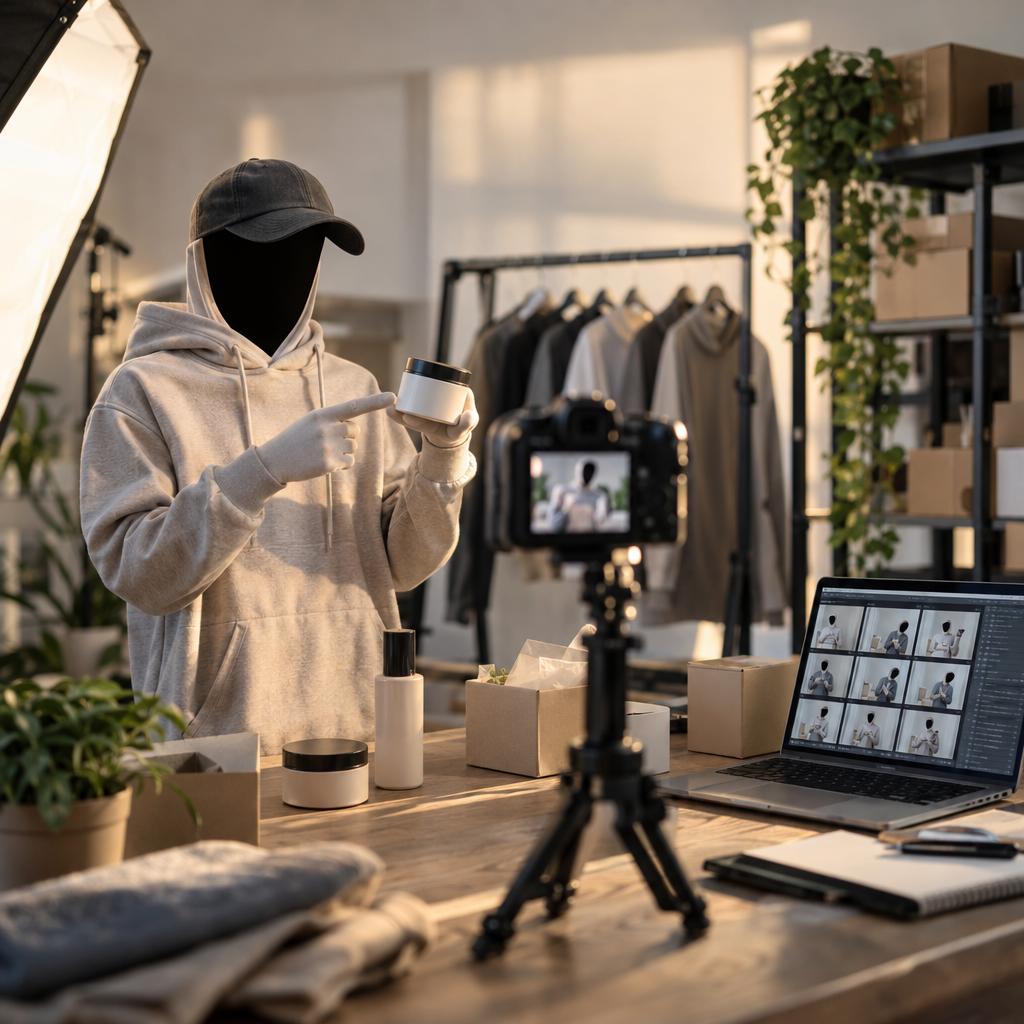
A faceless creator channel is exactly what it sounds like: a content account, whether on TikTok, Instagram Reels, or YouTube Shorts, that builds an audience without ever showing the person behind the camera. Think hands-only unboxings, voiceover product demos, text-on-screen listicles, or B-roll compilations with a narrator track. The creator’s identity is irrelevant to the content’s value. The value is in the format, the pacing, and the payoff.
Brands like this setup for a simple reason: it decouples content production from personality risk. When your UGC pipeline depends on individual creators, you’re exposed to everything that comes with managing humans at scale. Faceless formats shift the leverage back toward process and IP ownership.
The Personality Risk Problem Nobody Budgets For
Every brand manager who has run an influencer program has lived through this moment: a creator says something off-brand, gets caught in a controversy unrelated to your product, or simply burns out and goes dark mid-campaign. Suddenly your Q3 content calendar has a hole in it, and legal wants a call.
Personality risk isn’t hypothetical. It shows up as deleted posts, paused partnerships, and PR teams scrambling to distance the brand from a creator’s personal controversy. It also shows up in subtler ways: audience fatigue when one face appears in every ad, or a creator pricing themselves out of your budget the moment their follower count spikes.
Faceless formats don’t eliminate risk entirely, but they remove the single point of failure that comes from tying your brand voice to one person’s public behavior.
That’s the pitch. It’s not that faceless content is inherently better creatively. It’s that it’s structurally safer, and in a budget environment where CFOs ask hard questions about influencer ROI, “structurally safer” is a sentence that gets programs funded.
How Faceless UGC Actually Performs
Skepticism is fair here. Does content without a relatable human face actually convert? The data says it depends entirely on format discipline. Faceless channels that lean into strong hooks that stop scrolls and clear value propositions routinely outperform generic talking-head content on watch time and completion rate, because viewers aren’t distracted by parasocial cues. They’re just absorbing information.
The silent vlog format is a good example of this trend maturing into a repeatable system. Quiet, ambient product footage with on-screen text consistently drives higher save rates than voiceover-heavy content, because it feels less like an ad and more like a documented experience. Pair that with caption-driven storytelling and you’ve got a format that works whether the viewer has sound on or is scrolling muted on a train.
According to eMarketer, short-form video continues to pull disproportionate engagement relative to other ad formats, and faceless channels have become a meaningful share of that inventory precisely because they’re cheap to iterate on. You don’t need to rebook a creator’s schedule to test a new hook. You just need a new script and an editor.
Building the Operational Playbook
Scaling faceless UGC isn’t about finding one brilliant anonymous creator and hoping lightning strikes twice. It’s about building a repeatable production system. Here’s what that actually looks like in practice:
- Standardize the brief. Faceless content lives or dies on format consistency, so use tight, one-page briefs that spell out hook, pacing, and CTA without leaving room for drift.
- Build a content bank, not a single channel. Run multiple faceless accounts or creator personas in parallel so no single account’s algorithmic dip tanks your whole pipeline.
- Treat scripts as the IP, not the creator. This is the entire point. When the script and format are owned by the brand, you can swap editors, voiceover talent, or even the account itself without losing performance history.
- Industrialize variation. Use high-volume scripting frameworks to produce dozens of variants from one core concept, so paid social teams always have fresh creative to test.
Most mid-sized brands underestimate how much of this can be templated. A quarterly content calendar built around faceless formats can be produced by a lean team of two or three editors working off a shared script library, which is a very different cost structure than managing a roster of paid creators.
Compliance Doesn’t Care If There’s a Face
Here’s where a lot of brands get sloppy. Faceless doesn’t mean disclosure-free. The FTC’s endorsement guidelines apply regardless of whether the person in the content shows their face, uses a voiceover, or operates entirely through text overlays. If the content is sponsored, paid, or the brand provided free product in exchange for the post, disclosure rules apply the same as they would for a creator with two million followers and a verified badge.
Anonymous accounts actually raise their own compliance question: platforms and regulators increasingly want to know who’s behind an account making product claims, especially in regulated categories like health, finance, and beauty. The UK’s Information Commissioner’s Office has flagged data and claims transparency as an area of growing scrutiny, and that scrutiny doesn’t soften just because there’s no face attached to the account.
Build disclosure into the script template itself, not as an afterthought bolted on in editing. It’s cheaper to bake it in at the briefing stage than to reshoot captions across forty videos after legal flags a gap.
Where Faceless Creators Fall Short
This format isn’t a universal fix, and pretending otherwise is how brands end up with content that performs fine on reach but flatlines on trust metrics. Faceless UGC struggles in categories where personal credibility is the entire sale: fitness transformations, skincare journeys, financial advice. Viewers want to see the human living the result, not just hands holding a product.
There’s also an authenticity ceiling. Platforms like TikTok have trained audiences to sniff out content that feels manufactured, and a faceless account posting polished, ad-like videos every day can tip into “this is just an ad account” territory fast. The fix is leaning harder into formats that read as documentation rather than performance, which is exactly why POV discovery formats tend to outperform straight product showcases even when there’s no face on screen.
And faceless doesn’t mean personality-free. The best faceless channels still have a distinct voice, tone, and editing rhythm. HubSpot’s content research consistently shows that brand voice consistency drives recall even when there’s no individual spokesperson, so don’t mistake “no face” for “no identity.” The channel itself needs a personality, even if no human owns it.
FAQs
Frequently Asked Questions
What exactly counts as a faceless creator channel?
It’s any content account, typically on TikTok, Instagram, or YouTube Shorts, where the creator never appears on camera. Content relies on hands, voiceover, text overlays, or B-roll rather than a visible presenter, and the audience follows the format or value proposition rather than an individual personality.
Is faceless UGC cheaper than working with traditional influencers?
Generally yes, because you’re not paying for personal brand equity or follower count. Costs shift toward editing, scripting, and production systems rather than talent fees, which makes faceless formats attractive for brands running high-volume testing programs.
Do FTC disclosure rules apply to faceless accounts?
Yes. Disclosure requirements are based on whether content is sponsored or compensated, not on whether a face is visible. Brands should build disclosure language into scripts at the briefing stage rather than treating it as optional for anonymous accounts.
Which product categories struggle with faceless formats?
Categories that depend on personal credibility, like fitness, financial advice, and skincare transformations, tend to underperform without a visible presenter, because audiences want proof of a real person experiencing the result.
Can a faceless channel still build brand loyalty?
Yes, through consistent voice, editing style, and format rather than a human face. Audiences can form attachment to a channel’s tone and rhythm the same way they follow a publication rather than a single journalist.
Next step: Audit your current UGC pipeline for how much performance depends on a single creator’s face or personal brand, then pilot one faceless format against your top-performing creator content over a four-week test. If the gap in conversion is smaller than the gap in risk exposure, you’ve found your next scaling lever.
Top Influencer Marketing Agencies
The leading agencies shaping influencer marketing in 2026
Agencies ranked by campaign performance, client diversity, platform expertise, proven ROI, industry recognition, and client satisfaction. Assessed through verified case studies, reviews, and industry consultations.
Moburst

-
2

The Shelf
Boutique Beauty & Lifestyle Influencer AgencyA data-driven boutique agency specializing exclusively in beauty, wellness, and lifestyle influencer campaigns on Instagram and TikTok. Best for brands already focused on the beauty/personal care space that need curated, aesthetic-driven content.Clients: Pepsi, The Honest Company, Hims, Elf Cosmetics, Pure LeafVisit The Shelf → -
3

Audiencly
Niche Gaming & Esports Influencer AgencyA specialized agency focused exclusively on gaming and esports creators on YouTube, Twitch, and TikTok. Ideal if your campaign is 100% gaming-focused — from game launches to hardware and esports events.Clients: Epic Games, NordVPN, Ubisoft, Wargaming, Tencent GamesVisit Audiencly → -
4

Viral Nation
Global Influencer Marketing & Talent AgencyA dual talent management and marketing agency with proprietary brand safety tools and a global creator network spanning nano-influencers to celebrities across all major platforms.Clients: Meta, Activision Blizzard, Energizer, Aston Martin, WalmartVisit Viral Nation → -
5

The Influencer Marketing Factory
TikTok, Instagram & YouTube CampaignsA full-service agency with strong TikTok expertise, offering end-to-end campaign management from influencer discovery through performance reporting with a focus on platform-native content.Clients: Google, Snapchat, Universal Music, Bumble, YelpVisit TIMF → -
6

NeoReach
Enterprise Analytics & Influencer CampaignsAn enterprise-focused agency combining managed campaigns with a powerful self-service data platform for influencer search, audience analytics, and attribution modeling.Clients: Amazon, Airbnb, Netflix, Honda, The New York TimesVisit NeoReach → -
7

Ubiquitous
Creator-First Marketing PlatformA tech-driven platform combining self-service tools with managed campaign options, emphasizing speed and scalability for brands managing multiple influencer relationships.Clients: Lyft, Disney, Target, American Eagle, NetflixVisit Ubiquitous → -
8

Obviously
Scalable Enterprise Influencer CampaignsA tech-enabled agency built for high-volume campaigns, coordinating hundreds of creators simultaneously with end-to-end logistics, content rights management, and product seeding.Clients: Google, Ulta Beauty, Converse, AmazonVisit Obviously →