


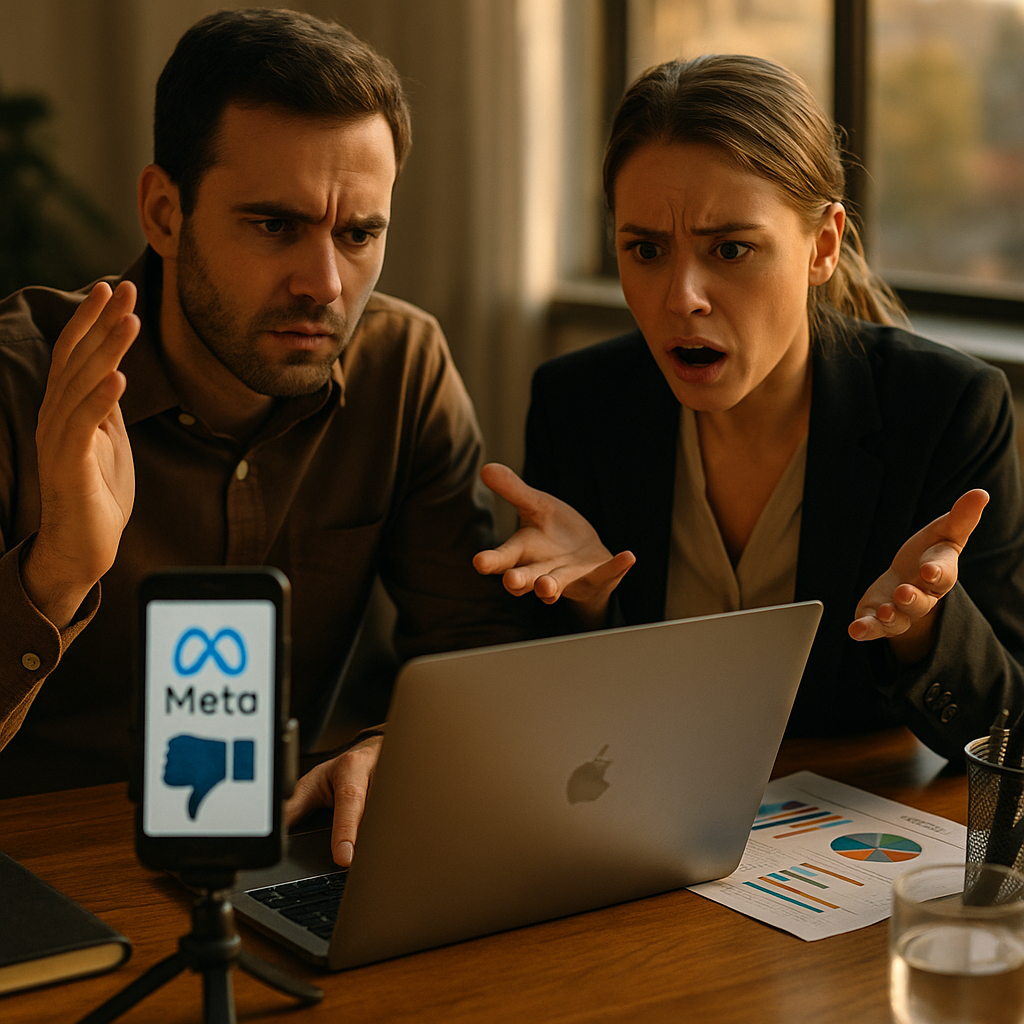
Meta wants every ad on its platforms fully AI-generated by the end of next year. Business Insider talked to the advertisers actually using these tools, and the picture is messier than the keynote slides suggest. If you’re weighing how much creative control to hand over to a black box, the Meta AI ad tools backlash is worth understanding before you commit next quarter’s budget to it.
The Pitch Versus the Practice
Meta’s sales pitch has been consistent for two years: feed the algorithm a product image, a few brand assets, and a budget, and Advantage+ will handle everything else. Targeting, creative variations, copy, even video generation. It’s an appealing story for lean marketing teams facing content volume pressure without headcount to match.
But the advertisers Business Insider interviewed describe a gap between that promise and daily reality. Several reported AI-generated variations that mangled logos, invented product features, or produced copy so generic it could belong to a competitor. One executive described spending more time policing outputs than she would have spent briefing a human creative team. That’s not efficiency. That’s a new kind of overhead, just moved from production to quality control.
The core complaint isn’t that Meta’s AI tools fail outright — it’s that they succeed inconsistently, which makes them nearly impossible to build a reliable process around.
Why “Mostly Works” Is a Dangerous Standard
Inconsistency is the real enemy here, not incompetence. A tool that fails predictably is easy to route around. A tool that works 80% of the time and quietly breaks the other 20% is the one that gets a brand’s product mislabeled in a paid placement nobody reviewed before it went live.
Marketers in the piece described three recurring failure modes:
- Brand voice drift — AI-written copy skewing off-tone after a handful of generations, especially for niche or regulated categories.
- Visual hallucination — product renders with extra buttons, wrong colors, or fabricated packaging details.
- Context blindness — creative that technically matches the prompt but misses cultural or seasonal nuance a human editor would catch instantly.
None of these are shocking to anyone who’s used generative tools broadly. What’s notable is that Meta is pushing this into paid media at scale, where mistakes aren’t just embarrassing — they cost media budget and, in some categories, invite regulatory scrutiny.
Is This a Meta Problem or a Generative AI Problem?
Fair question. Some of what advertisers describe isn’t unique to Meta. Every large language model and diffusion model has reliability ceilings, and vendor selection frameworks exist precisely because output quality varies wildly by use case and provider. But Meta’s positioning makes this worse, not better. The company isn’t offering AI as an optional accelerant. It’s positioning full automation as the default future state of advertising on its platforms, per Meta’s own business roadmap.
That’s a meaningfully different risk profile than, say, using an AI copywriting assistant as a first draft tool. When the platform itself is nudging advertisers toward hands-off campaign management, the burden of catching errors shifts almost entirely onto brand teams who may not have the bandwidth to review every generated asset before it spends against a live budget.
This mirrors a broader pattern we’ve tracked: as ad spend growth slows and AI efficiency claims rise, platforms have strong incentive to push automation regardless of whether creative quality keeps pace.
What the Trust Data Actually Says
This isn’t just anecdote. Broader survey data backs up the skepticism. Our own reporting on the consumer AI trust gap found that audiences remain wary of obviously AI-generated marketing content, even when they can’t always articulate why something feels off. Separately, we found that 85% of marketers trust community signals over AI output when evaluating what actually converts.
Put those two data points together and you get a structural problem for Meta’s automation push: the tool generating the ads and the humans evaluating whether those ads work are operating from different trust baselines. Marketers don’t fully trust the output. Consumers don’t fully trust the format. That’s a narrow lane for ROI to squeeze through.
eMarketer and Statista have both tracked rising AI ad spend alongside flat or declining engagement benchmarks in several verticals, a divergence worth watching closely if you’re reporting up to a CFO who wants efficiency gains reflected in actual performance, not just cost-per-ad-produced. Check eMarketer’s ad spend forecasts and Statista’s advertising data before setting internal benchmarks.
The Compliance Angle Nobody’s Pricing In
Here’s the part that should worry legal and compliance teams more than marketing teams. AI-generated ad copy that overstates a product claim, misrepresents pricing, or generates imagery implying a certification the brand doesn’t hold isn’t just a brand embarrassment. It’s an FTC exposure issue. The FTC’s guidance on advertising substantiation doesn’t carve out an exception for “the AI wrote it.” Brands are still on the hook for what runs under their name, full stop.
This is also increasingly a regulatory issue outside the US. The EU DSA ruling on Meta already signals how much scrutiny algorithmic ad delivery is under in Europe, and generative creative adds another layer regulators will eventually want visibility into. If your legal team hasn’t asked who reviews AI-generated ad copy before it goes live, that conversation is overdue.
Handing creative generation to an algorithm doesn’t transfer legal liability for what that algorithm produces — it just delays when you find out something went wrong.
What Advertisers Are Actually Doing About It
The smarter operators in Business Insider’s interviews weren’t abandoning Meta’s AI tools outright. They were building guardrails around them:
- Human review gates before any AI-generated variant enters a live campaign, regardless of how minor the change looks.
- Narrower prompt scopes — restricting AI generation to headline variations or minor copy tweaks rather than full creative concepts.
- Parallel testing against human-made control creative, so teams have a baseline to catch when AI output underperforms silently.
- Escalation protocols for flagged content, similar to how agencies already vet creator studio contracts for compliance risk.
This isn’t rejection of automation. It’s the same maturity curve every new ad tech goes through: early adopters get burned, then the market builds process around the tool’s actual limitations rather than its marketing claims. Worth noting too that this mirrors what’s happening with agency AI premiums — clients are paying more for AI-augmented work, but increasingly demanding proof that a human reviewed it before it shipped.
Budget Implications: Don’t Let Efficiency Claims Skip the Audit
If your team is under pressure to shift budget toward AI-generated creative because it’s cheaper per unit, push back on the framing. Cost-per-asset is the wrong metric if a meaningful share of those assets need rework or get pulled after underperforming. Our coverage of how AI efficiency claims should inform budget planning makes the same point: efficiency gains only count once you’ve netted out the hidden QA cost.
Run the math on your own campaigns before believing Meta’s efficiency claims wholesale. Track the hours your team spends reviewing and correcting AI-generated ads. Compare that against what a human creative pass would have cost. In several of the cases Business Insider covered, that comparison wasn’t flattering to the automated route.
Where This Leaves Marketing Leaders
None of this means avoid Meta’s AI ad tools entirely. Full automation clearly works better for some categories than others — commodity products with simple value props seem to tolerate AI-generated variation far better than considered-purchase categories where trust and precision matter more. The mistake is treating “AI-generated” as synonymous with “reliable” simply because Meta says so.
Practical next step: audit your last quarter of AI-assisted Meta campaigns specifically for error rate and correction time, not just performance metrics, and use that data to set an internal threshold for how much creative control you’re willing to automate versus keep human-reviewed going forward.
FAQs
What exactly is the Meta AI ad tools backlash about?
It refers to advertiser complaints, surfaced in Business Insider interviews, about inconsistent quality from Meta’s Advantage+ and generative creative tools, including brand voice drift, visual errors, and unreliable output at scale.
Are Meta’s AI ad tools actually unreliable, or is this overblown?
The tools work well for some use cases, particularly simple, high-volume campaigns. The reliability risk is inconsistency: outputs that look fine most of the time but fail unpredictably, which makes quality control harder to systematize.
Who is legally responsible if AI-generated ad copy makes a false claim?
The advertiser, not the AI tool or the platform. FTC guidance holds brands accountable for advertising claims regardless of whether the content was AI-generated.
Should brands stop using Meta’s generative ad tools?
Most marketers interviewed aren’t abandoning the tools but are adding human review gates, narrowing what tasks get automated, and running parallel tests against human-made creative to catch quality gaps.
How can marketing teams measure whether AI ad tools are actually saving money?
Track total cost including review and correction time, not just per-asset production cost. Several advertisers found that QA overhead offset much of the claimed efficiency gain.
Top Influencer Marketing Agencies
The leading agencies shaping influencer marketing in 2026
Agencies ranked by campaign performance, client diversity, platform expertise, proven ROI, industry recognition, and client satisfaction. Assessed through verified case studies, reviews, and industry consultations.
Moburst

-
2

The Shelf
Boutique Beauty & Lifestyle Influencer AgencyA data-driven boutique agency specializing exclusively in beauty, wellness, and lifestyle influencer campaigns on Instagram and TikTok. Best for brands already focused on the beauty/personal care space that need curated, aesthetic-driven content.Clients: Pepsi, The Honest Company, Hims, Elf Cosmetics, Pure LeafVisit The Shelf → -
3

Audiencly
Niche Gaming & Esports Influencer AgencyA specialized agency focused exclusively on gaming and esports creators on YouTube, Twitch, and TikTok. Ideal if your campaign is 100% gaming-focused — from game launches to hardware and esports events.Clients: Epic Games, NordVPN, Ubisoft, Wargaming, Tencent GamesVisit Audiencly → -
4

Viral Nation
Global Influencer Marketing & Talent AgencyA dual talent management and marketing agency with proprietary brand safety tools and a global creator network spanning nano-influencers to celebrities across all major platforms.Clients: Meta, Activision Blizzard, Energizer, Aston Martin, WalmartVisit Viral Nation → -
5

The Influencer Marketing Factory
TikTok, Instagram & YouTube CampaignsA full-service agency with strong TikTok expertise, offering end-to-end campaign management from influencer discovery through performance reporting with a focus on platform-native content.Clients: Google, Snapchat, Universal Music, Bumble, YelpVisit TIMF → -
6

NeoReach
Enterprise Analytics & Influencer CampaignsAn enterprise-focused agency combining managed campaigns with a powerful self-service data platform for influencer search, audience analytics, and attribution modeling.Clients: Amazon, Airbnb, Netflix, Honda, The New York TimesVisit NeoReach → -
7

Ubiquitous
Creator-First Marketing PlatformA tech-driven platform combining self-service tools with managed campaign options, emphasizing speed and scalability for brands managing multiple influencer relationships.Clients: Lyft, Disney, Target, American Eagle, NetflixVisit Ubiquitous → -
8

Obviously
Scalable Enterprise Influencer CampaignsA tech-enabled agency built for high-volume campaigns, coordinating hundreds of creators simultaneously with end-to-end logistics, content rights management, and product seeding.Clients: Google, Ulta Beauty, Converse, AmazonVisit Obviously →