


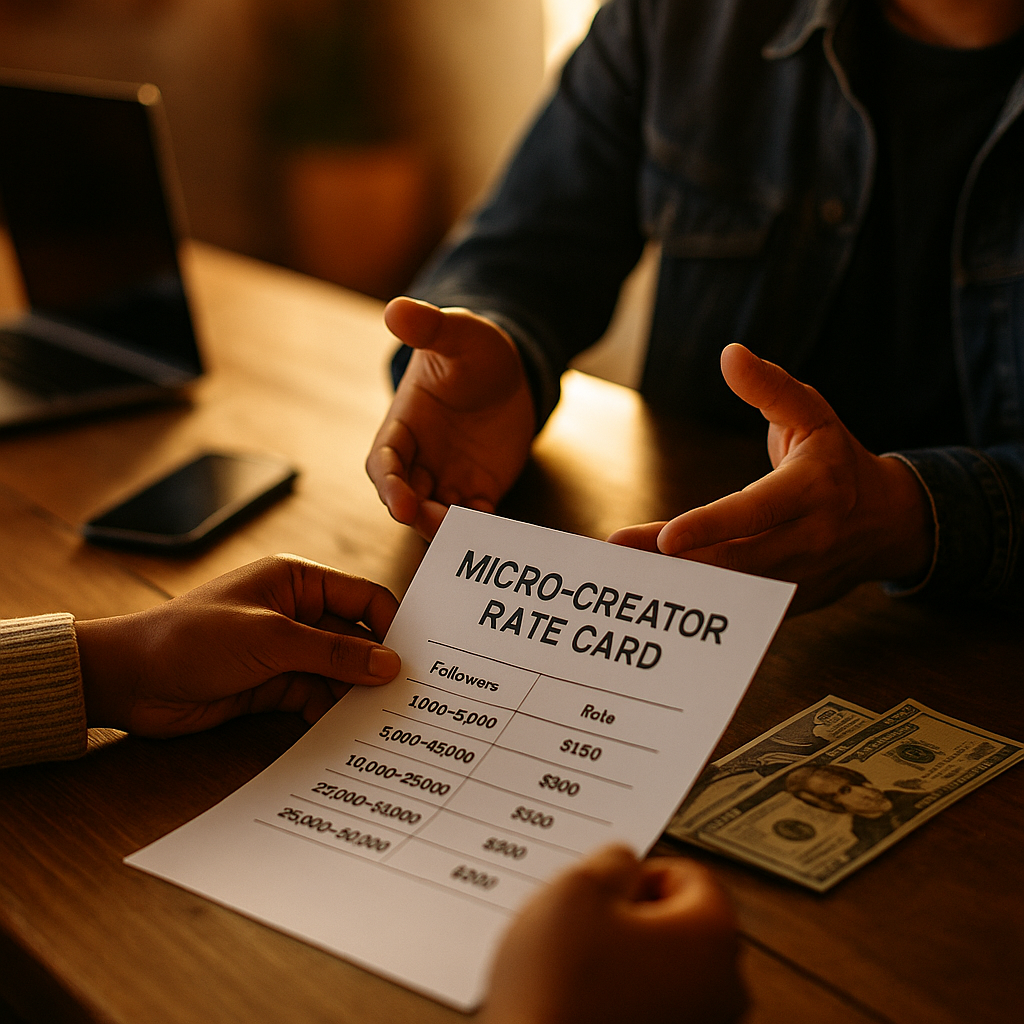
Micro-creator pricing power just crossed a threshold nobody in procurement was ready for: creators under 20,000 followers now capture roughly half of all influencer marketing spend, and their rate cards are climbing faster than any other tier. If your team is still budgeting off last year’s benchmarks, you’re already underpaying — or worse, overpaying for reach that no longer converts.
This isn’t a temporary blip caused by platform algorithm changes. It’s a structural repricing event. Brands that don’t rebuild their rate card logic now will spend the next four quarters negotiating from a position of ignorance.
Why Sub-20K Creators Suddenly Have Leverage
For years, micro-creators were treated as the budget option — the tier you used when the mega-influencer quote came back too high. That framing is dead. Engagement rates on sub-20K accounts consistently outperform macro and mid-tier creators by wide margins, and brands have finally started paying for outcomes rather than follower counts.
Three forces converged to create this shift. First, platform algorithms increasingly favor niche authenticity over broad reach, pushing discovery toward smaller, trust-heavy accounts. Second, brands burned by inflated macro-influencer costs with disappointing conversion pulled budget downstream. Third, the sheer volume of available micro-creators gives brands statistical advantages: run ten micro-creator campaigns instead of one macro campaign, and you get more data, more creative variance, and more resilience against any single creator’s off day.
Sub-20K creators now account for close to half of total influencer spend, according to recent industry tracking — a dramatic reversal from a market that once funneled the majority of dollars toward accounts with six-figure followings.
We covered the early signals of this shift in our piece on micro-creator rate increases, and the trend has only accelerated since. What started as a pricing anomaly is now the dominant procurement reality.
The Data Behind the Repricing
Numbers matter here, so let’s get specific. Industry benchmarking from sources like eMarketer shows influencer marketing spend continuing its steep climb, with the creator economy overall now valued well into the tens of billions. Our own analysis of that trajectory, in creator spend hitting $21B, laid out how fast the total addressable budget is expanding — but the more important story is where that money is actually landing.
Sub-20K creators are seeing rate card increases that outpace inflation and outpace macro-tier growth by a significant margin. Engagement-per-dollar for this tier remains the strongest in the market, which is exactly why procurement teams are reallocating.
Compare that to macro-influencer economics, where audience fatigue and ad-blindness have eroded performance even as base rates stayed flat or dropped slightly. The math simply favors the long tail now. We detailed this dynamic in how micro-creator pricing rewrites rate cards, and the pattern holds across verticals — beauty, fintech, CPG, SaaS.
What “Half of Spend” Actually Means for Your Budget
If you’re running a $2 million annual influencer program, a rough half now theoretically belongs in the sub-20K tier. That’s a meaningful reallocation from three years ago, when most budgets skewed 70/30 toward mid-tier and macro. Practically, this means more contracts, more relationships to manage, and more operational overhead — which is exactly why the negotiation framework below matters. Scale without structure just creates chaos.
A Framework for Renegotiating Rate Cards
Here’s where most brand teams get stuck. They know rates are shifting, but they don’t have a repeatable method for figuring out what a fair rate actually is in this tier. Use this four-part framework instead of guessing.
- Benchmark by engagement quality, not follower count. Pull the last 90 days of a creator’s content performance — comment sentiment, saves, shares, not just likes. A 12K-follower creator with a 9% engagement rate on relevant content should command more than an 18K-follower account with 2% engagement and bot-inflated comments.
- Price usage rights separately from posting fees. This is the single biggest source of overpayment and underpayment we see. A flat “package rate” that bundles organic posting with paid usage rights and whitelisting almost always shortchanges someone. Break it into line items: base content fee, usage license duration, paid amplification rights, and exclusivity clause. Our breakdown of UGC bundling and rights is a useful reference point for structuring this correctly.
- Build in performance tiers. Flat-fee-only contracts are increasingly outdated for this creator tier. A base rate plus a performance kicker (CPM bonus, affiliate override, or bonus for hitting an engagement threshold) aligns incentives and protects your downside. We explored this shift in detail in performance-based influencer contracts.
- Reset your rate card quarterly, not annually. Annual rate cards are functionally obsolete in a market moving this fast. Micro-creator rates in high-demand niches (finance, health, parenting) can shift 15-20% in a single quarter. Lock in quarterly reviews with your top-performing creator cohort.
Bundling posting fees with usage rights is the single most common way brands overpay or underpay micro-creators — separate the line items or expect disputes.
Where the Amplification Math Changes Everything
One overlooked variable: the crossover point where paid amplification of organic creator content becomes more cost-efficient than sponsored posts alone. As sub-20K creators gain leverage, some are pricing their organic content lower but charging steeply for amplification and whitelisting rights, betting that brands will pay more once they see performance data. This is worth modeling before you lock in annual contracts. We go deeper on this specific tension in the amplification-sponsorship crossover point.
Operational Realities: Scaling Without Losing Control
Managing 200 micro-creator relationships is operationally nothing like managing 15 macro-influencer contracts. Procurement and legal teams that haven’t adjusted their workflows are going to hit friction fast — contract review bottlenecks, inconsistent FTC disclosure compliance, and payment processing chaos across dozens of small invoices.
A few operational fixes worth prioritizing:
- Standardize contract templates with modular clauses for usage rights, exclusivity, and performance bonuses so legal isn’t rebuilding agreements from scratch each time.
- Centralize disclosure compliance tracking. The FTC’s endorsement guidelines apply just as strictly to a 15K-follower creator as to a celebrity, and enforcement has not slowed down. One missed disclosure across dozens of micro-creator posts is a real brand risk.
- Use creator marketplace platforms with built-in payment rails to avoid manual invoice processing for high-volume, low-dollar contracts. Tools that integrate with your existing marketing stack save real hours here.
- Track content as reusable assets, not one-off deliverables. Sub-20K creator content often performs exceptionally well when repurposed across paid social, email, and even product pages. Our piece on the creator-as-content-factory model covers how to extract more value from every session.
Watch the Org Chart, Too
As micro-creator programs scale in volume, some brands are creating dedicated roles to own the relationship layer, distinct from traditional influencer marketing management. That’s part of a broader shift we’ve tracked in creator-focused leadership roles. If your team is still treating this as a side project for a junior social media manager, you’re under-resourcing a channel that now represents half your influencer budget.
What Could Break This Trend
No pricing trend is permanent, and it’s fair to ask what could reverse micro-creator leverage. A few scenarios worth watching: platform algorithm changes that suddenly favor macro accounts again, a market correction where oversupply of micro-creators drives rates back down, or AI-generated content tools reducing brands’ reliance on human creators for certain formats entirely. Our coverage of AI ad trust trends suggests audiences are still skeptical of synthetic content, which buys human micro-creators more runway than some predicted. But don’t treat current leverage as guaranteed. Build contracts with renegotiation checkpoints, not rigid annual lock-ins.
For deeper context on how attribution and measurement are evolving alongside this shift, resources like HubSpot’s marketing research and Sprout Social’s benchmarking reports are worth folding into your quarterly rate reviews.
Next step: Pull your last four quarters of micro-creator spend, separate posting fees from usage rights in every contract, and rebuild your rate card using engagement-quality benchmarks instead of follower tiers before your next negotiation cycle starts.
FAQs
What counts as a micro-creator in current market terms?
Most brands and platforms define micro-creators as accounts with roughly 1,000 to 20,000 followers, though the exact ceiling varies by platform and vertical. What matters more than the number is consistent, niche-relevant engagement.
Why are micro-creator rates rising faster than macro-influencer rates?
Engagement quality, algorithmic favoritism toward niche content, and brand disillusionment with underperforming macro campaigns have all pushed demand — and pricing — toward the sub-20K tier.
How should brands separate usage rights from posting fees?
Treat them as distinct line items in every contract: a base content creation fee, a separate usage license fee tied to duration and channels, and additional charges for paid amplification or whitelisting rights.
How often should rate cards be updated in this market?
Quarterly, not annually. Micro-creator rates in high-demand categories can shift meaningfully within a single quarter, and annual rate cards risk becoming outdated before they’re even fully implemented.
What compliance risks come with scaling micro-creator programs?
The biggest risk is inconsistent FTC disclosure compliance across a large volume of small creator relationships. Centralized tracking and standardized contract templates reduce this risk significantly.
Top Influencer Marketing Agencies
The leading agencies shaping influencer marketing in 2026
Agencies ranked by campaign performance, client diversity, platform expertise, proven ROI, industry recognition, and client satisfaction. Assessed through verified case studies, reviews, and industry consultations.
Moburst

-
2

The Shelf
Boutique Beauty & Lifestyle Influencer AgencyA data-driven boutique agency specializing exclusively in beauty, wellness, and lifestyle influencer campaigns on Instagram and TikTok. Best for brands already focused on the beauty/personal care space that need curated, aesthetic-driven content.Clients: Pepsi, The Honest Company, Hims, Elf Cosmetics, Pure LeafVisit The Shelf → -
3

Audiencly
Niche Gaming & Esports Influencer AgencyA specialized agency focused exclusively on gaming and esports creators on YouTube, Twitch, and TikTok. Ideal if your campaign is 100% gaming-focused — from game launches to hardware and esports events.Clients: Epic Games, NordVPN, Ubisoft, Wargaming, Tencent GamesVisit Audiencly → -
4

Viral Nation
Global Influencer Marketing & Talent AgencyA dual talent management and marketing agency with proprietary brand safety tools and a global creator network spanning nano-influencers to celebrities across all major platforms.Clients: Meta, Activision Blizzard, Energizer, Aston Martin, WalmartVisit Viral Nation → -
5

The Influencer Marketing Factory
TikTok, Instagram & YouTube CampaignsA full-service agency with strong TikTok expertise, offering end-to-end campaign management from influencer discovery through performance reporting with a focus on platform-native content.Clients: Google, Snapchat, Universal Music, Bumble, YelpVisit TIMF → -
6

NeoReach
Enterprise Analytics & Influencer CampaignsAn enterprise-focused agency combining managed campaigns with a powerful self-service data platform for influencer search, audience analytics, and attribution modeling.Clients: Amazon, Airbnb, Netflix, Honda, The New York TimesVisit NeoReach → -
7

Ubiquitous
Creator-First Marketing PlatformA tech-driven platform combining self-service tools with managed campaign options, emphasizing speed and scalability for brands managing multiple influencer relationships.Clients: Lyft, Disney, Target, American Eagle, NetflixVisit Ubiquitous → -
8

Obviously
Scalable Enterprise Influencer CampaignsA tech-enabled agency built for high-volume campaigns, coordinating hundreds of creators simultaneously with end-to-end logistics, content rights management, and product seeding.Clients: Google, Ulta Beauty, Converse, AmazonVisit Obviously →