


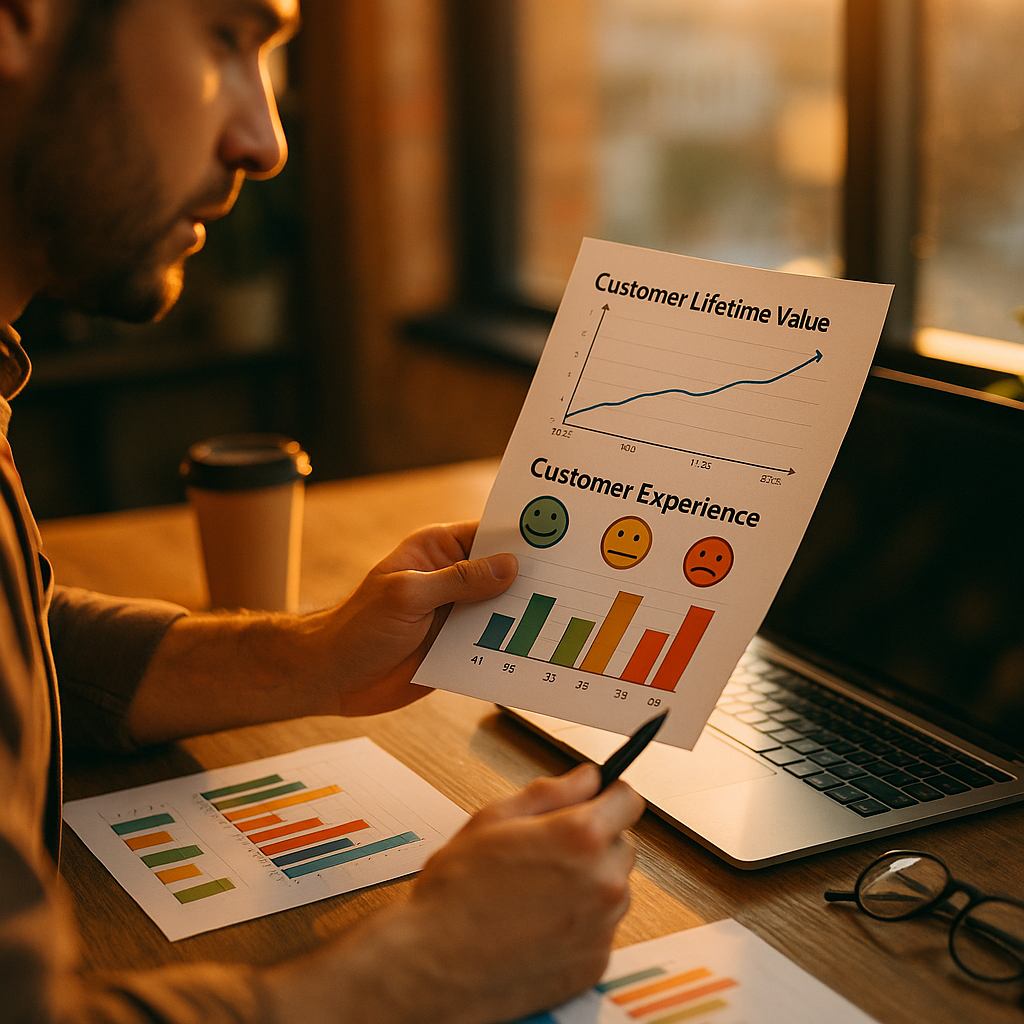
Understanding how to model the impact of customer experience on customer lifetime value is crucial for businesses aiming to maximize profitability and retention in 2025. Improving customer experience can powerfully boost lifetime value, but quantifying this link takes precision. This article breaks down the process and reveals practical steps to make data-driven decisions for long-term growth.
Why Customer Experience Is Central to Customer Lifetime Value
Customer experience is more than just good service—it’s every touchpoint with a brand, from browsing online to post-purchase support. This journey shapes perceptions, loyalty, and spending habits, directly influencing customer lifetime value (CLV). Recent research shows that companies prioritizing experience grow revenues 1.4x faster and increase CLV by up to 80% compared to laggards. In 2025, seamless experience isn’t a nice-to-have—it’s a revenue driver.
As new channels emerge and consumer expectations rise, modeling the interplay between experience and CLV helps businesses:
- Identify high-impact improvement areas
- Justify investments in customer-centric initiatives
- Forecast the long-term ROI of experience enhancements
Recognizing this centrality empowers brands to shift from short-term cost-cutting to value-building strategies.
Key Metrics Linking Customer Experience and CLV
To model how customer experience affects customer lifetime value, you need clear, measurable data. Common metrics include:
- Net Promoter Score (NPS): Measures customer willingness to recommend a brand, indicating satisfaction and potential advocacy.
- Customer Satisfaction Score (CSAT): Captures immediate sentiment after key interactions.
- Customer Effort Score (CES): Assesses how easy it is for customers to solve problems or complete tasks.
- Churn Rate: Reflects the percentage of customers who stop engaging over a period—often inversely related to positive experiences.
- Repeat Purchase Rate: An indication of loyalty and habitual buying patterns.
- Average Order Value (AOV): Tracks how much customers spend per transaction, which is often higher after positive experiences.
Analyzing these metrics in relation to CLV draws the quantitative line between a customer’s experience and their long-term value to your company.
Data Collection Strategies for Accurate Modeling
Reliable modeling hinges on strong data foundations. In 2025, businesses have access to sophisticated tools for capturing experience and value data:
- Transactional analytics: Use CRM and POS data to track spend, repeat rate, and purchase patterns.
- Survey integration: Embed NPS, CSAT, and CES surveys into web, email, and app touchpoints for real-time feedback.
- Behavioral analytics: Analyze onsite journeys, session replays, and heatmaps to identify pain points and delight moments.
- Omni-channel unification: Combine data from online, offline, social, and support channels to capture the full experience loop.
- Modern privacy standards: Ensure all personal data collection follows the latest GDPR and CCPA guidelines, building trust with customers.
These strategies ensure your model reflects the actual customer journey, not just isolated snapshots, making predictions more accurate and actionable.
Best Practices to Model the Impact of Experience on CLV
Once your data is gathered, effective modeling requires a mix of statistical rigor and practical understanding. The following structured steps will help:
- Segment your customer base: Divide customers into cohorts based on shared characteristics, such as first-time vs. repeat buyers, or high vs. low spenders.
- Correlate experience scores with CLV: Use regression analysis to see how NPS, CSAT, and other metrics predict future value.
- Assess causality: Implement controlled experiments where experience improvements are tested in select segments, measuring downstream CLV impact.
- Build predictive models: Leverage machine learning techniques to forecast individual or segment-level CLV based on historical experience data.
- Monitor and refine: Continuously update models as new data comes in, using A/B testing and feedback loops to validate accuracy.
By combining these steps with domain knowledge, you avoid overfitting and ensure resulting insights are practically useful—not just mathematically sound.
Real-World Applications: Driving Decisions with Experience-CLV Models
Accurately modeled relationships between customer experience and lifetime value can transform business strategies. Leading companies in 2025 use these models to:
- Personalize retention efforts: Identify at-risk customers with low satisfaction, targeting them with proactive support and tailored offers.
- Optimize resource allocation: Invest in high-impact touchpoints—such as onboarding or live chat—that show the strongest links to increased CLV.
- Prioritize product enhancements: Focus R&D on features where experience-driven gains in CLV are measurable.
- Justify customer-centric investments: Use model forecasts to secure C-suite support for experience improvement budgets.
- Refine marketing approaches: Retarget delighted customers likely to become advocates and repeat purchasers, amplifying CLV growth.
These applications demonstrate how robust modeling translates into competitive advantage, not just theoretical insights.
Future Trends: Evolving Experience-Driven CLV Modeling
As technology advances, so does the potential of CLV modeling. In 2025, key trends include:
- AI-powered analysis: Advanced neural networks interpret complex, non-linear relationships between experience variables and long-term value, uncovering patterns overlooked by traditional models.
- Predictive personalization: Real-time CLV estimation enables instant experience adjustments for each user, maximizing both satisfaction and revenue on the fly.
- Privacy-first modeling: Synthetic data and federated learning let brands improve predictions without sacrificing customer trust or violating regulations.
- Cross-industry benchmarking: Shared data standards allow brands to benchmark their experience-CLV links against peers, identifying gaps and opportunities faster.
Keeping ahead of these evolutions ensures your business captures the full value of customer experience in the years ahead.
Frequently Asked Questions: Modeling Customer Experience Impact on CLV
-
How often should I update my CLV models with new experience data?
Ideally, review and refresh your models quarterly to reflect evolving customer behaviors, new touchpoints, and feedback trends. For high-volume businesses, monthly updates may provide sharper insights. -
Which experience metric is the strongest predictor of increased CLV?
While results vary by industry, recent studies highlight Net Promoter Score (NPS) as a highly reliable leading indicator, especially when used in combination with transactional and behavioral data. -
What sample size is needed for reliable experience-CLV modeling?
A minimum of 1,000 customers per segment is recommended for robust statistical analysis. However, smaller cohorts can yield insights if they reflect high-value populations or unique journeys. -
How do I present CLV modeling results to executives?
Visual dashboards showing how specific improvements (e.g., reducing support wait times) link to projected CLV gains prove most persuasive. Use both qualitative (customer stories) and quantitative evidence.
Modeling the impact of customer experience on customer lifetime value is a powerful way to drive smart investments and long-term growth. By following structured data collection, analysis, and application best practices, you can confidently unlock the full financial potential of optimized customer journeys.
Top Influencer Marketing Agencies
The leading agencies shaping influencer marketing in 2026
Agencies ranked by campaign performance, client diversity, platform expertise, proven ROI, industry recognition, and client satisfaction. Assessed through verified case studies, reviews, and industry consultations.
Moburst

-
2

The Shelf
Boutique Beauty & Lifestyle Influencer AgencyA data-driven boutique agency specializing exclusively in beauty, wellness, and lifestyle influencer campaigns on Instagram and TikTok. Best for brands already focused on the beauty/personal care space that need curated, aesthetic-driven content.Clients: Pepsi, The Honest Company, Hims, Elf Cosmetics, Pure LeafVisit The Shelf → -
3

Audiencly
Niche Gaming & Esports Influencer AgencyA specialized agency focused exclusively on gaming and esports creators on YouTube, Twitch, and TikTok. Ideal if your campaign is 100% gaming-focused — from game launches to hardware and esports events.Clients: Epic Games, NordVPN, Ubisoft, Wargaming, Tencent GamesVisit Audiencly → -
4

Viral Nation
Global Influencer Marketing & Talent AgencyA dual talent management and marketing agency with proprietary brand safety tools and a global creator network spanning nano-influencers to celebrities across all major platforms.Clients: Meta, Activision Blizzard, Energizer, Aston Martin, WalmartVisit Viral Nation → -
5

The Influencer Marketing Factory
TikTok, Instagram & YouTube CampaignsA full-service agency with strong TikTok expertise, offering end-to-end campaign management from influencer discovery through performance reporting with a focus on platform-native content.Clients: Google, Snapchat, Universal Music, Bumble, YelpVisit TIMF → -
6

NeoReach
Enterprise Analytics & Influencer CampaignsAn enterprise-focused agency combining managed campaigns with a powerful self-service data platform for influencer search, audience analytics, and attribution modeling.Clients: Amazon, Airbnb, Netflix, Honda, The New York TimesVisit NeoReach → -
7

Ubiquitous
Creator-First Marketing PlatformA tech-driven platform combining self-service tools with managed campaign options, emphasizing speed and scalability for brands managing multiple influencer relationships.Clients: Lyft, Disney, Target, American Eagle, NetflixVisit Ubiquitous → -
8

Obviously
Scalable Enterprise Influencer CampaignsA tech-enabled agency built for high-volume campaigns, coordinating hundreds of creators simultaneously with end-to-end logistics, content rights management, and product seeding.Clients: Google, Ulta Beauty, Converse, AmazonVisit Obviously →